
Top Rated outdoor security camera wifi solar Cameras
Keeping your property safe has entered a new era with innovative surveillance solutions. Modern systems now harness the sun’s power to provide constant, wire-free protection. This approach is particularly effective in regions with consistent sunlight.
Singapore’s climate offers ideal conditions for photovoltaic technology. The abundant sunshine throughout the year ensures these devices operate reliably. Homeowners can enjoy continuous monitoring without worrying about battery changes or complex wiring.
This comprehensive guide examines the best available products on the market. We’ll explore various models across different price ranges to help you find the perfect fit. Understanding key specifications and installation requirements is crucial for making an informed choice.
Our focus is on providing factual comparisons and practical advice. We aim to help you select a system that meets both your safety needs and environmental values. The following sections will detail technical aspects, setup processes, and long-term maintenance.
Key Takeaways
- Solar-powered surveillance offers an eco-friendly way to protect your property.
- Singapore’s sunny weather makes these systems exceptionally reliable.
- Wire-free installation means no messy cables or complex setups.
- Different models cater to various budgets and feature requirements.
- Proper understanding of specifications ensures you choose the right product.
- Regular sunlight exposure keeps these devices functioning continuously.
- Modern options include smart connectivity for remote monitoring access.
Why Solar-Powered Security is a Smart Choice for Singapore
Modern surveillance technology has evolved to leverage local climate conditions for sustainable operation. In Singapore’s unique urban environment, this approach delivers practical advantages that extend beyond basic monitoring.
These systems address growing concerns while aligning with national sustainability goals. They represent a forward-thinking solution for property protection.
Leveraging Singapore’s Abundant Sunlight for Reliable Power
Singapore’s tropical position provides exceptional conditions for photovoltaic devices. The nation enjoys over 2,500 hours of bright sunshine each year.
This consistent exposure creates perfect circumstances for sun-powered equipment. The technology converts this abundant resource into dependable electricity.
High-quality photovoltaic panels capture energy throughout daylight hours. They store it in integrated batteries for continuous use.
Even during brief cloudy periods, most devices maintain operation. Many models can function for up to seven days without direct sunlight.
This reliability addresses a key concern for homeowners. Over 70% of Singapore residents express worry about property protection.
Reducing Environmental Impact and Energy Costs
Adopting sun-harvesting surveillance significantly lowers your carbon footprint. These systems minimize reliance on grid electricity.
They operate independently from traditional power sources. This autonomy translates into substantial financial savings.
Photovoltaic-powered monitoring can reduce energy expenses by up to 75%. Compared to wired alternatives, the long-term savings are considerable.
This efficiency aligns with broader environmental initiatives in Singapore. Government programs often encourage eco-friendly technology adoption.
The integration of sustainable technology into daily life represents a positive step forward. It combines practical needs with environmental responsibility.
Homeowners contribute to national sustainability targets. They also enjoy reduced utility bills as a direct benefit.
Overcoming Installation Challenges with Wire-Free Design
The wire-free nature of these systems eliminates complex setup hurdles. This is particularly valuable in Singapore’s dense urban landscape.
Traditional wired installations often require professional help and structural modifications. Photovoltaic options typically offer straightforward DIY setup.
Placement flexibility becomes a major advantage. You can position devices in optimal locations without wiring constraints.
This freedom allows for better coverage of priority areas. It ensures your surveillance system works effectively where needed most.
During Singapore’s monsoon seasons, reliability remains consistent. Advanced battery backup systems maintain operation through rainy periods.
Installation time drops dramatically compared to conventional systems. Most homeowners complete setup within hours rather than days.
The combination of easy installation and reliable performance addresses core concerns. It provides effective monitoring while supporting environmental values.
This makes photovoltaic surveillance a compelling choice for modern Singaporean homes.
How Solar WiFi Security Cameras Work: A Simple Breakdown
At their core, these autonomous protection systems operate through a harmonious integration of three key elements. Each component plays a vital role in delivering reliable surveillance without traditional power cords.
This elegant design allows for flexible placement and consistent performance. Let’s explore how these pieces come together to create a self-sufficient monitoring solution.
The Photovoltaic Panel: Your Camera’s Personal Power Plant
The process begins with sunlight conversion. Specialized cells within the panel transform solar radiation into usable electrical current.
This photovoltaic effect creates energy without moving parts or noise. High-efficiency models can achieve conversion rates approaching 22%.
Even on moderately cloudy days in Singapore, these panels capture sufficient light. They continue generating electricity throughout daylight hours.
The panel connects directly to your monitoring unit. It provides a continuous trickle charge during sunny periods.
This setup eliminates dependence on grid electricity. Your surveillance operates independently from household wiring.
Battery Storage: Ensuring 24/7 Operation, Rain or Shine
Energy collected by the panel needs preservation for nighttime use. This is where integrated battery packs become essential.
Most modern units utilize lithium-ion technology. These batteries offer excellent performance in tropical climates.
A proper charge cycle typically requires 5-8 hours of good sunlight. This investment provides up to seven days of continuous operation.
Advanced battery management systems optimize charging patterns. They prevent overcharging during intense sun exposure.
These systems also protect against deep discharge during extended cloudy weather. This careful management extends battery lifespan to 3-5 years.
The combination of efficient energy capture and smart storage creates a truly autonomous system. It delivers peace of mind through consistent operation.
Wireless Connectivity: Remote Access and Instant Alerts
The final piece involves communication technology. Your monitoring device connects to home networks through wireless signals.
This link enables real-time video streaming to smartphones and computers. You can check your property from anywhere with internet access.
Motion detection sensors trigger immediate responses. When activity occurs, the unit begins recording and sends alert notifications.
Video footage preservation happens through two primary methods. Cloud storage offers off-site backup accessible via subscription.
Local storage uses MicroSD cards within the device itself. This provides direct control over your recorded material.
Successful integration requires stable wireless signals. Ensure your router provides adequate coverage to the installation location.
Most modern units work with standard 2.4GHz or 5GHz networks. Compatibility checks during setup prevent connectivity issues.
This wireless approach completes the self-sufficient design. You gain remote access without complex wiring installations.
Essential Features to Look for in a Solar Security Camera
A well-informed purchase decision hinges on evaluating several critical performance characteristics. These specifications determine how effectively your system will monitor your property.
Focusing on the right capabilities ensures you get reliable protection that fits your specific needs. Let’s break down the most important aspects to consider.
Video Resolution and Image Clarity: From 1080p to 4K
The detail your device captures is defined by its resolution. Entry-level models typically offer 1080p Full HD, which provides a clear basic picture.
For superior identification, premium options deliver 2K or even 4K Ultra HD. Higher resolution means you can see finer details like faces or license plates from a distance.
Another crucial factor is the field of view. Angles range from a standard 90° to an ultra-wide 180° panorama.
A wider perspective minimizes blind spots around your installation point. This gives you more comprehensive coverage with fewer units.
Night Vision Capabilities for Round-the-Clock Monitoring
Effective protection doesn’t stop at sunset. Modern systems use advanced technology to see in the dark.
Standard infrared (IR) LEDs provide black-and-white imagery in total darkness. More advanced models feature starlight sensors or color night vision.
These technologies maintain much better clarity and color information in very low light. This can be crucial for identifying specific details after dark.
The effective distance of this illumination is also key. Ranges from 30 to 100 feet are common, so match this to your property’s layout.
Weather Resistance and Durability for Tropical Climates
In Singapore’s humid and rainy environment, build quality is non-negotiable. Look for an Ingress Protection (IP) rating on the product specifications.
Ratings like IP65, IP66, or IP67 indicate strong resistance to dust and water. An IP67 rating means the unit can withstand temporary immersion, perfect for heavy tropical downpours.
This durability ensures your investment lasts for years. It protects internal electronics from moisture and extreme temperatures.
Choosing a device built for your local climate is one of the smartest decisions you can make. It guarantees consistent performance through every season.
Battery Life and Solar Charging Efficiency
Autonomy is powered by two linked components: the battery and the panel. Battery capacity is measured in milliampere-hours (mAh).
Capacities typically vary from 5,000mAh to 10,000mAh. A larger capacity translates to more days of operation between charges.
The photovoltaic panel’s job is to replenish this power. Its wattage and conversion efficiency determine how quickly it can recharge the battery.
A more efficient panel keeps the system running smoothly even during periods with less direct sunlight. This synergy is vital for non-stop operation.
Smart Detection and Alert Systems
Basic motion sensors can trigger many false alarms from leaves or pets. Intelligent detection uses artificial intelligence to analyze what it sees.
Features like person or vehicle recognition filter out irrelevant activity. This means you only get alerts for events that truly matter.
You can often customize motion zones within the camera’s view. This focuses the detection on specific areas, like a driveway or gate.
Alerts can be sent via push notification, email, or even integrated with smart home platforms. Some models offer two-way audio, allowing you to speak directly through the device.
Finally, consider how footage is saved. Options include local storage on a MicroSD card, Network Attached Storage (NAS), or cloud subscription services.
Each choice offers different balances of convenience, cost, and data control.
Evaluating the Top Outdoor Security Camera WiFi Solar Models
Today’s market offers a spectrum of self-powered monitoring solutions across various price points. Understanding these categories helps you make an informed choice that fits both your needs and budget.
We divide photovoltaic surveillance into three main tiers. Each tier delivers different capabilities at corresponding investment levels.
Our evaluation considers several key factors. Video clarity, intelligent detection, construction quality, and power management all matter.
We also examine the overall value proposition. The best choice balances performance with practical affordability.
Premium Picks: High-End Performance and Advanced Tech
Top-tier models represent the pinnacle of current technology. These units typically cost over $300 and deliver exceptional capability.
You’ll find 4K Ultra HD resolution in this category. This provides stunning detail for identifying faces or license plates at distance.
Advanced artificial intelligence powers sophisticated detection. Systems can distinguish between people, vehicles, and animals with high accuracy.
Build quality matches the premium price. These devices feature robust materials and superior weatherproofing for challenging environments.
Extended warranties and dedicated support often accompany these investments. Manufacturers stand behind their flagship products with comprehensive service.
Consider premium options for critical monitoring areas. Entry points, driveways, and high-value locations benefit from this enhanced capability.
Mid-Range Marvels: Best Value for Balanced Budgets
The middle category spans from $150 to $300. This segment delivers excellent performance without the premium price tag.
Most mid-range units offer 2K resolution. This provides noticeably better detail than standard 1080p while remaining efficient.
Essential smart features are typically included. Person detection, customizable activity zones, and reliable alerts come standard.
Solar charging efficiency remains strong in this tier. These systems maintain consistent operation through Singapore’s varying weather.
This category represents the sweet spot for many homeowners. You get substantial capability at a reasonable investment level.
Mid-range models work well for general property coverage. They monitor yards, side areas, and secondary spaces effectively.
Budget-Friendly Options: Effective Security Without High Cost
Entry-level devices cost under $150. These provide fundamental protection for cost-conscious consumers.
Basic 1080p resolution delivers clear identification at reasonable distances. While not as detailed as higher tiers, it serves many situations adequately.
Motion detection remains functional though less sophisticated. These systems alert you to activity without advanced filtering capabilities.
Reliable photovoltaic charging keeps these units operational. They harness Singapore’s abundant sunlight for consistent power.
Don’t underestimate what budget options can achieve. They offer legitimate surveillance for secondary locations and supplemental coverage.
Consider these for monitoring garden sheds, side gates, or less critical perimeter areas. They extend your protection network affordably.
Matching the right category to each location optimizes your overall system. Blend different tiers based on specific area importance.
Price-to-performance ratios vary across these segments. Mid-range options often deliver the most capability per dollar spent.
Subsequent sections will examine specific models from each category. We’ll provide detailed comparisons to guide your final selection.
Remember that even budget photovoltaic systems provide real monitoring benefits. They represent a smart starting point for expanding your protection.
A mixed approach using different tiers can create comprehensive coverage while managing costs effectively. Strategic placement matters as much as technical specifications.
Your property’s unique layout determines the ideal combination. Assess each area’s surveillance needs before deciding on specific models.
This framework helps narrow your choices efficiently. You can focus on products that truly match your requirements and budget constraints.
High-End Contenders: Premium Solar Security Camera Systems
When performance cannot be compromised, these elite models set the standard for detail, durability, and smart connectivity. They represent the most advanced tier of photovoltaic-powered monitoring available to homeowners today.
Investing in this category brings professional-grade imaging and intelligence to your property. Each system offers distinct advantages in how it captures, processes, and stores surveillance data.
Reolink Argus 3 Pro: Engineering Excellence and 2K Detail
The Reolink Argus 3 Pro delivers exceptional value in the premium segment. Its 2K Super HD resolution provides crystal-clear imagery for identifying important details.
This unit features a 122-degree field of view. This wide perspective minimizes blind spots around its mounting position.
Advanced starlight sensor technology enables color imaging in very low light. Traditional infrared systems only show black and white at night.
You get clearer identification after sunset with this capability. The integrated person and vehicle detection further refines alerts.
Build quality meets rigorous standards with an IP65 weatherproof rating. This ensures reliable operation through Singapore’s tropical climate.
A compatible photovoltaic accessory panel keeps the internal battery charged. This setup promotes truly autonomous, year-round operation.
Local retailers like Challenger and Harvey Norman stock this model. The approximate price point makes it an attractive high-performance option.
EufyCam 3: Integrated HomeBase and Local AI Processing
EufyCam 3 takes a different architectural approach with its proprietary HomeBase 3 hub. This device handles all artificial intelligence processing locally.
Facial recognition and activity analysis occur within your home network. This method enhances privacy and eliminates monthly cloud fees.
The monitoring units themselves capture stunning 4K resolution footage. This is currently the highest consumer-grade video quality available.
Battery performance is remarkable, quoted at up to 180 days per charge. The optional integrated sun-harvesting panel can provide continuous power.
“Local processing represents the future of smart home privacy. It keeps your data where it belongs—in your home,” notes a smart home technology analyst.
The system is available as a bundle through platforms like Lazada and Shopee. Professional installation services can be arranged through authorized partners in Singapore.
Arlo Pro 4: Superior Visual Fidelity and Smart Platform Integration
Arlo’s Pro 4 model excels in visual performance and ecosystem connectivity. Its 2K HDR video delivers balanced exposure in challenging lighting.
A 160-degree diagonal viewing angle offers comprehensive area coverage. This wide lens reduces the number of devices needed for full perimeter monitoring.
Color night vision illuminates darkness without the monochrome limitation. The integrated spotlight can also deter unwanted activity.
Seamless integration is a hallmark of the Arlo ecosystem. The system works with Alexa, Google Assistant, and Apple HomeKit.
You can create automated routines using IFTTT applets. For example, lights can turn on when motion is detected after dark.
Arlo offers flexible storage options. You can choose local backup or optional cloud subscription plans for video history.
This model is sold at electronics stores across Singapore, including Best Denki. Its smart home compatibility makes it popular for integrated property management.
Comparing these contenders reveals different philosophies. Reolink focuses on imaging excellence at a competitive price.
Eufy prioritizes local data control and ultra-high resolution. Arlo emphasizes broad smart home integration and visual clarity.
All three feature robust construction for humid, rainy conditions. Their photovoltaic charging systems are optimized for consistent Singapore sunlight.
Warranty terms typically range from one to two years. Premium materials like polycarbonate housings ensure long-term durability.
When selecting among these elite options, consider your priority. Is it ultimate video detail, complete local data control, or seamless smart home automation?
Each delivers premium protection through slightly different technological paths. Your choice should align with your specific surveillance philosophy and technical preferences.
Best Value Champions: Mid-Range Solar Cameras
The sweet spot in self-powered surveillance combines essential features with reasonable pricing for comprehensive property protection. These mid-tier options deliver substantial functionality without the premium cost of flagship models.
They represent the optimal balance for most homeowners in Singapore. You get reliable performance and smart capabilities at accessible investment levels.
Ring Stick Up Cam Solar: Versatile Placement and Ecosystem Benefits
Priced around S$249, the Ring Stick Up Cam Solar offers excellent versatility. Its 1080p resolution provides clear imagery for general monitoring needs.
The design allows mounting on walls, ceilings, or flat surfaces. The adjustable photovoltaic panel ensures optimal energy capture regardless of positioning.
Integration with the Ring ecosystem delivers significant advantages. You can share Neighborhood Alerts and access professional monitoring services.
Comprehensive smart home compatibility includes Alexa voice control. This creates a unified protection network throughout your property.
Motion detection zones can be customized within the app. You focus alerts on specific areas like entry points or driveways.
Lorex Solar-Powered Camera: Rugged Build and Color Night Vision
At approximately S$399, the Lorex unit brings premium construction to the mid-range category. Its aluminum housing withstands Singapore’s high humidity and temperature extremes.
The 4K resolution represents the highest video quality in this price segment. You capture exceptional detail for identification purposes.
Color night vision technology maintains accuracy in low-light conditions. It provides clear imagery up to 25 meters after sunset.
“The combination of rugged durability and advanced imaging makes this model stand out. It performs like a premium device at a mid-range price point,” notes a home technology reviewer.
Local storage comes included with substantial capacity. This eliminates mandatory cloud subscription fees for basic operation.
The photovoltaic charging system efficiently harnesses Singapore’s abundant sunlight. It maintains consistent power even during brief cloudy periods.
TP-Link Tapo C425: Exceptional Battery Life and Simple Setup
The Tapo C425 costs about S$179, making it the most affordable option here. It claims up to 300 days of battery life per charge with its included panel.
This exceptional performance minimizes maintenance concerns. You enjoy nearly year-round operation from a single sunlight cycle.
Magnetic mounting offers flexible positioning options. The 2K resolution strikes a balance between detail and efficiency.
User-friendly setup uses QR code pairing for effortless configuration. It eliminates complex WiFi network steps that frustrate many users.
MicroSD card support provides local storage control. You manage your footage directly without monthly service fees.
Comparing these three reveals distinct value propositions. The Ring model excels in ecosystem integration and versatile placement.
Lorex delivers superior build quality and imaging capabilities. The Tapo C425 focuses on simplicity and outstanding battery performance.
Each photovoltaic charging system operates effectively in local conditions. They convert ample sunlight into reliable electricity for continuous monitoring.
Storage options vary according to user preference. Cloud services, local capacity, and memory cards each offer different benefits.
When assessing value, consider which features align with your priorities. The Ring ecosystem provides expansive smart home connectivity.
Lorex’s rugged construction suits challenging environmental conditions. Tapo’s straightforward approach appeals to users seeking minimal complexity.
All three represent solid investments in property protection. They harness renewable energy to deliver dependable surveillance without wiring constraints.
Affordable Security: Budget Solar Camera Options
The entry-level segment of self-powered surveillance has matured. It now offers genuine capability at prices accessible to nearly every budget.
These economical choices provide core monitoring functions for those starting their protection journey. They harness renewable energy to eliminate wiring hassles.
Blink Outdoor with Solar Charger: A Cost-Effective Entry Point
Priced around S$159, the Blink system is designed for simplicity. Its 1080p resolution delivers clear footage for general monitoring needs.
The included sync module is a key component. It manages communication to dramatically extend battery performance.
This setup can achieve up to two years of operation on standard batteries. Adding the dedicated photovoltaic accessory panel creates a truly maintenance-free solution.
This panel continuously harvests energy, keeping the device powered indefinitely. Installation is straightforward, requiring minimal technical knowledge.
Basic motion sensing triggers smartphone alerts for any activity. The system focuses on delivering reliable, no-fuss monitoring.
Video preservation relies on a cloud subscription model. A free tier exists but has limitations on clip length and history.
Wyze Cam Outdoor v2: Surprising Features at a Low Price
Under S$120, the Wyze model presents an exceptional value proposition. It delivers 2K resolution, a detail level often reserved for costlier units.
This higher clarity improves identification at a distance. The device also includes color night vision, providing better after-dark information.
Person detection helps filter out false alarms from animals or moving foliage. These smart features typically appear in more expensive setups.
“Wyze has consistently challenged the notion that advanced features must come with a high price. Their v2 model brings mid-tier capabilities to the budget category,” observes a smart home reviewer.
Setup is similarly user-friendly, guided by a mobile app. For video storage, it supports local MicroSD cards, giving you direct control over your footage.
While it doesn’t have a branded panel, it works with standard photovoltaic chargers. This offers flexibility in creating a self-sustaining power setup.
Evaluating Your Budget-Friendly Choice
Comparing these two reveals a clear trade-off. Blink prioritizes ultra-long battery life and ecosystem simplicity.
Wyze focuses on delivering superior image quality and local storage at a rock-bottom price. Both offer basic weather resistance suitable for sheltered placements.
It’s important to acknowledge their limitations. Construction may be less rugged than premium models.
Advanced features like extensive smart home integration or wide viewing angles are often absent. Their detection algorithms, while functional, may be less refined.
These economical systems are perfectly appropriate for specific scenarios. Use them for secondary entry points, garden sheds, or as a temporary monitoring solution.
They also serve as an excellent primary system for those with limited budgets. They prove that effective, wire-free protection is within everyone’s reach.
By understanding their strengths and ideal applications, you can make a smart, affordable investment in your property’s safety.
Side-by-Side Comparison of Leading Solar Camera Models
Direct comparison of specifications reveals which photovoltaic monitoring systems deliver the best performance for your investment. This analysis cuts through marketing claims to show real-world differences.
We examine top models across critical categories. Understanding these metrics helps you match a device to your specific property needs.
Video Quality, Field of View, and Resolution Face-Off
Image clarity determines what you can identify at a distance. Higher resolution captures finer details like faces or license plates.
Standard 1080p (Full HD) offers clear basic imagery. Mid-range 2K (1440p) provides approximately 78% more pixels for better detail.
Premium 4K (Ultra HD) delivers four times the pixels of 1080p. This allows digital zoom without losing critical identification information.
Field of view dramatically affects coverage area. A 90° lens covers a standard corridor or entry point effectively.
Wider 120°-135° lenses reduce blind spots significantly. Ultra-wide 150°-180° options can monitor entire yards with a single unit.
Here’s how leading models compare on these visual metrics:
- Reolink Argus 3 Pro: 2K/1440p resolution with 122° field of view. Excellent detail for mid-range pricing.
- EufyCam 3: 4K resolution with 135° field of view. Top-tier clarity for critical identification.
- Arlo Pro 4: 2K HDR resolution with 160° diagonal view. Balanced exposure in challenging light.
- Lorex Solar-Powered: 4K resolution with standard 110° view. Premium imaging at mid-range cost.
- TP-Link Tapo C425: 2K resolution with 110° field of view. Good value proposition.
Night vision capability varies equally. Standard infrared provides 30-50 feet of black-and-white coverage.
Advanced starlight or color night vision maintains better detail after dark. This can be crucial for Singapore’s well-lit urban environments.
Battery Performance and Estimated Days of Operation
Autonomy depends on both battery capacity and photovoltaic charging efficiency. These factors determine maintenance frequency.
Battery life spans from 45 days for basic models to 180 days for optimized systems. Actual performance depends on activity levels and settings.
Standby time refers to periods with minimal motion triggers. Active recording during frequent events consumes more power.
Typical battery capacities range from 5,000mAh to 10,000mAh. Larger capacities support longer operation between charges.
Photovoltaic panel wattage affects recharge speed. Higher wattage (5W-10W) panels replenish batteries faster under Singapore’s abundant sunlight.
“Efficient energy management distinguishes premium systems. They optimize recording and connectivity to extend operational days,” notes a renewable technology specialist.
During Singapore’s monsoon season, charging efficiency may decrease. Quality systems maintain operation for 5-7 days without direct sun exposure.
Here are estimated operational days for popular models under typical local conditions:
- EufyCam 3: 90-180 days (with HomeBase optimization)
- Reolink Argus 3 Pro: 60-90 days (standard use)
- TP-Link Tapo C425: Up to 300 days (claimed with included panel)
- Ring Stick Up Cam: 30-60 days (depending on activity)
- Wyze Cam Outdoor v2: 45-90 days (with efficient settings)
Charging times vary from 5-8 hours of good sunlight for a full recharge. Smart power management extends overall system longevity.
Smart Features, App Functionality, and Ecosystem Compatibility
Intelligence separates basic motion sensing from useful monitoring. Advanced algorithms filter out irrelevant activity.
Basic motion detection triggers on any movement. This includes leaves, animals, and changing shadows.
AI-powered recognition distinguishes people, vehicles, and animals with 85-95% accuracy. This dramatically reduces false alerts.
Mobile app design affects daily usability. Clean interfaces with intuitive controls make monitoring simpler.
Alert customization allows focusing on specific zones. You can mute notifications for less important areas.
Live view performance depends on network connectivity. Low-latency streaming provides real-time awareness.
Ecosystem integration expands your system’s capabilities. Compatibility with voice assistants enables hands-free control.
Most premium models work with Alexa and Google Assistant. Some offer Apple HomeKit support for iOS users.
IFTTT applets create automated routines. Lights can turn on when motion is detected after sunset.
Storage options present another key difference. Cloud subscriptions offer off-site backup with monthly fees.
Local storage via MicroSD cards gives direct data control. NAS compatibility provides network-based solutions.
Here’s how smart features compare across leading systems:
- AI Recognition: Eufy (local processing), Arlo (cloud-based), Reolink (person/vehicle)
- App Ratings: Ring (4.5+ stars), Eufy (4.4+ stars), Arlo (4.3+ stars)
- Ecosystem Support: Arlo (broadest), Ring (Alexa-focused), Eufy (local emphasis)
- Storage Options: Eufy (local included), Arlo (cloud/local hybrid), Reolink (MicroSD/cloud)
Weighted for Singapore’s priorities, tropical durability scores highest. Consistent sunlight availability makes efficient charging essential.
Typical HDB and landed property layouts favor wider field of view devices. These cover more area with fewer units.
Ultimately, your choice depends on which capabilities matter most for your specific surveillance needs.
Understanding Solar Panel Specifications for Optimal Performance
Selecting the right energy-harvesting components determines the long-term reliability of your entire protection network. The photovoltaic unit is not just an accessory—it’s the power plant for your monitoring equipment.
Proper specifications ensure continuous operation without interruption. This section breaks down the technical details you need to know.
Panel Wattage and Camera Power Requirements
Your monitoring device’s energy needs directly influence photovoltaic panel selection. Higher resolution models consume more electricity to process detailed imagery.
Basic 1080p units typically work well with 5-watt panels. These provide sufficient energy for standard recording schedules.
Mid-range 2K devices often require 8-10 watts for consistent performance. The increased pixel count demands more processing power.
Premium 4K systems need at least 10-12 watt panels. Continuous recording or frequent motion events further increase these requirements.
Additional features like color night vision or two-way audio also affect power consumption. Always check the manufacturer’s specifications for exact needs.
Voltage and current compatibility matters just as much as wattage. Most modern units operate on 5V or 12V DC power.
Integrated charge controllers manage the energy flow between the panel and battery. They prevent overcharging during intense sunlight exposure.
“Matching photovoltaic output to your device’s specifications prevents performance issues. An undersized panel leads to frequent battery depletion,” notes a renewable energy consultant.
Always verify the connector type and polarity before purchase. Using incompatible adapters can damage sensitive electronics.
Optimal Positioning for Maximum Sunlight Exposure in Singapore
Singapore’s geographical position offers excellent conditions for photovoltaic energy capture. The island nation receives consistent solar radiation throughout the year.
For maximum efficiency, position your panel facing true south. This orientation captures the most sunlight during peak hours.
The ideal tilt angle ranges from 25 to 30 degrees. This matches Singapore’s latitude and optimizes year-round performance.
Avoid shadows from nearby buildings, trees, or structures. Even partial shading can significantly reduce energy production.
Monitor potential obstructions throughout different seasons. The sun’s path changes slightly throughout the year.
Practical mounting solutions vary by property type. HDB flats often use balcony railings or window sills for placement.
Landed properties offer more flexibility with roof mounts or garden poles. Commercial buildings might use specialized brackets for facade installation.
Ensure your mounting hardware is corrosion-resistant. Singapore’s humid climate accelerates metal degradation.
Regularly check alignment every few months. Settlement or weather events can shift your panel’s position over time.
Maintenance Tips to Keep Your Solar Panel at Peak Efficiency
Photovoltaic surfaces require regular attention to maintain their energy conversion rates. Dust, pollen, and environmental debris accumulate quickly.
In Singapore’s urban environment, panels can lose up to 18% efficiency when dirty. Monthly cleaning restores optimal performance.
Use a soft cloth and mild detergent with lukewarm water. Avoid abrasive materials that might scratch the protective coating.
Early morning or late afternoon is the best time for cleaning. The surface will be cooler and safer to touch.
Create a simple inspection checklist for each cleaning session:
- Check for physical damage or cracks in the glass surface
- Verify all electrical connections remain secure and dry
- Ensure mounting brackets haven’t loosened over time
- Look for signs of corrosion on metal components
- Confirm no vegetation is encroaching on the panel area
Efficiency degradation occurs from several factors. Tropical mold growth can develop in shaded, moist areas.
Bird droppings create localized shading hotspots that reduce output. Anti-reflective coatings help minimize these effects over time.
Waterproof connectors prevent moisture ingress during heavy rains. Vandal-resistant mounting deters tampering in accessible locations.
During extended cloudy periods, monitor your battery levels more closely. Reduced sunlight means slower recharging cycles.
If you notice consistently low performance, check these common issues:
- Accumulated dirt reducing light penetration
- Micro-cracks in photovoltaic cells from thermal stress
- Loose wiring connections affecting current flow
- Partial shading from new obstructions
- Charge controller malfunction
Seasonal adjustments might be necessary as the sun’s angle changes. A slight tilt modification can improve winter performance.
Professional inspection every 2-3 years ensures long-term reliability. Technicians can test actual output versus rated specifications.
Proper care extends your photovoltaic investment’s lifespan. Well-maintained panels can operate effectively for 5-7 years or longer.
A Step-by-Step Guide to Installing Your Solar Security Camera
The effectiveness of your surveillance network depends significantly on correct setup and positioning. Following a systematic approach ensures your investment delivers maximum protection benefits from day one.
Most installations require just 30 to 60 minutes per unit with basic tools. Proper planning prevents common mistakes that could compromise performance.
This guide walks you through each critical phase. You’ll learn how to position devices for optimal coverage and energy harvesting.
Choosing the Optimal Location for Coverage and Sunlight
Begin with comprehensive pre-installation planning. Assess your property layout and identify priority areas that need monitoring.
Create a simple surveillance coverage map. Mark entry points, valuable assets, and potential blind spots.
For sunlight assessment, use free mobile apps or online calculators. These tools show the sun’s path across your property throughout the year.
Your photovoltaic unit needs six to eight hours of direct exposure daily. Position it facing true south with a 25-30 degree tilt in Singapore.
Avoid shadows from buildings, trees, or structures. Even partial shading can reduce energy production significantly.
For the monitoring device itself, ideal height is 8-10 feet (2.5-3 meters). This provides the best viewing angle while remaining out of easy reach.
Minimize obstructions like branches or decorative elements. Ensure a clear surveillance view of the targeted area.
Consider both daytime visibility and nighttime illumination. Test potential spots at different times before finalizing your decision.
Mounting the Camera and Solar Panel Securely
Select appropriate mounting hardware for your surface type. Concrete, wood, and metal each require different anchors and screws.
Most kits include suitable fasteners for common materials. Check compatibility before beginning the physical installation.
For the monitoring device, ensure the mounting bracket is level. Tighten all screws firmly to prevent movement during windy conditions.
Angle the lens to cover your priority area effectively. Many models offer adjustable joints for precise positioning.
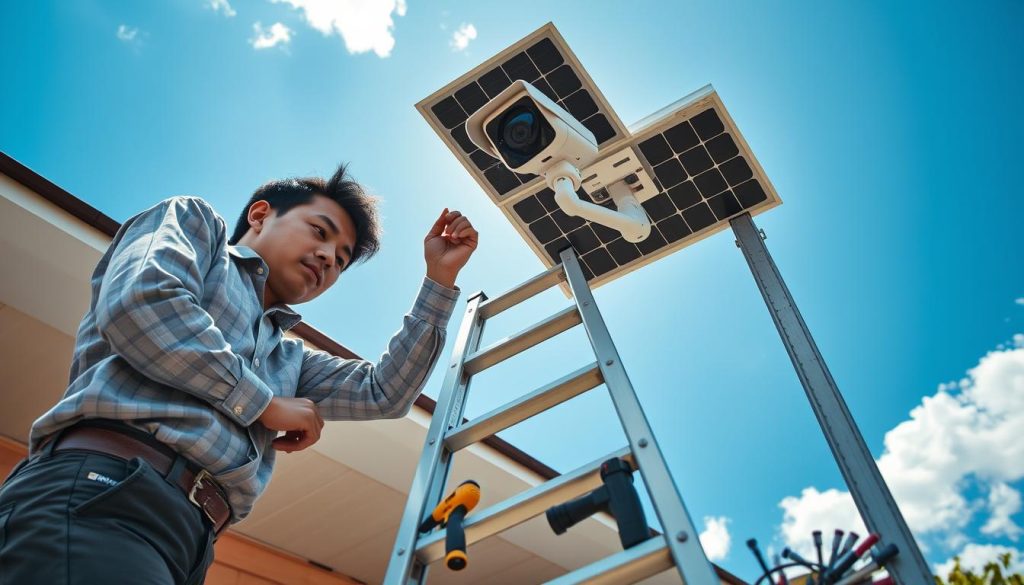
Your energy-harvesting unit needs secure attachment too. Use corrosion-resistant hardware suitable for Singapore’s humid climate.
Proper angling maximizes sunlight capture throughout the day. Adjustable brackets let you fine-tune the orientation seasonally.
Weatherproof cable routing protects connections from rain. Use conduit or protective tubing for exposed wiring runs.
“Lightning protection is worth considering for exposed installations. Surge protectors safeguard sensitive electronics during electrical storms,” advises a local installation specialist.
Electrical connections require careful attention. Properly link your photovoltaic unit to the charge controller and battery.
Verify correct polarity before making final connections. Waterproof all junction points to prevent moisture ingress.
Test the power flow before completing the setup. Most units have indicator lights showing charging status.
Connecting to WiFi and Configuring Your Mobile App
Prepare your wireless network before beginning this phase. Most monitoring devices require 2.4GHz frequency compatibility.
Check signal strength at the installation location. Weak signals cause connectivity issues and interrupted video streams.
Some routers need specific configuration adjustments. Enable proper protocols and ensure adequate bandwidth allocation.
Download the manufacturer’s mobile application from official stores. Create your account using a valid email address.
Adding your device typically involves scanning a QR code. Alternatively, enter the serial number manually if the code isn’t accessible.
Follow the in-app prompts for network selection and password entry. The process usually completes within a few minutes.
Configuration best practices enhance system performance. Set motion sensitivity appropriate for your environment.
Create detection zones focusing on important areas. This reduces false alerts from peripheral movement.
Configure alert preferences according to your schedule. You might want notifications only during certain hours.
Test all functions thoroughly after setup. Verify night vision activation and image clarity.
Check alert responsiveness by walking through detection zones. Confirm notifications arrive promptly on your smartphone.
Monitor the energy harvesting status in the app. Most interfaces display battery level and charging activity.
Optimize settings based on initial observations. Adjust sensitivity if you receive too many or too few alerts.
Your renewable-energy monitoring solution is now active. Regular checks during the first week ensure everything operates correctly.
Maintaining Your Solar Security System for Longevity
A well-maintained photovoltaic protection network delivers years of dependable service through Singapore’s varied climate. Consistent care routines prevent performance degradation and extend your investment’s lifespan.
Establishing a maintenance schedule ensures nothing gets overlooked. Daily checks involve quick app glances to verify operation.
Weekly reviews confirm alert functionality and battery levels. Monthly inspections examine physical components for wear or damage.
Seasonal tasks address climate-specific challenges. This systematic approach keeps everything running smoothly.
Routine Cleaning and Care for Solar Panels
Your energy-harvesting surfaces require regular attention. Dust and grime accumulation reduces efficiency significantly.
In Singapore’s urban environment, clean every three months. More frequent cleaning may help during dry, dusty periods.
Use a soft cloth with mild soap and lukewarm water. Avoid abrasive materials that could scratch the protective coating.
Early morning is the safest cleaning time. The surface remains cool enough for comfortable handling.
Check for physical damage during each cleaning session. Look for cracks in the glass or discolored cells.
Verify all electrical connections stay secure and dry. Ensure mounting brackets haven’t loosened over time.
Remove any vegetation encroaching on the panel area. Trim branches that might cast shadows during different seasons.
Bird droppings create localized shading hotspots. Address these promptly to maintain optimal energy production.
Monitoring Battery Health and Replacement Cycles
Lithium-ion power cells typically last three to five years locally. Tropical conditions affect their overall lifespan.
Monitor charge levels through your mobile application. Note how quickly they drain between sunny periods.
Degradation signs include shorter operation times. The unit may struggle through extended cloudy days.
Recognize end-of-life indicators before complete failure. Sudden power drops warrant immediate investigation.
Select compatible replacements from authorized dealers. Match voltage, capacity, and connector specifications exactly.
Proper disposal of old batteries is essential. Singapore has specific recycling programs for lithium-ion products.
During extended non-use, store batteries at partial charge. Avoid completely draining or fully charging them.
“Proactive battery management prevents unexpected system failures. Regular monitoring gives you advance warning for replacement needs,” advises a local energy storage specialist.
Camera lens care also matters in humid conditions. Clean gently with a microfiber cloth to avoid scratches.
Check for condensation inside the housing after heavy rains. Verify night vision functionality remains clear and bright.
Weather-related maintenance prepares for monsoon seasons. Inspect waterproof seals around all openings.
Secure mounts against potential strong winds. Tighten any fasteners that may have loosened over time.
Troubleshooting Common Connectivity and Performance Issues
Adopt a systematic approach when problems arise. First identify whether issues stem from power, connectivity, or components.
WiFi disconnections are frequent complaints. Signal strength often causes these interruptions.
Consider adding a signal booster for weak areas. Router compatibility checks resolve many connection problems.
Identify interference sources like microwave ovens. Adjust network configuration to minimize conflicts.
Reduced solar charging requires different investigation. Check for new shading problems from growing plants.
Panel orientation might need seasonal adjustment. Connection faults between components interrupt energy flow.
Charge controller problems manifest as inconsistent power. Test each element separately to isolate the fault.
Manufacturer support resources provide valuable assistance. Warranty claims cover defects within specified periods.
Regular firmware updates improve functionality and stability. Professional servicing options exist throughout Singapore.
These maintenance practices ensure continuous protection. Your photovoltaic monitoring remains reliable through every season.
Integrating Solar Cameras into Your Smart Home Ecosystem
Modern protection extends beyond standalone equipment. When your surveillance gear communicates with other smart home devices, you gain comprehensive awareness and control.
This connectivity allows automated responses to events. Your entire property becomes more secure through coordinated actions.
Voice Assistant Compatibility with Alexa and Google Home
Most premium and mid-range photovoltaic monitoring units work with popular voice platforms. Amazon Alexa and Google Home lead this integration.
Setup typically involves enabling a skill or action in your assistant’s app. You then discover devices through the voice platform interface.
Once connected, simple voice commands provide instant access. Say “Alexa, show me the front yard” to view live footage on compatible displays.
You can create routines that combine multiple actions. A morning routine might display your perimeter feed while announcing the weather.
Apple HomeKit support is less common but available in select systems. These require HomeKit Secure Video compatibility for iOS integration.
This platform emphasizes local processing and strong privacy controls. It’s ideal for users deeply invested in the Apple ecosystem.
Automating Security Routines with Motion Triggers
Advanced protection systems support IFTTT (If This Then That) applets. These create automated chains of events based on specific triggers.
When your device detects movement after sunset, it can activate smart lights. This illuminates the area while potentially deterring unwanted activity.
Practical automation scenarios enhance protection while minimizing false alerts. Consider these effective routines for Singaporean homes:
- Entry Alert: Receive a smartphone notification plus an audible chime inside when someone approaches your gate.
- Evening Lighting: Pathway lights automatically turn on when motion is detected in the garden after 7 PM.
- Vacation Mode: During extended absences, random interior lighting activates when perimeter activity occurs.
- Package Delivery: Get an immediate alert with snapshot when delivery personnel approach your doorstep.
These automations create layered responses that adapt to different situations. They make your property appear occupied and monitored at all times.
“Smart automation transforms passive monitoring into active protection. The system doesn’t just watch—it responds intelligently to what it sees.”
Choosing Between Cloud and Local Storage Solutions
Video preservation presents important decisions about convenience, cost, and control. Each approach offers distinct advantages for different users.
Cloud storage subscriptions provide off-site backup accessible from anywhere. Major providers typically charge monthly fees based on video history length.
Retention periods range from 7 to 30 days for most plans. Higher tiers offer extended history and additional features like advanced AI recognition.
Encryption standards protect your footage during transmission and storage. Look for end-to-end encryption for maximum privacy protection.
Local storage options give you direct data control. Network Attached Storage (NAS) devices offer substantial capacity and network accessibility.
MicroSD cards provide simple, affordable storage within the device itself. Manufacturer hubs like Eufy’s HomeBase combine local storage with processing power.
Hybrid approaches balance both methods effectively. Continuous recording can save to local storage while critical events backup to the cloud.
This strategy ensures you always have footage while protecting important moments off-site. It provides redundancy against device failure or theft.
Privacy considerations are paramount under Singapore’s PDPA regulations. Understand where your data resides and who can access it.
Review encryption methods and access controls for any storage solution. Ensure compliance with local personal data protection requirements.
Integration best practices enhance system reliability and security. Network segmentation isolates your protection devices from main home networks.
This limits potential vulnerabilities while ensuring consistent bandwidth. Backup power considerations maintain operation during brief electricity interruptions.
Your choice depends on balancing convenience, cost, and control priorities. Each homeowner will find their optimal storage configuration.
Cost Analysis: Solar vs. Traditional Wired Security Cameras
Financial planning for property protection requires careful evaluation of both upfront and long-term expenses across different technology approaches. This comparison examines the economic realities of sun-powered versus conventional grid-dependent monitoring solutions.
Understanding the complete financial picture helps homeowners make informed decisions. The analysis extends beyond initial purchase prices to include installation, energy use, and maintenance over the system’s lifespan.
Breaking Down Initial Purchase and Installation Costs
Upfront investment varies significantly between these two approaches. Photovoltaic monitoring typically carries higher equipment costs initially.
A quality sun-powered setup for four monitoring points might range from S$800 to S$1,600. This includes the devices, photovoltaic panels, and mounting hardware.
Traditional wired alternatives often appear cheaper at first glance. Basic equipment for similar coverage could cost S$600 to S$1,200.
The installation expense reveals the major difference. Grid-dependent systems require professional electrical work averaging S$800 in Singapore.
This covers wiring runs, conduit installation, and power supply connections. Complex properties with difficult access can increase this cost substantially.
Sun-powered units offer do-it-yourself installation for most homeowners. You avoid electrician fees entirely with this approach.
Placement flexibility reduces additional expenses too. You position devices where needed without wiring constraints.
Electrical upgrades sometimes become necessary with conventional setups. Older homes might need circuit breaker panel modifications.
These hidden costs add unexpected amounts to the final bill. Photovoltaic monitoring eliminates these potential surprises.
Calculating Long-Term Savings on Energy and Maintenance
Operational expenses diverge dramatically after installation. Grid-powered devices continuously draw electricity throughout their operation.
A typical wired monitoring point consumes 5-15 watts constantly. Four units operating 24/7 use approximately 350-1,050 kilowatt-hours annually.
At Singapore’s current electricity rates, this translates to S$70-S$210 yearly. These costs continue for the system’s entire lifespan.
Sun-powered alternatives harness natural light for zero ongoing energy expenses. The photovoltaic panels convert abundant local sunlight into usable power.
“The annual savings of approximately S$420 for a four-camera photovoltaic setup represents significant long-term value. This advantage accumulates year after year,” notes a financial analyst specializing in sustainable technology.
Maintenance presents another cost differentiation. Wired systems experience wiring degradation over time.
Connection points may corrode in Singapore’s humid climate. Power supply units occasionally fail and require replacement.
Photovoltaic equipment needs periodic battery replacements. Lithium-ion cells typically last 3-5 years in tropical conditions.
Replacement costs range from S$50 to S$100 per unit. This expense occurs every few years rather than continuously.
Consider this five-year cost comparison for a four-point system:
- Photovoltaic Monitoring: S$1,200 (initial) + S$400 (batteries) = S$1,600
- Wired Monitoring: S$1,000 (initial) + S$800 (installation) + S$525 (electricity) = S$2,325
The ten-year outlook shows even greater divergence. Utility rate increases further widen this gap over time.
Understanding the Return on Investment Timeline
Return on investment calculations help quantify the financial benefits. The payback period represents when cumulative savings equal the initial cost premium.
For photovoltaic monitoring in Singapore, this typically occurs within 3.2 years. Abundant sunlight accelerates this timeline compared to less sunny regions.
Calculate ROI using this simple formula: (Initial Cost Premium) ÷ (Annual Savings) = Payback Period in Years.
If photovoltaic equipment costs S$400 more initially but saves S$420 yearly, the math works favorably. The system pays for its premium within the first year of operation.
Total cost of ownership provides the most accurate financial picture. This includes every expense over the equipment’s expected lifespan.
For a ten-year period with four monitoring points:
- Photovoltaic: S$1,200 + S$800 (battery replacements) = S$2,000
- Wired: S$1,000 + S$800 + S$1,050 (electricity) + S$200 (maintenance) = S$3,050
Value-added benefits enhance the financial proposition further. Environmental impact reduction represents an important non-monetary advantage.
Installation flexibility allows optimal placement without structural modifications. Resilience during power outages ensures continuous operation when needed most.
Singapore-specific considerations improve the economic case. Potential government incentives for sustainable technology may reduce initial costs.
Property value impacts matter for homeowners. Modern, self-sufficient monitoring systems appeal to environmentally conscious buyers.
Insurance premium reductions sometimes apply for properties with reliable surveillance. Check with your provider about potential discounts.
The financial analysis clearly favors sun-powered solutions for Singaporean properties. The combination of lower long-term costs and additional benefits creates compelling value.
Your specific situation determines the exact timeline. Properties with excellent sunlight exposure achieve faster returns on their investment.
Consider both the numbers and the qualitative advantages. The complete picture makes photovoltaic monitoring an economically sound choice.
Choosing the Right Solar Security System for Your Property
Selecting optimal surveillance equipment requires careful consideration of your property’s unique characteristics and vulnerabilities. This final decision-making phase transforms technical specifications into practical protection tailored to your specific situation.
A systematic approach ensures you invest in equipment that delivers real value. Your choices should address both immediate needs and future expansion possibilities.
Assessing Your Coverage Needs and Priority Areas
Begin with a thorough property assessment to identify critical monitoring zones. Walk around your home and note all potential entry points and blind spots.
Create a simple surveillance map marking doors, windows, and perimeter boundaries. Highlight high-value areas like garages, sheds, or valuable landscaping features.
Entry points demand primary attention in any protection plan. These include main doors, ground-floor windows, and garage access points.
Perimeter coverage extends your awareness beyond immediate structures. It monitors approaches to your property before someone reaches buildings.
Interior-exterior transition zones are equally important. These areas include patios, decks, and spaces where indoor and outdoor activities overlap.
Determine equipment quantity based on coverage gaps rather than arbitrary numbers. Each monitoring point should serve a specific protective purpose.
Consider sight lines and potential obstructions throughout different seasons. Vegetation growth or new structures might create unexpected blind spots later.
For comprehensive guidance on sun-powered surveillance solutions, explore our detailed resource on photovoltaic monitoring equipment.
Aligning Features with Your Security Priorities and Budget
Feature selection depends on your primary protection goals. Different priorities demand different technological capabilities.
If identification is paramount, invest in higher resolution and better low-light performance. These capabilities help recognize faces or license plates clearly.
Deterrence-focused systems benefit from visible placement and audible alerts. Evidence collection requires reliable recording and storage solutions.
Create a simple decision matrix to evaluate options. List your must-have features separately from nice-to-have capabilities.
“Budget allocation should reflect your property’s risk profile. Higher-risk areas justify greater investment in advanced features,” advises a local protection consultant.
Essential functions typically include motion detection and weather resistance. Advanced capabilities might include person recognition or smart home integration.
Distribute your investment across several components. The monitoring devices themselves represent one part of the total cost.
Photovoltaic panels, storage solutions, and installation services each require budget consideration. A balanced approach ensures all elements work harmoniously.
Consider total cost of ownership over three to five years. Maintenance, potential repairs, and energy savings all affect long-term value.
When to Consider Professional Consultation and Installation
DIY setup works well for straightforward properties with good sunlight access. Simple layouts with clear mounting locations suit self-installation.
Complex situations often benefit from professional expertise. Multi-story buildings, extensive properties, or challenging lighting conditions warrant specialist involvement.
Professional installation in Singapore typically costs S$150 to S$300 per monitoring point. This investment ensures optimal placement and configuration.
Consultation services provide several valuable benefits. Site surveys identify the best locations for both coverage and energy harvesting.
Custom system design matches equipment to your specific layout. Integration with existing protection measures creates a unified approach.
Ongoing support resolves technical issues quickly and efficiently. Professionals handle warranty claims and component replacements.
Scalability planning prepares your system for future expansion. Consider compatibility with additional devices you might add later.
Upgrade paths should accommodate technological advancements. Your initial investment should support reasonable evolution over time.
Special requirements demand particular attention. Large properties need strategic placement to minimize equipment count.
Remote locations require robust connectivity solutions. Business applications often have specific compliance or recording requirements.
Use this final selection checklist before making your purchase:
- Property assessment completed with coverage map
- Priority areas identified and ranked
- Must-have features matched to protection goals
- Budget allocated across all system components
- Installation method determined (DIY vs professional)
- Storage solution selected for your needs
- Scalability considered for future expansion
- Warranty terms and support options reviewed
This comprehensive approach ensures your photovoltaic protection system delivers maximum value. Your property receives tailored monitoring that addresses specific vulnerabilities while working within practical constraints.
Taking the Next Step in Solar-Powered Security
Your journey toward eco-friendly surveillance begins with applying the insights from this comprehensive guide. Photovoltaic monitoring offers reliable protection while reducing environmental impact.
Singapore’s abundant sunlight makes these systems exceptionally practical. You gain wire-free placement flexibility and eliminate ongoing electricity costs.
Evaluate your property’s specific needs using our detailed framework. Compare shortlisted models based on video quality, smart features, and durability.
Consider both immediate protection and long-term savings. This technology represents a responsible choice for modern homeowners.
Begin with a simple property assessment. Then implement your chosen solution through DIY or professional installation.
FAQ
How long will a solar-powered device work on a cloudy day?
A high-quality model with a robust battery can operate for several days without direct sunlight. The integrated battery stores energy from sunny periods, ensuring continuous function during overcast weather. For consistent performance in Singapore’s climate, ensure the panel is positioned for maximum light capture.
Do I need to replace the batteries in these units?
Most systems use rechargeable lithium-ion batteries designed for hundreds of charge cycles. With proper maintenance, the internal power cell can last for several years before needing replacement. Monitoring battery health through the companion app helps plan for this eventual swap.
Can I view footage remotely on my phone?
Yes. These devices connect to your home’s wireless network, allowing live streaming and playback directly to your smartphone. You’ll receive instant alerts for motion events, enabling real-time monitoring from anywhere with an internet connection.
What happens to recorded video at night?
Advanced units feature infrared or color night vision, providing clear images in low-light conditions. Recorded clips are typically saved to cloud storage via subscription or locally to a microSD card or home hub, depending on the brand you choose.
Are these systems difficult to install myself?
Installation is generally straightforward due to the wire-free design. The process involves mounting the hardware, connecting the photovoltaic panel, and syncing the device to your app. Brands like Ring and TP-Link are known for user-friendly setups that most homeowners can manage.
How well do they withstand heavy rain?
Look for an IP65 or IP66 weather resistance rating, which guarantees protection against dust and powerful water jets. This durability is essential for reliable operation in tropical climates with frequent downpours, keeping internal components safe.
Is a monthly subscription required for basic use?
Not always. While some brands offer enhanced cloud features with a fee, many provide core functionality like live viewing and motion alerts for free. Options like Eufy offer local storage on a HomeBase, eliminating recurring costs entirely.


