
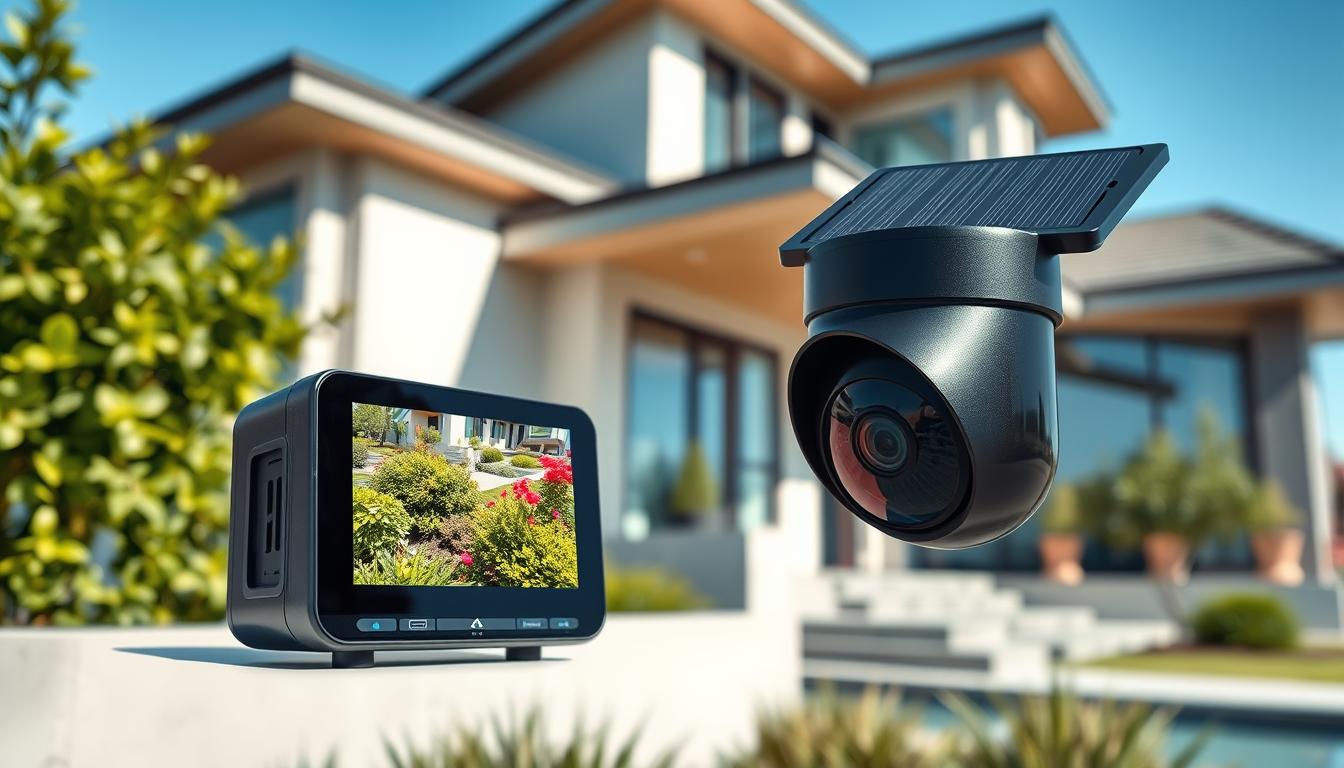
Top Rated Solar Powered Security Camera with Monitor
Keeping your home safe is a top priority for over 70% of Singapore residents. Modern technology now offers smart solutions that blend safety with sustainability.
These innovative devices use natural energy from the sun. They eliminate electricity costs and support eco-friendly goals. Singapore’s climate provides over 2,500 sunny hours each year. This makes sun-powered devices especially effective here.
The best systems combine renewable energy with advanced surveillance capabilities. You get reliable, green protection for your property. Installation is flexible without complex wiring requirements.
This guide reviews top-rated products for 2024. We examine key features, benefits, and setup considerations. Learn how these units can reduce energy bills by up to 75% compared to wired alternatives.
Built-in battery storage ensures operation during power outages. We cover technical details like video resolution and weather resistance. Our comparison helps you make an informed choice for your specific needs.
Key Takeaways
- Modern protection systems merge advanced surveillance with sustainable, renewable energy sources.
- Singapore’s abundant sunlight makes these units particularly efficient and cost-effective.
- Flexible installation without extensive wiring suits various property types and locations.
- Integrated battery backup maintains operation during electrical outages for continuous monitoring.
- These solutions can significantly reduce household electricity consumption and related costs.
- The guide provides comprehensive 2024 product comparisons and Singapore-specific advice.
- Key evaluation factors include video quality, durability, and ease of maintenance.
Why Solar-Powered Security is Revolutionizing Home Protection
Homeowners today are embracing a new era of surveillance that combines environmental consciousness with cutting-edge technology. This shift represents a fundamental change in how we think about property safety.
Traditional wired setups required complex electrical work and ongoing utility costs. Modern alternatives break free from these constraints entirely.
The move toward renewable energy sources aligns perfectly with global sustainability goals. Over 70% of residents express concern about property safety while also valuing eco-friendly solutions.
These innovative devices eliminate dependency on the electrical grid. They harness natural resources instead of consuming traditional power.
Financial savings represent a major advantage. By cutting the cord to utility companies, households save significantly on monthly bills.
Technological progress has made these units remarkably reliable. Early models faced limitations, but current versions offer robust performance.
Key advancements include:
- Enhanced battery storage for extended operation
- Improved photovoltaic cell efficiency
- Smart integration with mobile applications
- High-definition video streaming capabilities
Continuous monitoring provides peace of mind during electrical outages. Built-in energy reserves ensure the system never goes offline unexpectedly.
Installation flexibility is another compelling benefit. Without extensive wiring requirements, placement options expand dramatically.
Remote access functionality lets users check their property from anywhere. Real-time alerts keep homeowners informed about important events.
Consumer preference increasingly favors green products that deliver full performance. People want effective protection without environmental compromise.
Singapore’s climate offers abundant sunlight throughout the year. This natural advantage makes such devices exceptionally efficient locally.
As conventional energy expenses continue rising, this approach represents a future-proof investment. The initial cost delivers long-term savings and independence.
The combination of smart features and sustainable operation creates a powerful value proposition. Home protection evolves to meet both practical and ecological needs.
The Rise of Sustainable Security in Singapore
Driven by policy and climate, Singapore has become a natural testing ground for protection solutions that are both intelligent and independent. This movement represents more than a trend; it’s a strategic alignment of national goals, environmental awareness, and practical homeowner needs.
Aligning Security Needs with Environmental Goals
The Singapore Green Plan 2030 provides a powerful framework. This national roadmap encourages the adoption of eco-friendly technologies across all sectors, including home safety.
Over 70% of residents express a dual priority. They seek effective property protection while also making environmentally conscious choices.
Modern surveillance systems are a perfect fit. They deliver robust monitoring capabilities without relying on the traditional electrical grid.
This shift reduces household carbon footprints significantly. Homeowners contribute to national sustainability targets simply by choosing how they protect their space.
Regulatory support makes installation straightforward for most residential property types. The government’s clear guidelines help residents adopt these technologies with confidence.
There’s a strong cultural component too. Singaporeans are famously tech-savvy and value innovation that offers tangible benefits.
Singapore’s Climate: A Perfect Match for Solar Tech
The island’s tropical environment is a major advantage. It enjoys more than 2,500 hours of bright sunlight each year.
This consistent exposure is ideal for photovoltaic technology. Solar panels operate at peak efficiency under these conditions.
The angle of the sun in this region enhances energy capture. Properly positioned units can generate ample power throughout the day.
This natural resource eliminates dependency on utility companies. It also provides a reliable energy source for continuous operation.
Urban landscapes benefit greatly from this technology. High-rise apartments and landed homes can deploy wireless cameras in optimal spots.
They do this without the need for complex electrical work. The setup is clean, flexible, and minimally invasive.
Economic incentives add to the appeal. Reducing electricity bills is a immediate financial gain for households.
Long-term battery life is supported by the abundant sunshine. This ensures systems remain active, even during the occasional rainy stretch.
The combination of forward-thinking policy and a generous climate creates a unique opportunity. Singapore homeowners can now invest in protection that safeguards their families and the environment simultaneously.
Key Benefits of Choosing a Solar-Powered Security Camera with Monitor
Investing in modern surveillance technology brings multiple advantages that extend beyond basic protection. These integrated units deliver value through financial savings, environmental responsibility, and operational reliability.
Homeowners gain practical benefits that improve daily life and long-term property management. The combination of renewable energy and advanced monitoring creates a powerful solution.
Let’s explore the specific advantages that make these systems a smart choice for Singapore residences.
Significant Reduction in Energy Costs and Carbon Footprint
The financial impact is immediately noticeable on utility statements. By harnessing natural energy, these devices eliminate ongoing electricity consumption for surveillance.
Singapore households can save up to 75% on related energy costs. This represents substantial annual savings compared to traditional wired alternatives.
Environmental benefits are equally impressive. Operation produces zero emissions, aligning perfectly with sustainability goals.
This reduction in carbon footprint supports national initiatives like the Singapore Green Plan 2030. Homeowners contribute to environmental protection while safeguarding their property.
The technology operates completely independently from the grid. This independence translates to both economic and ecological advantages.
Unparalleled Installation Flexibility and Elimination of Wiring Hassles
Placement options expand dramatically without electrical constraints. You can position units in optimal monitoring spots regardless of power outlet proximity.
This flexibility is particularly valuable for various property layouts. Large gardens, multiple structures, and remote areas become easily monitorable.
The setup process is remarkably straightforward. Average installation requires just 2.5 hours versus complex wired alternatives.
No extensive electrical work or professional wiring is necessary. Most homeowners can complete the process themselves with basic tools.
This simplicity reduces both initial costs and long-term maintenance requirements. The clean, wireless design preserves your property’s aesthetics.
Reliable Operation During Power Outages and in Remote Areas
Continuous functionality is guaranteed even during electrical disruptions. Integrated energy storage maintains full operation when grid power fails.
Built-in batteries provide backup for extended periods. Some advanced models operate for up to 12 months between charges under optimal conditions.
Remote locations benefit exceptionally well from this technology. Areas previously difficult or expensive to wire now gain comprehensive coverage.
These systems thrive where traditional options struggle. They deliver consistent performance regardless of infrastructure limitations.
Maintenance demands are minimal for modern units. Self-cleaning panels and efficient energy management reduce required attention.
Regular updates happen automatically through connected applications. Users enjoy reliable protection without constant manual intervention.
Collectively, these benefits provide genuine peace of mind and long-term value. Homeowners invest in protection that works intelligently, sustainably, and reliably.
Critical Features to Evaluate Before You Buy
Beyond the eco-friendly appeal, the true value of a modern protection system lies in its performance features. Understanding these specifications ensures you select a unit that meets your specific needs for clarity, reliability, and intelligence.
This evaluation focuses on the hardware and software that determine daily functionality. We break down what matters most for effective monitoring in Singapore’s unique environment.
High-Resolution Video Quality and Night Vision Capabilities
Clarity is paramount for identification. Modern devices offer video resolution from 1080p Full HD to ultra-sharp 4K.
Higher resolution captures finer details like license plates or facial features. This can be crucial for providing useful information if an incident occurs.
After dark, night vision takes over. Standard infrared technology provides clear monochrome footage in low light.
Some advanced models feature color night vision. This uses ambient light or built-in spotlights to deliver full-color images at night.
Color footage can make identifying clothing or vehicle colors much easier. Evaluate both resolution and night vision capabilities together for round-the-clock quality.
Battery Life, Solar Charging Efficiency, and Weatherproof Ratings
Long-term operation depends on energy management. Top-tier units can operate for many months between charges under ideal conditions.
Good battery life is measured in months, not days. Look for systems designed for extended operation with efficient power use.
The attached solar panel is the lifeline. Its wattage, positioning, and the unit’s energy management system determine charging efficiency.
Proper placement in a sunny spot is key for Singapore’s abundant sunlight to be converted effectively. This keeps the internal batteries perpetually topped up.
Durability is non-negotiable. Singapore’s humid, rainy climate demands robust weather sealing.
Look for an IP65 or IP66 rating. These designations guarantee protection against dust and powerful water jets.
This ensures your equipment survives heavy tropical downpours and maintains functionality year-round. It’s a critical choice for reliable maintenance-free operation.
Smart Detection: Motion, Person, Vehicle, and Package Alerts
Basic motion detection can lead to false alerts from passing shadows or pets. Advanced features use AI to analyze the scene.
Smart detection algorithms can differentiate between a person, a vehicle, and even a delivered package. This filters out irrelevant notifications.
You receive alerts only for events that truly matter. This saves you time and provides greater peace of mind.
Consider how the unit stores recorded footage. Options typically include local storage on a microSD card, cloud storage services, or a hybrid of both.
Local storage keeps data on your property, while cloud storage offers remote access and backup. Some models offer expandable memory capabilities.
Additional features like two-way audio allow you to speak through the camera. Integrated spotlights or sirens can deter intruders.
Smart home integration lets you connect the device to other ecosystem devices for automated routines. Evaluating these features ensures your setup has the functionality you need.
How Solar-Powered Cameras with Monitors Work: The Technology Explained
At the heart of every reliable green monitoring system is a sophisticated interplay between energy capture, storage, and transmission. This trio of technologies transforms free natural resources into constant vigilance for your home.
Understanding this process reveals why these units are so effective and independent. Each component plays a specific role in the overall operation.
The journey begins with sunlight and ends with a clear video feed on your display. Let’s explore each technological step in detail.
Harnessing Sunlight: The Technology Behind the Solar Panel
The photovoltaic process is the foundation of the entire setup. Special cells convert photons from the sun directly into electrical energy.
These cells use semiconductor technology, typically made from monocrystalline silicon. This material offers excellent efficiency rates, often above 20%.
When sunlight strikes the panel, it energizes electrons within the silicon. This creates a flow of direct current electricity.
A charge controller then regulates this energy. It prevents overcharging and optimizes the flow to the storage unit.
Proper placement is crucial for maximum energy capture. The panel needs clear exposure to bright light for several hours daily.
In Singapore’s climate, this requirement is easily met. The abundant sunshine keeps these panels working at peak performance.
Energy Storage and Management: Keeping the Camera Powered 24/7
Modern units rely on advanced lithium-ion batteries for storage. These components provide exceptional longevity and reliability.
They withstand numerous charge cycles without significant degradation. A complete charge typically requires about eight hours of good sunlight.
Capacity is measured in watt-hours or milliamp-hours. Higher capacity means longer operation between charges.
Sophisticated energy management systems prioritize power distribution. They allocate electricity between recording functions, wireless transmission, and the monitor display.
Advanced setups include low-voltage protection circuits. These preserve battery health by preventing deep discharge.
This intelligent management allows quality systems to operate for up to seven days without direct sun exposure. Stored energy bridges gaps during cloudy periods or at night.
The entire process happens automatically in the background. Users enjoy uninterrupted protection without manual intervention.
Transmitting the Feed: The Connection Between Camera and Monitor
Wireless technology creates the vital link between components. Most setups use Wi-Fi or proprietary wireless protocols for communication.
This eliminates the need for physical cables between the recording unit and viewing screen. The connection must be stable and secure.
Range and reliability factors depend on the specific technology used. Modern systems maintain strong signals across typical residential property distances.
Real-time viewing occurs with minimal noticeable delay. The feed updates continuously as events happen.
Some systems use frequency-hopping spread spectrum technology. This enhances security and reduces interference from other wireless devices.
The integration between panels, recording units, and displays is seamless. All parts work together as a unified protection solution.
Technical considerations like voltage regulation and power optimization algorithms ensure smooth operation. Every component communicates to deliver a consistent experience.
This technological harmony provides peace of mind for homeowners. It combines sustainability with advanced digital surveillance capabilities.
An Overview of the Best Solar-Powered Security Systems for 2024
For homeowners ready to invest in green surveillance, 2024 presents three compelling options from established industry leaders.
The market for independent monitoring has evolved beyond basic functionality. Today’s top contenders deliver refined performance that meets diverse residential needs.
These units combine advanced technology with sustainable operation. They represent the current pinnacle of what’s available for Singapore properties.
Quality setups in the local market range between SGD 200 to SGD 600. This price bracket covers reliable equipment with excellent features.
Investment at this level ensures robust construction and smart capabilities. It also guarantees proper support and warranty coverage.
Three specific models currently stand out for their balanced value propositions:
- Reolink Argus 3 Pro: Known for outstanding video clarity and sturdy build quality
- EufyCam 3 with SoloCam S40 Monitor: Boasts impressive energy efficiency and built-in storage
- Arlo Essential 2nd Gen with Solar Panel: Offers accessible pricing with premium functionality
Each brand occupies a distinct position. Reolink emphasizes durability and video quality. Eufy focuses on self-sufficient operation.
Arlo targets the smart home enthusiast seeking integration. Understanding these differences helps match systems to specific priorities.
Technological evolution has been significant. Early versions struggled with inconsistent power and limited battery life.
Current generations solve these issues through improved photovoltaic cells and efficient energy management. Operation now continues reliably for many days.
Enhanced resolution and smarter detection algorithms provide clearer footage with fewer false alerts. Users enjoy a more polished experience.
Different property types find suitable options within this selection. Larger homes may prioritize extended wireless range.
Apartments often value compact design and easy installation. All three models accommodate various setup requirements.
Remote areas benefit from complete energy independence. Urban locations appreciate minimal maintenance needs.
What makes these the “best” choices? Several factors contribute to their top ratings:
- Proven reliability in Singapore’s humid weather conditions
- Consistent performance throughout day and night cycles
- Intuitive mobile applications for remote access and control
- Strong local distributor support for warranty claims
- Regular firmware updates that enhance functionality over time
The benefits extend beyond basic surveillance. Reduced electricity consumption is a tangible financial advantage.
Environmental contribution aligns with national sustainability goals. Peace of mind comes from knowing your equipment won’t fail during outages.
This overview sets the stage for detailed examination. Subsequent sections will explore each leading system’s specific strengths.
We’ll analyze video quality, smart features, and real-world performance. This helps you make the optimal choice for your home.
In-Depth Review: Reolink Argus 3 Pro Solar Kit
Reolink’s offering stands out for its balanced approach to performance and durability. It combines reliable energy harvesting with crisp video capture for residential use.
The unit’s construction immediately impresses with its solid feel. Every component feels designed to withstand challenging environmental conditions.
Pros: Stellar Video Quality and Robust Build
Visual clarity is this system’s strongest asset. The 1080p Full HD resolution provides sharp details throughout daylight hours.
Faces and license plates remain identifiable at reasonable distances. The consistency of this video quality is notable across different lighting conditions.
Build quality matches the visual performance. The housing carries an IP65 weatherproof rating that’s ideal for Singapore’s climate.
This protection guards against tropical humidity and heavy rain. The materials resist corrosion and UV damage effectively.
A 130-degree field of view covers wide areas with minimal blind spots. This broad perspective is valuable for monitoring driveways or garden spaces.
The integrated solar panel maintains excellent charging efficiency. Under typical local sunlight, it keeps the internal batteries consistently powered.
Cons: Subscription for Advanced Features
Some intelligent functionality requires a monthly service plan. Person detection and expanded cloud storage fall into this category.
The basic package includes standard motion detection and local storage. For more refined alerts, users must subscribe to Reolink’s cloud service.
This creates an ongoing cost beyond the initial purchase. Some competitors offer similar AI features without subscription requirements.
The monitor interface, while functional, isn’t as polished as some rivals. Navigation through menus can feel slightly less intuitive initially.
Key Specs: Resolution, Field of View, and Smart Integration
Technical specifications reveal why this model performs so reliably. The detailed numbers explain its real-world capabilities.
Video Resolution: 1080p Full HD (1920×1080 pixels) with adjustable bitrate. This balances clarity with efficient storage use.
Field of View: 130° diagonal provides comprehensive coverage. It reduces the need for multiple units in many setup scenarios.
Night Vision: Up to 10 meters range with 8 infrared LEDs. This ensures usable footage after dark without additional lighting.
Battery Capacity: 5200mAh rechargeable lithium-ion cell. Under optimal conditions, this provides months of operation between charges.
Weather Resistance: IP65 certified against dust and water jets. This rating guarantees performance during Singapore’s rainy seasons.
Storage Options: Local microSD card (up to 128GB) or Reolink Cloud. The hybrid approach offers both convenience and backup.
Smart Features: Basic motion sensing included; person detection via subscription. Notifications arrive through the mobile app with configurable schedules.
The solar charging component deserves special attention. Its 6W output efficiently converts abundant local sun into usable power.
This keeps the unit perpetually active without manual intervention. Even during extended cloudy days, the substantial battery reserve maintains operation.
Integration with smart home ecosystems works smoothly. The device connects to Google Assistant and Alexa for voice control.
Two-way audio allows communication through the built-in speaker and microphone. This functionality is useful for delivery instructions or deterrence.
Value assessment places this kit in the mid-range of Singapore’s market. Its price reflects the durable construction and consistent performance.
Compared to wired systems, the elimination of electricity costs creates long-term savings. The initial investment pays back through reduced utility bills.
For homeowners prioritizing reliability and clear footage, the Argus 3 Pro represents a sound investment. Its strengths align well with practical surveillance needs in local conditions.
The overall package delivers what most residents require: dependable, high-quality monitoring that works independently. It’s a choice that balances present performance with future sustainability.
In-Depth Review: EufyCam 3 with SoloCam S40 Monitor
The EufyCam 3 takes a distinctly different approach by integrating all essential components into a single unit. This design philosophy prioritizes convenience and long-term value over modular flexibility.
Eufy’s solution targets homeowners who want a complete package without ongoing fees. The system operates independently from day one with minimal configuration required.
Pros: Integrated Solar Panel and Subscription-Free AI Detection
The most notable advantage is the built-in energy harvesting component. Unlike separate panel systems, this unit captures sunlight directly through its housing.
This eliminates the need for mounting an additional device. Installation becomes simpler with fewer parts to position and connect.
Artificial intelligence processing happens locally on the device itself. The system identifies people, vehicles, and packages without sending data to external servers.
No monthly subscription is required for these smart features. All recognition capabilities are included in the purchase price.
Local storage provides another layer of independence. The 8GB built-in memory holds weeks of recorded footage based on typical usage patterns.
Homeowners maintain complete control over their video data. This addresses privacy concerns that some users have with cloud-based options.
Cons: Slightly Bulkier Design
The integrated approach does create a larger physical profile. The unit measures noticeably bigger than models with separate panels.
This size may limit placement options in some scenarios. Tight spaces or discreet mounting spots could be challenging.
The aesthetic is more utilitarian than sleek. Some homeowners might prefer a more minimalist look for their property.
Despite the size, the design remains weather-resistant. The bulk doesn’t compromise the unit’s durability or environmental protection.
Key Specs: 2K Resolution, 8GB Storage, and Weather Resistance
Video clarity reaches 2K resolution, which is a significant step above standard 1080p. This higher pixel count captures exceptional detail for identification purposes.
Facial features and text become clearer at greater distances. The improvement is noticeable when reviewing footage on the SoloCam S40 display.
Weather protection meets IP67 standards, representing excellent environmental sealing. The unit withstands complete immersion in water up to one meter deep for 30 minutes.
This rating ensures reliable operation during Singapore’s heaviest tropical downpours. Humidity and dust pose no threat to the internal components.
The monitor delivers a crisp viewing experience with responsive touch controls. Users can quickly access live feeds and review recorded events.
Battery performance benefits from the integrated charging system. Under optimal sun exposure, the unit maintains near-perpetual operation.
Even during extended cloudy periods, the energy reserves provide weeks of continuous monitoring. The setup requires minimal maintenance once properly positioned.
Priced around SGD 180, this model offers compelling value for its capabilities. The elimination of recurring fees creates long-term savings that offset the initial investment.
For Singapore residents seeking a self-sufficient solution, the EufyCam 3 represents a practical choice. It delivers premium functionality without dependency on external services or infrastructure.
In-Depth Review: Arlo Essential 2nd Gen with Solar Panel
Positioned as an accessible entry point into smart home monitoring, this unit combines advanced technology with straightforward operation. Arlo targets homeowners who want premium features without a premium price tag.
The system costs approximately SGD 80 in local markets. This makes advanced surveillance technology available to more households across Singapore.
It represents the budget-friendly segment of quality green monitoring systems. The package includes everything needed for immediate deployment on your property.
Pros: Affordable, Feature-Packed, with a Built-in Spotlight
The price point is this model’s most compelling advantage. For under SGD 100, you receive a complete setup with intelligent capabilities.
An integrated spotlight enhances nighttime visibility significantly. It activates automatically when motion detection triggers recording.
This creates a deterrent effect while illuminating the scene. The combination of light and recording often prevents incidents before they escalate.
Smart home integration works seamlessly with popular platforms. Alexa and Google Assistant support allows voice control and automated routines.
You can create “if this, then that” scenarios with other connected devices. This expands the unit’s functionality beyond basic surveillance.
The design is compact and unobtrusive for various mounting spots. Installation requires minimal tools and technical knowledge.
Cons: Full Potential Unlocked with Arlo Secure Subscription
Some advanced functionality requires monthly subscription access. Cloud storage and enhanced detection fall into this category.
The basic package includes live viewing and local alerts. For recorded footage and smarter notifications, users need Arlo Secure.
This creates an ongoing cost beyond the initial purchase. Some competitors offer similar features without recurring fees.
The subscription model may not suit all budget-conscious homeowners. It’s important to factor this into your total cost of ownership.
Free tier options provide limited cloud recording periods. Extended history and advanced AI detection require payment.
Key Specs: 2K HDR, Color Night Vision, and Two-Way Audio
Video clarity reaches impressive 2K HDR resolution. This captures exceptionally clear details compared to standard HD.
The High Dynamic Range preserves details in both bright and dark areas. License plates and facial features remain identifiable at greater distances.
Color night vision maintains accurate color representation after sunset. It uses ambient light and the built-in spotlight for full-color footage.
This technology provides clearer identification during nighttime hours. Traditional infrared monochrome images can’t match this color accuracy.
Two-way audio allows communication through the device. You can speak to delivery personnel or deter potential intruders remotely.
The built-in microphone and speaker provide clear sound transmission. This functionality adds interactive capabilities to basic monitoring.
Energy performance suits Singapore’s abundant sunlight conditions. The attached photovoltaic panel efficiently converts natural light into usable power.
Battery life extends for many days between charges under optimal placement. Even during cloudy weather, energy reserves maintain operation.
For Singapore residents watching their budget, the Arlo Essential represents strong value. It delivers modern features at an accessible price point while supporting sustainable operation.
The overall package meets core surveillance needs effectively. Homeowners gain intelligent protection without complex installation or high electricity costs.
Other Notable Contenders in the Market
The landscape of sustainable home monitoring extends well beyond the most frequently reviewed models to include specialized options. Singapore homeowners have diverse needs that sometimes align better with alternative brands.
These units offer unique advantages for specific scenarios. They might excel in particular features or provide better value for certain property types.
Exploring these alternatives ensures you find the perfect match for your situation. Each brings something different to the table worth considering.
TP-Link Tapo C420S1: Versatile Solar Panel and Dual Spotlights
This system stands out with its highly adaptable energy-harvesting component. The photovoltaic unit offers 360-degree pan and tilt adjustment.
You can position it to capture maximum light throughout the day. This flexibility is valuable for properties with shifting shade patterns.
The device requires just 30 minutes of direct sunlight to maintain full operation. Singapore’s abundant light makes this easily achievable.
Visual quality reaches 2K QHD resolution. This provides exceptional detail for identifying people or objects.
Dual integrated spotlights enhance nighttime visibility significantly. They activate with motion detection to illuminate the scene.
The combination of bright lights and recording creates a strong deterrent effect. It also delivers clearer color footage after dark.
This model suits homeowners who need precise panel positioning. It’s ideal for locations with partial sun exposure during certain hours.
Blink Outdoor 3 with Solar Mount: The Budget-Friendly Choice
For cost-conscious shoppers, this option delivers reliable performance at an accessible price point. The complete package includes everything needed for immediate deployment.
Installation is remarkably straightforward with clear instructions. Most users can complete the setup in under an hour.
App controls provide intuitive management from your smartphone. You can adjust settings, view live feeds, and review recordings remotely.
Standard features include clear night vision, two-way audio, and responsive motion sensing. These capabilities cover essential monitoring needs effectively.
The dedicated charging mount keeps the internal batteries perpetually charged. It converts natural light into usable power efficiently.
This system represents excellent value for basic surveillance requirements. It’s perfect for supplementary coverage or secondary property locations.
Singapore residents appreciate the balance of affordability and functionality. The low ongoing maintenance adds to its appeal.
Ring Stick Up Cam Pro: Ideal for Large Yards and Spaces
Properties with extensive grounds benefit from this unit’s expansive coverage. The extra-large field of view monitors wide areas with minimal blind spots.
A unique Bird’s Eye View feature excels at tracking movement across large spaces. It creates a top-down map showing detected activity paths.
This functionality is invaluable for understanding how people move through your property. It helps identify common routes and potential vulnerabilities.
The device performs reliably in Singapore’s humid weather conditions. Robust construction withstands tropical rain and intense heat.
Integration with the Ring ecosystem allows comprehensive home monitoring. You can connect multiple devices for coordinated protection.
Large landed homes and estates find particular value in this solution. It reduces the number of units needed for complete coverage.
The system’s tracking capabilities provide peace of mind for spacious properties. You gain detailed awareness of all activity.
Another noteworthy option is the Google Nest Cam paired with a Wasserstein photovoltaic panel. This combination offers free AI object recognition without subscription fees.
The system provides three free hours of cloud video storage for event recordings. This gives homeowners basic backup without additional costs.
For those already invested in the Google ecosystem, integration is seamless. The device works smoothly with other smart home products.
Each alternative system addresses specific homeowner priorities. The TP-Link model offers unparalleled positioning flexibility.
The Blink unit delivers maximum value for limited budgets. Ring’s solution provides superior coverage for large spaces.
Google’s option appeals to users wanting advanced AI without monthly fees. These distinctions help match technology to individual needs.
Consider these alternatives when your priorities differ from mainstream requirements. They might offer better solutions for unique property layouts or specific budget constraints.
Singapore’s market supports diverse approaches to independent surveillance. Exploring beyond the top brands can reveal your ideal protection partner.
Comparing Top Models: Features, Prices, and Value for Money
Choosing the right green surveillance system requires a detailed side-by-side analysis of performance, cost, and long-term value. This comparison cuts through marketing claims to highlight the practical differences between leading units.
We examine critical specifications that impact daily use in Singapore. The goal is to match each product’s strengths with specific homeowner needs.
Video Resolution and Clarity Head-to-Head
Visual detail is paramount for effective monitoring. The top contenders offer different approaches to image quality.
Reolink delivers 1080p resolution at approximately 60 frames per second. This ensures smooth motion capture, which is vital for tracking fast-moving objects.
Eufy upgrades to 2K resolution with enhanced detail recognition. The higher pixel count makes identifying faces and text at a distance more reliable.
Arlo matches this clarity with HDR technology for balanced exposure. It preserves details in both bright and shadowy areas of the scene.
After dark, the technologies diverge further. Reolink uses traditional infrared for clear black-and-white footage.
Eufy and Arlo incorporate color night vision. This uses ambient light or built-in spotlights to deliver full-color images, aiding in identification.
Battery Performance and Solar Charging Efficiency Compared
Long-term independence hinges on energy management. Each system employs a unique strategy for power.
Battery capacity directly influences how long a unit can run without direct sun. Higher milliamp-hour (mAh) ratings generally mean longer life between charges.
The attached photovoltaic component’s wattage and efficiency are crucial. They determine how quickly natural light is converted into stored energy.
In Singapore’s climate, most panels can maintain a full charge with a few hours of daily exposure. Advanced power management software further optimizes this process.
It extends operation during consecutive cloudy days. This ensures your surveillance remains active through varying weather conditions.
Smart Features and Subscription Models Breakdown
Intelligent detection separates basic motion alerts from useful notifications. Advanced algorithms can distinguish between people, vehicles, and animals.
This significantly reduces false alarms triggered by passing shadows or pets. You receive alerts only for events that truly matter.
The approach to these smart features varies by brand. Some include them for free within the device’s local processing.
Others require a monthly subscription to unlock advanced AI detection and cloud storage. This creates an important difference in long-term cost.
Understanding these models helps calculate the total investment. It’s not just the initial price but the ongoing expenses over years of use.
| Specification | Reolink Argus 3 Pro | EufyCam 3 | Arlo Essential 2nd Gen |
|---|---|---|---|
| Video Resolution (Day) | 1080p Full HD @ 60fps | 2K | 2K HDR |
| Night Vision | Infrared (B&W) | Color Night Vision | Color Night Vision |
| Battery Capacity | 5200mAh | Built-in, Long-life | Rechargeable |
| Solar Panel | 6W Separate Panel | Integrated Panel | Attached Panel |
| Smart Detection | Person (via subscription) | Person/Vehicle/Package (No subscription) | Advanced (via subscription) |
| Storage | microSD / Cloud (subscription) | 8GB Built-in / Local | Cloud (subscription) / Local |
| Weather Resistance | IP65 | IP67 | Weatherproof |
| Price Range (SGD) | Mid-range | Mid to High | Budget-friendly |
| Best For | Prioritizing image smoothness & durability | Privacy-conscious users wanting no fees | Smart home enthusiasts on a budget |
Systems in Singapore range between SGD 200 to SGD 600. This table shows where each model delivers its core value.
Reolink suits those prioritizing proven reliability and smooth video. Its separate panel offers flexible placement for optimal sun capture.
Eufy appeals to users wanting complete independence from subscriptions. The all-in-one design and local storage provide peace of mind and control.
Arlo fits smart home enthusiasts seeking integration at an accessible price point. Its feature set is robust, though full potential often requires a service plan.
When evaluating overall value, consider both the upfront cost and any recurring fees. Also, factor in durability ratings like IP65 or IP67 for Singapore’s humid, rainy climate.
The right choice balances your budget with the specific capabilities you need most. This comparison provides the clarity to make that decision confidently.
Top Considerations for Singaporean Homeowners
Singapore homeowners face distinct considerations when deploying renewable energy-based protection equipment on their properties. Success depends on both technical placement and regulatory compliance.
Local conditions and rules shape every decision. Understanding these factors ensures optimal performance and avoids legal issues.
Assessing Your Property’s Sunlight Exposure and Placement
Sun availability directly impacts your equipment’s performance. Analyze your property’s orientation and potential obstructions carefully.
South-facing positions typically receive optimal light throughout the day. This maximizes energy capture for continuous operation.
Consider how shadows move across your space during different seasons. Tall buildings or trees can block precious rays for critical hours.
Different property types require unique approaches. HDB flats often have limited external mounting options.
Condominium residents must check management committee rules. Landed homes offer more flexibility but need strategic positioning.
Evaluate potential mounting spots for at least six hours of direct sun daily. The photovoltaic component needs clear exposure to function efficiently.
Track the sun’s path across your intended installation area. Morning versus afternoon exposure can make a significant difference.
Use a simple sunlight calculator or mobile app for accurate assessment. This data helps choose the best location for your equipment.
Proper placement balances surveillance coverage with energy harvesting. You want clear sightlines for monitoring while capturing maximum natural light.
Local Support, Warranty Services, and Compliance with Regulations
Choose brands with established Singapore service centers for reliable support. Local warranty coverage simplifies maintenance and repairs.
Quick access to technical assistance is crucial for uninterrupted protection. Verify that distributors offer genuine local warranty terms.
Singapore’s regulatory framework includes important requirements. The Personal Data Protection Act sets clear guidelines for surveillance.
Your equipment should not capture neighbors’ private spaces. Point lenses toward your own property boundaries exclusively.
HDB regulations may restrict external mounting options significantly. Always check with your town council before installing any external devices.
Condo management rules often require written approval for installations. Submit proper requests to avoid later removal demands.
IMDA certification ensures electrical safety and compliance. Look for approved equipment meeting Singapore’s specific standards.
Certified systems undergo rigorous testing for local conditions. They’re designed to handle humidity, heat, and voltage fluctuations safely.
Practical tips help ensure compliance while maximizing effectiveness. Position your equipment to monitor entry points without overlooking adjacent properties.
Use privacy masks in your device’s settings when available. These digital zones block recording of sensitive neighboring areas.
Inform neighbors about your surveillance setup when appropriate. Transparency often prevents misunderstandings and complaints.
Keep documentation for warranty claims and regulatory compliance. Store receipts, approval letters, and installation records securely.
Regularly review your system’s positioning as surroundings change. New constructions or growing vegetation might affect both sunlight and sightlines.
Installation Guide: Maximizing Your System’s Performance
After selecting the ideal unit, precise installation ensures you capture both optimal sunlight and comprehensive coverage. The average setup takes just 2.5 hours for energy-harvesting systems compared to traditional wired alternatives.
Placement options become virtually unlimited with no need for complex electrical work. This guide provides Singapore-specific steps to maximize your equipment’s effectiveness from day one.
Proper positioning balances surveillance needs with energy harvesting requirements. Each decision impacts long-term reliability and performance.
Step-by-Step Setup for Optimal Sunlight Capture
Begin by analyzing your property’s sun exposure throughout the day. South-facing positions typically receive the most consistent light in Singapore.
Photovoltaic components need to be angled toward the equator and tilted according to your latitude. In regions closer to the equator like Singapore, these panels generate more power.
Follow this sequence for reliable results:
- Survey potential mounting spots for at least six hours of direct daily sun. Consider how shadows from buildings or trees might change with seasons.
- Choose mounting surfaces common in local homes. Concrete walls, metal brackets, and wooden surfaces each require specific anchors and tools.
- Position the energy-harvesting component first. Ensure it faces true south with minimal obstructions for maximum efficiency.
- Mount the surveillance unit while maintaining its connection to the panel. Balance coverage area with charging capability.
- Connect and configure the monitoring display and mobile application. Complete initial calibration for local conditions.
Different property types require unique approaches. HDB flats often have limited external mounting options that need creative solutions.
Condominium residents must check management committee rules before installation. Landed homes offer more flexibility but need strategic positioning.
Camera placement should cover entry points while maintaining solar charging efficiency. Avoid installing units under eaves or overhangs where sunlight is limited.
Shaded spots or indoor locations dramatically reduce energy collection. Proper positioning ensures optimal angle toward the sun throughout the year.
Common Installation Mistakes to Avoid
Poor photovoltaic panel positioning tops the list of errors. Even slight shading can reduce energy capture by over 50%.
Obstructed views compromise both surveillance and charging. Ensure no vegetation or structures block the unit’s line of sight.
Incorrect angles prevent maximum sunlight absorption. The ideal tilt in Singapore is approximately 10-15 degrees from horizontal.
Testing system functionality after installation catches issues early. Verify all components communicate properly before considering the job complete.
Cable management matters even with wireless designs. Secure any connections against weather and potential tampering.
Weatherproofing protects sensitive electronics from Singapore’s humid climate. Use silicone sealant on mounting holes and connection points.
Optimize settings for local conditions including motion detection sensitivity. Higher sensitivity may trigger false alerts from tropical rain or wildlife.
Consider professional assistance for complex installations. Services like solar-powered WiFi security camera installation ensure optimal results.
Regularly check alignment as surroundings change. New constructions or growing plants might affect both sunlight and surveillance sightlines.
Document your setup for future reference and maintenance needs. Record positioning details and configuration settings for consistency.
Maintenance and Long-Term Care for Your Solar Security System
While these units require minimal attention, strategic care maximizes their efficiency and extends operational lifespan. Proper upkeep ensures your renewable energy surveillance investment delivers reliable protection for years.
Singapore’s unique environment presents specific maintenance considerations. Humidity, occasional haze, and tropical weather patterns affect equipment performance.
A consistent routine preserves optimal functionality and protects your financial investment. Let’s explore the essential practices for long-term success.
Keeping Your Solar Panel Clean and Efficient
Photovoltaic components need regular cleaning for peak performance. Dust, pollution, and haze can reduce energy capture by up to 30%.
This directly impacts your system’s ability to operate through the night. Reduced efficiency means shorter battery life between charges.
Singapore’s urban environment creates unique cleaning challenges. Construction dust and vehicle emissions settle on surfaces regularly.
Follow this simple cleaning procedure every 4-6 weeks:
- Use a soft microfiber cloth or sponge with mild soapy water.
- Gently wipe the surface in circular motions to remove debris.
- Rinse with clean water using a spray bottle or damp cloth.
- Allow the component to dry completely before reactivating.
Avoid abrasive materials or harsh chemicals that could scratch protective coatings. Early morning or late afternoon cleaning prevents rapid drying streaks.
Check mounting brackets during each cleaning session. Ensure they remain tight and corrosion-free in Singapore’s humid climate.
Seasonal considerations matter throughout the year. Northeast monsoon periods may require more frequent attention.
Heavy rain can actually help clean surfaces naturally. However, it often leaves water spots that reduce light transmission.
Monitor energy production through your device’s app when available. A sudden drop may indicate cleaning is needed sooner.
Battery Health and System Updates
Energy storage units in modern surveillance equipment are remarkably durable. With proper care, replacement becomes exceedingly rare.
Lithium-ion batteries prefer partial discharge cycles over complete depletion. Avoid letting them drain to 0% regularly.
Optimal charging maintains levels between 20% and 80%. This practice significantly extends overall life.
Signs of degradation include shorter operation hours and slower charging. The unit may struggle to last through the night despite full sun exposure.
Most models include battery health indicators in their applications. Check these periodically to monitor performance trends.
To conserve energy, adjust motion detection sensitivity and alert frequency. Reducing unnecessary triggers saves substantial power over time.
Create activity zones that focus on critical areas. This prevents recordings for irrelevant movement like passing shadows or small animals.
Regular firmware updates provide crucial benefits. They deliver security patches, feature improvements, and performance optimizations.
Most systems update automatically when connected to Wi-Fi. Ensure your setup maintains a stable internet connection for this process.
Manual updates are sometimes required. Check manufacturer websites or applications quarterly for available improvements.
Updates often enhance night vision algorithms and motion tracking capabilities. They can also improve energy management for longer battery performance.
Seasonal maintenance adapts to Singapore’s weather patterns. Before monsoon seasons, verify all weather seals remain intact.
Check for moisture accumulation in housing units after heavy rains. Ensure drainage paths aren’t blocked by debris or insect nests.
Troubleshooting common issues starts with basic checks. Poor video quality often relates to lens cleanliness rather than component failure.
Wipe the lens gently with appropriate cleaning materials. Avoid touching image sensors directly with fingers.
Reduced battery life typically points to panel positioning or cleanliness issues. Verify the photovoltaic unit receives adequate direct sunlight.
Most maintenance tasks are homeowner-friendly. Cleaning, basic inspections, and software updates require minimal technical skill.
Professional assistance becomes valuable for complex issues. Electrical diagnostics, component replacements, and structural repairs benefit from expert attention.
Consider professional servicing every 2-3 years for comprehensive evaluation. Technicians can identify potential problems before they affect operation.
Proper maintenance extends equipment lifespan by several years. It protects your investment and ensures continuous property protection.
The combination of simple routines and occasional professional care delivers optimal results. Your surveillance equipment remains reliable through Singapore’s varying conditions.
Future-Proofing Your Investment: Trends in Solar Security
Forward-thinking homeowners recognize that today’s surveillance technology choices must align with emerging innovations and environmental priorities. Selecting equipment with an eye toward tomorrow ensures your property protection remains effective and sustainable.
Energy-harvesting surveillance represents more than current convenience. It’s a strategic investment in technology that evolves with advancing standards and Singapore’s green initiatives.
Photovoltaic components are undergoing significant material science breakthroughs. New perovskite cells promise dramatically higher efficiency rates compared to traditional silicon.
These advanced materials could capture more energy from Singapore’s abundant sunlight. They might also perform better in low-light conditions common during monsoon seasons.
Transparent solar films represent another exciting development. These could integrate directly into window surfaces or building materials.
Such integration would make energy capture virtually invisible. It would expand placement options beyond traditional mounting spots.
Battery technology continues its steady evolution toward greater capacity and longevity. Solid-state batteries represent the next major leap forward.
These promise faster charging, improved safety, and significantly longer operational life. They could extend equipment runtime between maintenance cycles.
Energy storage units might soon last the entire lifespan of the surveillance device. This would eliminate replacement concerns for homeowners.
Artificial intelligence is transforming detection capabilities beyond basic motion sensing. Machine learning algorithms now recognize specific behaviors and patterns.
Future systems might identify familiar faces versus strangers automatically. They could learn your household’s normal activity patterns.
Advanced analytics could predict potential security concerns before incidents occur. This proactive approach represents the next evolution in property protection.
Integration with smart home ecosystems is becoming more seamless and intuitive. Future standards will likely emphasize universal compatibility.
Your surveillance equipment should communicate effortlessly with lighting, locks, and alarms. This creates coordinated responses to detected events.
Voice control and automated routines will become more sophisticated. Systems might initiate specific actions based on complex scenarios.
Singapore’s regulatory landscape continues evolving to support sustainable technology adoption. The Green Plan 2030 creates favorable conditions for energy-independent solutions.
Future policies might offer additional incentives for homeowners choosing green surveillance. These could include tax benefits or installation subsidies.
Data privacy regulations will likely become more stringent. Equipment with local processing and storage aligns well with this direction.
Current high-quality systems offer excellent expansion and upgrade paths. Many support additional units through their existing networks.
Modular designs allow component upgrades as technology advances. You might replace just the photovoltaic panel or battery unit.
Firmware updates regularly enhance functionality on existing hardware. This extends useful life without complete system replacement.
Investing now positions Singapore homeowners advantageously for coming developments. Early adoption establishes infrastructure compatible with future innovations.
You gain immediate benefits while preparing for technological advancements. This dual advantage makes current investment particularly strategic.
Energy costs will likely continue rising, making independent operation increasingly valuable. Environmental regulations may eventually favor or require sustainable alternatives.
Choosing systems with strong local support ensures access to future upgrades. Singapore-based distributors provide crucial firmware updates and compatibility patches.
For those exploring current options, our solar-powered security cameras top picks review highlights models with excellent future-proofing characteristics.
These selections balance present performance with upgrade potential. They represent smart choices for homeowners thinking long-term.
The convergence of sustainability and smart technology creates powerful value. Your investment today protects both your property and your future adaptability.
Forward-looking choices today ensure your home remains securely monitored through tomorrow’s technological shifts. This approach delivers peace of mind that extends well beyond immediate needs.
Making Your Final Choice: Selecting the Right System for Your Home
The ultimate decision about your property’s surveillance rests on matching technology to your lifestyle. Consider your specific needs, space layout, and technical comfort first.
Balance the initial investment against long-term savings and any subscription fees. Prioritize essential features over nice-to-have extras for your situation.
Your ideal choice should work reliably with Singapore’s climate and regulations. It must deliver both immediate protection and lasting value.
Selecting the right system brings sustainable operation and genuine peace of mind. Your home gains intelligent, independent monitoring that fits your life perfectly.
FAQ
How long does the battery last on a cloudy day?
Modern systems have efficient energy storage. High-quality models can operate for several days without direct sunlight, relying on their internal batteries. The exact duration depends on the battery capacity and how much power the device uses for features like motion detection and video recording.
Can I install a solar-powered camera in a shaded area?
For optimal performance, placement in a spot with good sun exposure is key. If an area is permanently shaded, the panel may not generate enough electricity to keep the battery fully charged. You might need to consider a model with a larger, detachable panel that can be mounted separately in a sunnier location.
Do these systems work at night?
A> Yes, absolutely. They are equipped with infrared or color night vision capabilities. The stored energy from the daytime powers the device after dark, ensuring continuous monitoring and recording with clear video quality even in low-light conditions.
What maintenance is required for the solar panel?
Maintenance is minimal. Periodically wiping the panel clean of dust, pollen, or bird droppings ensures it captures sunlight efficiently. In Singapore’s climate, a quick rinse during routine cleaning is often sufficient to maintain peak charging performance.
Are solar security cameras reliable during Singapore’s rainy season?
A> Reputable brands like Reolink and Eufy design their products with high weatherproof ratings (like IP65 or IP66). This means they are built to withstand heavy rain and humidity, keeping the internal components safe and functional throughout the year.
Do I need a professional for setup?
A> Most kits are designed for DIY installation. The main advantage is the elimination of complex wiring. You typically mount the unit, connect the solar accessory, and sync the device with its dedicated monitor or your smartphone via an app. It’s a straightforward process that saves on installation costs.


