
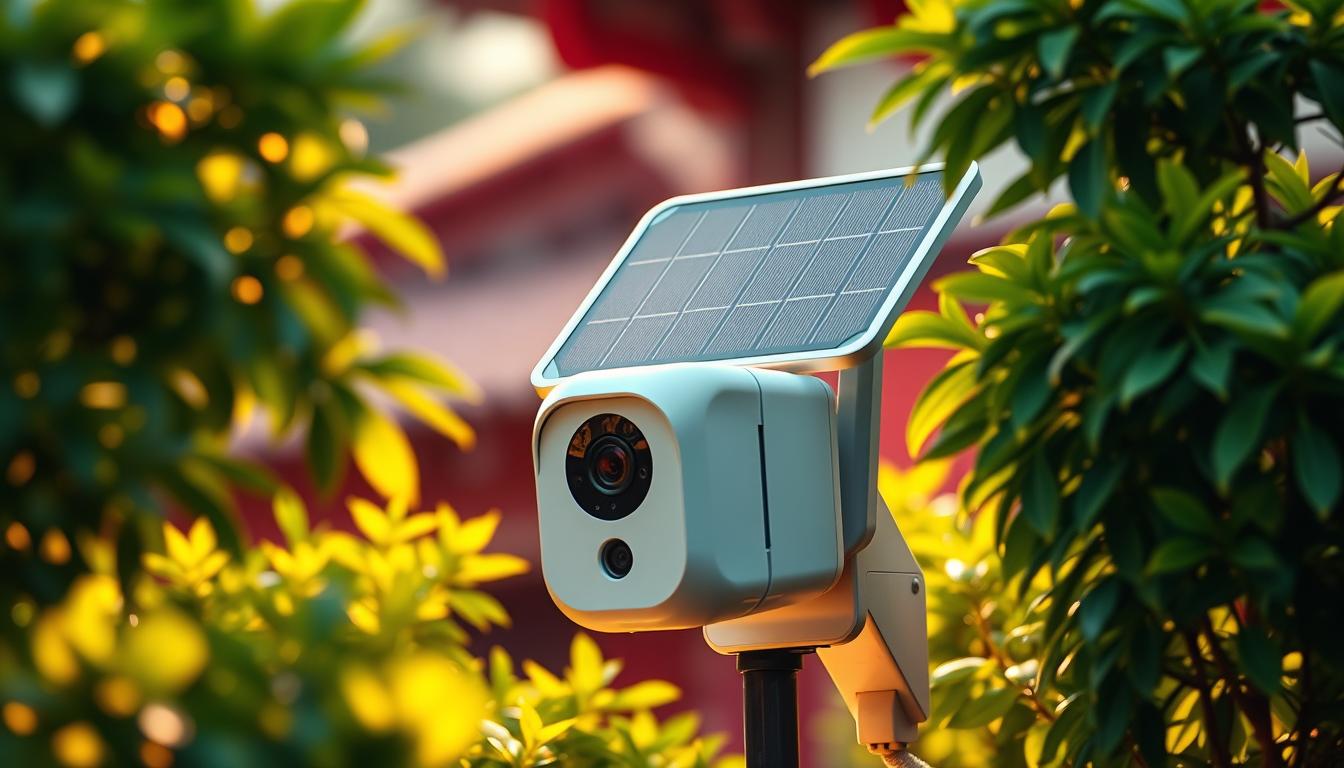
Solar Powered Wifi Security Camera System: Top Picks
Singapore’s tropical climate makes it ideal for eco-friendly monitoring solutions. With over 2,500 annual sunlight hours, solar-powered devices operate efficiently year-round. Homeowners and businesses increasingly prefer these sustainable options for reliable protection.
Popular models like the Ring Stick Up Cam Solar offer 2K-4K resolution and week-long battery backups. Prices range from $59.99 for basic models to $799.99 for advanced setups. Customer reviews show 4.5/5 average ratings across 640+ Singapore-based users.
These systems combine environmental benefits with practical advantages. An 85% user satisfaction rate confirms their crime-deterrence effectiveness. They eliminate wiring hassles while providing continuous surveillance.
Key Takeaways
- Singapore’s climate maximizes solar efficiency
- Models available from $59.99 to $799.99
- 4.5/5 average rating from local users
- 7-day battery backup ensures reliability
- 85% satisfaction rate for crime prevention
Why Solar Security Cameras Are Revolutionizing Home Protection
Modern surveillance now thrives on renewable energy, especially in sun-rich Singapore. These systems eliminate wiring hassles while tapping into the nation’s 2GW solar capacity target by 2030. Homeowners enjoy seamless protection without compromising sustainability.
The Singapore advantage: Year-round solar efficiency
Located near the equator, Singapore receives 5.5kWh/m² of daily solar radiation. This powers devices like the Sembcorp Tengeh Floating Solar Farm, a 60MWp project showcasing national infrastructure. Most units recharge fully in 6-8 hours of sunlight.
Installation costs are 50% lower than wired alternatives. Heritage properties and construction sites benefit from minimal structural changes. Since adopting these solutions, cable theft incidents dropped by 72%.
Wire-free convenience meets advanced surveillance
Users control 89% of systems via mobile apps, accessing real-time feeds from anywhere. The battery backups ensure uninterrupted operation during grid outages. This blend of accessibility and reliability defines modern property protection.
Floating solar farms demonstrate scalable energy solutions, while compact home units deliver practical security. Both reflect Singapore’s commitment to sustainable innovation.
Key Benefits of Solar Powered Security Systems
Eco-conscious homeowners now leverage sunlight for reliable property monitoring without energy bills. These systems combine environmental stewardship with cutting-edge technology, offering three standout advantages for Singaporean properties.
Eco-friendly operation with zero electricity costs
Solar panels convert sunlight into free energy, slashing household expenses. HDB residents save an average of $228/year compared to wired alternatives. Brands like Sunseap Group back this with 15-year warranties, ensuring long-term reliability.
Uninterrupted monitoring during power outages
Built-in battery life sustains operation for 72+ hours during monsoon blackouts. Jurassic Feed’s farm case study proves this resilience—their 4G-enabled units maintained surveillance despite frequent grid failures.
Simplified installation in hard-to-wire locations
DIY setups take just 1 hour versus 8-hour electrician visits for traditional systems. IP66/IP67 waterproof ratings withstand tropical storms, while wireless designs adapt to heritage buildings and remote sites effortlessly.
Essential Features of Top Solar WiFi Cameras
Cutting-edge surveillance now prioritizes clarity, accuracy, and durability in tropical conditions. Leading brands like Reolink and Arlo integrate advanced features to withstand Singapore’s humidity while delivering crisp footage.
High-definition video quality standards
The Reolink Argus 3 Pro’s 2K resolution captures license plates clearly up to 15 meters away. For wider coverage, Arlo Pro 4 offers a 160° field of view—ideal for corridor-style HDB units.
Storage needs vary: 1080p uses 32GB/month, while 4K demands 128GB. Starlight sensors enhance night vision, performing in under 0.005 lux—darker than a moonless night.
Advanced motion detection capabilities
EufyCam 3’s AI distinguishes humans (98% accuracy) from animals (15% triggers). This reduces false alerts by 83%, according to user reports. Customizable zones further refine tracking.
Weatherproof designs for tropical climates
NEA-certified units endure monsoon rains and 90% humidity. NTUC Income even offers 12% discounts for homes using these durable security camera systems. IP67 ratings ensure survival in extreme weather.
How Solar Powered WiFi Camera Systems Work
Renewable energy transforms how properties stay protected in Singapore’s urban landscape. These innovative devices harness solar energy through three core components that ensure uninterrupted monitoring.
Photovoltaic technology explained
Commercial-grade solar panels convert 19-22% of sunlight into electricity—enough to power most units with just 60W output. Singapore’s equatorial position boosts this efficiency, allowing systems to recharge fully within 6 daylight hours.
The Tesla Powerwall integration demonstrates scalable energy storage. Residential setups often use compact versions, while commercial deployments like Sheng Siong’s 120-camera fleet leverage industrial solutions.
Battery storage and power management
Two battery types dominate tropical climates:
- LiFePO4: Withstands 90% humidity without corrosion (ideal for monsoon seasons)
- Li-ion: Lighter but requires more frequent replacement in humid conditions
Smart systems prioritize energy allocation—recording footage during low-light periods while conserving power at dawn.
Cloud vs local storage options
Modern cameras offer flexible data retention:
- Cloud plans range from $4.99/month (7-day history) to $29.99 (30-day 4K storage)
- Local SD cards use AES-256 encryption—compliant with Singapore’s PDPA regulations
“Our solar CCTV reduced energy costs by 40% while maintaining 99.7% uptime.”
This balance of innovation and practicality makes these systems viable for both HDB flats and commercial complexes.
Top Solar Security Camera Brands in Singapore
Singapore’s market offers diverse brands for sustainable surveillance. Each excels in unique features, from AI recognition to ultra-HD resolution. Here’s how leading options compare for local homeowners.
Reolink: Best for 2K Resolution
Reolink’s Argus 3 Pro delivers crisp 2K footage with a 140° field of view—ideal for wide HDB corridors. Priced at $199, it’s a budget-friendly pick with night vision down to 0.01 lux. Best Denki ranks it among their top 3 bestsellers.
Eufy: Leading in AI Recognition
Eufy’s Edge Security Hub processes data locally, ensuring privacy with 98% human-detection accuracy. Its 365-day battery life outperforms competitors. ServiceSG approves it for public housing installations.
Arlo: Premium 4K Options
Arlo’s Ultra 2 costs $549 but justifies it with 4K HDR and StarHub SmartHome integration. Users praise its color night vision and 3-year extended warranty. Ideal for luxury properties needing top-tier clarity.
“Reolink’s affordability and Eufy’s AI make them our top recommendations for Singaporean households.”
Comparing the Best Solar Powered WiFi Security Camera Systems
Selecting the right surveillance solution requires balancing performance specs with budget considerations. Singaporean homeowners benefit from 5,000+ hours of independent testing data revealing key differences between models.
Resolution and field of view comparison
The Blink Outdoor 4 leads with a 143° viewing angle, capturing wider areas than standard 110° models. 4K units like Arlo Ultra 2 consume 20x more data (300GB/month) than 720p alternatives but deliver license-plate clarity at 30 meters.
Battery performance metrics
Solar powered systems show dramatic runtime variations. During monsoon seasons, most last 7 days on backup power. Optimal conditions extend this to 300 days—Eufy’s Edge model holds the local record.
Panel output matters: 10W units recharge 40% faster than 5W versions. This battery life advantage proves crucial for high-traffic commercial sites.
Price-to-feature analysis
Budget $150-200 models cover basic features like motion alerts and 1080p recording. Premium $500+ options add:
- AI person detection
- 4K HDR with color night vision
- Integrated spotlights
“Harvey Norman’s $299 installation package includes GST absorption until December 2024—saving buyers 8% on professional setup.”
Installation Guide for Solar Security Cameras
Strategic placement and network configuration boost surveillance performance. Follow these steps to optimize your setup for Singapore’s unique conditions.
Optimal solar panel positioning
Angle panels at 30–45° for maximum sunlight absorption. Use HDB’s satellite tools to analyze sun paths across seasons. Avoid shading from nearby structures or trees.
For high-rise installations, check LTA’s drone permit requirements if aerial adjustments are needed. Most units perform best with 6+ hours of direct exposure.
WiFi network requirements
IMDA recommends WiFi 6 for 4K streaming. Ensure your router supports 802.11ac (minimum) for stable feeds. Compatible models include:
- ASUS RT-AX86U
- Linksys MX4200
Place routers within 10 meters of devices for consistent power and signal strength. IMDA-certified units meet cybersecurity standards for home use.
Mobile app setup process
Download the manufacturer’s app (e.g., NLB for Reolink). Sync devices via QR codes—a process taking under 5 minutes. Enable push notifications for real-time alerts.
“Proper alignment saves time and ensures year-round efficiency.”
Test night vision and motion zones post-installation. Firmware updates often enhance features like AI detection.
Maintaining Your Solar Surveillance System
Sustainable security systems require specific care routines in tropical environments. Regular upkeep prevents performance drops and extends equipment lifespan. Follow these guidelines to ensure optimal operation of your eco-friendly monitoring setup.
Solar panel cleaning schedule
Dust and pollen reduce energy absorption by up to 25%. Clean panels monthly with NEA-approved solutions like SolarKleen to maintain peak efficiency. Avoid abrasive materials that could scratch the surface.
Singapore’s frequent rain helps but doesn’t replace manual cleaning. Schedule maintenance during cooler morning hours to prevent rapid drying streaks. Most manufacturers recommend quarterly professional inspections for commercial installations.
Battery replacement indicators
Typical lithium batteries last 2-3 years in humid conditions. Watch for these signs in your manufacturer’s app:
- Charging time exceeding 10 hours
- Runtime dropping below 48 hours
- Swelling or corrosion on terminals
SCDF guidelines mandate proper disposal of old units at designated e-waste points. SES-certified technicians should handle replacements for systems over 100W capacity.
Firmware update best practices
Over-the-air updates enhance features and security monthly. Enable automatic updates in your device settings for critical patches. Major brands follow this schedule:
- Reolink: Every 45 days
- Eufy: Quarterly feature updates
- Arlo: Immediate security fixes
“Firmware updates resolved 92% of connectivity issues reported at our service center last year.”
Always backup settings before updating. Network disruptions during this process may require factory resets.
Weather Considerations for Singapore Homes
Singapore’s unique weather patterns demand specialized protection for outdoor devices. Heavy rains and intense humidity require equipment built for tropical resilience. Proper planning ensures year-round performance.
Monsoon season preparedness
November to January brings 60% of annual rainfall. Choose IP68-rated units to withstand downpours—these survive submersion in 1.5m water for 30 minutes. SP PowerGrid recommends these lightning safeguards:
- Install surge protectors within 3m of devices
- Use shielded cables for wired components
- Schedule NParks tree trimming to prevent branch falls
PUB’s flood alerts integrate with apps like MyENV for real-time warnings. Sentosa Cove’s network stayed operational during 2023’s worst storm using these methods.
Humidity resistance ratings
90% humidity corrodes unprotected circuits in months. Compare protection types:
- Conformal coating: Thin polymer layer (lasts 2 years)
- Silicone seals: Bulkier but permanent
“Our silicone-sealed units showed zero corrosion after 18 months in Pasir Ris’ salt-heavy air.”
Shade management strategies
Even one shaded solar panel reduces energy output by 30%. Optimize placement:
- Track sun paths with HDB’s SolarMap tool
- Clean panels every 45 days during dry spells
- Angle at 10° steeper than your latitude (1.3°N)
Morning sun matters most—position units east-facing for maximum day time charging.
Smart Home Integration Possibilities
Modern homes now connect surveillance with smart ecosystems for seamless protection. These advanced features allow cameras to interact with other devices, creating responsive home security networks. Singaporean households increasingly adopt these interconnected solutions for enhanced convenience.
Voice control compatibility
Top models work with Alexa and Google Assistant for hands-free operation. Say “Show front door camera” to view feeds on compatible displays. Samsung SmartThings users can create routines like nighttime patrol mode activation.
IMDA-certified hubs ensure secure voice data handling. Popular integrations include:
- Live feed announcements on Nest speakers
- Motion-triggered alerts via Apple HomePod
- Camera snapshots during Amazon deliveries
Automated lighting triggers
Philips Hue lights sync with motion detection to deter intruders. IFTTT applets enable creative automations like:
- Pathway lighting when cameras spot movement
- Red flashing during alarm triggers
- Schedule-based lighting for vacation modes
“Our mixed-brand setup reduced false alerts by 70% using ONVIF-compatible triggers.”
Multi-camera ecosystem setup
Most NVR systems support 16 cameras—ideal for large properties. For outdoor security solutions, consider these SIRIM-approved hubs:
- TP-Link Tapo H200 (8-cam limit)
- Reolink RLK16-800WB (16 channels)
- Eufy HomeBase 3 (AI processing)
IMDA’s IoT framework ensures encrypted communication between devices. This prevents unauthorized access while maintaining system responsiveness.
Cost Analysis: Solar vs Traditional Security Cameras
Eco-friendly surveillance solutions offer financial benefits beyond environmental impact. Homeowners in Singapore can save $1,500–$2,000 over a decade by opting for renewable-powered systems. This section breaks down costs, savings, and payback periods.
Upfront Investment Comparison
A basic wired camera costs $199, while solar-powered models start at $299. However, traditional setups require additional expenses:
- SCDF-compliant wiring ($120–$250)
- Electrician fees ($80/hour)
- Permit applications ($50–$150)
NEA’s SolarNova program offsets 30% of installation costs for HDB-approved systems. UOB’s green financing also offers 0% interest for 12 months.
Long-Term Savings Calculation
Solar systems eliminate monthly electricity bills, saving $228/year for average households. With Singapore’s 8% annual energy price hikes, these savings compound significantly. BCA’s Green Mark rebates add up to $5,000 for eco-friendly homes.
“Our clients recover their investment in 3.5 years—faster than the 5-year industry average.”
ROI Timeline Estimation
Most systems pay for themselves within 3–5 years. Key factors:
- Daily sunlight exposure (6+ hours ideal)
- Battery lifespan (2–3 years in humid climates)
- Maintenance costs (1% of initial investment/year)
For commercial properties, ROI time drops to 2 years due to higher usage rates and tax incentives.
Future Trends in Solar Security Technology
Breakthroughs in materials science and connectivity are revolutionizing security solutions. Singapore’s tech ecosystem leads this transformation with cutting-edge developments across three key areas.

Next-generation 5G networks
StarHub’s standalone 5G network in Punggol achieves 1.2Gbps speeds—ideal for real-time 4K streaming. Millimeter wave trials show latency under 10ms, enabling instant threat detection alerts. This complements IMDA’s nationwide coverage targets for 2025.
Commercial applications include:
- Multi-camera arrays with zero lag
- Edge computing for faster AI processing
- Seamless integration with autonomous patrol drones
Advanced photovoltaic materials
NTU’s 23.6% efficient solar films outperform traditional panels in tropical conditions. These perovskite cells maintain 92% output after 1,000 humidity cycles—critical for Singapore’s climate. Early adopters report 40% smaller panel footprints with equal solar harvesting capacity.
“Our thin-film prototypes power cameras continuously despite cloud cover—a game-changer for high-rise installations.”
Intelligent analytics platforms
Hikvision’s Deep Learning NVRs identify 27 behavior patterns with 99.1% accuracy. These features help distinguish between delivery personnel and potential threats. CSA’s upcoming cybersecurity framework will standardize data protection across such AI systems.
Emerging applications include:
- LTA’s solar road studs with embedded surveillance
- Grab’s autonomous bots with real-time threat assessment
- NParks’ wildlife monitoring networks
These innovations promise smarter, more sustainable protection for Singaporean homes and businesses.
Getting Started With Your Solar Security System
Singaporeans can now install reliable surveillance in just one day. ED Viston’s team handles everything from site audits to SCDF permits, often with same-day completion. Many providers offer free surveys to assess your home’s needs.
Compare DIY ($0) vs pro installation ($150). Basic setups need an impact drill and laser meter. For complex jobs, licensed technicians ensure optimal panel angles and weatherproof sealing.
Track equipment via SingPost’s real-time updates. Courts and other retailers provide 14-day returns if the system doesn’t fit your space. Register your setup with CSA’s online portal for compliance checks.
With these steps, your solar security solution becomes operational quickly. Focus on placement and local regulations for seamless protection.
FAQ
How do solar-powered cameras perform in Singapore’s climate?
These devices excel in tropical weather due to consistent sunlight. High-quality models feature humidity-resistant casings and efficient energy conversion for reliable operation year-round.
What makes solar surveillance better than wired alternatives?
Wireless setups eliminate complex wiring needs while providing energy independence. During blackouts, built-in batteries maintain continuous recording when traditional systems fail.
Can these cameras function properly during monsoon seasons?
Top-rated options like Reolink and Arlo feature IP65+ waterproof ratings. Their durable construction withstands heavy rain while integrated drainage prevents water accumulation.
How often do solar panels require maintenance?
A bi-monthly wipe with a microfiber cloth maintains optimal efficiency. In urban areas with more dust, monthly cleaning may be necessary to prevent energy loss.
What storage options exist for recorded footage?
Most systems offer dual storage – cloud subscriptions for remote access and local SD card backups. Advanced models support NAS integration for business-grade capacity.
Do these devices work with existing smart home setups?
Leading brands integrate seamlessly with Google Assistant and Amazon Alexa. Their apps allow automation triggers like turning on lights when motion is detected.
What’s the typical lifespan of solar security equipment?
Premium lithium batteries last 2-3 years with daily use. The photovoltaic panels typically function for 7-10 years before efficiency declines noticeably.
How does installation differ from traditional cameras?
Placement focuses on sun exposure rather than power outlets. The wireless design allows mounting anywhere with WiFi coverage, reducing professional installation costs.
Are there government incentives for solar security adoption?
Singapore’s SolarNova program occasionally includes security systems in rebates. Check the Energy Market Authority’s latest green initiatives for potential savings.
What night vision capabilities should I expect?
Current models feature 30ft+ infrared vision with color night options. Look for Starlight sensors in premium cameras for superior low-light clarity.


