

Solar Powered Construction Cameras – Reliable Site Surveillance
Keeping a close watch on a work zone is crucial for safety and asset protection. Traditional monitoring setups often struggle in areas without easy access to electricity.
An innovative solution has emerged, combining sustainable energy with advanced video technology. These off-grid units provide continuous oversight without the need for complex wiring.
In Singapore, the demand for eco-friendly security is growing rapidly. Businesses and homeowners recognize the value of systems that harness abundant sunlight. This approach offers a practical and green alternative for round-the-clock observation.
This technology represents a major leap forward for project site management. It delivers uninterrupted surveillance while cutting down on installation hassle and long-term costs. For remote or temporary locations, it solves the classic problem of limited power access.
Key Takeaways
- Off-grid surveillance systems operate independently of electrical outlets and cables.
- They provide a reliable, 24/7 monitoring solution for remote or temporary work areas.
- These setups are gaining popularity in Singapore due to strong environmental and practical benefits.
- They reduce installation complexity and ongoing operational expenses.
- The technology is well-suited to Singapore’s climate, which offers consistent sunlight.
- It addresses common site challenges like harsh weather and frequent equipment relocation.
- The core value is continuous security with a smaller environmental footprint.
Introducing Cable-Free Site Monitoring for the Modern Builder
Modern builders now have access to surveillance technology that operates completely independent of traditional power grids. This represents a fundamental shift in how project sites are secured.
The old approach relied on extensive electrical work and cable networks. These systems were rigid, expensive to install, and difficult to modify.
Today’s solutions eliminate this dependency. They function autonomously, freeing managers from infrastructure constraints.
One major advantage is the streamlined installation process. Leading brands like Hikvision design their units to minimize excess parts and design work.
This approach saves significant time and effort. A typical setup can be completed in just two to four hours.
Traditional alternatives often require days of electrical labor. The difference in deployment speed is substantial.
True wireless operation is enabled by modern connectivity. Options like 4G LTE and WiFi allow footage transmission without physical cables.
Data travels directly to remote monitoring stations. This gives supervisors instant access to live feeds from anywhere.
Flexibility is another key benefit. These units can be positioned in optimal locations without worrying about power sources.
As project phases change, the equipment can be easily relocated. This adaptability suits dynamic work environments perfectly.
Security improves with reduced vulnerability. Exposed cabling networks are tempting targets for disruption or accidental damage.
Wireless systems have fewer physical failure points. They’re less likely to suffer from cut lines or connector issues.
Maintenance becomes simpler with integrated, self-contained designs. Troubleshooting is more straightforward when dealing with single units rather than complex networks.
Builders appreciate this reduced complexity. It means less downtime and more reliable protection for their assets.
Scalability is a final advantage. Expanding security coverage is as simple as adding another unit to the perimeter.
There’s no need for major infrastructure upgrades. Each new camera operates independently while integrating into the overall monitoring plan.
This makes it easy to adjust coverage as project needs evolve. For comprehensive outdoor solutions, consider exploring solar-powered WiFi security options designed for Singapore’s environment.
The transition to cable-free monitoring delivers practical benefits at every stage. From initial setup to ongoing operation, it simplifies site security management.
How Solar-Powered Surveillance Systems Operate
At the core of these independent monitoring systems is a sophisticated process that converts daylight into reliable electrical power. This begins with photovoltaic cells, commonly called PV panels. These specialized components capture sunlight and transform it into usable electricity through a scientific principle.
The generated electrical current then flows to a storage unit. High-capacity rechargeable batteries, typically lithium-ion, hold this energy for later use. This storage capability is what enables round-the-clock functionality.
During daylight hours, the system prioritizes charging these batteries. Any surplus energy beyond what the unit needs for immediate operation gets saved. This creates a reserve for periods without direct sunlight.
Intelligent power management governs the entire cycle. Advanced controllers optimize energy distribution between charging, storage, and device operation. They employ Maximum Power Point Tracking technology for peak efficiency.
This smart management extends operational duration significantly. Some models can function for up to seven consecutive days without any sunlight. The system achieves this through careful energy conservation and intelligent power cycling.
Proper installation maximizes performance. In Singapore’s geographical context, positioning the panels facing south yields optimal results. This orientation captures the most sunlight throughout the day.
Weather adaptation is another crucial feature. During overcast conditions, the system draws from battery reserves. It may also activate low-power modes to conserve energy until sunlight returns.
Night operation employs several complementary technologies. Infrared illumination provides visibility in complete darkness. Specialized low-light image sensors enhance picture quality.
Motion-activated recording further optimizes resource use. The unit conserves energy during inactive periods. It springs to full operation when detecting movement.
This integrated approach creates a self-sustaining security solution. It harnesses renewable resources while delivering consistent monitoring performance. The technology represents a practical fusion of environmental sustainability and reliable protection.
Core Components and Advanced Features
Behind every reliable monitoring unit lies a carefully engineered combination of durable components and smart technology. These elements work together to deliver consistent performance in challenging outdoor environments.
The integration of hardware and software creates a cohesive solution. This approach ensures both physical resilience and intelligent operation.
The Integrated System: Solar Panel, Battery, and Camera Unit
Commercial-grade units feature an all-in-one design for simplified deployment. Brands like Hikvision combine several key elements into a single package.
The energy harvesting component uses high-efficiency monocrystalline silicon panels. These are mounted on sturdy aluminum alloy frames for durability.
An advanced Maximum Power Point Tracking controller optimizes energy capture. This technology maximizes output even in Singapore’s variable light conditions.
The power storage unit typically employs lithium-ion batteries. These offer high capacity and excellent temperature tolerance for outdoor use.
The imaging hardware forms the heart of the system. Most units feature progressive CMOS sensors that deliver sharp images.
Resolution options range from 1080p to 4K for detailed observation. Lens specifications determine the field of view and zoom capabilities.
Housing materials provide essential weather protection. IP66 and IP67 ratings guarantee resistance to dust and water ingress.
This rugged construction withstands harsh site conditions. It ensures reliable operation through rain, heat, and vibration.
Smart Features for Enhanced Security
Modern units go beyond basic recording with intelligent capabilities. These features transform simple observation into proactive threat management.
Flexible viewing options include varifocal lenses and mechanical PTZ functions. Operators can pan, tilt, and zoom to cover large areas effectively.
24/7 color imaging provides consistent visibility day and night. Advanced sensors maintain clarity in low-light conditions without switching to monochrome.
Intelligent analytics represent a major advancement. Automatic Number Plate Recognition identifies vehicles entering restricted zones.
AcuSense technology distinguishes between human movement and other activity. This reduces false alarms and focuses attention on genuine threats.
Multiple detection methods work in concert for comprehensive coverage. Passive infrared sensors identify heat signatures from living beings.
Radar detection offers another layer of perimeter monitoring. These technologies complement each other for reliable alert generation.
Connectivity options ensure flexible deployment. 4G LTE modules provide cellular network access where WiFi isn’t available.
Local storage solutions include SD cards and built-in SSD drives. Cloud integration offers remote access to recorded video footage.
Two-way audio capability enables communication through the camera. Supervisors can issue warnings or instructions directly from monitoring stations.
Advanced encoding like H.265 compresses video efficiently. This reduces bandwidth usage while maintaining high-quality images.
These smart features transform basic CCTV cameras into intelligent security partners. They provide not just recording, but meaningful analysis and alerting.
The combination of rugged hardware and sophisticated software creates a complete solution. This approach addresses both environmental challenges and security requirements effectively.
The Transformative Benefits of Solar Powered Construction Cameras
Project managers are discovering that eco-friendly security technology directly enhances their bottom line and operational efficiency. This approach moves beyond simple theft deterrence to deliver comprehensive value.
The advantages span financial, regulatory, and environmental domains. Each benefit contributes to smoother project execution and stronger risk management.
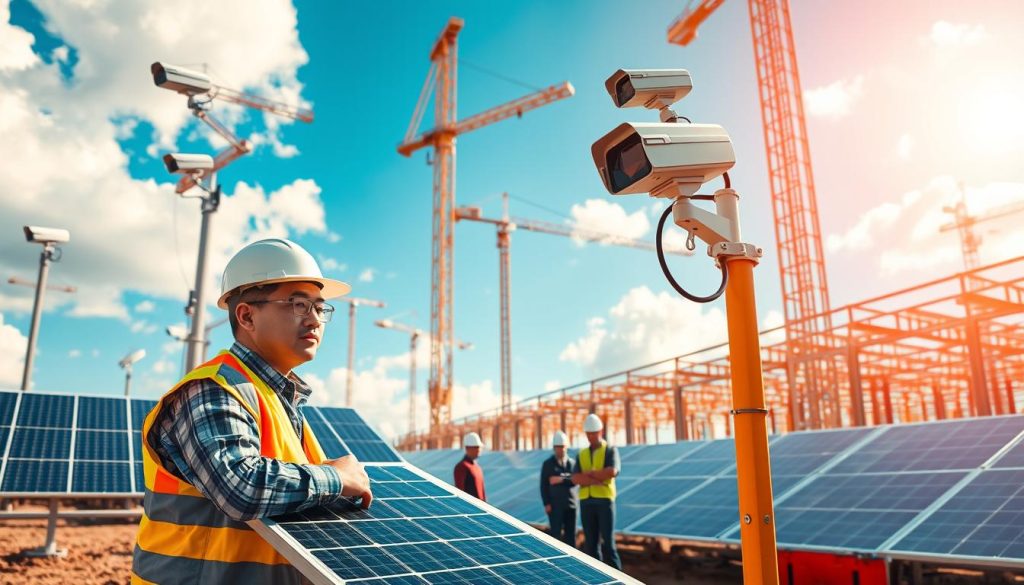
Quantifiable improvements in site safety represent the most immediate gain. Industry studies reveal a dramatic decrease in criminal activity where visual monitoring is present.
Implementing a robust surveillance system can lead to a reduction in theft and vandalism incidents by up to 72%.
Autonomous units ensure this protection is continuous. They operate through grid outages and overnight, eliminating coverage gaps that criminals exploit.
Financial savings accumulate from several directions. The most obvious is the elimination of electricity consumption for each unit.
This translates to approximately $10 in monthly utility savings per device. The absence of complex wiring further slashes initial installation costs by thousands.
Ongoing expenses also drop. With fewer physical components to maintain, these systems demand less technical support over their lifespan.
In Singapore, regulatory compliance is a critical concern for project leaders. The Ministry of Manpower mandates specific oversight for work zones.
An off-grid CCTV solution provides the required audit trail and documentation. It helps companies satisfy official requirements for safety investigations and reporting.
This creates a verifiable record of site activity. Managers can demonstrate due diligence with clear video evidence.
The environmental contribution aligns with national sustainability goals. Using renewable energy significantly cuts the carbon footprint of site operations.
It removes the need for noisy, polluting generators in remote areas. This supports green building initiatives and corporate social responsibility pledges.
Operational reliability is a cornerstone benefit. Advanced units deliver 24/7 security with consistent all-day color imaging.
They are built to withstand Singapore’s tropical climate. Robust housing protects against heavy rain, dust, and corrosive elements.
Integrated battery systems provide backup power for extended periods. This ensures monitoring continues uninterrupted during prolonged cloudy weather.
Deployment flexibility is a major advantage for dynamic work environments. Units can be relocated quickly as project phases progress.
Scaling the system is straightforward. Adding more units does not require worrying about electrical capacity or new conduit runs.
The technology adapts to various site layouts and specific surveillance needs. This adaptability future-proofs your investment.
Finally, these systems boost overall productivity. Remote viewing capabilities reduce the need for costly physical security patrols.
Automated alert systems notify managers immediately of any incidents. This enables a faster, more targeted response.
Recorded footage becomes an invaluable tool for resolving disputes and investigating accidents. It provides objective context that speeds up resolution.
The collective impact is a more secure, efficient, and compliant construction operation. The technology pays for itself through loss prevention and operational savings.
Ideal Deployment Scenarios in Singapore
Singapore’s diverse urban landscape presents unique challenges for securing temporary and remote work areas. Autonomous surveillance technology offers practical solutions across multiple sectors.
These self-sufficient units excel where traditional systems struggle. They deliver reliable oversight without infrastructure constraints.
Continuous Monitoring for Construction Site Safety
Work zones require constant observation for compliance and protection. The Ministry of Manpower mandates visual documentation on many projects.
Off-grid monitoring addresses this need effectively. It provides an audit trail for safety investigations and incident reporting.
Key applications include observing worker activities and equipment usage. Material storage areas benefit from 24/7 oversight.
Perimeter access control becomes more manageable with autonomous units. They create surveillance zones around site boundaries without extensive wiring.
Specialized uses demonstrate the technology’s versatility. Tower crane operation monitoring enhances safety during complex lifts.
Excavation sites gain an extra layer of observation. Material storage yards remain protected after hours.
Night shift security improves with units that operate independently of site lighting. This ensures consistent coverage during all work phases.
Environmental compliance documentation becomes straightforward. Units can monitor sediment control measures and observe regulatory adherence.
Temporary Events and Perimeter Security
Short-term installations demand rapid deployment and easy relocation. Corporate launches, public festivals, and pop-up venues all need temporary protection.
Traditional setup often takes days of electrical work. Autonomous alternatives can be operational in hours.
The mobility advantage is significant. As event layouts change, units move to optimal positions without technical constraints.
Perimeter security for these venues becomes more flexible. Units create overlapping coverage zones that adapt to crowd flow and activity patterns.
Corporate functions benefit from discreet yet comprehensive oversight. Festival organizers gain crowd management tools.
Event security teams report that wireless surveillance reduces setup time by 70% compared to traditional wired systems.
After the event concludes, equipment removal is equally straightforward. There are no cables to retrieve or electrical connections to dismantle.
This makes the technology ideal for back-to-back events. The same system can secure multiple locations throughout the year.
Remote Industrial and Infrastructure Projects
Singapore’s development includes challenging locations without power access. Highway expansion, bridge construction, and utility installations often occur far from electrical grids.
These projects benefit tremendously from autonomous oversight. The technology solves the classic problem of limited infrastructure.
Pipeline projects spanning forested areas gain continuous observation. Workers remain safe with remote monitoring capabilities.
Bridge building over waterways becomes more secure. Supervisors can observe progress and safety compliance from any location.
Utility installations in remote zones maintain protection. Equipment and materials stay secure despite isolation.
The environmental aspect aligns with Singapore’s sustainability goals. For comprehensive off-grid security options, explore our complete autonomous CCTV system solutions designed for local conditions.
These applications demonstrate the technology’s adaptability. It meets specific project needs while reducing logistical complexity.
Infrastructure monitoring extends beyond construction phases. Completed projects in remote locations can maintain security without permanent power connections.
This creates long-term value for asset protection. The initial installation supports ongoing operational security.
Understanding the Cost-Effectiveness and ROI
Financial analysis reveals that autonomous surveillance delivers compelling economic advantages beyond initial purchase price. A thorough examination of expenses shows why these units represent a smart investment.
The upfront cost for a do-it-yourself setup typically ranges from $400 to $1,000 per unit. Professional installations with comprehensive support can exceed $4,000 for complete systems.
Traditional wired alternatives appear cheaper at first glance. Their true expense emerges during implementation and long-term operation.
Electrical contractor fees add thousands to project budgets. Conduit installation requires specialized labor and materials.
Circuit breaker upgrades may become necessary for additional load. Permit costs and inspections further increase the total.
Autonomous CCTV cameras eliminate these infrastructure expenses completely. Their self-contained design requires no external power connections.
This independence translates to immediate savings. The absence of complex wiring reduces both material and labor costs.
Ongoing operational expenses show even greater divergence. Each autonomous unit saves approximately $10 monthly on electricity bills.
Over a five-year lifespan, this accumulates to $600 in avoided utility costs per camera. Multiple units multiply these savings significantly.
The battery and energy management components operate efficiently. They maximize renewable resource utilization while minimizing waste.
Properties implementing these systems report up to 72% reduction in break-ins and vandalism incidents.
This dramatic improvement in protection delivers substantial financial returns. Reduced theft losses directly protect project assets and materials.
Insurance providers often offer premium discounts for enhanced security measures. Liability exposures decrease with continuous monitoring evidence.
Regulatory compliance becomes more affordable. Proper documentation helps avoid fines for safety violations.
Maintenance comparisons favor autonomous designs. Traditional CCTV networks have vulnerable cabling exposed to site hazards.
Weather damage, equipment strikes, and accidental cuts plague wired options. Repairing these issues demands technical support and site disruption.
Self-sufficient units have fewer physical failure points. Their integrated construction withstands harsh environmental conditions better.
Manufacturers typically provide 3-5 year warranties on complete systems. With proper care, key components can last 7-10 years.
Scalability presents another cost advantage. Expanding traditional surveillance requires electrical infrastructure upgrades.
Each new CCTV camera needs dedicated circuits and conduit runs. This complexity increases with larger installations.
Autonomous solutions scale through simple addition. New units operate independently while integrating into the monitoring network.
There’s no need for breaker panel modifications or capacity calculations. This flexibility adapts to changing project needs efficiently.
Total cost of ownership calculations reveal the complete picture. Consider this comparison over a seven-year period:
- Traditional wired system: High installation + monthly electricity + frequent maintenance
- Autonomous solution: Moderate equipment cost + zero electricity + minimal maintenance
The break-even point typically occurs within 18-24 months. After this period, the renewable-powered approach becomes financially superior.
Intangible benefits add further value beyond direct metrics. Improved safety culture develops with visible monitoring presence.
Workers follow protocols more consistently knowing oversight is active. This reduces accidents and improves overall site discipline.
Project management enhances through remote viewing capabilities. Supervisors save time traveling between sites for inspections.
Real-time access to live feeds enables quicker decision-making. Problem identification and resolution accelerate significantly.
Environmental branding carries positive public relations value. Companies demonstrate commitment to sustainability through technology choices.
This aligns with Singapore’s green building initiatives and corporate responsibility goals. It positions organizations as forward-thinking industry leaders.
The comprehensive financial picture makes a strong case for adoption. These systems deliver security while improving the bottom line.
Investment recovery happens through multiple channels simultaneously. Reduced losses, lower operating costs, and improved efficiency all contribute.
For temporary projects, the economics become even more favorable. Equipment redeployment across multiple sites maximizes utilization.
The combination of practical protection and financial wisdom defines modern site management. Smart investments in technology yield returns that extend far beyond basic surveillance.
Selecting the Optimal System for Your Project Needs
Effective system selection begins with understanding your site’s unique surveillance needs and operational constraints. A methodical approach ensures your investment delivers reliable protection and meets specific project requirements.
Start by defining your primary monitoring objectives. Are you focusing on theft prevention, worker safety compliance, or equipment tracking? Each goal influences technical specifications differently.
The physical environment plays a crucial role in equipment selection. Consider factors like area size, terrain features, and potential obstructions. These elements determine camera placement and coverage requirements.
Evaluating Camera Specifications
Resolution choices significantly impact observation quality. Full HD 1080p provides clear identification for general monitoring situations. It captures sufficient detail for recognizing individuals and activities.
4K Ultra HD delivers exceptional clarity for detailed observation needs. This higher resolution is ideal for reading license plates or identifying specific tools from distance. It requires more data storage and bandwidth.
Lens selection determines your field of view and zoom capabilities. Fixed lenses offer consistent coverage of predetermined areas. They’re reliable for stationary monitoring points.
Varifocal lenses provide adjustable viewing angles. Operators can fine-tune the coverage area during installation. This flexibility accommodates changing site layouts.
PTZ (Pan-Tilt-Zoom) units offer the greatest operational flexibility. They can rotate horizontally and vertically while zooming in on details. These cameras cover expansive areas with fewer devices.
Low-light performance is essential for night operation. Look for units with advanced image sensors and infrared illumination. Some models maintain color imaging in near-darkness.
Power System Assessment
Energy requirements depend on daily operation patterns and local sunlight availability. Singapore receives approximately 4-5 hours of peak sunlight daily. This data helps calculate necessary panel capacity.
Panel wattage should exceed your device’s daily energy consumption. A 20-30% buffer accommodates cloudy days and seasonal variations. Higher efficiency monocrystalline panels perform better in limited space.
Battery capacity determines backup duration during extended low-light periods. Lithium-ion batteries offer excellent performance in tropical climates. They maintain charge efficiency despite temperature fluctuations.
Calculate total daily energy needs by adding camera operation, connectivity, and feature consumption. Match this with panel output and storage capacity. Proper sizing prevents power interruptions.
Connectivity Options Analysis
4G LTE cellular connectivity works where WiFi infrastructure is unavailable. It provides reliable data transmission from remote locations. This option requires SIM cards with adequate data plans.
WiFi connections leverage existing site networks. They offer cost-effective data transmission where signal strength is strong. Ensure your access points cover all camera locations adequately.
Hybrid systems combine multiple connectivity methods for redundancy. They automatically switch between available networks. This approach maximizes transmission reliability.
Local network options include Ethernet connections for temporary wired setups. These provide stable data transfer during critical monitoring periods. They’re useful for high-bandwidth applications.
Feature Prioritization Strategy
Motion detection sensitivity should match your security requirements. Adjustable settings prevent false alarms from environmental movement. Customizable zones focus attention on critical areas.
Intelligent analytics transform basic recording into proactive security. Human detection algorithms distinguish people from animals or vehicles. This reduces unnecessary alerts.
Automatic Number Plate Recognition (ANPR) identifies vehicles entering restricted zones. It creates searchable databases of site visitors. This feature enhances access control.
Audio capabilities enable two-way communication through the security camera. Supervisors can issue warnings or instructions remotely. This feature supports real-time intervention.
Integration compatibility ensures new equipment works with existing security systems. Check protocol support and software interface options. Seamless integration reduces implementation complexity.
Remote access requirements determine mobile app features and web portal capabilities. Multiple user access levels maintain security while providing necessary oversight. Cloud storage options offer flexible footage retention.
Durability Considerations
Ingress Protection (IP) ratings indicate environmental resistance levels. IP66 certification guarantees protection against heavy rain and dust. It’s suitable for most outdoor applications.
IP67-rated units withstand temporary immersion in water. They’re ideal for coastal environments or flood-prone areas. This higher rating provides extra protection assurance.
Corrosion-resistant materials maintain integrity in humid conditions. Stainless steel components and protective coatings prevent deterioration. These materials withstand Singapore’s tropical climate.
Operating temperature ranges should match local conditions. Equipment must function reliably in both heat and occasional cooler periods. Wide temperature tolerance ensures year-round performance.
Vibration resistance is important for sites with heavy machinery. Shock-absorbing mounts and reinforced housings prevent damage. This consideration extends equipment lifespan.
Vendor Evaluation Criteria
Product warranties demonstrate manufacturer confidence in reliability. Look for comprehensive coverage periods on major components. Extended support options provide long-term assurance.
Technical support availability is crucial during installation and operation. Local service networks in Singapore ensure prompt assistance. Check response time commitments and expertise levels.
System scalability options accommodate future expansion needs. Modular designs allow adding cameras without replacing entire systems. This flexibility protects your investment.
Regulatory compliance ensures equipment meets Singaporean standards. Verify certifications with relevant authorities. Proper documentation simplifies approval processes.
Brand reputation reflects product quality and customer satisfaction. Established manufacturers like Hikvision and Dahua offer proven reliability. Their extensive experience informs product development.
Implementation Planning Guidance
Conduct thorough site surveys before equipment selection. Document sunlight patterns, potential obstructions, and network availability. This information informs optimal placement decisions.
Develop realistic installation timelines accounting for site preparation. Factor in mounting requirements, cable management, and testing procedures. Proper planning prevents project delays.
Staff training ensures effective system utilization. Cover basic operation, maintenance procedures, and troubleshooting steps. Knowledgeable operators maximize security value.
Establish ongoing maintenance schedules for optimal performance. Regular cleaning of solar panels maintains energy efficiency. Battery health checks prevent unexpected power failures.
Performance monitoring tracks system effectiveness over time. Review footage quality, alert accuracy, and coverage adequacy. Adjust settings and placement as project needs evolve.
A well-planned selection process matches technical capabilities with practical requirements, creating security solutions that deliver consistent value throughout project lifecycles.
This systematic approach transforms equipment selection from a technical exercise into strategic security planning. Each consideration contributes to overall system effectiveness and return on investment.
The right combination of specifications, features, and support creates tailored solutions for unique project challenges. Careful evaluation today prevents operational issues tomorrow.
Your selected system should provide reliable protection while adapting to changing site conditions. This balance between performance and flexibility defines successful security implementation.
Empower Your Project with Sustainable, Uninterrupted Security
Forward-thinking project leaders are embracing technology that delivers protection without environmental compromise. These autonomous units provide continuous oversight while supporting green initiatives.
In Singapore’s climate, they operate reliably year-round. The advanced technology ensures consistent performance with minimal maintenance needs.
Operational benefits include simplified installation and lower long-term costs. The systems adapt easily to changing site conditions and future requirements.
For implementation guidance, contact local experts like ED Viston at +65 8313 4578. They offer current information and professional advice tailored to specific needs.
This approach represents a smart investment in both security and sustainability for modern projects.
FAQ
How do these systems work without any electrical wiring?
These surveillance units operate completely off-grid. High-efficiency photovoltaic panels capture sunlight and convert it into electrical energy. This energy charges an integrated, high-capacity battery pack, which then provides continuous power to the camera and its network connection, ensuring 24/7 operation without trenching for cables.
What happens during periods of bad weather or at night?
Modern systems are engineered for resilience. The onboard battery storage is designed to supply power for multiple days, even with minimal sun. For night-time monitoring, cameras feature infrared LEDs or low-light imaging to deliver clear video. Rugged, weatherproof housing protects the entire setup from heavy rain and harsh conditions.
Are solar-powered security cameras reliable for long-term deployment?
A>Yes, they are an exceptionally reliable solution for extended projects. Their self-sustaining design eliminates power outage risks from the grid. With proper sizing of the solar panel and battery, the system can support continuous video streaming, motion detection alerts, and remote access for months or years with minimal maintenance.
Can I monitor the video feed remotely in real-time?
Absolutely. These cameras connect via 4G/5G cellular networks or Wi-Fi, transmitting live footage and recorded clips directly to a secure cloud platform or your mobile device. This allows project managers and security personnel to access the surveillance network from anywhere, providing instant visibility into site activity.
What advanced features do these cameras typically offer?
Beyond basic video, many models include intelligent analytics. Features like AI-powered motion detection can distinguish between people, vehicles, and animals, sending targeted alerts. Pan-Tilt-Zoom (PTZ) capabilities offer remote control of the viewing angle. Some systems also integrate with access control and provide high-resolution images for detailed oversight.
How cost-effective are they compared to traditional wired CCTV?
While the initial investment may be similar, the total cost of ownership is often lower. You save significantly on installation costs by avoiding extensive electrical work and cabling. There are also no ongoing electricity bills, and the durability reduces maintenance expenses, leading to a strong return on investment over the project’s lifespan.


