

What does a flashing red light mean Your Ultimate Guide
In Singapore, understanding the significance of a flashing red light is crucial for every driver. This signal functions like a stop sign, demanding a complete stop before proceeding. The Land Transport Authority (LTA) has established these signals as essential traffic control measures, particularly at intersections with lower traffic volumes.
These flashing red lights play a critical role in enhancing road safety, especially in school zones and areas with less traffic. Ignoring them can lead to severe penalties, including fines and potential accidents. Singapore’s strict enforcement of these rules has proven effective, contributing to a remarkable 22% reduction in intersection accidents from 2020 to 2023.
This guide aims to provide comprehensive coverage of the legal definitions, proper responses, and penalties associated with flashing red signals. By understanding these elements, drivers can navigate intersections safely and legally.
What Does a Flashing Red Light Mean?
Recognizing the meaning of a flashing red light is essential for safe driving in Singapore. Under the Road Traffic Act, this signal commands drivers to bring their vehicle to a complete stop, functioning identically to a stop sign. The Land Transport Authority (LTA) defines these signals as critical traffic control measures aimed at preventing collisions, especially in areas where permanent signals are unnecessary.
Unlike solid red lights that require waiting until the signal turns green, flashing red lights allow movement after stopping and confirming the way is clear. This feature is particularly beneficial at low-traffic intersections, such as those near schools during off-peak hours. The core principle across jurisdictions—including Singapore, the U.S., U.K., and Malaysia—is that flashing traffic signals demand caution and a full stop.
The LTA strategically deploys these signals in locations like schools, parks, and residential areas, where permanent timed signals would not be practical. This approach aligns with international standards while maintaining strict enforcement through the Driver Improvement Points System.
It’s important to note that the legal equivalence to stop signs means that rolling stops are illegal. Such actions constitute a violation under the Road Traffic Act. By understanding this definition, every licensed driver in Singapore can navigate intersections safely and effectively.
Legal Significance of Flashing Red Lights in Singapore
Flashing red lights hold important legal weight that every driver in Singapore must recognize. Under the Road Traffic Act, these signals are treated with the same legal authority as stop signs. This means that when approaching a flashing red light, drivers must come to a complete stop, regardless of whether other vehicles or pedestrians are present.
Mandatory compliance is crucial. Every driver is required to halt their vehicle fully at these signals. This rule is designed to enhance road safety and prevent accidents at intersections. Ignoring this requirement can lead to serious penalties, including fines and demerit points.
The enforcement of these laws is stringent. The Land Transport Authority (LTA) employs advanced technology, including AI-powered cameras, at high-risk intersections such as Rochor and Newton Circus. These cameras are capable of detecting rolling stops with an impressive accuracy of 99.3%. Additionally, mobile enforcement squads utilize license plate recognition technology to monitor compliance during peak hours.
Furthermore, drivers must yield to all pedestrians and cross traffic before proceeding. Failure to do so constitutes a violation of the law. The LTA maintains a zero-tolerance policy for any infractions related to flashing red lights, treating even partial stops as violations.
Data from heat maps indicates that specific locations, like Tampines Ave 7, are frequent hotspots for violations. Here, 43% of incidents involve right-turning vehicles ignoring flashing red signals. The automated violation detection system processes approximately 12,000 incidents daily across Singapore’s road network.
Understanding the legal significance of flashing red lights is essential for avoiding penalties and contributing to overall road safety for all users.
How to Respond to a Flashing Red Light: Step-by-Step
Navigating a flashing red light requires specific actions to ensure safety and compliance. When approaching this signal, drivers must adhere to a clear set of guidelines to avoid accidents and legal repercussions.
Coming to a Complete Stop
The first and most crucial step is to come to a complete stop behind the white stop line. This means that the vehicle’s wheels must cease all motion for at least three full seconds. It’s essential to understand that rolling stops, where a driver slows down but does not fully stop, are illegal. In fact, these rolling stops account for a staggering 40% of all violations at busy intersections, such as those on Orchard Road.
Scanning for Pedestrians and Vehicles
After stopping, drivers must conduct a thorough 180-degree visual sweep. This involves checking:
- Left for oncoming traffic and pedestrians.
- Right for cyclists and motorcycles.
- Front for crossing patterns.
- Rearview mirror for emergency vehicles.
Distracted scanning can lead to accidents, as it causes 23% of incidents at flashing red intersections. Always maintain full attention during this process.
Proper Yielding Before Proceeding
Before proceeding, drivers must yield according to the established hierarchy. Emergency vehicles with active sirens take precedence, followed by pedestrians in marked crosswalks, and then vehicles approaching from the right. Heavy vehicles require additional braking distance, so they must begin their stop earlier to comply with the complete stop requirement.
Finally, it’s crucial to double-check all directions before accelerating. Ensure the intersection is entirely clear before moving forward. This is especially important during monsoon season when visibility may be reduced due to heavy rainfall.
Right-of-Way Rules at Flashing Red Light Intersections
Understanding right-of-way rules at intersections is vital for drivers in Singapore. These rules help maintain order and safety on the roads. When approaching a flashing red signal, it’s essential to know how to respond, especially in scenarios involving multiple vehicles.
Single Vehicle and Multi-Vehicle Scenarios
In single-vehicle situations, the driver must follow all stopping and scanning protocols before proceeding. This ensures safety and compliance with traffic regulations.
For multi-vehicle scenarios, the fundamental right-of-way rule under LTA Rule 78B states that when two vehicles arrive simultaneously, the driver on the right proceeds first after stopping. This rule is crucial for preventing accidents and maintaining smooth traffic flow.
Priority Hierarchy for Drivers, Pedestrians, and Emergency Vehicles
The priority hierarchy has been updated as of 2024. It places pedestrians in crosswalks at the top, followed by cyclists in bike lanes, and then vehicles yielding to the right. Emergency vehicles with active sirens and flashing lights always take absolute precedence, regardless of arrival order at any intersection.
Dashcam analyses reveal that 70% of right-of-way conflicts stem from drivers misjudging arrival order at multi-vehicle stops. Understanding this hierarchy is essential for all road users.
Resolving Simultaneous Arrivals
In cases where multiple vehicles arrive at a flashing red light at the same time, the first-to-stop principle applies at four-way intersections. The vehicle that came to a complete stop first gains priority to proceed. If there’s a tie, the right-hand priority prevails.
At intersections with refuge islands, pedestrians are allocated 15 seconds to cross, and drivers must wait until they have safely crossed. Proper communication through eye contact and turn indicators can help prevent confusion and reduce collision risks at busy intersections.
By understanding and following these right-of-way rules, drivers can prevent gridlock and ensure orderly traffic flow across Singapore’s road network.
Differences Between Flashing Red Lights and Other Traffic Signals
Recognizing the differences between flashing red lights and other signals is vital for safe driving. Each type of traffic signal serves a unique purpose and understanding these distinctions can enhance safety on the roads.
Flashing Red vs. Solid Red Lights
A solid red light requires drivers to remain stopped until the signal turns green. This rule is non-negotiable and must be followed at all times. In contrast, a flashing red light allows movement after a complete stop and a thorough safety check. This flexibility optimizes traffic flow while maintaining safety standards.
Flashing Red vs. Flashing Yellow Lights
Flashing yellow lights signal caution. They require drivers to slow down and be vigilant for potential hazards, but do not mandate a complete stop. These caution signals frequently appear on roads like Clementi Ave 6 during off-peak hours to facilitate smoother traffic flow.
Flashing Red Lights Compared to Steady Red Arrows
Steady red arrows impose the strictest prohibitions, completely forbidding specific turning maneuvers until the arrow changes. Multi-phase intersections often combine flashing red lights with steady red arrows for complex traffic control scenarios. This combination ensures clarity in traffic rules and enhances overall safety.
Moreover, LED technology allows signals to switch between modes automatically. For instance, the East Coast Parkway utilizes this feature extensively during nighttime operations. Smart traffic systems are also capable of adjusting signal types based on real-time conditions, optimizing both safety and efficiency.
Understanding these distinctions helps drivers respond correctly to each signal type and avoid dangerous confusion at intersections. For more information on the significance of flashing red lights, visit this guide.
Safety Protocols for Pedestrians at Flashing Red Intersections
Pedestrians play a crucial role in maintaining safety at intersections marked by flashing red signals. Understanding their responsibilities and the legal protections available is essential for reducing accidents and ensuring safe crossings.
Pedestrian Responsibilities and Right-of-Way
Under Singapore’s Active Mobility Act, pedestrians have absolute right-of-way once they enter marked crosswalks. This means:
- Drivers must respect this legal protection and yield to pedestrians.
- Motorists are required to maintain a minimum of 1.5 meters clearance from crosswalk markings when stopping at flashing red intersections.
Pedestrians also have responsibilities. They should check for approaching vehicles and obey crossing signals. Remaining alert to bike lanes before stepping onto the road is crucial for safety.
Tips for Safe Crossing
To enhance safety while crossing, pedestrians should follow these practical tips:
- Avoid using mobile phones while crossing.
- Wear high-visibility clothing, especially during nighttime or in bad weather.
- Make eye contact with drivers before crossing to ensure they are aware of your presence.
School Zones and Enhanced Protections
School zones feature enhanced protections for children. Key measures include:
- Flashing beacon systems that activate during dismissal times.
- Volunteer crossing guards who assist children in safely crossing the road.
- High-visibility road markings to alert drivers to the presence of students.
The SG Road Safety Council’s “Stop for Students” initiative further deploys additional safety measures around educational institutions. Notably, fines for signal violations near schools start at S$300, reflecting the heightened importance of pedestrian safety in these areas.
New LED countdown timers at crossings, such as those in Clementi, help pedestrians gauge remaining crossing time, making safer decisions possible.
Handling Multiple Vehicles at Flashing Red Lights
Navigating intersections with multiple vehicles can be challenging, especially at flashing red signals. Drivers must understand the rules that govern these situations to ensure safety and compliance. This section outlines essential procedures and communication strategies for handling four-way stops effectively.
Four-Way Stop Procedures
The first-come-first-served principle governs most four-way stops. The vehicle that reaches a complete stop first gains the right to proceed. This rule is crucial for maintaining order and preventing accidents at busy intersections.
When two or more vehicles arrive simultaneously, the right-hand priority rule applies. The driver on the right proceeds first after stopping. This system is evident during peak hours at locations like Orchard Road, where multiple vehicles often converge.
Priority Rules for Simultaneous Arrival
It’s important to note that public transport buses and heavy vehicles receive no special privileges at flashing red intersections unless specifically marked. This ensures that all vehicles adhere to the same rules, promoting fairness on the road.
Communication and Avoiding Conflicts
Clear communication is vital among drivers at flashing red lights. Proper use of turn indicators and establishing eye contact can signal intentions effectively. Additionally, hand signals or headlight flashes can serve as supplementary communication methods when intentions may be unclear.
Patience and alertness are essential virtues when navigating multi-vehicle stops. Rushing can lead to misjudgments and potential accidents. Always watch for pedestrians and cyclists who may be crossing the intersection while vehicles negotiate right-of-way.
Penalties and Legal Consequences for Violating Flashing Red Light Rules
The penalties for ignoring flashing red signals in Singapore can be severe and must be understood by all drivers. When it comes to traffic regulations, compliance is not optional. Understanding the legal consequences is essential for every motorist.
The base penalty structure is straightforward. First-time offenders face a fine of S$150 and receive 4 demerit points for running a flashing red signal. This initial penalty serves as a warning, but the stakes increase significantly for repeat offenders.
Fines and Demerit Points Structure
Repeat violations within a 12-month period escalate the penalties. Offenders will face fines of S$300 and 8 demerit points. This system is designed to deter reckless driving behavior and encourage compliance with traffic laws.
Repeat Offense Penalties and License Implications
For those who accumulate 24 points within 24 months, mandatory driving retests are triggered. This Driver Improvement Points System aims to improve road safety. Commercial drivers face even stricter consequences, with vocational license suspension possible at just 13 demerit points.
Legal Cases and Enforcement Practices
Legal precedents have further defined the implications of these violations. The landmark case of Tan vs Lim in 2021 established strict liability for drivers when pedestrians are involved in signal violation incidents. In 2023, the courts affirmed that rolling stops constitute complete violations, regardless of surrounding traffic conditions.
Demerit points remain on a driver’s record for 12 months, impacting insurance premiums and driving privileges during that period. The automated violation detection system provides irrefutable evidence in legal proceedings, boasting a 99.3% accuracy rate. Understanding these penalties serves as a powerful deterrent, encouraging full compliance with flashing red light regulations.
Impact of Flashing Red Light Violations on Insurance and Driving Records
Flashing red light violations can have serious implications for your insurance and driving record. Understanding these consequences is crucial for all drivers in Singapore.
When a driver is at fault for a violation, it can lead to an increase in motor insurance premiums by up to 50%. Major insurers, such as NTUC Income, utilize a three-tier calculation model to determine premium adjustments:
- Base Rate Adjustment: A 30-50% increase based on the violation.
- Risk Surcharge: Additional charges for accumulated demerit points.
- Claims History Multiplier: Adjustments based on past claims.
Drivers with multiple traffic violations may face coverage limitations. In some cases, insurers require completion of defensive driving courses for policy renewal. This ensures that drivers are aware of safe driving practices.
Demerit points remain on driving records for 12 months. This duration affects insurance underwriting decisions during that period. Insurers evaluate:
- Frequency of traffic violations.
- Demerit point accumulation rate.
- Involvement in prior accidents.
Foreign license holders also face additional consequences. If they have outstanding violations, their conversion to Singaporean licenses may be denied. Furthermore, drivers seeking point recovery after license suspensions must participate in the Comprehensive Driving Evaluation (CDE) program.
Insurance claims related to signal violations may require documented proof of reported traffic signal malfunctions. This is vital for processing claims efficiently.
Maintaining a clean driving record is essential. It not only protects your legal standing but also ensures lower insurance costs, benefiting your financial well-being.
Managing Malfunctioning or Blacked-Out Traffic Signals
Drivers in Singapore must know how to handle malfunctioning traffic signals effectively. A malfunction differs from intentional flashing. Look for signs such as complete darkness, flickering, or inconsistent blinking patterns. Missing pedestrian crosswalk indicators can also indicate a problem.
During the 2022 Woodlands outage, a staggering 80% of collisions occurred because drivers misidentified the malfunction. Understanding how to respond correctly can prevent accidents and enhance safety at intersections.
Identifying Signal Failures
To identify a genuine signal malfunction, pay attention to the following:
- Complete darkness of the signal.
- Flickering lights or inconsistent blinking patterns.
- Missing pedestrian indicators at crosswalks.
Temporary Four-Way Stop Procedures
When facing a malfunctioning signal, treat the intersection as an all-way stop. This means:
- Come to a complete stop behind the stop line.
- Yield to vehicles that arrived first.
- Proceed cautiously, using the right-hand priority rule for ties.
Reporting Defective Signals to Authorities
Report any defective signals to the authorities promptly. You can contact the LTA Hotline at 1800-CALL-LTA, which has an average response time of 38 minutes. Additionally, the MyTransport.SG app allows for real-time reporting of issues.
When approaching a blacked-out intersection at night, it’s advisable to flash your hazard lights. This alerts other motorists to the hazardous condition.
Insurance claims related to accidents caused by malfunctioning signals may require documented proof that the defect was reported. Remember, hesitation can cause 60% of congestion during signal outages. Following these protocols decisively is essential while maintaining caution.
Flashing Red Lights in Temporary Traffic Situations and Construction Zones
Flashing red lights serve a critical function in managing traffic flow during temporary situations. These signals are vital in construction zones, alerting drivers to slow down and adhere to specific rules. When encountering these lights, drivers must treat them as stop signs, ensuring complete stops before proceeding.
Use of Flashing Red Lights in Traffic Management
In construction areas, flashing red lights are deployed to protect workers and maintain vehicle flow. They indicate that drivers must:
- Stop completely at the signal.
- Yield to pedestrians and construction workers.
- Only proceed when it is safe to do so.
Driver Obligations at Construction Sites
Drivers must understand their obligations at construction sites. This includes treating all temporary flashing red signals as mandatory stop signs. It is essential to:
- Come to a full stop behind the stop line.
- Check for pedestrians and other vehicles before moving.
- Be cautious of construction workers in the vicinity.
Emergency Vehicle Protocols
When emergency vehicles approach, the Singapore Civil Defence Force (SCDF) requires motorists to create a 30-meter clearance zone. This protocol is crucial for:
- Allowing ambulances and fire engines to pass swiftly.
- Reducing potential delays for emergency services.
- Ensuring that drivers stay stopped until all emergency vehicles have completely passed.
Smart traffic systems enhance this process by providing emergency vehicles with preemptive right-of-way at 92% of Singapore’s signaled crossings. This technology has successfully reduced ambulance response times by 17% since its implementation in 2021.
Data from Ang Mo Kio Fire Station shows that maintaining a 30-meter buffer prevents 78% of potential delays for emergency services. Remember, blocking an intersection during an emergency response can result in a S$200 fine under the Road Traffic Act.
Technology Behind Flashing Red Traffic Signals in Singapore
The technology behind traffic signals in Singapore is a testament to modern innovation. The country has implemented advanced systems to ensure safety and efficiency at intersections. This includes the GLIDE (Green Link Determining) system, which processes real-time data from over 2,000 intersections.
Using sensors, the GLIDE system detects vehicle volume and adjusts signal phases accordingly. This ensures that traffic flows smoothly, especially during peak hours. The standardized LED signal modules guarantee consistent visibility, with flashing red intervals lasting precisely 0.5 seconds followed by 1.5-second pauses.
To maintain compliance with the Land Transport Authority (LTA) regulations, roadside sensors continuously verify signal timing accuracy. New smart junctions are currently trialing adaptive timing based on real-time traffic flow, reducing driver wait times by 18% during off-peak hours.
LED Signal Modules and Visibility Standards
LED technology plays a crucial role in enhancing the visibility of traffic signals. These lights are designed to be bright and easily seen, even in adverse weather conditions. The consistent flashing intervals help drivers recognize the signals quickly, promoting safer driving practices.
Adaptive Signal Timing and Smart Junction Systems
Adaptive signal timing systems are a game-changer for traffic management. By analyzing real-time data, these systems adjust signal timings to optimize traffic flow. This innovation not only reduces congestion but also enhances overall safety for all road users.
Enforcement Technologies: Cameras and AI Monitoring
AI-powered cameras are deployed at high-risk intersections, such as Rochor and Newton Circus. These cameras instantly detect rolling stops, ensuring compliance with traffic regulations. Moreover, over 87% of Singapore roads now feature 24/7 CCTV surveillance at signalized junctions, providing comprehensive monitoring.
Additionally, pedestrian countdown timers synchronize with vehicle signals at 92% of crossings. This synchronization enhances safety by informing pedestrians of the time remaining to cross safely. Future upgrades scheduled for 2025 include glare-resistant signals designed specifically for monsoon conditions.
These technological advancements demonstrate Singapore’s commitment to leveraging innovation for enhanced road safety. As technology continues to evolve, it will play an even more significant role in traffic management and safety.
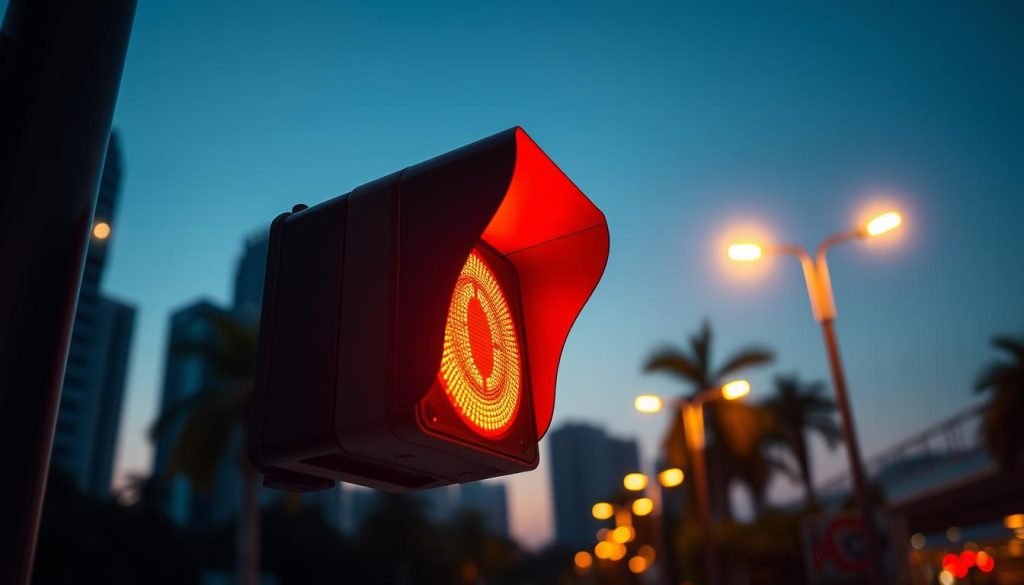
Influence of Weather Conditions on Flashing Red Light Visibility and Safety
Weather conditions can significantly impact the visibility and safety of traffic signals, especially in Singapore. During the monsoon season, heavy downpours can reduce the visibility of signals by up to 40%. This creates substantial safety challenges for drivers navigating intersections.
The National Environment Agency has taken proactive measures by integrating real-time weather alerts with traffic management systems. This helps drivers anticipate hazardous conditions and adjust their driving behavior accordingly.
Monsoon Season Challenges and Adjustments
When driving in heavy rain, it is crucial to follow certain tips to ensure safety:
- Activate low beam headlights to improve the reflection of signals.
- Increase following distance to allow for extra reaction time.
- Replace windshield wiper blades every six months for optimal clarity.
Additionally, retroreflective materials that meet AS/NZS 1906 standards ensure that flashing red signals remain visible even during torrential rain.
Nighttime Visibility Enhancements
At night, visibility is further enhanced through upgraded LED signal modules. These lights provide brighter illumination, which is essential for safe driving. Anti-fogging treatments on lens covers help maintain clarity in humid conditions.
Moreover, smart windshield projection systems are currently in trial phases to further assist drivers in recognizing signals at night.
Driver Tips for Safe Operation in Adverse Conditions
Research from NTU in 2023 revealed that most drivers underestimate their stopping distances by 1.2 meters in wet conditions. This can increase the risk of accidents. To mitigate this, drivers should:
- Regularly clean windshields to maintain visibility.
- Adjust headlight angles according to vehicle load for better signal recognition.
- Be aware that reflective vests are now mandatory for school crossing guards during evening hours, complementing technological visibility solutions.
By understanding how weather affects traffic signals, drivers can take the necessary precautions to enhance their safety and that of others on the road.
Enhancing Road Safety Through Awareness and Compliance with Flashing Red Signals
Enhancing road safety in Singapore relies heavily on understanding the role of flashing red lights. Compliance with these signals has contributed to a remarkable 22% reduction in intersection accidents from 2020 to 2023. This achievement highlights that awareness of traffic signal rules is not just about avoiding penalties; it is fundamentally about protecting lives and preventing collisions.
The Land Transport Authority (LTA) continues to implement public education campaigns, integrating traffic signal awareness into school curricula and workplace training. Additionally, drivers are encouraged to enroll in defensive driving courses to sharpen their skills in responding to flashing signals.
As we look to the future, upcoming technological advancements like adaptive signals and glare-resistant lights will further enhance safety. Every driver shares the responsibility of maintaining Singapore’s reputation as one of the safest places to drive. Understanding and respecting flashing red signals protects not only drivers but also pedestrians and cyclists.
Let us commit to full compliance with flashing red light regulations as part of our daily driving practices, ensuring safer roads for everyone.
FAQ
What should drivers do when they see a flashing red light?
Drivers must come to a complete stop, similar to a stop sign, and yield to any pedestrians or vehicles before proceeding.
Are flashing red lights the same as solid red lights?
Yes, both indicate that vehicles must stop. However, flashing red lights may be used in different contexts, such as at intersections or school zones.
What are the penalties for ignoring a flashing red light?
Violating flashing red light rules can result in fines, demerit points on your driving record, and potential increases in insurance premiums.
How do pedestrians navigate intersections with flashing red lights?
Pedestrians should ensure the way is clear before crossing and have the right-of-way when the light is flashing.
What happens if multiple vehicles arrive at a flashing red light simultaneously?
The first vehicle to arrive has the right-of-way. If unsure, drivers should communicate using signals and proceed with caution.
How can drivers safely handle construction zones with flashing red lights?
Drivers should reduce speed, follow posted signs, and be prepared to stop for workers or equipment in the area.
What technology is used in flashing red traffic signals?
Many signals use LED modules for visibility and may be integrated with smart systems that adapt to traffic conditions.
How do weather conditions affect the visibility of flashing red lights?
Adverse weather, like rain or fog, can reduce visibility. Drivers should exercise extra caution and adjust their speed accordingly.
Are there special rules for emergency vehicles at flashing red lights?
Yes, emergency vehicles have the right-of-way, and drivers must yield to them, even at flashing red signals.
What should I do if I encounter a malfunctioning flashing red light?
Treat it as a four-way stop. Ensure the intersection is clear before proceeding and report the malfunction to local authorities.


