

Solar Wireless Security Cameras with DVR: Top Rated Models
Homeowners across Singapore are embracing a new wave of sustainable protection. These modern setups offer constant monitoring without the need for messy wires or grid electricity.
They are perfectly suited for our tropical climate, providing reliable performance through sun and rain. This guide focuses on the top-rated models that combine clean energy with robust local recording.
We will explore systems known for long battery life, like those with a 7-day backup, and devices featuring advanced sensors for clear night vision. Whether you live in an HDB or a landed property, finding the right system is key.
This commercial review aims to help you make a smart choice. We compare features, durability, and value. For more on the technology behind these solutions, see our guide on solar-powered WiFi CCTV cameras.
Key Takeaways
- Eco-friendly protection systems are gaining popularity in Singapore for their sustainability and ease of installation.
- These all-in-one solutions provide 24/7 surveillance and local video storage, independent of the main power grid.
- The right equipment must withstand local weather conditions like high humidity and intense sunlight.
- Key features to look for include long battery life, high-resolution sensors, and reliable connectivity.
- This roundup is designed to help you select the best product for your specific home and security needs.
Why Solar-Powered Security with DVR is Ideal for Singaporean Homes
Singapore’s unique urban landscape demands protection solutions that are both resilient and resource-smart. The integration of clean energy generation with dedicated local recording creates a perfect match for local needs.
Sustainable and Cost-Efficient Protection
These eco-friendly setups deliver significant financial benefits from day one. Swann’s technology, for example, helps households save approximately $380 on electricity costs each year.
A typical HDB flat can cut operational expenses by half compared to traditional wired surveillance. This makes the initial investment quickly worthwhile.
The environmental impact is equally compelling. Adopting this approach aligns perfectly with Singapore’s Green Plan 2030.
According to NEA benchmarks, it reduces carbon dioxide emissions by 1.2 tons annually. Hikvision’s innovations alone decrease overall energy use by 40%.
This technology also eliminates frequent battery swaps common in purely battery-operated models. You avoid ongoing replacement costs and reduce electronic waste.
The local DVR component ensures your footage remains accessible without monthly cloud fees. Your video history stays private and under your direct control.
Wireless Convenience Meets Tropical Climate Durability
The design eliminates complex and disruptive electrical work. Setup becomes simpler and far more flexible for different property layouts.
This is crucial for various Singaporean homes. It works for HDB balcony installations and landed properties needing wider perimeter coverage.
Durability against local weather is non-negotiable. Manufacturers build these products specifically for high humidity, intense rain, and salt air.
Swann’s equipment carries an IP66 rating, guaranteeing performance during heavy downpours. Hikvision uses 14kg wind-resistant brackets to withstand seasonal storms.
Anti-corrosion materials protect components in coastal areas like East Coast Park or Sentosa. Your investment remains secure year after year.
Energy independence is a key advantage. Efficient photovoltaic panels paired with robust batteries like the 18650mAh cell ensure continuous operation.
Your monitoring continues during grid outages or prolonged cloudy periods. The 7-day backup capability provides peace of mind through monsoon season blackouts.
This combination represents a smart, future-proof choice for local homeowners. It delivers reliable protection while supporting sustainable living values.
Key Features to Evaluate in Your Solar Security Camera System
The effectiveness of your eco-friendly monitoring setup hinges on several technical specifications. A smart purchase decision looks beyond the basic promise of off-grid operation.
Focusing on these core components ensures you get a reliable product suited for Singapore’s environment. Let’s break down what truly matters for performance and value.
Solar Panel Efficiency and Battery Longevity
Your system’s energy independence starts with the photovoltaic panel. Not all panels are created equal.
Monocrystalline cells are more efficient than older polycrystalline types. They convert more sunlight into power, which is crucial during our cloudy or rainy days.
Advanced charge controllers make a big difference. Technology like Hikvision’s MPPT (Maximum Power Point Tracking) can boost energy conversion by up to 30%.
You must match the panel’s wattage to your device’s power needs. An undersized panel will struggle to keep the battery full.
Speaking of batteries, capacity and chemistry are key. Look for high-quality lithium-ion cells, like the 18650mAh type, known for durability.
Battery life is measured in days of operation without sunlight. For peace of mind through the monsoon season, seek models offering a week or more of backup power.
This combination of efficient panels and a robust battery is the foundation of continuous, worry-free monitoring.
Night Vision Capabilities: Color vs. Infrared
When the sun sets, your system’s vision becomes critical. Traditional infrared (IR) illumination provides monochrome images in pitch-black conditions.
It’s effective for long-range detection but lacks detail. Newer color night vision technology, like Swann’s, needs only minimal ambient light—as low as 2 lux.
This provides clearer, more identifiable footage in low-light urban settings. You can distinguish clothing color or vehicle details.
For most Singaporean homes with some street lighting, color vision is superior. Pure IR models are better suited for completely dark areas like backyards or storage spaces.
Consider your specific location’s lighting when choosing between these night vision technologies.
Connectivity: 4G LTE vs. Wi-Fi for Reliable Access
How your device sends alerts and live video is vital. Wi-Fi is the standard for most urban homes and HDB flats with strong network signals.
It’s cost-effective and offers high-speed data transfer. For areas with poor Wi-Fi coverage or as a failsafe backup, 4G LTE with a SIM card is essential.
This cellular option provides a dedicated connection, independent of your home router. It’s a reliable choice for landed properties or garden sheds where Wi-Fi is weak.
Some advanced systems offer hybrid setups. They use Wi-Fi as the primary link but automatically switch to 4G if the network drops.
This dual-path approach guarantees you never miss a critical alert, no matter your local internet stability.
Understanding DVR and Hybrid Storage Options
Where your footage is saved impacts security, cost, and control. A local DVR (Digital Video Recorder) or NVR stores video directly on a hard drive.
This gives you complete data ownership with no monthly fees. Hikvision uses robust eMMC storage that resists data corruption.
Other brands utilize microSD cards, like Swann, which allow for easy physical swapping and expansion. Local storage is reliable but has physical limits.
Cloud storage offers remote backup and access from anywhere. It protects footage even if the camera itself is stolen or damaged.
The trade-off is an ongoing subscription cost. The smartest storage options are often hybrid.
They keep recent footage locally on an SD card or DVR while offering cloud backup for important event clips. This balances cost with redundancy.
When evaluating, consider video resolution (1080p to 4K) and how it affects storage needs. Higher clarity fills drives faster but provides essential detail for identification.
Beyond these basics, look for intelligent features. AI-powered motion detection distinguishes people from vehicles or animals, filtering false alarms from moving foliage.
Wide field of view or PTZ (Pan-Tilt-Zoom) capabilities affect how many devices you need for full coverage. Two-way audio lets you communicate directly through the unit.
Use this breakdown as a checklist. Comparing these elements will lead you to the ideal system for your specific Singapore property.
Top Contenders: Reviewing Leading Solar Wireless Security Cameras with DVR
Choosing the right equipment involves comparing leading products that have proven their worth locally. The market offers several excellent options, each with distinct strengths.
This review examines five top performers available in Singapore. We evaluate their specifications, durability, and suitability for different property types.
Hikvision Solar-Powered Series: For Extended Operation and AI Detection
Hikvision delivers professional-grade reliability for demanding applications. Their setup is ideal for homeowners who prioritize uninterrupted operation.
The modular battery provides seven days of power without sunlight. This ensures continuous monitoring during prolonged rainy periods.
With 4K resolution, footage captures fine details like license plates. The IP67 rating guarantees protection against heavy tropical rain.
Advanced AI detection distinguishes people from vehicles. This reduces false alerts from passing animals or moving foliage.
Two-way audio allows direct communication through the unit. Hikvision’s local support includes a three-year warranty at major retailers.
Real-world testing at East Coast Park confirmed its salt-air resistance. This series suits landed properties needing robust, expandable systems.
Swann MaxRanger4K: High-Resolution Imaging with Robust Storage
Swann focuses on exceptional video clarity and flexible data management. The MaxRanger4K captures stunning detail in both day and night conditions.
Its 30-meter infrared night vision covers large outdoor areas. The wind-resistant bracket withstands Singapore’s seasonal storms.
Storage combines a 512GB local hard drive with optional cloud backup. This hybrid approach balances cost with redundancy.
Performance tests in Orchard Road handled urban light pollution well. The system includes a free mounting kit at Challenger stores.
Swann offers reliable two-year local warranty coverage. It’s a strong choice for those wanting top-tier image quality and generous storage options.
AOSU SolarCam Series: High-Resolution Value for HDB Living
AOSU provides impressive performance at a budget-friendly price point. This makes it particularly appealing for HDB flats and smaller homes.
The SolarCam D1 Lite delivers 5MP ultra-HD footage. Its 180-degree panoramic view covers wide areas with a single unit.
Weather-resistant casing handles high humidity effectively. Setup is straightforward, requiring minimal technical knowledge.
Battery performance is adequate for typical Singaporean balcony installations. The mobile app offers intuitive monitoring and playback.
Available at online platforms like Lazada with frequent promotions. AOSU represents excellent value for cost-conscious homeowners seeking clear color imaging.
Lorex Solar-Powered Kits: Champion of Local DVR Storage
Lorex dominates for users who prioritize massive local recording capacity. Their kits eliminate ongoing subscription fees entirely.
The central DVR unit offers up to 3TB of local storage. This can archive months of continuous high-definition video.
AES 256-bit encryption keeps your data secure. The system supports expanding to eight cameras for comprehensive coverage.
Ideal for large landed homes or small businesses. Lorex provides reliable Singapore distribution through authorized installers.
Their two-year warranty includes on-site support options. Choose Lorex if you want complete control over your recorded footage without monthly costs.
Arlo & Ring: Smart Home Integration and User-Friendly Monitoring
Arlo and Ring excel in seamless smart home ecosystem integration. Their devices prioritize user-friendly apps and wire-free convenience.
Arlo Ultra 2 offers 4K resolution with advanced color night vision. It works smoothly with Apple HomeKit, Google Home, and Alexa.
Ring Stick Up Cam features adjustable solar panels for optimal charging. It sends real-time motion alerts directly to your phone.
Both brands provide excellent mobile app experiences. Installation is truly tool-free, taking minutes to complete.
Available at Best Denki and Harvey Norman with regular bundle deals. These models are perfect for tech-savvy users wanting connected home automation.
Each contender serves different priorities. Hikvision offers professional endurance, Swann delivers premium imaging, and AOSU brings budget-friendly clarity.
Lorex provides massive local capacity, while Arlo and Ring focus on smart integration. Match these strengths to your specific Singapore property needs.
Head-to-Head: Comparing Solar Camera Performance and Value
Beyond marketing claims, real-world performance metrics separate exceptional products from merely adequate ones. This direct comparison analyzes five leading models across critical categories.
We evaluate how each handles Singapore’s unique climate and urban challenges. The goal is to identify which system delivers the best value for your specific property type.
Resolution and Video Quality Comparison
Video clarity determines whether you see a face or just a blur. Higher resolution provides essential detail for identification.
Here’s how the top contenders compare:
- Hikvision & Swann: Both offer true 4K Ultra HD. Swann uses Sony STARVIS sensors for exceptional low-light performance.
- Arlo Ultra 2: Also delivers 4K with advanced color night vision requiring only minimal ambient light.
- AOSU SolarCam: Provides 5MP ultra-HD, which is excellent for most HDB applications at a lower cost point.
The practical difference matters most at longer distances. For identifying a license plate or facial features from 10+ meters, 4K is superior.
2K resolution may suffice for monitoring a front porch. With 5G networks expanding, real-time 8K streaming will become feasible by 2025.
For Singapore’s well-lit urban areas, color night technology like Swann’s (needing just 2 lux) outperforms traditional infrared. Pure IR still excels in completely dark spaces with its 30-meter range.
Battery Life and Solar Charging Performance
Energy independence hinges on two components: the battery and the photovoltaic panels. Efficiency here dictates reliability during monsoon season.
Hikvision leads with a modular battery providing seven full days of backup power. This is crucial for prolonged rainy periods common in Singapore.
Other systems typically offer 3-5 days of reserve. The actual longevity depends heavily on panel efficiency and placement.
Panel wattage and Maximum Power Point Tracking (MPPT) technology significantly affect charging performance on cloudy or hazy days.
Monocrystalline cells are now standard for better efficiency. During December’s Northeast Monsoon, systems with superior solar intake maintain charge most effectively.
Component costs have fallen 18% yearly since 2020, making high-efficiency panels more affordable. This improves the long-term value proposition.
For landed properties with larger perimeters, extended battery life is a top priority. HDB residents might prioritize compact panels that fit balcony spaces.
Storage Capacity and Management Flexibility
Where your footage lives impacts cost, security, and accessibility. The main storage options are local, cloud, or hybrid.
Lorex dominates local storage with DVR units offering up to 3TB capacity. This eliminates monthly fees and keeps data entirely on-premises.
Arlo and Ring utilize cloud-based solutions. They offer convenient remote access but require ongoing subscriptions for full features.
Swann provides a smart hybrid approach. It combines a 512GB local hard drive with optional cloud backup for critical event clips.
Each approach has trade-offs:
- Local DVR/NVR: Highest upfront capacity, no recurring costs, but vulnerable to physical damage or theft.
- Cloud Storage: Accessible anywhere, provides off-site backup, but creates ongoing expenses and potential privacy concerns.
- Hybrid Models: Balance cost with redundancy, protecting important footage even if the device is compromised.
Advanced features like AI-powered motion detection enhance storage efficiency. Swann’s TrueDetect+ technology reduces false alarms by 95%, saving space and review time.
Value and Recommendations Summary
Considering total cost of ownership reveals the best investments. Upfront price is just one factor.
Long-term expenses include cloud fees, potential battery replacements, and expansion costs. Here’s our category-by-category assessment:
- Best for Video Quality: Swann MaxRanger4K. Its Sony STARVIS sensor delivers unmatched clarity in both day and low-light conditions.
- Best for Battery Life: Hikvision Solar-Powered Series. The seven-day backup provides unmatched peace of mind during rainy seasons.
- Best Value: AOSU SolarCam Series. Offers 5MP ultra-HD and reliable performance at a budget-friendly price point for HDBs.
- Best for Local Storage: Lorex Solar-Powered Kits. Massive 3TB DVR capacity with no monthly fees suits large properties.
- Best for Smart Integration: Arlo & Ring. Seamless connection with Apple HomeKit, Google Home, and Alexa for automated homes.
Your property type guides the final choice. Landed homes should prioritize battery endurance and range. HDB flats benefit from compact design and strong Wi-Fi reliability.
All reviewed devices handle Singapore’s humidity with proper IP ratings. The right choice balances performance metrics with your specific monitoring needs and budget.
Ensuring Reliability Through Singapore’s Weather
Weather resistance isn’t just a feature—it’s a fundamental requirement for protection systems operating in Singapore’s humid, coastal environment. The combination of intense sunlight, heavy rainfall, and salty air creates a perfect storm for equipment failure.
Selecting the right build quality ensures your investment lasts for years. This section breaks down the technical specifications that matter most for local conditions.
IP Ratings and Weatherproofing Explained
Ingress Protection (IP) codes tell you how well a unit seals against dust and water. These ratings are your first line of defense against Singapore’s elements.
An IP65 rating means the housing is dust-tight. It can also withstand water jets from any direction. This is suitable for sheltered balcony installations.
IP66 offers a higher standard. It provides protection against powerful water jets. This rating handles the sideways rain common during our monsoon seasons.
The gold standard is IP67. Devices with this rating can survive temporary immersion in water up to 1 meter deep. It’s ideal for ground-level placements in gardens.
Operational temperature range is equally critical. Singapore’s heat can cause devices to overheat and shut down.
Swann’s weatherproof housing operates from -20°C to 50°C. This wide tolerance ensures stable performance during our hottest afternoons. It also protects internal batteries from heat damage.
Position your equipment to avoid direct exposure to wind-driven rain. Even with a high IP rating, angled mounting provides extra protection.
Anti-Corrosion Builds for Coastal and Humid Conditions
Coastal areas like Sentosa and East Coast present a special challenge. Salt air accelerates metal degradation through corrosion.
Hikvision conducts rigorous salt spray tests. Their systems prove 500 hours of resistance in controlled environments. This certification is ideal for seaside properties.
Anti-corrosion coatings on internal circuits prevent damage from high humidity. These specialized treatments shield sensitive electronics from Singapore’s constant moisture.
Mounting hardware material makes a big difference. Stainless steel brackets significantly outperform aluminum in long-term coastal tests.
NEA data confirms that northeast monsoons require extra supply protection for outdoor electronics. Proper sealing is not optional.
Apply silicone seals to all cable connection points during installation. This simple step prevents water seepage that can short-circuit the entire system.
Singapore’s unique weather patterns affect performance in specific ways. The Northeast Monsoon season brings prolonged heavy rain that tests waterproofing seals.
Periodic haze from regional fires can coat solar panels and camera lenses. This reduces both energy capture and video clarity.
Routine maintenance preserves weatherproofing over time. Clean lenses with a soft cloth after hazy periods to restore image quality.
Check all rubber seals and gaskets before the rainy season begins. Replace any that show cracks or brittleness.
Durability needs vary across different locations. A sheltered HDB balcony faces less direct weather exposure than an open garden in a landed property.
For balcony setups, IP65 may be sufficient. For exposed gardens, prioritize IP67 ratings and stainless steel mounts.
Beware of false economy with cheaper models. Units with lower IP ratings or plastic housings often fail quickly in our climate.
This leads to higher long-term costs through replacements and repairs. Investing in proven durability from the start saves money and frustration.
Weather resistance should be a top-tier criterion when selecting any outdoor security solution for Singapore. The right build quality guarantees your peace of mind through every storm.
Smart Features and Modern Surveillance Capabilities
The true power of contemporary monitoring lies in its ability to think, communicate, and connect with your entire home ecosystem. Modern protection goes beyond passive recording.
Intelligent features transform these devices into proactive guardians. They analyze scenes, filter distractions, and deliver meaningful alerts directly to your smartphone.
This evolution creates a responsive shield tailored to Singaporean living. From HDB corridors to landed property gates, smart capabilities solve real local challenges.
Advanced Motion Detection and AI-Powered Alerts
Basic motion sensors are a thing of the past. They triggered alerts for every passing shadow or swaying branch, creating notification fatigue.
Today’s analytics distinguish between people, vehicles, animals, and foliage. Swann’s TrueDetect+ technology reduces false alarms by an impressive 95%.
This precision comes from sophisticated algorithms. Hikvision’s radar covers a 12-meter radius with remarkable accuracy.
AI human detection now achieves 98% reliability. Your phone only buzzes when something truly matters.
Customizable activity zones let you focus on critical areas. You can monitor your driveway while ignoring the public sidewalk.
Sensitivity settings fine-tune this focus further. This is perfect for homes near busy streets or parks with frequent animal movement.
For a landed property, this means alerts only for gate entries. In an HDB, it filters out elevator lobby traffic.
Advanced analytics turn data into actionable intelligence, not just endless video clips to review.
Some systems offer even finer recognition. Package detection alerts you when deliveries arrive at your doorstep.
Vehicle license plate recognition helps monitor carpark access. These features provide specific context for each event.
Two-Way Audio and Real-Time Mobile App Access
Clear communication adds a powerful layer to any protection setup. Two-way audio lets you speak and listen through the unit remotely.
This feature serves multiple practical purposes. You can instruct delivery personnel where to leave parcels.
It allows you to screen visitors before opening the gate. You can even talk to family members in the garden without shouting.
Companion mobile apps bring everything to your fingertips. They offer reliable live streaming from anywhere with an internet connection.
Playback is intuitive with smart timelines and event markers. You can quickly find relevant footage without endless scrolling.
Alert customization lets you choose which notifications you receive. You can set quiet hours or prioritize certain zones.
Battery status monitoring ensures you’re never caught off guard. The app shows exactly how much power remains.
Cloud backup options provide off-site protection for important clips. Your data stays safe even if the physical device is compromised.
These apps have become remarkably user-friendly. Setup guides and troubleshooting are built right into the interface.
Integration with Smart Home Ecosystems
Standalone devices are giving way to connected systems. Modern units seamlessly integrate with popular smart home platforms.
Compatibility includes Amazon Alexa, Google Assistant, and Apple HomeKit. Samsung SmartThings support is also common.
This connectivity enables useful automations. Your lights can turn on automatically when motion is detected at night.
Your smart locks might engage when the system arms itself. Thermostats could adjust when everyone leaves the property.
In Singapore, integration extends to broader initiatives. Some platforms connect with Smart Nation frameworks like NEST+.
This allows for centralized monitoring and coordinated responses. Camera alerts can trigger alarm systems or notify security services.
Advanced capabilities push boundaries further. ADT’s Nest Cam uses facial recognition through its Trusted Neighbor feature.
It can recognize family members and automatically disarm the system. This eliminates false alarms when loved ones arrive home.
Privacy remains a crucial consideration with these features. Reputable brands comply with Singapore’s PDPA regulations.
They employ strong data encryption for both transmission and storage. You maintain control over what data is collected and shared.
When evaluating these smart features, focus on practical value. Reliable motion filtering and clear two-way audio offer immediate benefits.
Smart home integration provides convenience for tech-savvy households. Facial recognition might be essential for some but unnecessary for others.
Match the capabilities to your specific lifestyle needs. A family with frequent deliveries benefits greatly from package detection.
Someone living alone might prioritize reliable intrusion alerts above all else. Choose features that solve your actual problems, not just impress with technology.
Installation Guide for Optimal Performance in Singapore
Strategic installation decisions directly impact how effectively your equipment captures sunlight and monitors your property. Getting this right ensures your investment delivers reliable protection through Singapore’s unique climate.
This guide walks you through three critical aspects: panel positioning, network setup, and camera placement. Follow these steps to maximize performance from day one.
Solar Panel Placement for Maximum Sunlight Capture
Your photovoltaic units need optimal exposure to generate sufficient power. Singapore’s location at 1°N latitude requires specific orientation.
Tilt the panels at approximately 25 degrees facing north. This angle captures maximum sunlight year-round in our equatorial position.
Avoid shading from buildings, trees, or other structures. Partial coverage can reduce charging efficiency by 30% or more.
For different housing types, consider these mounting options:
- HDB balcony railings: Use rust-proof stainless steel brackets on window grilles.
- Landed property roofs: Secure mounts with weather-resistant fasteners.
- Garden areas: Ground stakes work well for flexible positioning.
Clean the surfaces monthly to remove dust and haze residue. This maintains peak energy conversion.
Test the output with a multimeter during setup. Verify the battery receives adequate current for continuous operation.
Wi-Fi Network Considerations and 4G Backup Setup
Reliable connectivity is essential for real-time monitoring and instant alerts. Assess your network strength at each intended location.
Use your smartphone to check signal quality before mounting devices. Weak signals cause delayed notifications and choppy video.
For dead zones, consider these solutions:
- Wi-Fi extenders: Boost coverage to distant garden sheds or gates.
- Mesh networks: Provide seamless whole-home coverage for larger properties.
- Router relocation: Sometimes moving your main unit solves the issue.
Setup is often straightforward. Swann’s QR code pairing completes the process in under five minutes.
For critical security applications, configure 4G LTE backup. This provides a dedicated cellular connection independent of your home network.
Choose local telco SIM cards from Singtel, StarHub, or M1. Select data plans that support continuous video transmission during network outages.
4G boosters can enhance signal strength in remote areas. This ensures your system remains connected during primary network failures.
Positioning Cameras for Comprehensive Coverage
Thoughtful placement eliminates blind spots and maximizes surveillance effectiveness. Start by identifying all entry points and vulnerable areas.
Cover doors, gates, windows, and garage access points. Also monitor valuable outdoor assets like bicycles or garden equipment.
Maintain neighbor privacy by angling devices away from adjacent properties. This respects community guidelines while protecting your home.
For optimal detection, position units 7-9 feet above ground level. This provides a clear view while being less noticeable.
Configure motion detection zones to focus on critical pathways. This reduces false alerts from public sidewalks or moving foliage.
Test night vision range after installation. Verify the cameras capture clear images in your specific lighting conditions.
DIY vs. Professional Installation Comparison
You have two main options for getting your security cameras operational. Each approach has distinct advantages.
DIY installation offers significant cost savings. Most modern kits include all necessary hardware and clear instructions.
You maintain full control over the process and timing. Many homeowners complete setup in a single afternoon.
Professional support typically costs 40% more than DIY kits. However, it guarantees expert weatherproofing and optimal positioning.
Certified installers often provide extended warranty coverage. They ensure all connections are properly sealed against Singapore’s humidity.
Consider your comfort level with technical tasks. Also evaluate the complexity of your property layout when making this choice.
Installation Day Checklist
Follow this step-by-step guide for a smooth setup process:
- Test solar panel output at the intended mounting location.
- Secure all brackets and mounts with appropriate fasteners.
- Apply silicone sealant to cable connection points for waterproofing.
- Connect and pair all devices with the mobile application.
- Configure motion zones and notification preferences.
- Verify live streaming and playback functionality.
- Test the system during both day and night conditions.
Conduct a week-long trial period. Ensure the system sends alerts correctly and maintains consistent connectivity.
Proper installation is critical to realizing your equipment’s full potential. It prevents performance issues and ensures long-term reliability for your Singapore home.
Local Storage vs. Cloud Backup: Making the Right Choice
Deciding where your surveillance footage resides is a critical choice that affects cost, security, and accessibility. Each storage method offers distinct advantages tailored to different Singaporean lifestyles.
This comparison examines local, cloud, and hybrid solutions. We’ll help you select the right approach for your property and peace of mind.
The Case for Local DVR/NVR and SD Card Storage
Keeping your video data on-site provides complete control. Local solutions like DVRs, NVRs, or SD cards store everything within your home.
The primary benefit is financial. You pay once for the hardware with no monthly subscription fees.
Over five years, hardware upgrades typically cost 40% less than cloud service plans. This makes local storage ideal for budget-conscious homeowners.
Data ownership is another major advantage. Your footage never leaves your property, ensuring maximum privacy.
Playback is faster since it doesn’t depend on internet speed. You can review recordings instantly without buffering delays.
These systems remain operational during internet outages. Your monitoring continues uninterrupted even if your Wi-Fi fails.
Hikvision offers optional SSDs that expand to 2TB for extensive archives. SD cards provide simple offline access for quick retrieval.
However, local storage has limitations. The physical hardware is vulnerable to theft, damage, or environmental factors.
Capacity is finite. You must manage space by deleting old files or upgrading drives.
Retrieving specific clips requires manual searching on the device itself. You can’t access it remotely from your phone.
For Singapore homes with reliable physical security, local storage options offer excellent value and control.
Benefits and Considerations of Cloud Storage Services
Remote servers provide a different set of advantages. Cloud-based solutions store your footage off-site with professional management.
The biggest benefit is accessibility. You can view live feeds or archived clips from anywhere with an internet connection.
Automatic backup protects against local device failure. If a camera is stolen or damaged, the footage remains safe in the cloud.
Many providers include advanced features like AI analytics. These intelligent tools can identify people, vehicles, or packages.
Swann offers free Dropbox integration for automated offsite backups. This creates an additional layer of protection without extra cost.
In Singapore, cloud services comply with local data retention laws. They typically store footage for 30 days or more as required.
Cloud solutions do have drawbacks. Recurring subscription fees create ongoing expenses that add up over time.
Performance depends entirely on your internet bandwidth and stability. Slow connections cause delayed alerts and poor video quality.
Privacy concerns exist since your data resides on third-party servers. Reputable providers use strong encryption to protect your information.
AES-256 encryption significantly outperforms the older AES-128 standard for securing sensitive video data during transmission and storage.
For homeowners who prioritize remote access and convenience, cloud storage delivers powerful functionality. It’s particularly useful for frequent travelers or those managing multiple properties.
Hybrid Solutions for Redundant Security
The smartest approach often combines both methods. Hybrid setups record continuously to a local dvr while uploading triggered events to the cloud.
This offers the best of both worlds. You maintain local control with instant access while having off-site backup for critical incidents.
Hybrid systems provide excellent redundancy. If the local drive fails, important event clips remain safe online.
These solutions are ideal for businesses needing maximum reliability. They also suit homeowners who want extra protection for valuable property.
Real-time notifications can alert you to failed uploads. This ensures you never miss important footage due to technical issues.
When evaluating your needs, consider these factors:
- Camera resolution: Higher clarity (4K vs. 1080p) fills storage faster
- Number of devices: More units require greater capacity
- Retention period: How many days of footage you need to keep (7, 14, 30)
- Recording mode: Continuous vs. event-only significantly affects space requirements
Here are our recommendations based on different user profiles:
Local storage works best for cost-conscious users with reliable physical home security. It’s perfect for HDB flats where devices are well-protected.
Cloud storage suits those prioritizing remote access and convenience. Frequent travelers or tech-savvy families benefit most from this approach.
Hybrid solutions deliver maximum protection for landed properties or small businesses. The redundancy ensures critical evidence is never lost.
All storage options should comply with Singapore’s PDPA regulations. Choose providers with transparent data policies and strong encryption standards.
Your final choice should balance immediate needs with long-term value. Consider both upfront costs and ongoing expenses over 3-5 years.
Long-Term Maintenance and Support in Singapore
Maintenance isn’t about fixing problems—it’s about preventing them before they compromise your home’s safety. A well-cared-for protection setup delivers reliable performance through Singapore’s challenging climate.
This section covers essential upkeep routines and local support networks. Both elements ensure your investment remains effective for years.
Routine Care for Solar Panels and Batteries
Regular cleaning maintains peak energy conversion. Dust and pollen can reduce efficiency by 15-20%.
Follow this simple monthly routine:
- Clean photovoltaic surfaces with a microfiber cloth and distilled water
- Remove haze residue that accumulates during dry seasons
- Check for physical damage like cracks or water pooling
- Ensure mounting brackets remain tight and corrosion-free
Lithium-ion cells thrive when kept between 20-80% charge. Deep discharges strain the internal chemistry.
Avoid leaving batteries at 100% constantly. This practice extends their operational lifespan significantly.
Store spare units in cool, dry locations away from direct sunlight. Proper storage prevents premature degradation.
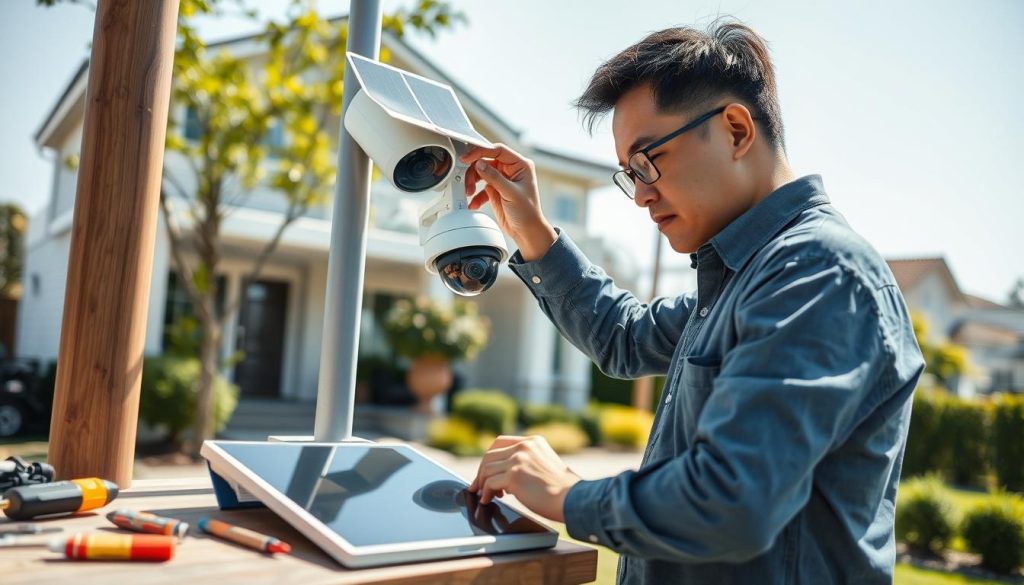
Monitor your equipment’s health through companion mobile apps. Watch for notifications about low power or poor charging.
Storage error alerts indicate potential memory card issues. Address these warnings promptly to prevent data loss.
Conduct seasonal checks before the Northeast Monsoon arrives. Verify all weatherproofing seals remain intact.
Ensure mounts can withstand strong winds common during stormy periods. Tighten any loose fasteners.
Proactive care prevents 80% of common equipment failures in tropical environments. A few minutes monthly saves hours of troubleshooting later.
Accessing Local Technical Support and Warranty Services
Choosing brands with strong Singapore presence offers significant advantages. Local spare parts and familiar technicians ensure faster resolution.
AOSU leads with 24-hour Singapore-based assistance. They promise same-day dispatch for valid warranty claims.
Authorized service centers in Ubi and Jurong provide convenient access. Quick-replacement programs swap faulty units within four hours.
Compare warranty terms carefully before purchasing. Some cover monsoon-related damage while others exclude weather events.
Here’s how to access support when needed:
- Contact local service centers directly for hardware issues
- Use dedicated hotlines for urgent technical assistance
- Access online chat for configuration questions
- Schedule professional maintenance visits annually
Typical response times vary by provider. Premium brands often guarantee 2-hour callback commitments.
Professional upkeep services cost 30-50% more than DIY approaches. However, they guarantee expert assessment and proper sealing.
Consider your technical comfort level when choosing between these options. Complex setups benefit from certified technician attention.
Understand typical component lifespans to plan replacements:
- Photovoltaic panels: 20+ years with proper care
- Lithium-ion batteries: 3-5 years depending on usage patterns
- Surveillance units: 5+ years with regular maintenance
Proactive maintenance combined with reliable local support creates a dependable asset. Your protection remains robust through Singapore’s unique environmental challenges.
Selecting the Best System for Your Singapore Property
Making an informed choice requires matching specific product strengths to your property’s unique requirements.
Consider climate durability, energy efficiency, and your preferred storage method. Smart features and budget complete your checklist.
For HDB flats, compact Wi-Fi-dependent systems like AOSU’s $399.99 kit offer excellent value. Landed homes need robust multi-camera setups with 4G backup.
Our top picks serve different priorities. Choose Hikvision or Swann for maximum reliability. Select AOSU for best resolution value.
Lorex excels for heavy local storage needs. Arlo provides seamless smart home integration.
Balance upfront cost against long-term savings on electricity. Future-proof choices support 5G and edge computing.
Purchase from trusted Singapore retailers like Wen Hong for legitimate warranties. Use this guide as your final evaluation checklist.
You now have the knowledge to invest confidently in your family’s safety. Take the next step toward sustainable, effective protection today.
FAQ
How do these systems handle Singapore’s frequent rain and limited sunlight?
Leading models are built for resilience. They feature high IP ratings for weatherproofing and use efficient solar panels paired with large-capacity batteries. This combination stores enough energy during sunny periods to maintain battery life through several cloudy days, ensuring continuous monitoring.
What is the advantage of having a DVR with a solar-powered camera?
A DVR provides local storage, typically via a hard drive, which is a one-time cost without monthly fees. This is ideal for storing high-resolution footage continuously or based on motion detection. It offers a secure, on-premise storage option that works independently of your internet connection.
Can I still see clear footage at night with these outdoor devices?
A> Absolutely. Modern units offer superior night vision. Many now feature color night capability using ambient light or built-in spotlights, providing more detail than traditional infrared. This allows for better identification in low-light conditions around your home.
Do I need a strong Wi-Fi signal for these wireless cameras to work?
While Wi-Fi is common, it’s not the only option. For areas with poor signal, many brands like Swann and Lorex offer models with 4G LTE connectivity using a SIM card. This provides reliable access and alerts without relying on your home network, perfect for remote sheds or gardens.
How difficult is the setup and installation process?
Installation is designed for user-friendliness. The wireless nature means no complex wiring. The key steps involve mounting the camera and panel in a location with good sunlight, connecting to power for initial charging, and syncing with the DVR or mobile app. Most systems guide you through this via their app.
What happens to my recorded videos if someone steals the camera or DVR?
This is where hybrid solutions excel. Many security systems offer dual storage options. While the DVR holds footage locally, you can often enable cloud storage backup for critical motion detection clips. This redundant approach ensures your evidence is safe even if the physical devices are tampered with.
Are these systems compatible with my existing smart home setup?
A> Many top brands like Arlo and Ring specialize in smart home integration. Their products often work with platforms like Google Assistant and Amazon Alexa, allowing you to view footage on smart displays or incorporate cameras into automated routines. Other models may use standard protocols for broader compatibility.
What kind of maintenance do the solar panels and batteries require?
A> Routine care is minimal but important. Periodically wipe the solar panels clean of dust, pollen, or bird droppings to maintain charging efficiency. For the batteries, most are long-lasting lithium-ion units requiring no upkeep, but checking manufacturer guidelines for optimal battery life is recommended every few months.


