
Farm Security Cameras Solar Powered: Top Picks & Buying Guide
Protecting agricultural operations in Singapore presents unique challenges. Over 70% of those working the land express concern about various threats to their property and livelihood.
Traditional surveillance often fails in remote locations where electrical infrastructure is limited. This leaves valuable assets vulnerable to theft and vandalism.
Innovative monitoring solutions harness Singapore’s abundant sunshine—approximately 2,500 hours annually. These self-sufficient units can operate for up to a week without direct sunlight.
This guide explores the best options for safeguarding your property. We’ll compare features, benefits, and provide practical installation advice tailored to Singapore’s climate.
Key Takeaways
- Most agricultural operators in Singapore are concerned about property threats.
- Remote locations often lack access to conventional power sources for surveillance.
- Singapore’s climate provides excellent conditions for solar energy harvesting.
- Modern solar-powered units offer extended operation even without direct sunlight.
- Agricultural theft results in substantial financial losses for operators.
- This guide will help you select the right system for your specific needs.
- Proper installation considers Singapore’s tropical weather patterns.
Why Farm Security is a Critical Concern in Singapore
Maintaining protection over rural properties presents distinct difficulties that demand modern solutions. Agricultural operations are often spread across large, open areas with limited personnel present at all times. This creates numerous vulnerable points that criminals can exploit.
The consequences of inadequate protection extend beyond immediate losses. They threaten the very sustainability of local food production. Understanding these risks is the first step toward implementing effective countermeasures.
The Rising Threats to Agricultural Assets
Agricultural holdings face a diverse range of criminal activities. Equipment theft represents a significant problem, with tools, vehicles, and machinery being prime targets. High-value items like irrigation systems and generators are particularly vulnerable.
Crop and livestock pilferage also occurs regularly. Trespassers may harvest produce or take animals without permission. Vandalism to infrastructure can cause costly repairs and operational delays.
The isolated nature of most agricultural land increases these risks. Remote locations lack natural surveillance from neighbors or passing traffic. This isolation provides cover for unauthorized access and extended criminal activity.
Global data highlights the severity of this issue. In Australia, 81% of rural operators have experienced crime. Alarmingly, 88% of those were targeted more than once. Theft of agricultural vehicles and tools caused nearly £14 million in losses during 2023 alone.
These incidents disrupt daily operations and threaten livelihoods. Insurance claims may rise, affecting premium costs. The psychological impact on landowners cannot be underestimated either.
The Limitations of Traditional Security in Rural Areas
Conventional protection methods often fail in agricultural settings. Wired monitoring systems require extensive electrical infrastructure. Many rural locations lack consistent grid access or face frequent power interruptions.
Physical guards provide limited coverage across vast properties. They are also cost-prohibitive for most operations. Fences and gates offer basic deterrence but can be easily bypassed.
Standard CCTV installations face multiple obstacles:
- High installation costs for running cables over long distances
- Dependence on unreliable power sources in remote zones
- Limited flexibility to reposition units as needs change
- Vulnerability to weather-related power outages
These limitations leave critical assets unprotected. Operations may suffer interruptions that affect productivity. The financial impact can be substantial over time.
Effective agricultural protection requires continuous monitoring capability. It needs a reliable power source independent of local grids. This ensures consistent operation regardless of infrastructure challenges.
Robust security measures support business continuity. They provide peace of mind for those managing the land. This protection also contributes to broader food security goals for Singapore.
The search for solutions leads naturally toward self-sufficient systems. Modern technology now offers answers to these specific rural challenges. Independent operation becomes possible through innovative design approaches.
Introducing Solar-Powered Surveillance: A Game-Changer for Farms
The evolution of surveillance technology has reached a pivotal point with self-sustaining designs. These innovative units operate completely independently from traditional infrastructure. They represent a fundamental shift in how agricultural properties are monitored and protected.
This approach eliminates the constraints of wired installations. It provides reliable coverage across expansive rural landscapes. The technology harnesses natural resources to create a resilient detection network.
How Solar Security Cameras Work Independently of the Grid
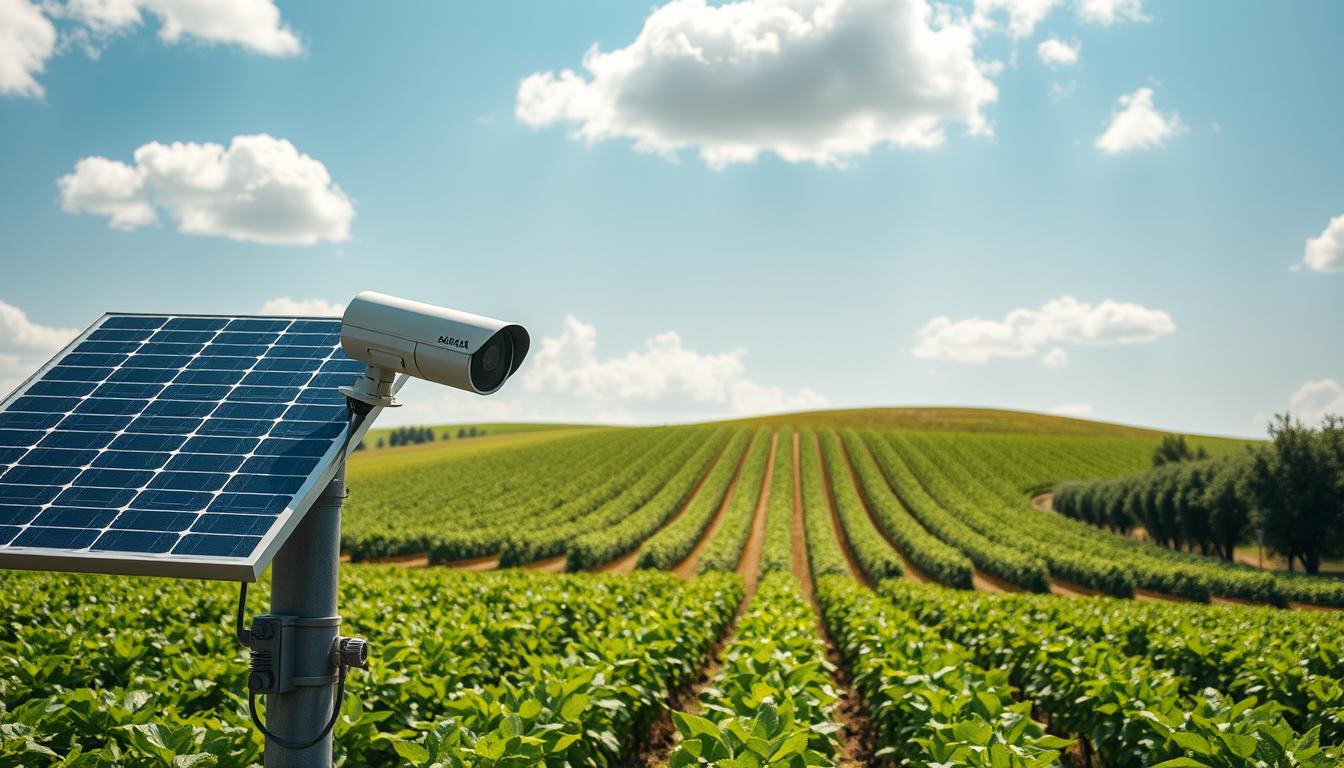
These autonomous devices function through a clever integration of components. A photovoltaic panel captures sunlight throughout the day. This energy converts into electricity that charges a high-capacity battery.
An intelligent energy management system regulates the entire process. It ensures optimal charging during daylight hours. The system also conserves power during nighttime operation.
The stored electricity powers all device functions continuously. This includes image capture, motion sensing, and data transmission. The result is uninterrupted 24/7 monitoring capability without grid connection.
This design creates what experts call a “set and forget” solution. Once installed, the unit maintains itself through daily charging cycles. It requires minimal intervention from property owners or staff.
The technology has advanced significantly in recent years. Modern batteries retain charge efficiently during prolonged cloudy periods. Some models operate for a week without direct sunlight exposure.
The Core Advantage: Sustainable, Off-Grid Operation
The wireless nature of these units simplifies installation dramatically. They can be positioned anywhere with adequate sunlight exposure. This includes fields, perimeter fences, and remote storage buildings.
There’s no need for expensive cable runs or electrical work. Mounting typically involves securing the pole or bracket. The integrated battery systems guarantee operation through night and adverse weather.
Energy independence transforms how we protect agricultural assets. It removes vulnerability to power outages that plague rural regions. This reliability is crucial for immediate response to security incidents.
Traditional wired security systems often fail when needed most. Grid disruptions can disable entire protection networks. Solar-powered alternatives remain operational regardless of infrastructure issues.
Leading manufacturers like Hikvision specialize in robust outdoor solutions. Their products feature IP67 weatherproof ratings for tropical climates. This ensures durability against Singapore’s heavy rains and humidity.
Some misconceptions suggest renewable energy is unreliable for critical applications. Technological advances have addressed these concerns completely. Today’s units deliver consistent performance comparable to grid-connected options.
This approach represents a proactive investment in agricultural infrastructure. It pays dividends through enhanced protection and operational efficiency. The technology supports broader sustainability goals for modern farming practices.
Autonomous surveillance becomes a cornerstone of smart agriculture. It integrates with broader property management strategies. This creates a comprehensive approach to asset protection and operational resilience.
Top Benefits of Choosing Solar-Powered Farm Security
The shift toward autonomous monitoring delivers tangible benefits across environmental, economic, and operational dimensions. These advantages make renewable-powered surveillance an intelligent choice for modern agricultural properties.
Each benefit contributes to a more resilient and sustainable operation. They address specific challenges faced by landowners in Singapore’s unique landscape.
Eco-Friendly Monitoring and Reduced Carbon Footprint
Renewable-powered units operate without drawing electricity from the grid. This significantly cuts reliance on fossil fuels for property protection.
Every kilowatt-hour generated from sunlight prevents carbon emissions. Studies show this approach can reduce a property’s surveillance-related carbon output by over 80%.
This aligns perfectly with Singapore’s national sustainability goals. The country actively promotes green initiatives across all sectors, including agriculture.
Landowners contribute to environmental stewardship while protecting their assets. It represents a practical application of sustainable technology in daily operations.
Adopting clean energy for surveillance supports broader green farming practices. It demonstrates commitment to environmental responsibility while maintaining operational efficiency.
These systems work silently without pollution or noise. They integrate seamlessly with natural surroundings on agricultural land.
Significant Long-Term Cost and Energy Savings
The financial advantages begin immediately after installation. Property owners eliminate expensive trenching and electrical work typically needed for wired CCTV.
Operational savings are even more substantial. Renewable-powered surveillance can slash electricity bills by 50% to 75% compared to traditional setups.
Insurance providers often recognize enhanced protection measures. Many offer premium discounts of 10% to 15% for properties with verified 24/7 monitoring systems.
Maintenance costs remain remarkably low over time. Quality units feature durable construction with minimal moving parts requiring service.
The total cost of ownership becomes favorable within the first two years. This calculation includes avoided infrastructure expenses and ongoing energy savings.
Agricultural operations in Singapore benefit from predictable protection costs. There’s no vulnerability to fluctuating electricity prices affecting surveillance budgets.
Simplified Installation and Flexibility in Remote Locations
Setup becomes straightforward with self-sufficient units. Most installations complete in under twenty minutes without specialized electrical expertise.
The absence of wiring allows placement anywhere sunlight reaches. This includes perimeter fences, distant storage sheds, and isolated field corners.
Operational flexibility transforms how properties are monitored. Landowners can reposition units as needs change with different growing seasons or livestock movements.
Previously inaccessible zones now receive constant surveillance. These include water sources, boundary lines, and equipment parking areas far from buildings.
User feedback highlights dramatic improvements in peace of mind. Agricultural operators report feeling 40% more secure knowing their entire property has coverage.
Crime reduction data supports this psychological benefit. Properties using these systems experience approximately 30% fewer theft and vandalism incidents.
The technology empowers landowners to protect their livelihood effectively. It provides reliable observation regardless of location or existing infrastructure limitations.
This approach future-proofs agricultural operations against evolving threats. It creates a scalable protection network that grows with the property’s needs.
Key Features to Look for in Farm Security Cameras Solar Powered
Selecting the right surveillance equipment requires careful evaluation of several technical specifications. The performance of your monitoring system depends on these critical components working together effectively.
Understanding what to prioritize helps you make an informed investment. This ensures your property receives reliable protection tailored to Singapore’s unique environment.
Camera Resolution and Image Clarity for Identification
Image quality determines whether you can identify people, vehicles, or activities at a distance. For clear evidence, start with at least 1080P Full HD resolution.
This standard provides sufficient detail for most situations. Higher resolutions like 4MP or 5MP offer even better clarity for large areas.
These megapixel counts capture finer details like license plates or facial features. They provide usable evidence if an incident occurs on your land.
Covering expansive spaces demands sharp video quality. Lower resolution footage often appears blurry when zoomed in for identification purposes.
Make sure your chosen model delivers crisp images day and night. This capability is fundamental for effective property monitoring.
Advanced Motion Detection and Smart Alerts
Basic motion sensors often trigger false alarms from animals or moving vegetation. Advanced technology solves this problem through intelligent filtering.
Passive Infrared (PIR) sensors detect body heat rather than just movement. This significantly reduces alerts caused by wind or small creatures.
AI-powered human and vehicle recognition takes accuracy further. The system analyzes shapes and patterns before sending notifications.
Smart alert systems deliver instant messages to your mobile device. You receive real-time updates about potential security breaches.
Intelligent detection transforms how we respond to threats. It filters out irrelevant activity while highlighting genuine concerns requiring immediate attention.
This technology enables rapid response to trespassing or theft attempts. You can assess situations remotely through live feeds on your phone.
Customizable sensitivity settings let you fine-tune the system. You define which zones require strict monitoring versus areas with regular activity.
Weatherproof and Durable Design for Tropical Climates
Singapore’s tropical environment demands robust construction from outdoor equipment. Heavy rain, high humidity, and dust test the limits of any device.
Ingress Protection (IP) ratings indicate resistance to these elements. Look for IP65 or IP66 certification for reliable performance in local conditions.
These ratings guarantee protection against powerful water jets and dust ingress. Your surveillance units will withstand monsoon seasons without malfunction.
Construction materials must resist corrosion from constant moisture exposure. UV-resistant housing prevents sun damage over years of operation.
Extreme temperature fluctuations also challenge electronic components. Quality designs accommodate Singapore’s warm days and cooler nights seamlessly.
Durability ensures your investment lasts through challenging weather patterns. It maintains consistent operation when you need protection most.
Battery Life and Solar Panel Efficiency
Autonomous operation hinges on reliable energy storage and collection. The battery must support continuous function during prolonged cloudy periods.
Manufacturers specify “days of standby” indicating performance without direct sunlight. Aim for units offering up to seven days of operation on a full charge.
This buffer handles Singapore’s occasional overcast weather seamlessly. You maintain surveillance coverage even when sunshine is limited.
Solar panel wattage and efficiency determine how quickly batteries recharge. Match panel output to the camera’s power consumption for optimal performance.
Higher efficiency panels generate more electricity from the same sunlight exposure. They keep your system running smoothly throughout the year.
Additional features enhance overall functionality. Built-in microphones and speakers enable two-way audio communication with visitors or intruders.
Integrated spotlights improve night vision capabilities dramatically. Customizable alarm sirens provide audible deterrence when motion is detected.
Consider these elements when comparing different models:
- Minimum 1080P resolution with 4MP or 5MP recommended for large properties
- AI-powered human/vehicle detection to minimize false alerts
- IP65 or IP66 weatherproof rating for tropical climate durability
- Battery capacity supporting at least one week without direct sunlight
- Efficient solar panel matching the unit’s energy requirements
- Two-way audio, spotlights, and alarm sirens for enhanced functionality
Evaluating these features ensures your monitoring system meets specific security needs. It provides reliable protection tailored to Singapore’s agricultural landscape.
Remote Monitoring Capabilities: Staying Connected to Your Land
Modern technology now allows landowners to maintain constant oversight of their property from anywhere in the world. This connectivity transforms how you protect and manage agricultural assets.
You no longer need to be physically present to know what’s happening. Real-time access through digital platforms provides peace of mind and operational control.
Live View and Mobile App Access
Your smartphone becomes a portable command center with dedicated applications. These apps display live feeds from multiple monitoring devices simultaneously.
Setup typically involves scanning a QR code on the unit. The process takes minutes and requires no technical expertise.
Manufacturers design interfaces specifically for agricultural users. Large buttons, clear menus, and intuitive controls make navigation simple.
You can check on different zones of your property with a few taps. This includes livestock areas, storage buildings, and perimeter fences.
Mobile access revolutionizes property management. It gives landowners eyes on their operations regardless of their physical location, enabling immediate response to any situation.
Live viewing isn’t limited to daylight hours. Quality units with enhanced night vision provide clear images after dark.
This capability helps you keep an eye on nocturnal activity. You can verify if movements are animals, authorized personnel, or potential intruders.
Cloud Storage and Video Playback
Recorded material needs secure storage for later review. Cloud-based options offer convenient off-site backup.
Subscription plans vary in capacity and retention periods. Some providers offer 7 to 30 days of continuous recording storage.
Cloud storage prevents data loss from physical tampering. Footage remains accessible even if someone damages the monitoring unit.
Local alternatives include microSD cards with capacities up to 256GB. These store recordings directly within the device.
Regular downloading of important clips ensures you preserve evidence. Most apps include easy export functions for this purpose.
Playback features let you search recordings by date and time. Motion-tagged events make finding specific incidents faster.
The Role of 4G Connectivity in Areas Without Wi-Fi
Broadband internet often proves unreliable in rural Singapore. 4G LTE cellular networks provide a robust alternative for data transmission.
These networks cover most agricultural regions across the country. They maintain consistent connectivity where Wi-Fi signals fail.
Selecting appropriate data plans requires understanding usage patterns. Motion-activated recording consumes less data than continuous streaming.
Singapore’s major telcos offer suitable packages for monitoring applications. Consider these factors when choosing:
- Network coverage maps for your specific location
- Data allowances matching your expected usage
- Cost-effectiveness for multiple units
- Reliability during peak usage times
Multi-user access allows up to five people to monitor simultaneously. Family members and managers can share responsibility for watching the property.
Instant push notifications deliver alerts directly to phones. These inform you of motion events in real-time, enabling swift action.
Advanced remote capabilities enhance functionality further:
- Pan-tilt-zoom (PTZ) control lets you adjust viewing angles remotely
- Two-way audio enables communication with visitors or warnings to intruders
- Recording schedules optimize storage based on activity patterns
This technology supports daily management beyond basic protection. You can check irrigation systems, observe animal behavior, and monitor equipment status.
Remote monitoring creates a virtual presence across your entire operation. It represents one of the most valuable security solutions available today.
Top Solar-Powered Security Camera Picks for Singaporean Farms
Multiple manufacturers now offer specialized monitoring solutions designed specifically for Singapore’s rural landscape. Each model brings unique strengths to address different protection needs across agricultural properties.
Understanding these differences helps you select the optimal equipment for your situation. We’ve evaluated leading options based on performance, durability, and value.
This comparison focuses on practical benefits for local conditions. Consider your property’s layout and specific vulnerability points when making your final choice.
Hikvision Solar-Powered Camera: Reliability and Extended Operation
Hikvision stands out for exceptional battery performance in challenging environments. Their units can operate continuously for over seven days without direct sunlight exposure.
This reliability comes from efficient energy management systems. The technology maximizes power storage during daylight hours for consistent nighttime operation.
The 4MP resolution delivers crisp video quality for identification purposes. You can distinguish faces, license plates, and activities at considerable distances.
Color night vision enhances low-light monitoring capabilities significantly. Unlike traditional infrared, this technology maintains color information after dark.
Hikvision’s robust construction withstands Singapore’s tropical climate effectively. The IP67 rating guarantees protection against heavy rain and high humidity common in our region.
Integration capabilities allow these units to connect with broader property management systems. This creates a unified approach to overseeing agricultural operations.
Landowners appreciate the minimal maintenance requirements. The “set and forget” design reduces daily management tasks while ensuring constant vigilance.
Reolink Go: Starlight Night Vision and Versatility
Reolink’s Go series excels in extremely low-light conditions through advanced sensor technology. The starlight night vision captures detailed footage with minimal ambient light.
This capability proves invaluable for monitoring perimeter areas after sunset. You can identify movement and activities that standard infrared might miss.
Power efficiency represents another major advantage. User reports indicate months of operation on a single full charge under optimal conditions.
The design suits locations with infrequent human traffic. You maintain surveillance without constant battery anxiety or frequent maintenance visits.
Installation simplicity makes this model accessible for most property owners. The wireless design eliminates complex wiring requirements across expansive areas.
Mobile app functionality provides real-time alerts and live viewing. You stay connected to remote sections of your land from anywhere with internet access.
This combination of features makes the Reolink Go ideal for boundary monitoring. It offers reliable performance where traditional infrastructure proves impractical.
Dahua Imou Cruiser 4G: Pan-Tilt Flexibility and Full HD Coverage
Dahua’s Imou Cruiser addresses coverage challenges through motorized movement capability. The 360-degree pan-tilt function scans large areas from a single mounting point.
This reduces the number of units needed for comprehensive property oversight. One device can monitor an entire storage yard or open field effectively.
The 1080P Full HD resolution ensures clear imagery across the viewing range. You get detailed footage whether the lens points near or far.
4G LTE connectivity represents the standout feature for remote locations. The unit operates independently of Wi-Fi networks, which often prove unreliable in rural zones.
Temperature tolerance ranges from -10°C to 55°C, accommodating Singapore’s climate variations. The construction handles both intense heat and cooler nights without performance degradation.
Two-way audio enables communication with visitors or warnings to intruders. This interactive capability adds another layer to your property protection strategy.
The Cruiser suits large, open agricultural spaces perfectly. Its sweeping view and cellular connection overcome distance and infrastructure limitations.
Additional Notable Options for Agricultural Monitoring
Trueview offers competitive models worth considering for specific applications. Their 4MP Smart Solar Bullet provides focused, high-resolution observation of fixed points.
The companion 4MP/3MP Pan-Tilt model adds scanning capability similar to Dahua’s offering. Both feature 4G connectivity for standalone operation in isolated areas.
Passive Infrared (PIR) sensors minimize false alerts from animals or vegetation movement. This smart detection focuses notifications on human activity.
IP66 waterproofing ensures durability against Singapore’s frequent rainfall. The rating confirms protection against powerful water jets from any direction.
Other brands continue entering this growing market segment. Evaluate newer options against these established performers for your specific requirements.
Comparative Analysis and Application Recommendations
Each model serves different purposes within an agricultural protection strategy. Matching equipment to location optimizes both performance and investment.
Consider these application guidelines for your property:
- Hikvision: Ideal for high-traffic entry points, equipment storage areas, and locations requiring detailed evidence collection. The extended battery life and high resolution suit critical zones.
- Reolink Go: Perfect for perimeter fencing, boundary lines, and areas with nocturnal activity concerns. The exceptional low-light performance and power efficiency serve remote locations well.
- Dahua Imou Cruiser: Best for large open fields, storage yards, and plots without existing network infrastructure. The panoramic view and 4G connectivity overcome coverage and communication challenges.
- Trueview and similar options: Suitable for secondary zones, supplemental coverage, or budget-conscious implementations. The balanced feature set provides reliable basic monitoring.
Video quality varies between 1080P and 4MP resolutions. Higher megapixel counts deliver finer detail for identification purposes.
Battery performance ranges from days to months depending on model and usage patterns. Consider your location’s sunlight exposure when evaluating these specifications.
Special features like two-way audio, spotlight illumination, and smart detection add functionality. Determine which capabilities address your specific vulnerability concerns.
Purchasing Considerations in Singapore
Local availability ensures prompt delivery and installation support. Several reputable electronics suppliers stock these agricultural monitoring solutions.
Major retailers like Challenger, Harvey Norman, and Best Denki often carry selected models. Specialized surveillance equipment stores offer broader ranges with expert advice.
Online platforms provide convenient comparison and purchasing options. Verify seller authenticity and warranty coverage before completing transactions.
Consider these factors when selecting your supplier:
- Local warranty terms and service center accessibility
- Technical support availability for setup and troubleshooting
- Return policies in case of compatibility issues
- Installation services if you prefer professional setup
Price points reflect feature sets and brand positioning. Balance your budget against the specific capabilities your property requires.
Some suppliers offer package deals for multiple units. These can provide cost savings when covering extensive agricultural areas.
Remember that the right choice depends on your unique situation. Evaluate how each model’s strengths address your property’s specific layout and vulnerability points.
Installation Guide: Positioning Your Solar Security System for Success
The success of your monitoring network depends heavily on strategic placement and correct setup procedures. A well-planned installation ensures maximum coverage and reliable operation from day one. This guide walks you through the complete process from site selection to final testing.
Following these steps guarantees your equipment performs optimally in Singapore’s unique environment. You’ll create a robust protection network that requires minimal ongoing attention.
Choosing Optimal Locations for Sunlight and Coverage
Begin with a thorough survey of your agricultural property. Identify all critical zones that need constant observation. These typically include main gates, equipment storage buildings, water sources, and valuable crop fields.
Each location must meet two essential criteria. First, it needs unobstructed southern exposure for the photovoltaic panel. Second, the unit’s lens must have a clear view of the target area.
Southern orientation captures the most sunlight throughout the day in Singapore. This maximizes energy collection for continuous operation. Avoid spots shaded by trees, structures, or other permanent obstacles.
Consider the viewing angle needed for each specific zone. Entry points require wide coverage to capture approaching vehicles. Storage areas benefit from focused observation of access doors.
Mounting height affects both visibility and deterrence. Position units 2.5 to 3 meters above ground level. This height provides a comprehensive field of view while discouraging tampering.
Account for seasonal changes in vegetation and structures. Growing crops or new buildings shouldn’t block the lens or panel. Plan for these developments during your initial placement decisions.
Step-by-Step Mounting and Setup Process
Most modern units feature remarkably straightforward installation. The entire process often completes in under twenty minutes with basic tools. Follow this systematic approach for reliable results.
- Initial Preparation: Fully charge the device using the provided cable before mounting. Insert the SIM card for 4G models or prepare your Wi-Fi network details. Place a microSD card for local video storage if desired.
- Bracket Assembly: Construct the mounting bracket according to manufacturer instructions. Ensure all screws are tight and components align correctly. Test the adjustment mechanism for smooth movement.
- Surface Preparation: Choose a solid mounting surface like a wall, pole, or tree. Clean the area and mark drilling points using the bracket as a template. Use appropriate anchors for the surface material.
- Device Mounting: Secure the bracket firmly to the prepared surface. Attach the observation unit to the bracket, ensuring it’s level. Tighten all fasteners to prevent movement in strong winds.
- Panel Alignment: Position the photovoltaic panel for optimal southern exposure. Adjust the angle between 15 to 30 degrees for Singapore’s latitude. Secure all connections between the panel and main unit.
- Connection Setup: For Wi-Fi models, connect to your network using the app. For 4G units, activate the SIM card and configure APN settings. Verify signal strength exceeds minimum requirements.
- Final Testing: Power on the device and confirm all indicator lights function. Check the mobile app for live video feed. Test motion detection by walking through the monitored zone.
Weatherproof all cable connections using provided seals or silicone. This prevents moisture ingress during Singapore’s frequent heavy rains. Proper sealing extends equipment lifespan significantly.
Systematic installation creates a foundation for long-term reliability. Taking time during setup prevents countless issues later. Document each step for future reference or expansion of your network.
Configuring Network Settings and Mobile App Integration
Modern protection equipment connects seamlessly to your digital life. The mobile application becomes your command center for property oversight. Configuration tailors the system to your specific operational needs.
Begin by downloading the manufacturer’s application like UBOX or similar platforms. Create an account using your email address and a strong password. This account manages all your connected observation devices.
Add your first unit by scanning the QR code typically found on the device or manual. The app will guide you through the pairing process step by step. Name each device according to its location for easy identification.
Configure these critical network settings for optimal performance:
- Motion Detection Zones: Draw specific areas within the camera’s view that should trigger alerts. Exclude zones with regular movement like trees or roads.
- Recording Schedule: Choose between continuous recording or event-based capture. Event recording saves storage space and simplifies review.
- Notification Preferences: Set which events generate mobile alerts. Adjust sensitivity to avoid false alarms from animals or vegetation.
- User Access: Add family members or staff to the application. Assign appropriate viewing permissions for different users.
Test each feature after configuration. Walk through detection zones to verify alert accuracy. Review recorded clips to ensure video quality meets identification needs.
Troubleshoot common issues immediately during setup. Poor charging often results from panel shading or incorrect angle. Weak network signals may require a signal booster or antenna adjustment.
Failed motion detection tests usually need sensitivity adjustments. Review the detection zone boundaries and exclusion areas. Sometimes simply changing the detection type solves the problem.
Make sure to document your complete system layout. Create a simple map showing unit locations and coverage areas. Record all login credentials, network settings, and model numbers.
This documentation proves invaluable for future maintenance. It helps technicians understand your setup during service calls. The information also guides expansion when adding more units.
Regularly keep an eye on system performance through the application dashboard. Monitor battery levels, signal strength, and storage capacity. Address any warnings before they become operational issues.
Your properly installed and configured network now provides reliable oversight. It delivers peace of mind through continuous observation of critical assets. The system operates independently while keeping you connected to your land.
Essential Maintenance for Peak Performance and Longevity
Like any sophisticated equipment, autonomous observation systems require periodic attention to maintain optimal function. A simple, consistent routine preserves your investment and ensures reliable operation through Singapore’s challenging climate.
Proactive care prevents minor issues from becoming major problems. It extends the lifespan of your components while maintaining clear visibility and consistent power.
Regular Cleaning of Camera Lenses and Solar Panels
Dust, spider webs, and water spots accumulate on exterior surfaces over time. These contaminants reduce image clarity and energy collection efficiency.
Establish a monthly routine for wiping observation lenses. Use a soft, microfiber cloth to avoid scratching the glass. Pay special attention after heavy rainfall or during dry, dusty periods.
Photovoltaic surfaces need quarterly attention. Bird droppings, pollen, and dirt significantly impact charging performance. Clean panels with water and a non-abrasive cleaner to restore full efficiency.
Visual inspections should accompany each cleaning session. Check all components for physical damage, loose connections, or corrosion. Look for insect nests that could obstruct ventilation or movement.

Battery Health Checks and Seasonal Troubleshooting
Your companion mobile application provides valuable insights into energy storage status. Monitor battery indicators regularly to keep an eye on performance trends.
Most units display remaining capacity and estimated lifespan. Note any sudden drops in available power between charges. This could signal the need for replacement.
Seasonal adjustments protect your equipment during extreme weather. Increase cleaning frequency during monsoon periods to prevent water ingress. Check seals and mounts after heavy storms for any compromise.
Software updates deliver important improvements and security patches. Update device firmware through the app whenever notifications appear. This ensures access to the latest features and performance enhancements.
Common issues often have simple solutions. Poor night vision might require lens cleaning or sensitivity adjustment. Failed motion detection alerts may need zone recalibration.
Rapid energy drain suggests panel shading or battery degradation. Loss of network connectivity could require SIM card replacement or antenna repositioning.
Consider pre-emptive battery replacement before complete failure. This is especially important for systems protecting critical assets. Most lithium batteries last two to three years in tropical conditions.
Maintain a simple log to track your maintenance activities. Record cleaning dates, battery performance trends, and resolved issues. This documentation helps identify patterns and plan future servicing.
These minimal efforts preserve your property’s protective capabilities. They ensure continuous oversight of vulnerable areas without unexpected interruptions.
Solar vs. Traditional Security Systems: A Direct Comparison
Property owners face a fundamental choice between two distinct approaches to monitoring their land. This decision impacts installation complexity, ongoing expenses, and long-term reliability. Understanding the differences helps you select the optimal solution for your specific needs.
We’ll examine both options side-by-side. The analysis covers initial setup costs, operational efficiency, and total ownership value over several years.
Installation Ease and Upfront Cost Analysis
Wireless solar units offer dramatically simpler setup compared to conventional wired networks. A single person can typically install a self-sufficient device in under twenty minutes. No trenching for cables or electrical expertise is required.
Traditional security systems demand extensive labor and materials. Electricians must run conduits and wiring across sometimes vast distances. This process can take days or even weeks for large agricultural properties.
The initial investment breaks down differently for each approach. Renewable-powered hardware includes the observation unit, photovoltaic panel, and integrated battery. This represents the complete package with no hidden extras.
Grid-dependent setups involve multiple cost components:
- Base camera hardware similar to solar models
- Expensive copper cabling for power and data transmission
- Protective conduits to shield wires from weather and animals
- Professional electrician fees for safe installation
- Additional power supplies and network equipment
Labor expenses often exceed equipment costs for traditional installations. Running wires to remote field corners or boundary lines proves particularly costly. Each new unit requires fresh cabling back to a central power source.
Wireless alternatives eliminate these infrastructure challenges completely. You simply mount the device where needed and ensure adequate sunlight exposure. Repositioning units as your operation evolves requires minimal effort.
The flexibility of solar-powered surveillance cannot be overstated. Agricultural layouts change with seasons and crop rotations. A system that adapts to these changes protects your investment for years to come.
Long-Term Operational Costs and Energy Dependence
Ongoing expenses reveal the true economic advantage of autonomous technology. Self-sufficient units operate without drawing electricity from the utility grid. This eliminates monthly power bills for your monitoring network.
Conventional CCTV consumes energy continuously. Multiple devices running 24/7 contribute noticeably to your operational expenses. In Singapore, where energy prices fluctuate, this creates unpredictable costs.
Maintenance demands also differ significantly. Renewable-powered options need periodic cleaning of lenses and panels. Battery health checks ensure optimal performance through Singapore’s tropical weather.
Wired networks face more frequent repair issues:
- Cable damage from rodents, machinery, or environmental factors
- Power supply failures requiring technician visits
- Connection corrosion in high-humidity conditions
- Network equipment malfunctions affecting multiple units
Reliability during outages represents another critical distinction. Solar units continue operating independently through grid failures. Traditional systems typically fail unless backed by expensive uninterruptible power supplies.
This independence proves invaluable during storms or infrastructure work. Your property remains protected when conventional methods would be blind.
Scalability favors the wireless approach for expanding operations. Adding new units involves minimal incremental cost and effort. Moving devices to monitor different zones takes minutes rather than days.
Fixed wired networks resist modification. Extending coverage requires fresh cabling runs and electrical work. This makes adapting to changing property layouts expensive and disruptive.
Remote area performance highlights the solar advantage most clearly. Where grid power is absent, traditional installation becomes impossible. Autonomous devices thrive in these isolated locations.
Environmental impact completes the comparison. Renewable-powered monitoring represents a clean, sustainable choice. It aligns with green agricultural practices and reduces your carbon footprint.
Grid-dependent alternatives rely on fossil fuel-generated electricity. This contradicts sustainability goals many modern operations pursue.
Total cost of ownership over three to five years tells the complete story. While solar may have higher initial hardware costs, operational savings quickly offset this difference.
Consider this typical breakdown for a medium-sized property:
- Year 1: Solar requires larger upfront investment but no electrical work
- Year 2: Solar eliminates energy bills while traditional systems incur ongoing costs
- Year 3: Solar maintenance remains minimal while wired networks may need repairs
- Year 4-5: Solar’s cumulative savings exceed its initial price premium
The break-even point typically occurs within 24-36 months. After this period, the renewable option delivers net positive savings each year.
Your final decision should consider specific property factors. Remote locations with limited infrastructure strongly favor solar solutions. Operations committed to sustainability will appreciate the environmental benefits.
Budget-conscious owners should calculate total five-year costs rather than just initial prices. The long-term value of autonomous operation often justifies the higher starting investment.
Modern solar surveillance represents more than just an alternative. It’s a superior approach for most agricultural monitoring needs in Singapore’s landscape.
Practical Applications on Your Farm
Beyond basic protection, modern observation systems serve multiple operational purposes that enhance productivity. These autonomous units transform how you manage daily activities across your land. They provide insights that improve both safety and efficiency.
Monitoring Livestock Pens and Crop Fields
Animal enclosures benefit greatly from constant visual oversight. You can check on herd health remotely without disturbing the animals. This reduces stress while ensuring their well-being.
During calving or lambing seasons, these devices offer invaluable assistance. You can monitor the process from a distance. Immediate intervention becomes possible if complications arise.
Predator threats are detected early through intelligent motion detection. The system alerts you to unusual activity around enclosures. This allows for prompt response to protect your animals.
Crop fields present different monitoring challenges. Vast areas need observation for signs of trouble. Unauthorized harvesting can be spotted immediately.
Early detection of pest infestation saves entire harvests. You notice problems before they spread widely. Irrigation issues become visible through visual checks.
Disease patterns in plants can be tracked over time. This data helps with future planting decisions. Crop management becomes more scientific and effective.
Deterring Trespassing, Theft, and Vandalism
Visible observation units act as powerful psychological deterrents. Potential intruders think twice when they see these devices. The presence alone prevents many incidents.
Warning signs complement the visual impact of the equipment. They communicate that the property is under constant watch. This combination reduces opportunistic crimes significantly.
The deterrent value of visible surveillance cannot be overstated. Studies show properties with obvious monitoring experience 40% fewer security incidents. This prevention is more valuable than reaction after loss occurs.
Agricultural theft often targets high-value tools and machinery. These items represent substantial financial investment. Their protection is crucial for operational continuity.
Vandalism to infrastructure causes costly repairs and downtime. Perimeter breaches can introduce diseases to crops or livestock. Constant watch prevents these threats from materializing.
Recorded video provides evidence for law enforcement. Clear footage helps identify perpetrators and vehicles. This increases the likelihood of recovery and prosecution.
Observing Equipment Storage and Perimeter Access Points
Machinery parks and tool sheds house valuable assets. These areas require focused attention throughout the day and night. Autonomous units provide this consistent coverage.
Fuel storage locations present specific risks. Leaks or tampering need immediate identification. Visual monitoring ensures these areas remain secure.
All entry points to your property should have oversight. Main gates and secondary access roads need recording. This creates a complete access log for your operation.
Consider these strategic placement locations:
- Primary vehicle entrances for license plate capture
- Equipment storage zones with wide-angle views
- Boundary lines where trespassing occurs most frequently
- Remote infrastructure like water pumps and fertilizer storage
- Greenhouses and specialized growing facilities
Remote infrastructure often goes unchecked for days. Water pumps, irrigation controls, and storage tanks need regular verification. These units provide that verification without physical visits.
Operational analysis becomes possible with recorded data. You can observe worker efficiency patterns. Animal behavior during different weather conditions provides insights.
Safety compliance monitoring protects everyone on your land. Work areas can be observed for proper procedure adherence. Accident prevention becomes more proactive.
A well-planned network creates comprehensive protection. It covers both assets and the peace of mind of farmers. This approach addresses multiple threats simultaneously.
These systems integrate with broader management strategies. They become tools for improvement beyond basic security. The data collected informs better decision-making.
Boundary disputes with neighbors find resolution through evidence. Recorded material shows actual usage patterns. This prevents costly legal conflicts.
Every application contributes to smoother operations. You keep an eye on multiple aspects simultaneously. Management becomes more informed and responsive.
Understanding the Challenges and How to Overcome Them
While autonomous surveillance offers tremendous advantages, it’s important to address potential challenges head-on. Acknowledging these considerations helps you implement a robust protection network. Proper planning ensures reliable performance across Singapore’s unique conditions.
Managing Performance During Prolonged Cloudy Weather
The primary concern for any sunlight-dependent system is energy collection during overcast periods. Singapore’s monsoon season brings extended cloudy days that reduce photovoltaic output. Understanding this dependency is key to maintaining continuous operation.
A standard 40W panel with a 15Ah battery provides a useful reference point. This setup typically charges in 7.5 hours of good sunlight. When fully charged, it can operate for about 15 hours during rainy conditions.
For greater resilience, consider oversizing your components. A 50W panel paired with a 20Ah battery creates a multi-day energy buffer. This extra capacity handles Singapore’s occasional prolonged low-light periods effectively.
Strategic placement maximizes available light even in overcast weather. Position panels with clear southern exposure without obstructions. High-efficiency monocrystalline photovoltaic cells perform better in diffused light conditions.
Intelligent energy management extends operational time during challenges. Quality units conserve power by adjusting recording frequency and transmission rates. They prioritize essential functions when battery levels drop.
Proper system design with adequate energy storage is fundamental for weather resilience. Building a buffer for Singapore’s monsoon season ensures your protection remains active when you need it most.
Regularly monitor your battery status through the companion mobile application. This lets you anticipate needs before critical levels are reached. Proactive management prevents unexpected shutdowns.
Ensuring Data Security and Privacy in Wireless Systems
Wireless transmission of footage raises legitimate concerns about information protection. Reputable brands address these issues through modern encryption standards. Understanding these measures builds confidence in your security investment.
Wi-Fi connections should use WPA3 encryption where available. Data transmission typically employs TLS protocols. These technologies scramble information during transfer, preventing unauthorized access.
Take these steps to make sure your network remains secure:
- Create strong, unique passwords for all applications and cloud accounts
- Enable two-factor authentication when the feature is available
- Regularly update device firmware to patch potential vulnerabilities
- Choose established brands with proven track records for updates
Privacy considerations extend beyond data encryption. Thoughtful placement prevents recording beyond your property boundaries. Avoid pointing lenses toward public roads or neighboring land.
4G network coverage presents both opportunities and challenges. Cellular connectivity works where Wi-Fi signals fail. However, data plans add ongoing operational costs that require budgeting.
Optimize data usage to manage expenses effectively. Event-based recording consumes significantly less data than continuous streaming. Adjust motion sensitivity to capture only relevant activity.
Wireless signals can experience interference in rural areas. Metal structures, dense vegetation, and distance affect transmission quality. Troubleshooting often involves simple adjustments.
Consider these solutions for connectivity issues:
- Relocate the unit to improve line-of-sight to cellular towers
- Install a signal booster for persistently weak zones
- Test different network providers for optimal coverage
- Use external antennas where internal ones prove inadequate
Regular firmware updates are crucial for maintaining security. Manufacturers release patches to address newly discovered vulnerabilities. Automated update features simplify this maintenance task.
These challenges are manageable with proper planning and product selection. They don’t outweigh the substantial benefits of autonomous property protection. A well-configured system delivers peace of mind alongside practical oversight.
Making the Right Choice: Factors Specific to Your Farm
The final decision on your property’s surveillance network should reflect your specific operational needs and vulnerabilities. A one-size-fits-all approach rarely works for agricultural protection. Your land’s unique characteristics demand careful consideration before selecting equipment.
This personalized assessment ensures your investment delivers maximum value. It matches technology capabilities with actual protection requirements. The process involves both practical evaluation and strategic planning.
Assessing Your Farm’s Layout and Security Priority Zones
Begin with a detailed map of your entire operation. Mark all structures, fields, access points, and boundary lines. This visual reference becomes your planning foundation.
Identify high-value assets requiring constant observation. Machinery storage, fuel tanks, and livestock enclosures typically top this list. Also note historical trouble spots where incidents occurred previously.
Categorize zones based on protection importance. Use this three-tier system for clarity:
- Critical Zones: Main equipment sheds, chemical storage, and primary access gates. These demand uninterrupted monitoring with the best available technology.
- Important Zones: Crop fields, secondary buildings, and water sources. These need reliable coverage but may accept slightly less frequent updates.
- Monitor Zones: Remote boundaries, perimeter fences, and less-visited areas. Basic observation suffices for these locations.
Calculate coverage requirements for each category. Most units cover 50-100 square meters with clear detail. Overlapping fields of view prevents blind spots criminals might exploit.
Consider connectivity options for different property sections. 4G cellular works best for isolated zones without Wi-Fi access. Networked areas can use standard wireless transmission.
Strategic zone classification transforms random placement into intelligent protection. It allocates resources where they matter most, creating layered defense rather than scattered observation points.
Consult with other agricultural operators who implemented similar systems. Their practical experience reveals what works in Singapore’s conditions. Professional installers also provide valuable layout advice.
Balancing Budget with Required Features and Coverage Area
Financial planning separates one-time hardware costs from recurring expenses. Create a clear budget framework before comparing equipment options. This prevents overspending on unnecessary capabilities.
Hardware investment includes the observation units, mounts, and any additional accessories. Installation services add to this initial outlay if you choose professional help.
Ongoing costs involve cellular data plans and optional cloud storage subscriptions. These monthly expenses vary based on usage patterns and recording preferences.
Feature prioritization requires honest evaluation of what you truly need. Consider these common trade-offs:
- Longer battery life versus ultra-high resolution for remote locations
- Pan-tilt flexibility against fixed-position reliability
- Advanced alerts versus basic motion detection
- Two-way audio communication compared to silent observation
Remote boundary units might prioritize endurance over image quality. Central monitoring points benefit from panoramic viewing capability. Entry gates need clear identification video above all else.
The quantity versus quality dilemma affects every budget. Fewer high-end units provide detailed observation of critical spots. More basic devices offer wider coverage across the entire property.
Future expansion should influence your initial choice. Select systems that allow easy addition of units as your operation grows. Scalable cloud infrastructure accommodates increasing storage needs over time.
Local support proves invaluable for agricultural applications. Singapore-based suppliers understand our climate challenges and connectivity issues. They offer installation assistance, troubleshooting, and reliable warranty service.
Consider these factors when evaluating suppliers:
- Availability of technical support during business hours
- Warranty terms covering tropical weather damage
- Replacement part accessibility within Singapore
- Experience with agricultural protection requirements
Farmers should test equipment responsiveness before finalizing decisions. Verify mobile app functionality matches your daily workflow. Ensure night vision performance meets practical identification needs.
Your final selection checklist should include these evaluation points:
- Clear mapping of all protection zones with priority levels assigned
- Realistic coverage calculations based on unit specifications
- Budget allocation separating hardware from ongoing expenses
- Feature prioritization matching each zone’s specific requirements
- Expansion capability for future property development
- Supplier evaluation including local support availability
- Practical testing of shortlisted options in similar conditions
This systematic approach transforms a complex decision into manageable steps. It ensures your investment addresses actual threats rather than hypothetical scenarios. The right choice provides peace of mind through tailored protection.
Remember that agricultural security needs evolve with your operation. Regular reassessment keeps your protection network effective against changing threats. What works today should adapt to tomorrow’s requirements.
Future-Proofing Your Farm Security Investment
Forward-thinking agricultural operators recognize that today’s protection investments must accommodate tomorrow’s technological advancements. What you install now should integrate seamlessly with emerging innovations. This approach ensures your property remains both secure and efficient for years ahead.
The landscape of rural management is shifting toward interconnected intelligence. Standalone devices are giving way to collaborative networks. Your visual monitoring choices today determine your operational capabilities tomorrow.
The Growing Trend Towards Smart and Sustainable Agriculture
Internet of Things technology is revolutionizing how land is managed globally. In Singapore, this movement aligns with national sustainability goals. Sensors now monitor everything from soil moisture to animal health.
These interconnected devices create a data-rich environment for decision-making. They reduce waste while improving yields and animal welfare. The approach represents a fundamental shift from intuition-based to data-driven farming.
Visual monitoring units serve as foundational IoT nodes in this ecosystem. They provide the eyes for your digital management system. This complements other sensors measuring environmental conditions.
Future integration possibilities are particularly exciting. Imagine a system where dry soil readings combine with visual confirmation of crop stress. This could trigger automated irrigation without human intervention.
Artificial intelligence advancements will make these systems even smarter. Future algorithms may distinguish between workers, trespassers, and wildlife with near-perfect accuracy. Predictive analytics could flag crop health issues before they become visible to the human eye.
Choosing monitoring systems with open APIs or compatibility with popular management platforms is crucial for future integration. This ensures your visual data contributes to broader operational intelligence rather than existing in isolation.
The sustainability angle strengthens this trend further. Consumers and regulators increasingly favor environmentally responsible practices. Renewable-powered monitoring aligns perfectly with green agricultural credentials.
Connectivity evolution will enhance these systems dramatically. The future rollout of 5G networks promises higher-quality video streaming. Faster response times will benefit remote agricultural operations significantly.
How Solar Surveillance Integrates with Broader Farm Management
Your visual monitoring network should function as more than just a theft deterrent. It becomes a strategic component of overall operational intelligence. The data collected informs multiple aspects of land management.
Modular system design offers particular advantages for future-proofing. Look for units that allow easy upgrading of components. You might swap in a newer camera module without replacing the entire power base.
This approach protects your investment against technological obsolescence. It lets you adopt new features as they become available. Your initial infrastructure remains relevant through multiple upgrade cycles.
Integration extends beyond simple data collection. Advanced systems might correlate visual events with other operational metrics. For example, unusual nighttime activity near storage areas could trigger additional lighting or alerts.
Consider these integration pathways for your operation:
- Connect visual feeds with climate control systems for greenhouse management
- Correlate animal movement patterns with automated feeding schedules
- Use perimeter monitoring data to optimize worker routing and resource allocation
- Combine visual confirmation with sensor data for automated response protocols
For reliable performance in Singapore’s conditions, consider professional solar-powered outdoor wireless surveillance camera installation and maintenance services. These experts ensure optimal placement and integration.
The evolution points toward standardized infrastructure. Renewable-powered monitoring will likely become as common as fencing or lighting. Early adopters gain operational advantages while establishing proven systems.
View your protection expenditure through a strategic lens. It’s not merely an isolated cost but an investment in long-term viability. The intelligence gathered supports better decisions across your entire operation.
Make sure your chosen solution grows with your needs. Scalable systems accommodate expansion without complete overhauls. They adapt as your property evolves and new technologies emerge.
This forward-thinking approach delivers multiple benefits. It enhances protection while contributing to operational efficiency. Your investment today prepares your land for tomorrow’s agricultural landscape.
Securing Your Farm’s Future with Solar-Powered Surveillance
The convergence of sustainability and surveillance creates a powerful tool for modern agricultural stewardship. Self-sufficient monitoring delivers energy independence and significant long-term savings.
Addressing property threats is urgent. Theft and trespassing cause real financial losses and operational disruptions. Robust protection safeguards your livelihood.
Singapore’s climate perfectly suits this technology. Trusted brands offer feature-rich units with excellent night vision and motion detection. Start with a pilot system covering critical zones.
Take the next step today. Use this guide to shortlist products or consult a specialist. For personalized advice on a solar-powered outdoor security camera with night, contact Wen Hong at +65 6013 5960.
This investment brings peace of mind and business continuity. It contributes to national food security while adopting environmentally sound practices. Your property will thrive with reliable, modern protection.
FAQ
How do these cameras function without an electrical outlet?
These surveillance units operate independently using an integrated photovoltaic panel. This component converts sunlight into electrical energy, which charges a built-in, high-capacity battery. This stored power keeps the device running day and night, completely off the grid.
What is the main benefit for remote agricultural locations?
The primary advantage is complete energy autonomy. You can install them anywhere on your property—from distant crop fields to equipment sheds—without worrying about trenching for power lines. This provides vital oversight in areas where traditional wired systems are impractical or too costly to implement.
What features are most important for protecting assets?
A> Focus on high-resolution video for clear identification, robust motion detection with instant mobile alerts, and a durable, weatherproof housing rated for harsh conditions. For consistent operation, prioritize models with efficient solar charging and a long-lasting battery to ensure continuous monitoring.
Can I watch the live feed from my smartphone?
Yes, absolutely. Most modern systems include a dedicated mobile application. This allows you to view real-time footage, receive push notifications for detected activity, and review stored video clips from anywhere, keeping you connected to your land 24/7.
What happens during several days of cloudy weather?
Quality systems are designed with this in mind. They feature large batteries that can sustain operation through multiple low-sun days. Selecting a panel with high conversion efficiency and placing it in an optimal, unobstructed location are key steps to mitigate this challenge.
Are they a cost-effective choice compared to wired CCTV?
While the initial purchase price may be higher, they eliminate ongoing electricity costs and complex installation fees. Over time, the savings on energy and maintenance can be significant. The flexibility and lack of wiring also make them a scalable, long-term investment for property safety.
How do I maintain the system for best performance?
Simple, regular upkeep is essential. Gently clean the camera lens and the surface of the solar panel every few months to remove dust, pollen, or bird drovis that can block sunlight and blur video. Periodically check the battery’s health via the app and ensure all mounts remain secure.


