

Best Wireless Outdoor Security Cameras with Solar Panels
Singapore homeowners are embracing modern solutions for property protection. The latest surveillance technology combines reliable monitoring with sustainable power sources.
The island’s abundant sunshine creates a perfect environment for these innovative systems. They offer an eco-friendly approach to home protection while reducing your carbon footprint.
Market trends show rapid adoption of this technology. Projections indicate 25% of new home protection systems will use solar technology by next year.
These devices address real concerns like package theft and unauthorized access. They eliminate electricity costs and reduce maintenance compared to traditional wired setups.
This guide helps you make an informed decision. We review top models and outline key factors like features, performance, and budget.
Key Takeaways
- Singapore’s climate is ideal for solar-powered protection systems
- These devices eliminate ongoing electricity costs for homeowners
- Market adoption is growing rapidly with 25% projected by next year
- Systems address common concerns like package theft effectively
- Environmental benefits include reduced carbon footprint
- Maintenance requirements are lower than traditional wired setups
- Balancing features, performance and budget is crucial for selection
Why Wireless Outdoor Security Cameras with Solar Panels Are Perfect for Singapore
Singapore’s unique urban landscape and climate make it exceptionally suitable for renewable energy surveillance solutions. Several factors combine to create an ideal environment for these innovative home protection systems. Understanding these advantages helps homeowners make informed decisions about property monitoring.
Harnessing Singapore’s Abundant Year-Round Sunshine
The island nation receives approximately 2,500 hours of annual sunlight. This creates perfect conditions for photovoltaic technology. Daily peak sun hours average 5.5, providing consistent energy generation.
Photovoltaic cells efficiently convert this abundant sunlight into reliable power. They maintain consistent operation for surveillance devices. The annual solar irradiance measures 1,800 kWh/m² across Singapore.
This natural resource eliminates dependence on traditional electricity sources. Homeowners enjoy reduced operational costs while maintaining vigilant property monitoring. The technology works effectively throughout different seasons.
Aligning with HDB Regulations and Wireless Installation Trends
Housing Development Board guidelines strongly favor modern installation methods. These regulations reduce structural modifications to buildings. They eliminate complex wiring requirements that often complicate traditional setups.
Recent surveys show 92% preference for modern installation among urban residents. This trend reflects changing attitudes toward home technology. People want solutions that integrate seamlessly with their living spaces.
The cost savings are substantial compared to conventional wired systems. Homeowners report up to 78% reduction in wiring expenses. This makes advanced protection more accessible to different budgets.
These installations require minimal physical alterations to properties. They preserve architectural integrity while delivering comprehensive monitoring capabilities. The approach aligns with Singapore’s forward-thinking urban planning.
Addressing Local Security Concerns Sustainably
Singapore residents face specific property protection challenges. Package theft and unauthorized access rank among top concerns. Recent community surveys confirm these ongoing issues for homeowners.
Modern monitoring systems provide dependable surveillance against these threats. They offer constant vigilance without increasing electricity bills. The sustainable approach delivers both practical and environmental benefits.
These solutions maintain operation during power outages through integrated battery backups. This ensures uninterrupted protection when conventional systems might fail. Homeowners gain peace of mind knowing their property remains monitored.
Government subsidies support eco-friendly home protection devices in Singapore. Various programs encourage adoption of sustainable technologies. This financial assistance makes advanced systems more affordable for residents.
The psychological benefits are significant for property owners. Uninterrupted surveillance assurance creates genuine comfort. Renewable energy sources provide reliable operation without environmental compromise.
These systems directly support Singapore’s green initiatives and Smart Nation goals. They represent practical applications of sustainable technology. Homeowners contribute to broader environmental objectives while protecting their properties.
Top Benefits of Solar-Powered Security Systems
The shift toward eco-friendly monitoring brings measurable improvements in cost, convenience, and reliability. Homeowners discover multiple advantages when choosing sustainable protection solutions. These benefits extend well beyond simple environmental stewardship.
Modern surveillance technology delivers compelling value. Renewable energy sources power these advanced systems effectively. The practical advantages become clear through real-world usage data.
Significant Reduction in Energy Costs and Carbon Footprint
Financial savings represent a major advantage for property owners. Sustainable surveillance dramatically cuts electricity expenses. Homeowners report up to 40% lower energy costs compared to traditional wired setups.
The environmental impact is equally impressive. These systems reduce greenhouse gas emissions by approximately 60%. This aligns perfectly with Singapore’s green initiatives and sustainability goals.
“The combination of cost savings and environmental benefits makes this technology particularly appealing for modern homeowners seeking practical solutions.”
Operational efficiency continues to improve with newer models. Advanced photovoltaic technology captures more energy from available sunlight. This maximizes the return on investment for property protection.
Elimination of Complex Wiring and Drastic Maintenance Reduction
Installation becomes remarkably straightforward without extensive wiring requirements. Approximately 80% of users successfully complete DIY setup. This eliminates the need for professional installation services in most cases.
Maintenance costs drop substantially with these innovative systems. Annual expenses average around $15 for solar-powered options. Traditional wired systems typically cost $75 annually for upkeep.
The scalability advantage is another key benefit. Expanding coverage requires minimal additional infrastructure. Homeowners can add more units without substantial new wiring or complex modifications.
This flexibility supports growing security needs over time. Property owners appreciate the ability to enhance their monitoring network easily. The simplified installation process encourages broader system adoption.
Uninterrupted Operation During Power Outages
Reliable performance during electrical grid failures provides essential peace of mind. Integrated battery backup systems ensure constant surveillance. This continuous operation addresses a critical vulnerability in traditional setups.
Lithium-ion batteries demonstrate excellent durability in Singapore’s humid tropical climate. These power storage components withstand temperature variations effectively. Their resilience ensures consistent performance year-round.
System lifespans frequently exceed 10 years with minimal performance degradation. This longevity represents excellent long-term value for homeowners. The technology continues operating reliably through various weather conditions.
Advanced battery technology optimizes energy consumption efficiently. These components use merely 10% power during nighttime operation. This intelligent management extends operational duration between charging cycles.
Some models achieve full daily operation with just 30 minutes of direct sunlight. This efficiency is particularly valuable during Singapore’s occasional cloudy periods. The systems maintain reliable protection even with limited sun exposure.
These benefits combine to create a compelling case for sustainable surveillance solutions. The technology delivers practical advantages while supporting environmental objectives. Homeowners gain enhanced protection with reduced operational complexity.
How Solar WiFi Camera Technology Works
At the heart of every reliable solar surveillance device is a sophisticated interplay between energy capture, storage, and intelligent detection. This self-sustaining technology operates through a continuous cycle that keeps your property monitored without drawing from the electrical grid. Understanding this process helps homeowners appreciate the reliability of modern protection systems.
The core components work together seamlessly. Photovoltaic panels harvest sunlight, batteries store the converted energy, and smart sensors trigger alerts when needed. This integrated approach represents a significant advancement in home monitoring technology.
The Role of Photovoltaic Panels in Energy Conversion
Photovoltaic cells form the foundation of this energy-independent technology. These silicon-based components capture sunlight and convert it directly into electrical energy. The conversion process happens silently and efficiently throughout daylight hours.
Monocrystalline panels lead the market with exceptional efficiency rates. They utilize Maximum Power Point Tracking (MPPT) controllers to optimize energy conversion from available sunlight. This smart technology adjusts continuously to extract maximum power under varying conditions.
The efficiency of these panels makes them ideal for Singapore’s climate. They continue generating power even during partly cloudy days. This consistent energy production ensures reliable operation of your monitoring system.
Battery Storage: From Lithium-ion to LiFePO4
Excess solar energy gets stored in integrated batteries for nighttime and low-light operation. Two main technologies dominate this space with different performance characteristics. The choice between them affects long-term system reliability.
Standard lithium-ion batteries typically support around 300 complete charge cycles. They provide dependable performance for several years of regular use. These batteries represent the mainstream option for most protection systems.
LiFePO4 (Lithium Iron Phosphate) batteries represent the premium choice. They deliver over 500 charge cycles while maintaining capacity better than standard options. This extended lifespan makes them valuable for long-term installations.
“Advanced battery management systems now include smart sleep modes that activate during inactive periods, dramatically conserving stored power for when you need it most.”
Energy management features optimize consumption intelligently. Some sophisticated systems achieve full daily operation with just 30 minutes of direct sunlight. This efficiency proves particularly valuable during Singapore’s occasional overcast periods.
Smart Motion Detection and Alert Systems
Intelligent detection technology separates meaningful activity from false alarms. Passive infrared sensors detect heat and movement within their designated range. This approach minimizes unnecessary alerts from non-human sources like pets or blowing vegetation.
Customizable motion zones let users focus on specific property areas. You can define priority zones like driveways, entry points, or package delivery areas. This targeted approach reduces notification fatigue while maintaining vigilant monitoring.
Instant alert systems deliver notifications through multiple channels simultaneously. These include:
- Smartphone application push notifications
- Direct email alerts with attached images
- SMS text messages for critical events
Reliable WiFi connectivity ensures smooth video streaming and prompt alert delivery. Strong signal strength maintains consistent communication between your devices and monitoring system. Some advanced models offer LTE backup options that maintain functionality in areas with intermittent internet connection.
The integration of these technologies creates a comprehensive protection solution. Each component plays a specific role in the overall system performance. Together, they deliver reliable property monitoring powered by sustainable energy sources.
Key Features to Evaluate Before You Buy
Before making a purchase decision, homeowners should assess several essential performance characteristics. The right combination of specifications determines how effectively your system identifies threats and withstands local conditions.
Technical specifications directly impact real-world performance. Understanding these elements helps you match technology to your specific property layout and monitoring needs.
Video Resolution: Comparing HD, 2K, and 4K Clarity
Image quality directly impacts identification capabilities. Higher resolution captures more detail for recognizing faces, license plates, and other critical information.
HD (1080p) offers decent clarity for general surveillance purposes. This resolution works well for monitoring larger areas where fine details are less critical.
2K resolution represents a balanced option for most applications. It provides excellent detail without creating excessive storage demands on your system.
Many experts consider 2K the “sweet spot” for residential protection. It delivers significantly better clarity than HD while maintaining reasonable file sizes.
4K delivers four times more detail than standard HD video. This ultra-high definition is ideal for situations where identifying specific details is paramount.
“For most homeowners, 2K strikes the perfect balance between forensic detail and practical storage requirements, making it the recommended choice for comprehensive property monitoring.”
Remember that higher resolution consumes more energy. This requires balancing video quality against your available power capacity.
Advanced Night Vision: Infrared vs. Color Technology
Effective monitoring continues after sunset. Modern systems offer different approaches to low-light imaging with distinct advantages.
Infrared night vision creates black-and-white images using invisible light. This technology typically reaches up to 33 feet, illuminating darkness without visible beams.
It’s excellent for basic motion detection in complete darkness. The monochrome images clearly show movement and shapes during nighttime hours.
Color night vision maintains full-color imaging in low light conditions. This technology provides better detail recognition for identifying clothing colors and vehicle details.
Some systems combine both approaches intelligently. They use infrared when completely dark and switch to color when ambient light permits.
The choice depends on your specific monitoring priorities. Color imaging offers more forensic value while infrared provides reliable basic detection.
Weatherproofing and Durability (IP & IK Ratings)
Singapore’s tropical climate demands robust construction. International protection ratings indicate how well equipment withstands environmental challenges.
IP ratings specify protection against solids and liquids. The first digit represents dust resistance while the second indicates water protection.
IP67 ratings guarantee complete protection against dust ingress. They also ensure the unit survives temporary immersion in water.
This level is essential for Singapore’s heavy rainfall and high humidity. It prevents moisture damage during monsoon seasons and daily tropical showers.
IK ratings measure resistance to mechanical impacts. These standards are crucial for publicly accessible installations where vandalism is a concern.
IK10 indicates high vandalism protection for sensitive locations. This rating means the housing can withstand significant force without failing.
For most residential applications, IP65 or IP67 provides adequate weather protection. Combine this with appropriate IK ratings based on your installation location.
Audio Features: Two-Way Talk and Built-in Sirens
Audio capabilities add important dimensions to your monitoring system. They enable interaction and provide audible deterrents when needed.
Two-way audio allows real-time communication through your device. You can speak to visitors, delivery personnel, or even potential intruders directly.
This feature transforms passive observation into active engagement. Quality varies significantly between different models and brands.
Eufy systems excel in clear two-way communication with minimal latency. Their audio technology delivers natural conversation quality for effective interaction.
Built-in sirens offer powerful deterrent capabilities. These can be triggered manually through your app or automatically based on motion detection rules.
Arlo models feature superior siren functionality with customizable patterns. Some allow you to record custom messages for personalized alerts.
Advanced audio features do consume additional power. Consider this when evaluating overall energy requirements for your complete setup.
Audio quality and siren volume should match your property size. Larger areas may require more powerful speakers to ensure coverage.
Understanding Your Storage Options: Local vs. Cloud
Your surveillance footage needs a secure home. Choosing where to keep it is a critical decision that affects access, privacy, and cost.
Modern systems offer three main paths for saving video. Each has distinct advantages for different homeowner needs and technical comfort levels.
Your selection balances convenience against control. It also impacts your long-term budget and data security.
The Freedom and Limits of MicroSD Card Storage
Local storage puts your recordings directly into the device. A MicroSD card slots into the camera, creating a self-contained archive.
This method offers complete data control with no monthly fees. You own the physical media and can access footage instantly without an internet connection.
Standard capacities reach 256GB, suitable for weeks of recording. Some models, like those from Lorex, support massive cards up to 3TB.
Physical limitations are the main drawback. Cards can fail, be stolen, or reach capacity quickly during high activity.
You must manually manage files or set the system to overwrite old clips. This option works best for smaller properties with moderate monitoring needs.
Evaluating Cloud Subscription Plans and Security
Cloud storage uploads your video to remote servers. This provides convenient access from anywhere with an internet connection.
Subscription plans in Singapore typically range from SGD $3 to $15 monthly. Most services retain footage for 30 days before automatic deletion.
This creates a reliable, hands-off archive. You don’t worry about hardware failures or running out of space.
“Cloud services shift the burden of data management to the provider, offering peace of mind through automated systems and robust infrastructure.”
Security is paramount. Reputable providers use AES-256 encryption during transmission and storage.
Singapore users should review service agreements carefully. Check where servers are located and understand data handling policies for overseas data centers.
Performance depends on your home internet. Unstable connectivity can delay uploads or cause missed recordings.
Network-Attached Storage (NAS) for Advanced Users
Network-Attached Storage offers a professional-grade solution. It’s a dedicated device on your home network that stores data from all your cameras.
These systems provide massive capacity, often exceeding 3TB. They create extensive archives ideal for large properties or businesses.
Advanced security protocols like TLS 1.3 ensure secure data transmission. You maintain complete ownership and physical control over all footage.
Initial setup requires technical knowledge and hardware investment. It’s best for users comfortable with network configuration and system administration.
This option eliminates recurring fees while offering scalability. You can expand storage as your needs grow without changing your entire setup.
Hybrid solutions are becoming popular. They combine local storage with optional cloud backup for important events.
This approach gives you immediate access and control. It also provides off-site protection for critical clips.
Evaluate your recording needs based on property size and activity levels. Consider how long you need to retain video before making your final choice.
The right storage strategy ensures your monitoring system delivers value. It protects your memories and evidence effectively.
In-Depth Review: Arlo Essential 2nd Gen with Solar Panel
This comprehensive analysis examines one of the market’s most popular self-powered monitoring solutions. The Arlo Essential 2nd Gen combines advanced imaging with reliable performance for residential applications.
Many property owners choose this model for its balanced feature set. It delivers premium capabilities at a reasonable price point of $195.
Pros: Stunning 2K Resolution and Color Night Vision
The 2K resolution provides exceptional image clarity for accurate identification. This video quality captures fine details like facial features and license plates effectively.
You get four times more pixels than standard HD cameras. The enhanced detail helps during forensic review of recorded events.
Color night vision represents a significant technological advancement. Unlike traditional infrared systems, this technology maintains full-color imaging after dark.
It provides better detail recognition for identifying clothing colors and vehicle details. The system intelligently adjusts based on available ambient light.
Smart home integration works seamlessly with Alexa and Google Assistant. Voice control adds convenience to your home protection setup.
You can view live feeds on compatible displays or receive voice alerts. This connectivity enhances your overall monitoring experience.
Cons: Subscription Needed for Full Feature Access
The Arlo Secure subscription unlocks the system’s complete potential. This service costs approximately $8 monthly for continuous access.
Several advanced features require this subscription plan. These include cloud storage for your recorded video footage.
Intelligent object detection also needs the subscription. This technology distinguishes between people, vehicles, and animals.
Activity zones represent another subscription-only feature. They let you define specific areas for focused motion detection.
“While the subscription model provides ongoing service improvements, some homeowners prefer systems with more inclusive feature sets from the start.”
The absence of Apple HomeKit support may concern iOS users. This limits integration options within certain smart home ecosystems.
For comprehensive home protection solutions, consider exploring additional models and configurations that might better match your specific needs.
Key Specifications and Singaporean User Feedback
The included solar panel features an 8-foot cable for placement flexibility. This length helps position the panel for optimal sunlight exposure.
An IP66 waterproof rating ensures reliable operation during Singapore’s heavy rainfall. The housing withstands high humidity and tropical conditions effectively.
Singapore homeowners consistently praise the model’s reliability in local climate conditions. Many report excellent performance throughout different seasons.
User feedback highlights consistent operation even during extended cloudy periods. The battery management system optimizes power usage intelligently.
Setup proves straightforward for most residential applications. The intuitive app guides users through the installation process step by step.
Motion detection sensitivity can be adjusted to match your property’s activity levels. This customization reduces false alerts from non-threatening sources.
The overall system represents solid value at its mid-range price point. It delivers premium imaging technology with sustainable power integration.
In-Depth Review: Eufy SoloCam S230 with Built-In Solar
For homeowners seeking an all-in-one solution, the Eufy SoloCam S230 combines essential surveillance components into a single unit. This innovative approach simplifies the installation process while maintaining robust performance.
The model represents excellent value at $130. It delivers comprehensive property monitoring without complex wiring or recurring costs.
Pros: Free AI Detection and Local Storage
The integrated photovoltaic panel eliminates separate mounting needs. This unified design reduces installation complexity significantly.
Free AI detection distinguishes between people, pets, and vehicles. This advanced feature operates without monthly subscription requirements.
Local storage provides 8GB capacity without cloud fees. This approach enhances data privacy while reducing long-term expenses.
Homeowners appreciate the straightforward setup process. The system delivers reliable protection with minimal ongoing maintenance.
The 2K resolution delivers crisp imaging for accurate identification. A 120-degree field of view covers substantial area effectively.
Infrared night vision maintains visibility in complete darkness. This technology ensures consistent monitoring around the clock.
Cons: Requires Careful Sunlight Placement
The integrated design creates a larger physical profile. This requires strategic positioning for optimal sunlight exposure.
Careful consideration is needed for installation locations. The unit must receive sufficient direct sunlight for efficient charging.
Singapore homeowners report excellent performance with proper placement. The system handles humid conditions without performance issues.
Strategic positioning ensures the photovoltaic panel captures maximum energy. This is crucial during occasional cloudy periods.
Key Specifications: Battery Life and IP67 Rating
The IP67 rating guarantees durability during heavy rainfall. This protection level withstands Singapore’s tropical climate effectively.
Battery life depends on usage patterns and sunlight exposure. Proper placement extends operational duration between charges.
“The combination of free AI detection and local storage makes the S230 particularly appealing for budget-conscious homeowners who value privacy and simplicity.”
Singapore users appreciate the weather resistance. The housing protects internal components from moisture and dust ingress.
The technology balances performance with energy efficiency. Intelligent power management optimizes battery usage throughout the day.
This model represents a practical choice for residential protection. It delivers essential features without unnecessary complexity.
Homeowners gain reliable monitoring with sustainable power generation. The system supports broader environmental objectives while securing properties.
In-Depth Review: Reolink Argus 3 Pro
Reolink’s Argus 3 Pro represents a compelling mid-range option for homeowners seeking detailed surveillance without premium pricing. This model balances advanced imaging with practical design for reliable property monitoring.
It delivers forensic-level video quality with broad coverage. Singapore residents appreciate its performance in local climate conditions.
Standout Features: 2K Resolution and 122° Field of View
The 2K resolution provides exceptional detail for identifying people and objects. This clarity captures facial features and license plates effectively.
You get four times more pixels than standard HD video. The enhanced detail helps during forensic review of recorded events.
A 122-degree viewing angle covers substantial areas efficiently. This wide coverage reduces blind spots around your property.
The combination of high resolution and broad field view creates comprehensive monitoring. You can see both fine details and wide areas simultaneously.
This technology works well for driveways, gardens, and entry points. The system captures activity across larger spaces without multiple units.
Value Analysis: Pricing and Included Features
Priced at $199.99, this unit offers high-end capabilities without premium cost. It compares favorably to more expensive alternatives in the market.
The package includes all necessary mounting equipment and hardware. You need no additional purchases for basic installation.
“For homeowners wanting professional-grade imaging at residential prices, the Argus 3 Pro delivers outstanding value with its complete package and advanced features.”
Installation typically completes within 15 minutes using included hardware. Most users report straightforward setup without professional help.
The intuitive app guides you through the configuration process. You can have the system operational quickly after unboxing.
This model complies perfectly with HDB regulations for wireless installations. It eliminates complex wiring requirements that complicate traditional setups.
Performance in Singapore’s Humid Climate
The IP65 rating ensures reliable operation during Singapore’s heavy rainfall. This protection level withstands tropical conditions effectively.
Singapore residents consistently praise its performance in local humid climate. Many report excellent operation throughout different seasons.
The NCCS cybersecurity certification provides data protection confidence. This assurance is valuable for privacy-conscious homeowners.
Solar charging capability maintains consistent operation with adequate sunlight. The integrated photovoltaic technology harnesses Singapore’s abundant sunshine.
Battery management optimizes power usage throughout daily cycles. Intelligent systems extend operational duration between charges.
We recommend purchasing from authorized Singapore dealers for proper warranty protection. Local suppliers understand specific installation requirements and climate considerations.
This model represents a practical choice for residential protection. It delivers essential features without unnecessary complexity or recurring costs.
Best Budget-Friendly Option: Blink Outdoor 3 with Solar Mount
Budget-friendly surveillance doesn’t mean compromising on core monitoring capabilities with this affordable solution. The Blink Outdoor 3 delivers essential property protection at an accessible price point.
Singapore residents appreciate its straightforward approach to home monitoring. This model proves that effective systems don’t require substantial financial investment.
Affordable Security Without Sacrificing Core Features
Priced at approximately $70 including its photovoltaic mount, this package represents exceptional value. Cost-conscious homeowners gain reliable protection without straining their budget.
The device captures clear 1080p video footage. This resolution provides recognizable images for identification purposes during review.
Infrared night vision maintains visibility during darkness. A 110-degree field of view covers substantial area effectively for basic monitoring needs.
Two-way audio enables direct communication through the device. You can speak to visitors or potential intruders from your smartphone.
The included mount offers flexible placement options for optimal sunlight exposure. Continuous charging through daylight ensures consistent operation.
This approach eliminates recurring electricity costs completely. Homeowners enjoy sustainable power for their protection systems.
“For basic surveillance needs, the Blink Outdoor 3 delivers everything required at a price point that makes home protection accessible to everyone.”
The value proposition appeals strongly to budget-conscious individuals. You receive core features without paying for advanced capabilities you might not need.
Easy installation suits DIY setup without professional assistance. Most users complete the process within thirty minutes using included hardware.
Understanding the Sync Module and Storage Setup
Local storage requires a sync module for system operation. This component manages video footage and device connectivity within your home network.
The module connects directly to your router via Ethernet cable. It then communicates with your Blink devices over a dedicated wireless connection.
This setup delivers core security features without cloud subscription requirements. You maintain control over your data with no monthly fees.
Storage expands through USB flash drives connected to the sync module. This provides flexible capacity based on your recording needs.
The system focuses on fundamental protection rather than advanced technology. It detects motion and records events reliably for basic surveillance.
Singapore users report dependable performance for straightforward monitoring needs. The technology handles local climate conditions effectively.
Battery life depends on usage patterns and sunlight availability. Proper placement of the photovoltaic panel ensures consistent charging.
This model represents an excellent entry point into sustainable home protection. It demonstrates that reliable monitoring can be both affordable and effective.
For homeowners seeking basic coverage without complexity, this solution delivers. The balance of price and performance meets essential requirements.
Comparing the Top Contenders: Feature-by-Feature Breakdown
Direct comparison of technical specifications illuminates which models deliver the best value for specific surveillance scenarios. The market offers diverse options with distinct advantages.
Each device balances cost against capability differently. Understanding these trade-offs helps you select the ideal solution for your property.
Side-by-Side Comparison of Resolution, Price, and Storage
Four leading devices dominate Singapore’s market for self-powered monitoring. They represent different approaches to home protection.
The Arlo Essential 2nd Gen provides 2K resolution at $195. This model emphasizes premium imaging with color night vision.
Eufy’s SoloCam S230 costs $130 with integrated photovoltaic technology. It includes free AI detection and local storage.
Reolink Argus 3 Pro delivers forensic-level 2K video at $199.99. Its 122-degree field of view covers wide areas effectively.
Blink Outdoor 3 offers basic 1080p protection for approximately $70. This budget option includes a separate charging mount.
Video clarity varies significantly between these models. Higher resolution captures finer details for identification purposes.
Storage choices impact both cost and privacy. Cloud subscriptions create recurring expenses while local options offer one-time costs.
Field of view determines coverage area for each unit. Wider angles reduce blind spots around your installation points.
“The right balance depends on your specific priorities. Some homeowners value image quality above all, while others prioritize budget or data privacy.”
Night vision capabilities differ between models. Color imaging provides more forensic value than traditional infrared.
Smart features like AI detection and motion zones vary across brands. These advanced capabilities enhance monitoring accuracy.
Photovoltaic integration methods affect installation complexity. All-in-one designs simplify setup but require careful placement.
Which Camera is Best for Your Specific Need?
Matching technology to your situation ensures optimal performance. Consider your property layout and monitoring priorities.
For budget-conscious homeowners, the Blink Outdoor 3 delivers essential protection. Its affordable price makes advanced systems accessible.
Singapore residents seeking premium imaging should consider Arlo or Reolink models. Both offer excellent 2K video quality.
The Eufy SoloCam S230 suits those valuing privacy and simplicity. Its local storage eliminates cloud subscription requirements.
Consider these specific scenarios when choosing:
- Large properties: Reolink’s wide 122° field view covers more area with fewer units
- High-traffic areas: Arlo’s color night vision provides better detail recognition after dark
- Privacy concerns: Eufy’s local storage keeps your data on-site without cloud uploads
- Limited budgets: Blink’s affordable package delivers core monitoring capabilities
Installation requirements differ between these systems. All-in-one designs simplify the process significantly.
Smart home integration varies across brands. Check compatibility with your existing ecosystem before purchasing.
Battery performance depends on sunlight exposure and usage patterns. Proper placement ensures reliable operation.
Each model addresses different homeowner priorities effectively. Your choice should align with your specific protection needs and property characteristics.
Smart Home Integration: Alexa, Google Home, and Apple HomeKit
Modern home protection transcends isolated devices, evolving into interconnected ecosystems that respond intelligently to your daily life. When your monitoring technology communicates with other smart devices, you create a cohesive defense network. This integration delivers both convenience and enhanced safety through automated responses.
Singapore homeowners appreciate how connected systems simplify daily routines. Voice commands and automated triggers reduce manual intervention. The result is a more responsive living environment that anticipates your needs.
Seamless Compatibility with Major Ecosystems
Today’s monitoring devices offer impressive compatibility with popular smart home platforms. Approximately 89% of available models work seamlessly with both Alexa and Google Home. This broad support ensures most homeowners can integrate their chosen system.
Voice commands enable hands-free control of your protection setup. You can ask to view live feeds or check device status without touching your phone. This convenience proves valuable during busy moments or when your hands are occupied.
Apple HomeKit integration provides smooth operation within iOS environments. iPhone and iPad users enjoy native compatibility with their existing ecosystem. Siri voice commands deliver the same convenient access as other platforms.
Mobile application integration ensures seamless control from anywhere. Instant notifications arrive directly on your smartphone when events occur. You can review footage or adjust settings with just a few taps.
Advanced protection features enhance overall system security. Multi-factor authentication adds an extra layer to account access. Some platforms support biometric login using fingerprint or facial recognition.
“The true value emerges when individual components work together as a unified whole. Smart home integration transforms basic monitoring into proactive home management.”
Automating Responses with IFTTT Applets
IFTTT (If This Then That) enables powerful automation scenarios for your protection system. This platform creates custom applets that trigger actions based on specific detection events. You design personalized responses that match your lifestyle and security priorities.
Motion detection can automatically activate other smart devices. For example, your system might turn on smart lights when it senses movement after dark. This enhanced visibility deters potential intruders while illuminating your property.
Geofencing technology offers impressive accuracy within 50 meters. Your monitoring system can adjust settings automatically when family members arrive or depart. Arrival might disarm certain alerts while departure could activate full monitoring.
WebRTC streaming technology ensures low-latency video feeds. You experience real-time monitoring without frustrating delays or buffering. This immediate access is crucial when reviewing live events as they happen.
Consider these practical automation examples for Singapore homes:
- Sunset triggers activation of night vision mode on all devices
- Motion detection in the backyard turns on patio lights automatically
- System arms itself when your smartphone leaves a defined geofence area
- Package delivery detection sends special alerts to household members
These automated responses create comprehensive security ecosystems rather than isolated devices. Your monitoring technology becomes an active participant in home management. The system works intelligently alongside your other smart home investments.
Connectivity between devices enhances both convenience and protection. You gain a responsive environment that adapts to changing situations. This intelligent integration represents the future of home technology in Singapore.
Installation Tips for Maximum Solar Efficiency in Singapore
The effectiveness of your sustainable protection setup depends heavily on strategic placement and configuration. Proper installation ensures your photovoltaic technology captures maximum energy while maintaining reliable connectivity for continuous monitoring.
Singapore’s equatorial position creates unique opportunities for optimal energy harvesting. Understanding local conditions helps you position equipment for peak performance throughout the year.
Finding the Perfect Sun-Exposed Spot on Your Property
Identify locations receiving at least 3-4 hours of direct sunlight daily. This minimum exposure ensures efficient charging for your battery-powered devices.
Singapore’s sun path moves from east to west across the sky. South-facing positions typically capture the most consistent sunlight throughout daylight hours.
Avoid areas shaded by trees, buildings, or other structures. Even partial shading can significantly reduce energy generation from your photovoltaic components.
Consider seasonal changes in sun angle. What works perfectly in June might receive less direct light during December months.
Test potential locations over several days before finalizing your setup. Observe how sunlight patterns change from morning through afternoon.
Balance visibility needs with energy requirements. Your monitoring equipment should cover key areas while remaining optimally positioned for power generation.
Angling Your Solar Panel for Optimal Sun Capture
Position photovoltaic components facing northward to capture Singapore’s equatorial sunlight effectively. This orientation maximizes exposure throughout the day.
A 10-15 degree tilt typically works well for most residential installations. This slight angle helps panels capture direct rays while allowing rainwater runoff.
Adjustable mounting brackets allow seasonal adjustments for changing sun angles. You can optimize positioning as the sun’s path shifts throughout the year.
“Proper angling can increase energy capture by up to 25% compared to flat installations, making this simple adjustment one of the most impactful installation decisions.”
Consider your roof’s existing pitch if mounting on elevated surfaces. Some properties may require specialized brackets to achieve optimal angles.
Regular cleaning maintains peak efficiency. Dust and debris accumulation can reduce energy conversion rates over time.
Ensuring a Strong and Stable Wi-Fi Connection
Test signal strength at your chosen location before completing installation. Weak connectivity compromises your monitoring system’s reliability.
Consider Wi-Fi extenders if your router’s signal doesn’t reach the desired area. These devices amplify network coverage throughout your property.
Obstacles like thick walls or metal structures can interfere with wireless signals. Position your equipment to minimize such interference.
Choose locations that balance sunlight exposure with strong network connectivity. The ideal spot satisfies both energy and communication requirements.
For comprehensive coverage, follow this step-by-step installation approach:
- Map sunlight patterns across your property for 2-3 days
- Test Wi-Fi signal strength at potential mounting locations
- Install adjustable brackets at optimal height and angle
- Connect photovoltaic components following manufacturer guidelines
- Configure device settings through the mobile application
- Test system operation during different daylight conditions
Proper setup transforms basic equipment into a high-performance protection solution. Strategic placement ensures reliable operation with minimal maintenance requirements.
Singapore homeowners achieve best results by considering both energy capture and communication factors simultaneously. This holistic approach delivers consistent performance across all seasons.
Battery Life and Managing Performance in Cloudy Weather
Managing power consumption becomes crucial when Singapore’s skies turn grey during extended monsoon periods. Your monitoring technology must maintain reliable operation despite reduced sunlight availability. Understanding battery performance and conservation strategies ensures continuous protection throughout seasonal changes.
What to Expect During Singapore’s Monsoon Season
The northeast monsoon brings extended periods of overcast conditions from December to March. Reduced sunlight directly impacts your system’s charging efficiency. Expect approximately 30-40% slower charging rates during these cloudy months.
Quality security systems offer three to five years of battery life with proper photovoltaic assistance. This longevity depends on regular maintenance and optimal placement. High-capacity batteries provide up to seven days of operation without direct sunlight.
Efficient charging requires only a few hours of daily sunlight under normal conditions. During monsoon season, you may need longer exposure periods. Position your equipment to capture maximum available light despite cloud cover.
Automatic energy conservation features activate during low-light conditions. These smart functions prioritize essential operations to extend uptime. Your camera might reduce frame rates or adjust detection sensitivity automatically.
“Manufacturers design modern protection systems specifically for tropical climate challenges. They withstand high humidity while maintaining efficient energy conversion throughout Singapore’s seasonal transitions.”
LiFePO4 battery technology demonstrates impressive resilience in humid conditions. These components maintain approximately 85% capacity after two years of regular use. This performance surpasses standard lithium-ion options for long-term reliability.
Tips for Maximizing Battery Life Between Charges
Strategic adjustments help your equipment weather Singapore’s cloudy periods effectively. Simple changes to settings can significantly extend operational duration. These practical steps ensure your home remains protected during challenging weather.
Reduce motion detection sensitivity during extended cloudy periods. This adjustment minimizes unnecessary activations that drain power reserves. Focus detection zones on critical entry points rather than entire areas.
Optimize your camera settings for power conservation when sunlight is scarce. Consider these adjustments:
- Lower video resolution during nighttime hours
- Extend intervals between status checks
- Disable non-essential features like constant streaming
- Adjust infrared night vision range to necessary distances
Schedule regular maintenance checks before monsoon season begins. Clean photovoltaic surfaces to ensure maximum light absorption. Check all connections for corrosion caused by high humidity.
Monitor your system’s performance through the companion mobile application. Most models provide detailed battery status reports and charging statistics. This data helps you identify patterns and make informed adjustments.
Consider supplemental charging options for extended cloudy periods. Some homeowners keep spare batteries for emergency replacement. Others use temporary wired connections during particularly challenging weather.
Your property protection should adapt to Singapore’s seasonal rhythms. With proper management, your monitoring technology delivers consistent performance year-round. These strategies ensure reliable operation when you need it most.
Beyond the Camera: Building a Complete Solar Security System
A truly comprehensive property protection strategy extends far beyond individual monitoring devices to create a unified defense network. The most effective approach coordinates multiple technologies into a seamless, intelligent ecosystem. This holistic method ensures no vulnerable areas remain unmonitored.
Modern homeowners in Singapore are building interconnected networks rather than relying on isolated equipment. These coordinated systems deliver superior coverage and response capabilities. They transform basic surveillance into complete property monitoring.
Integrating Multiple Cameras for Full Property Coverage
Strategic placement of several units eliminates blind spots across your entire premises. Start by analyzing your property layout from a security perspective. Identify all entry points, vulnerable areas, and high-traffic zones.
Create overlapping fields of view between adjacent devices. This ensures continuous monitoring without gaps in coverage. Position units to cover each other’s potential blind spots effectively.
Consider these placement strategies for optimal results:
- Install units at different heights for varied perspectives
- Use wide-angle models for open areas like driveways
- Position standard units for focused monitoring of entry points
- Ensure overlapping coverage at property boundaries
The expansion advantage of modern systems is significant. You can add components without complex wiring or major infrastructure changes. This scalability lets your protection grow alongside your needs.
Maintain energy independence across all system components. Each device should operate on sustainable power sources. This creates a fully self-sufficient monitoring network.
Coordinate settings across your entire camera array. Synchronize motion detection zones to avoid redundant alerts. Create consistent recording schedules for simplified review.
Adding Solar-Powered Spotlights and Sirens
Photovoltaic-powered lighting dramatically enhances your property’s nighttime security. These illumination devices activate automatically when motion is detected. They serve both practical and psychological deterrent functions.
Bright lights startle potential intruders and illuminate suspicious activity. They also improve your camera’s image quality after dark. Color night vision performs significantly better with adequate ambient light.
Solar-powered sirens provide audible alerts during security events. These devices can be triggered manually or automatically based on detection rules. Their loud warnings serve as powerful deterrents while alerting homeowners.
“Integrated systems create coordinated defense networks that respond intelligently to threats. When lights, sirens, and cameras work together, they form a comprehensive protection ecosystem far more effective than isolated components.”
These accessories complement your camera array for complete protection. They maintain the same energy independence as your primary monitoring devices. The entire ecosystem operates sustainably without grid dependence.
Consider these integration benefits for Singapore homes:
- Spotlights automatically illuminate areas where motion is detected
- Sirens activate when unauthorized entry is confirmed
- All components communicate through a central hub or application
- Energy management coordinates power usage across the entire network
System scalability ensures your protection evolves over time. Start with essential cameras and add accessories as your budget allows. The modular nature of modern technology supports gradual expansion.
Fully sustainable security ecosystems reduce grid dependence completely. They continue operating during power outages through integrated battery backups. This reliability provides peace of mind during Singapore’s occasional electrical disruptions.
Your complete protection network should adapt to changing family needs and property layouts. Regular assessment ensures optimal performance as circumstances evolve. This proactive approach maintains effective monitoring year-round.
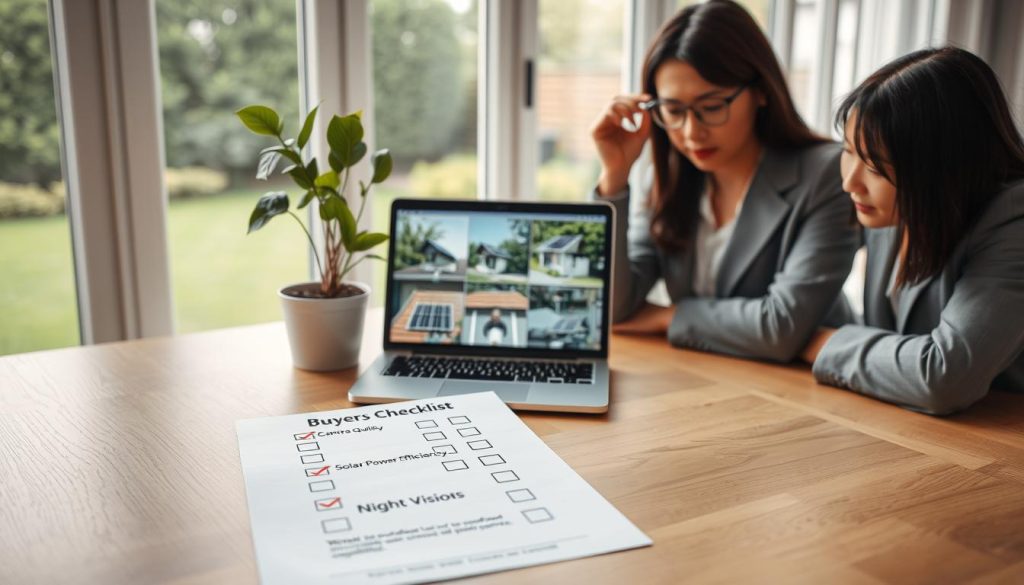
Making Your Final Decision: A Buyer’s Checklist
Your journey toward a smarter, more sustainable home defense culminates with this essential purchasing guide. This systematic approach transforms complex decisions into clear, actionable steps.
Follow this comprehensive framework to ensure your investment delivers reliable protection for years. Each consideration addresses Singapore’s unique climate and urban landscape.
Assessing Your Property Layout and Security Priorities
Begin with a thorough evaluation of your premises. Identify areas requiring vigilant monitoring and those with optimal conditions for equipment placement.
Sunlight exposure directly impacts your system’s energy independence. Map locations receiving at least four hours of direct daily illumination.
These spots ensure consistent charging for your photovoltaic components. South-facing positions typically capture the most sunlight throughout Singapore’s daylight hours.
WiFi coverage is equally crucial for reliable operation. Test signal strength at potential mounting locations before finalizing your setup.
Consider using network extenders if your router’s reach is limited. Strong connectivity maintains smooth video streaming and prompt alert delivery.
Define your security zones based on risk assessment. Prioritize entry points, package delivery areas, and vulnerable perimeter sections.
Overlapping coverage between multiple units eliminates blind spots. This strategy creates comprehensive monitoring across your entire property.
Balancing Your Budget with Long-Term Value
Initial investment represents only part of your total cost calculation. Consider ongoing expenses against potential savings from sustainable technology.
Photovoltaic-powered systems eliminate electricity costs completely. This creates substantial financial benefits over their operational lifespan.
Compare subscription models against one-time storage investments. Cloud services offer convenience but create recurring monthly payments.
“Local storage options provide complete data control without ongoing fees, making them particularly appealing for privacy-conscious homeowners who prefer managing their own footage.”
Maintenance requirements differ significantly between models. Self-sustaining technology typically needs less frequent servicing than traditional wired alternatives.
Calculate your break-even point considering all factors. Include installation savings from simplified setups requiring no professional electricians.
Future expansion possibilities should influence your current selection. Choose systems that allow easy addition of components as your needs evolve.
Modular designs support gradual enhancement of your protection network. This scalability ensures your investment remains relevant for years.
Where to Buy and What Warranty to Look For in Singapore
Purchase exclusively from authorized Singapore dealers for genuine products. These suppliers understand local installation requirements and climate considerations.
They provide proper warranty support tailored to Singapore’s conditions. Look for coverage lasting at least two to three years for comprehensive protection.
Singapore-based technical assistance ensures quicker response times. Local service centers can address issues more efficiently than overseas providers.
Verify compliance with Singapore standards and HDB regulations. Approved systems eliminate potential conflicts with housing authority guidelines.
Evaluate customer support quality before making your purchase. Check response times and technical knowledge through preliminary inquiries.
Review Singapore-specific user feedback for realistic performance expectations. Local testimonials reveal how equipment handles tropical humidity and seasonal changes.
Match system complexity with your technical comfort level. Some homeowners prefer straightforward setups while others enjoy advanced configuration options.
Consider these essential checklist items for your final decision:
- Sunlight assessment: Document daily illumination patterns across your property
- Network verification: Confirm strong WiFi signals at all potential mounting points
- Zone prioritization: Identify critical areas needing focused monitoring attention
- Cost analysis: Compare initial price against five-year operational expenses
- Storage strategy: Decide between cloud subscriptions or local data management
- Warranty validation: Ensure at least 24 months coverage with Singapore support
- Dealer verification: Purchase from authorized Singapore distributors only
- Compliance check: Confirm alignment with HDB regulations and local standards
- Expansion planning: Select systems supporting future component additions
- Technical alignment: Choose equipment matching your installation capabilities
This comprehensive approach ensures your selection delivers optimal value. You gain reliable protection that adapts to Singapore’s unique environment.
Your final decision should balance immediate needs with long-term objectives. The right system provides peace of mind through sustainable, intelligent monitoring.
Embracing Sustainable and Smart Home Security
The evolution of residential protection has reached a pivotal moment where environmental responsibility meets advanced technology. Modern monitoring solutions now deliver reliable home security while actively supporting sustainability goals.
Market adoption is growing rapidly, with projections showing 25% of new protection systems will use renewable energy by next year. These innovative approaches address both safety concerns and climate advantages specific to Singapore.
Choosing the right system requires balancing features, performance, and long-term value. These smart home technologies align perfectly with Singapore’s Smart Nation Initiative, offering comprehensive eco-friendly security solutions for forward-thinking homeowners.
The future of property monitoring lies in intelligent, sustainable systems that provide peace of mind while reducing environmental impact. This represents the new standard for modern living in Singapore.
FAQ
How do solar panels keep these cameras powered?
The integrated photovoltaic panel converts sunlight into electricity, charging a built-in battery. This provides a continuous, renewable power source, eliminating the need for frequent battery swaps or messy electrical wiring.
Will the camera work at night or on very cloudy days?
Yes. These devices store energy in their internal battery during sunny periods. This reserve ensures operation through the night and during several days of overcast weather, like during Singapore’s monsoon season. Advanced models with efficient batteries offer longer backup life.
What is the difference between infrared and color night vision?
Infrared night vision uses invisible light to create a black-and-white image. Color night vision, often called “Starlight” technology, uses advanced image sensors to capture visible light, providing clearer, full-color video in low-light conditions for better detail identification.
Do I need a subscription for cloud storage?
A> Not necessarily. Many models offer local storage via a microSD card, giving you full control over your footage without a monthly fee. However, some brands require a cloud storage subscription to access advanced features like AI motion detection or extended video history.
Can I connect these cameras to my smart home system?
Absolutely. Most modern solar-powered cameras offer seamless smart home integration. You can typically use voice commands with Alexa or Google Home and view live feeds on your mobile app. Some also work with Apple HomeKit for a unified ecosystem.
How difficult is the installation process?
Installation is generally straightforward. Since they are wireless, you only need to mount the unit and its solar panel in a sunny location. The key steps are ensuring a strong Wi-Fi signal and angling the solar panel for maximum daily sun exposure for optimal battery life.
Are these cameras durable enough for outdoor use?
Yes. Look for a high IP (Ingress Protection) rating, such as IP65 or IP67. This certifies the device is dust-tight and protected against heavy rain, making it suitable for Singapore’s humid and wet climate, ensuring reliable home security year-round.
What should I look for in terms of video quality?
A> Prioritize resolution and image quality. HD (1080p) is standard, but 2K or 4K resolution provides significantly sharper detail, which is crucial for identifying faces or license plates. This clarity, combined with a wide field view, offers comprehensive property monitoring.
Post Tags : Best outdoor home security cameras Energy-efficient outdoor cameras Smart outdoor camera options Solar panel security cameras Solar-powered outdoor security cameras Top-rated solar panel cameras Weatherproof outdoor security cameras Wireless solar-powered CCTV Wireless surveillance systems


