
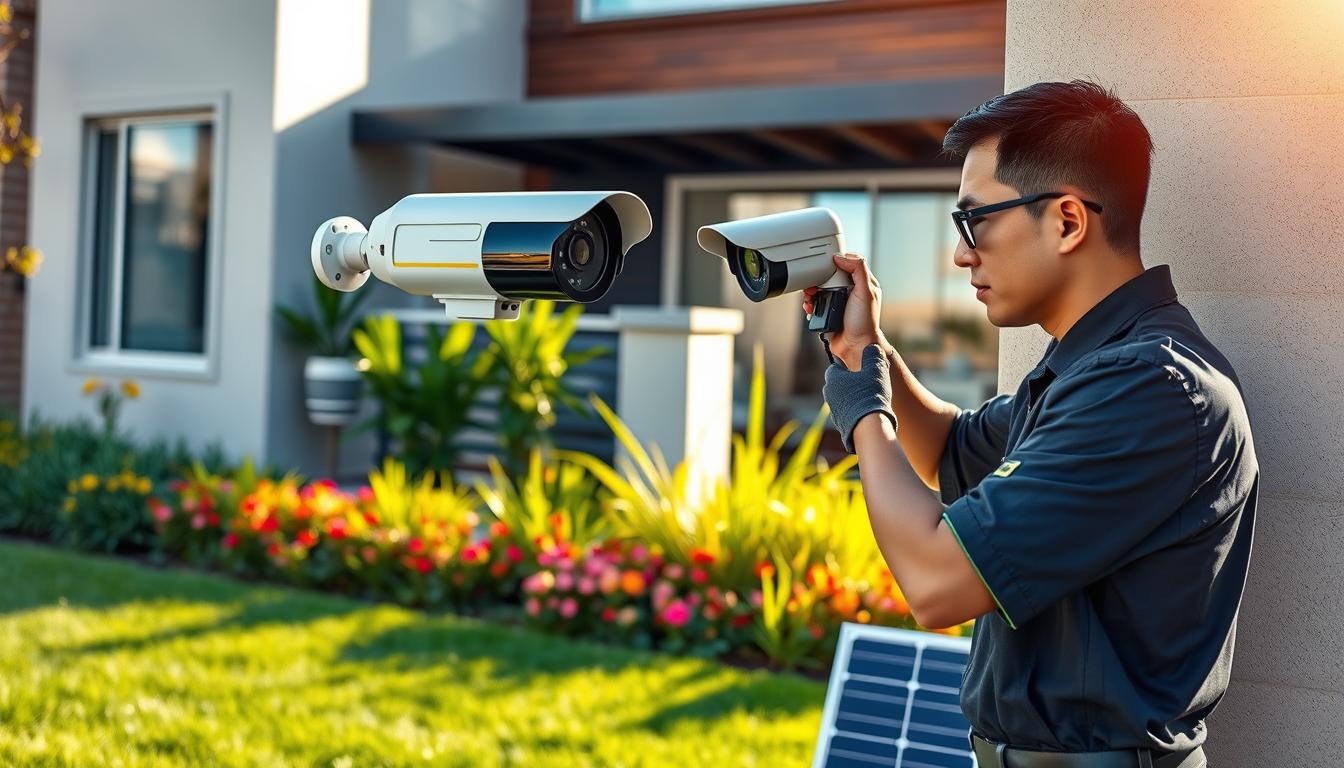
Top Long Range WiFi Solar Security Cameras
Keeping your property safe is a major concern for many Singapore residents. Recent data shows over 70% of people worry about home protection. This has led to growing interest in innovative surveillance solutions.
Sun-powered monitoring devices offer a smart alternative to traditional wired setups. They harness Singapore’s abundant sunlight to operate independently. This makes them perfect for urban areas and locations without easy power access.
The wireless design eliminates complex wiring requirements. Installation becomes straightforward, even in challenging spots. You save on electricity costs while maintaining constant vigilance.
Some units can function for up to seven days using stored charge. This reliability ensures continuous operation during cloudy periods. Our guide will help you find the ideal model for your specific needs.
Key Takeaways
- Solar-powered surveillance systems provide eco-friendly property protection in Singapore.
- Wireless installation makes these devices easy to set up in various locations.
- Singapore’s sunny climate is ideal for maximizing solar energy efficiency.
- Advanced models offer extended battery life, working for days without direct sunlight.
- These solutions reduce or eliminate electricity costs associated with monitoring.
- Choosing the right model depends on your specific property layout and surveillance needs.
- This article compares top-performing options available in the Singapore market.
Why Solar-Powered Security is Ideal for Singapore
With over 2,500 hours of annual sunlight, Singapore residents can leverage natural energy for reliable surveillance. This tropical climate creates perfect conditions for sun-dependent monitoring devices. These innovative systems transform abundant sunshine into constant property protection.
Singapore’s weather patterns support consistent energy harvesting throughout the year. Modern units require only six hours of daily sunlight for optimal performance. This ensures your monitoring remains active even during brief cloudy periods.
Harnessing Abundant Sunlight for Reliable Power
The island nation’s geographical position guarantees substantial sun exposure. Photovoltaic panels efficiently convert this light into electrical energy. This process happens automatically without manual intervention.
Advanced battery technology stores surplus power for nighttime operation. Some models can function for months using only stored charge. This reliability eliminates concerns about power interruptions.
Energy independence represents a significant advantage. Systems operate completely off-grid, removing vulnerability to electrical outages. Your property protection continues uninterrupted during blackouts.
Singapore’s urban landscape offers excellent sun exposure for panel placement. Rooftops, walls, and open spaces all work effectively. Strategic positioning maximizes energy collection throughout the day.
Cost Savings and Elimination of Wiring Hassles
Financial benefits begin immediately after installation. You eliminate monthly electricity costs associated with traditional surveillance. The sun provides free power for years of operation.
Initial setup expenses decrease significantly with wireless designs. Complex cabling through walls and structures becomes unnecessary. This simplification makes professional installation more affordable.
Consider these economic advantages:
- Zero ongoing energy bills for your monitoring system
- Reduced labor costs due to straightforward installation
- Long-term savings over conventional wired alternatives
- Minimal maintenance requirements compared to grid-connected units
Environmental sustainability adds another layer of value. Renewable energy use reduces your property’s carbon footprint. This eco-friendly approach aligns with Singapore’s green initiatives.
Aesthetic improvements accompany practical benefits. Properties maintain cleaner appearances without visible cables. This wireless approach preserves architectural integrity while providing protection.
For comprehensive setup guidance, explore our detailed resource on solar panel wifi security camera installation. This guide covers optimal placement strategies and maintenance tips.
Addressing Widespread Home Security Concerns
Recent surveys reveal that over 70% of Singapore residents worry about property protection. This creates strong demand for effective, reliable solutions. Sun-powered systems directly respond to these community needs.
Versatility represents a key strength for various applications. These units work effectively for:
- Residential homes and condominiums
- Commercial establishments and retail spaces
- Construction sites and temporary locations
- Rural properties and agricultural areas
Remote placement possibilities expand coverage dramatically. Difficult-to-wire locations become accessible for monitoring. Perimeter fencing, garden sheds, and driveway entrances all become viable positions.
The integration of renewable energy with modern surveillance technology represents a perfect match for Singapore’s urban environment and climate conditions.
Advanced features enhance overall effectiveness. Motion detection alerts notify you immediately of activity. High-resolution video capture ensures clear identification of subjects.
Night vision capabilities maintain 24-hour monitoring. Infrared technology provides visibility in complete darkness. This comprehensive coverage addresses round-the-clock security concerns.
Long-term reliability builds confidence in your investment. Quality components withstand Singapore’s humid climate. Regular maintenance ensures years of consistent performance.
Peace of mind grows with each day of trouble-free operation. Knowing your property remains protected without ongoing costs provides genuine value. This combination of benefits explains why sun-powered protection suits Singapore perfectly.
How Long Range Solar WiFi Camera Technology Works
At the heart of every autonomous surveillance device lies an efficient system for capturing and storing natural energy. This technology merges photovoltaic science with intelligent power management. The result is reliable property protection without dependence on electrical outlets.
Modern units convert abundant daylight into continuous operational capability. They achieve this through several integrated components working in harmony. Understanding this process helps you select the right model for your needs.
Solar Panel Operation and Energy Storage
Photovoltaic cells within the panels absorb photons from sunlight. These cells typically operate at 15-21% efficiency rates. This means they convert a significant portion of captured light into electrical current.
The generated electricity flows directly to a built-in lithium-ion battery. This component stores surplus energy for use when sunlight isn’t available. High-quality batteries can hold charge for extended periods.
Advanced systems include maximum power point tracking (MPPT) technology. This optimizes energy harvest from the photovoltaic panels. It ensures every hour of sunlight contributes to your system’s reserve.
Maintaining Operation Without Constant Sunlight
Intelligent power management is crucial for consistent performance. The system prioritizes essential functions during low-light conditions. It reduces power to non-critical features to preserve battery life.
Many models can function for up to seven days without direct sunlight. This reliability addresses Singapore’s occasional cloudy weather patterns. Your monitoring continues uninterrupted during brief sunless periods.
Energy-efficient components play a key role in this endurance. LED infrared lights for night vision consume minimal electricity. Smart motion detection activates recording only when needed, conserving precious stored energy.
Wireless connectivity also operates efficiently. Devices connect to your network only when transmitting alerts or live feeds. This approach uses far less power than continuous streaming.
Proper panel positioning maximizes energy capture throughout the year. In Singapore’s latitude, angling panels toward the north generally yields optimal results. Regular cleaning maintains peak photovoltaic efficiency.
Understanding Real-World Battery Life Expectations
Battery longevity depends on multiple usage factors. Under normal conditions, expect six months to over a year of service. Frequent motion events and high-resolution video recording will reduce this timeframe.
Several variables influence actual battery performance. These include the number of daily detections and chosen video quality settings. Night vision usage frequency also affects overall energy consumption.
Technological advancements have significantly improved reliability. Modern power management systems rival the performance of wired alternatives. They deliver consistent operation for residential and commercial applications.
Regular maintenance ensures your system performs at its best. Periodically clean photovoltaic surfaces to remove dust and debris. Check battery health indicators through the companion mobile application.
For those considering a comprehensive setup, explore our guide to solar WiFi CCTV camera installation. This resource covers optimal placement strategies for Singapore’s environment.
These technological foundations explain how autonomous surveillance devices achieve their independence. They combine efficient energy capture with smart consumption management. The outcome is dependable property protection that leverages Singapore’s natural advantages.
Essential Features to Look for in a Solar Security Camera
When evaluating autonomous property guardians, several technical aspects determine overall performance. Not all photovoltaic monitoring units offer the same capabilities. Understanding key specifications helps you choose a model that meets your specific requirements.
Advanced features enhance both reliability and usability. They transform basic observation into intelligent property protection. Let’s explore the most important elements to consider.
High-Resolution Video and Advanced Night Vision
Clarity is paramount for effective surveillance. Look for units capturing at least 1080p resolution. This ensures faces and license plates remain identifiable.
Higher-end options provide 2K or 4K video quality. These deliver exceptional detail capture. They prove valuable for larger properties where subjects appear smaller in the frame.
After-dark monitoring requires robust night vision. Standard infrared illumination creates black-and-white images in complete darkness. More advanced starlight sensors enable color recording in very low light.
This dual approach covers all lighting conditions. You maintain visual clarity from dusk until dawn. It’s a critical feature for round-the-clock peace of mind.
Smart Motion Detection and Alert Systems
Intelligent activity recognition minimizes unnecessary notifications. Basic systems trigger for any movement. Advanced algorithms differentiate between humans, vehicles, and animals.
This specificity dramatically reduces false alerts. You receive notifications only for relevant events. It also helps conserve valuable battery life.
Customizable sensitivity settings add further control. You can define specific zones for monitoring. This focuses attention on high-priority areas of your property.
The most effective systems combine accurate detection with instant mobile alerts. This creates a responsive monitoring solution that adapts to your lifestyle.
Storage Options: Cloud vs. Local Recording
How your device stores footage impacts both accessibility and cost. Cloud storage offers remote access from anywhere. Your recordings remain secure on remote servers.
This approach typically involves monthly subscription fees. It provides backup security if the physical unit is compromised. Many users appreciate the convenience.
Local storage uses microSD cards within the device itself. Capacities often reach 256GB. This eliminates ongoing costs and keeps complete control on your premises.
Some models support both methods simultaneously. This hybrid approach offers redundancy. You enjoy both convenience and local control.
Weatherproof Design and IP Ratings Explained
Singapore’s tropical climate demands durable construction. Ingress Protection (IP) ratings indicate weather resistance. An IP65 rating means protection against low-pressure water jets.
Higher ratings like IP66 or IP67 handle powerful jets or temporary immersion. These are ideal for exposed locations. They ensure reliable operation during heavy monsoon rains.
The housing material also matters. UV-resistant plastics prevent degradation from constant sun exposure. Proper sealing keeps internal electronics safe from humidity.
Additional features enhance functionality further. Two-way audio allows communication through the device. Built-in sirens or spotlights provide active deterrent functionality.
Power management extends operational time between charges. Optimized recording schedules and motion-activated operation preserve energy. Efficient designs can function for many days without direct sunlight.
Mobile applications provide real-time alerts and live viewing. They enable complete system management from your smartphone. Look for intuitive interfaces with regular updates.
Smart home integration adds another layer of convenience. Compatibility with ecosystems like Google Home or Amazon Alexa enables voice control. This creates a seamless connected protection system.
Field of view determines coverage area. Wider angles (120-180 degrees) monitor more space with fewer units. Note that extreme wide-angle lenses may create distortion at the edges.
Considering all these elements together ensures you select the right solution. Each feature contributes to overall effectiveness. Your choice should align with your specific property layout and monitoring needs.
Comparing the Best Long Range WiFi Solar Security Cameras
Multiple sun-powered surveillance systems compete for attention, each offering distinct advantages for property protection. Singapore’s market features diverse photovoltaic monitoring devices with varying capabilities.
Understanding key differences helps you make an informed choice. This comparison examines leading options across price categories.

Each model balances features against cost. Your selection should match your specific surveillance requirements.
Reolink Argus Series: Balancing Price and Performance
The Reolink Argus 3 Pro represents excellent value at approximately SGD 99.99. It earns a strong 4.4 out of 5 rating from users.
This device captures 1080p video for clear identification. The picture quality satisfies most residential needs.
Battery performance stands out as a key strength. It can operate for up to six months on a single charge.
Installation proves straightforward with minimal tools required. The wireless design eliminates complex wiring.
Key advantages include:
- Affordable pricing for capable performance
- Reliable six-month operational duration
- Crisp 1080p resolution video capture
- Strong community approval ratings
This model suits homeowners seeking dependable protection without premium costs. It handles Singapore’s climate effectively.
EufyCam 3: Premium Features and Local Storage
EufyCam 3 delivers top-tier surveillance for those prioritizing advanced capabilities. A two-pack costs around SGD 549.99.
It receives a 4.3 out of 5 rating from satisfied customers. The system captures stunning 4K resolution footage.
Battery endurance impresses with up to twelve months of operation. This reduces maintenance frequency significantly.
Local storage represents a major benefit. The included 16TB capacity eliminates monthly cloud fees.
For users demanding the highest video clarity and extensive local recording, the EufyCam 3 provides a comprehensive premium solution.
This option excels for larger properties requiring detailed monitoring. The investment justifies itself through superior performance.
Budget-Friendly Options: SEHMUA and Blink Outdoor
Cost-conscious consumers have viable alternatives. SEHMUA outdoor units offer basic surveillance around SGD 100-150.
These provide 720p resolution for fundamental observation needs. Battery performance reaches approximately 180 days.
The Blink Outdoor system presents another economical choice. Individual devices cost between SGD 80-120.
They feature 1080p video quality for sharper images. Expect about 120 days of operation per charge.
Setup simplicity makes Blink particularly appealing. Many users complete installation without professional assistance.
Both options deliver essential protection at accessible price points. They work well for monitoring smaller areas.
Additional Notable Models
Several other photovoltaic surveillance units deserve consideration. The Arlo Essential XL offers exceptional battery longevity.
It can function for up to sixteen months between charges. This sets a benchmark for endurance.
The Ring Spotlight Cam Solar integrates charging directly into its design. It provides 1080p footage with color night vision.
This enhances after-dark monitoring capabilities. Subjects appear in color rather than monochrome.
Real-World Performance in Singapore’s Climate
Singapore’s tropical environment affects different models uniquely. High humidity and frequent rain test weatherproofing.
Consistent sunlight benefits all photovoltaic units. However, efficiency varies between brands.
More advanced systems manage energy more intelligently. They adjust operation based on available power.
Basic models may require more frequent panel cleaning. Dust accumulation reduces energy harvest.
Value Across Price Segments
Each price category serves specific user needs effectively. Budget options cover fundamental surveillance requirements.
Mid-range models like Reolink offer balanced capabilities. They provide strong performance without premium costs.
Premium systems justify their higher investment through advanced features. Superior video quality and extended operation deliver tangible benefits.
Consider these value propositions:
- Basic monitoring: SEHMUA or Blink for essential coverage
- Balanced protection: Reolink Argus for reliable performance
- Premium surveillance: EufyCam 3 for top-tier capabilities
Installation Complexity Comparison
Setup difficulty varies between systems. Truly wireless units offer the simplest installation.
Some models require minimal wiring for optimal panel placement. This adds slight complexity.
Mobile applications guide users through configuration steps. Most systems become operational within an hour.
Professional installation remains available for all major brands. This ensures proper positioning and setup.
Brand Ecosystems and Expandability
Certain manufacturers offer integrated product families. Adding additional units creates comprehensive coverage.
Compatibility with other smart devices enhances functionality. Voice control and automated responses become possible.
Consider future expansion when selecting your initial system. Some platforms simplify adding more cameras later.
Recommendations Based on Use Cases
For basic perimeter monitoring, budget options perform adequately. They alert you to activity around your property.
Homeowners seeking reliable all-around protection should consider mid-range models. They balance cost with capable performance.
Businesses or those requiring detailed evidence benefit from premium systems. Higher resolution aids identification.
Your specific situation determines the ideal choice. Assess your property layout and surveillance priorities carefully.
Leading Solar Security Camera Brands Available in Singapore
Choosing the right brand is as crucial as selecting the features for your autonomous monitoring setup. The manufacturer determines build quality, video performance, and long-term support.
Singapore hosts a robust market with options for every need. From professional installations to simple DIY kits, you can find a perfect match.
This guide explores six prominent companies. We compare their philosophies, strengths, and suitability for local conditions.
Hikvision and Revlight: Professional-Grade Solutions
Hikvision stands as a global leader in professional surveillance. Their photovoltaic units are engineered for demanding applications.
You get exceptional video clarity with up to 4K resolution. The systems earn a top SecureScore rating of 9.4 out of 10.
These are ideal for businesses or large residential estates. They offer robust construction and advanced analytics.
Revlight provides a more accessible professional option. Their models deliver reliable 1080p resolution at competitive price points.
With a SecureScore of 9.0, they offer dependable performance. This brand suits those wanting pro-level reliability without the highest cost.
Key advantages of professional brands include:
- Superior durability and weatherproofing
- Advanced features for complex monitoring needs
- Strong local distributor and installer networks in Singapore
- Consistent performance in tropical climates
Arlo and Google Nest: Smart Home Integration
Arlo champions the DIY approach with user-friendly installation. Their devices often feature up to 4K resolution.
A key benefit is the dedicated solar panel accessory. It typically costs around SGD 59.99 for continuous power.
The system integrates well with various smart home platforms. It receives a SecureScore of 8.2, focusing on convenience.
Google Nest cameras are built into the smart home ecosystem. They offer 1080p to 2K resolution for clear footage.
Compatible with third-party panels like the Wasserstein solar panel (approx. SGD 59.99). They score 8.5 for seamless integration.
For homeowners invested in smart automation, brands like Arlo and Nest transform standalone cameras into connected, responsive guardians of your property.
These brands prioritize ease of use and app control. They are perfect for tech-savvy users wanting a unified smart home.
Lorex and Ring: Versatile Consumer Choices
Lorex offers a versatile range with standout features. Many models provide a wide 180-degree field of view.
Video quality reaches up to 4K resolution for detailed capture. Their weather-resistant designs handle Singapore’s humidity well.
A compatible solar panel accessory is available for about SGD 79.99. The brand earns a high SecureScore of 9.2.
Ring operates a comprehensive security ecosystem. Their devices work seamlessly with doorbells, alarms, and lights.
Video quality goes up to 4K, and solar panel options range from SGD 49.99 to 99.99. They also hold a SecureScore of 9.2.
These consumer-focused brands excel in:
- Providing extensive product compatibility and expandability
- Offering flexible cloud and local storage plans
- Featuring straightforward DIY installation processes
- Maintaining strong community support and regular updates
Comparing Brand Philosophies and Costs
Brands differ in their core approach. Hikvision and Revlight favor professional installation and setup.
Arlo, Nest, Lorex, and Ring are designed for user installation. Your comfort with technology guides this choice.
Pricing structures vary beyond the initial equipment cost. Consider ongoing subscription fees for cloud storage.
Accessory costs, like dedicated panels, also add up. Professional brands may have higher upfront costs but fewer subscriptions.
DIY ecosystems often use subscriptions for advanced features. Calculate the total cost over two to three years.
Availability and Support in Singapore
Local support is vital for troubleshooting and maintenance. Major brands have established distributors here.
Check for authorized service centers and warranty coverage. Professional brands typically offer stronger local technical support.
DIY brands rely more on online resources and community forums. Ensure you can get help if needed.
Guidance for Selecting Your Brand
Your choice depends on technical expertise, budget, and desired features. Follow this simple decision framework.
For maximum reliability and professional oversight: Choose Hikvision or Revlight. Invest in professional installation.
For smart home integration and DIY convenience: Choose Arlo or Google Nest. Prioritize ecosystem compatibility.
For versatile features and strong consumer value: Choose Lorex or Ring. Look for the specific features you need most.
Evaluate your property’s layout and your personal comfort with technology. The right brand ensures your system works flawlessly for years.
Installation Tips and Ensuring Durability in Singapore’s Climate
Proper installation is the foundation of reliable photovoltaic monitoring in Singapore’s challenging tropical environment. Your unit’s effectiveness and lifespan depend on correct setup from day one.
Singapore’s high humidity and frequent rainfall test every component. Strategic placement and regular care ensure your investment delivers years of protection.
Optimal Placement for Solar Panels and Camera Coverage
Positioning your photovoltaic collector correctly maximizes energy harvest. In Singapore’s southern hemisphere location, face panels toward true north.
This orientation captures the most sunlight throughout the year. Angle the surface to match Singapore’s latitude of approximately 1°N.
Seasonal adjustments can further optimize performance. A slight tilt change helps during different monsoon periods.
Place your monitoring device to cover key entry points and vulnerable areas. Mount it 8-10 feet above ground for a balanced view.
This height deters tampering while providing clear identification. Consider the unit’s field of view when selecting locations.
Avoid pointing lenses directly at the sun. This prevents glare that can reduce image quality during certain hours.
Test different angles during setup to minimize blind spots. Your property’s unique layout determines the ideal position.
Tools and Steps for a DIY Setup
Most photovoltaic guardians come with mounting hardware. You’ll need additional tools for a professional-grade installation.
Essential equipment includes:
- A power drill with appropriate bits for your wall material
- High-quality screws and anchors suitable for outdoor use
- Mounting brackets provided with your specific model
- Waterproof sealant for all connection points
- A level to ensure proper alignment
- Measuring tape for precise placement
Begin with a thorough site assessment. Identify the sunniest spot for your energy collector.
Mark drilling points using the mounting template. Drill pilot holes slightly smaller than your anchors.
Apply sealant around each anchor before insertion. This creates a watertight barrier against Singapore’s heavy rains.
Secure the bracket firmly to the wall. Use your level to confirm perfect alignment.
Proper weatherproofing during installation prevents 80% of common issues in tropical climates. Take extra time with sealing to ensure long-term reliability.
Attach your monitoring unit to the bracket. Connect it to the photovoltaic collector with the provided cable.
Route this cable neatly along walls or eaves. Use additional clips if needed to secure the line.
Download the companion mobile application. Follow the prompts to connect your device to home networks.
Test all functions before completing the installation. Verify motion detection, night vision, and live streaming capabilities.
Maintenance Practices for Long-Term Performance
Regular care extends your system’s operational life significantly. Establish a simple schedule for key tasks.
Clean photovoltaic surfaces every 2-3 months. Dust and pollen accumulation reduces energy harvest efficiency.
Use a soft cloth and mild detergent for this task. Avoid abrasive materials that could scratch the protective coating.
Check battery health every 6-12 months through the app. Most units provide status indicators for power storage levels.
Inspect all seals and mounting points annually. Singapore’s humidity can degrade materials over time.
Common issues and solutions:
- Reduced battery performance: Clean panels thoroughly and check for shading
- Connectivity problems: Restart the device and verify network settings
- Image quality degradation: Clean the lens with appropriate materials
- False motion alerts: Adjust sensitivity settings in the application
Consider professional assistance for complex installations. Multi-unit systems or difficult mounting locations may require expert help.
Integration with existing smart home networks enhances functionality. Many modern units work with popular automation platforms.
This creates a comprehensive protection ecosystem. Your photovoltaic guardian becomes part of a coordinated defense strategy.
With proper installation and regular maintenance, expect 5-15 years of reliable service. Higher-quality models typically reach the upper end of this range.
Your vigilance combined with these practices ensures continuous property monitoring. Peace of mind grows as your system operates flawlessly through Singapore’s seasons.
The Advantage of 4G Connectivity for Ultimate Reliability
Cellular connectivity eliminates one of the most common vulnerabilities in property protection systems. When traditional networks fail, 4G technology ensures your surveillance remains active and alert.
This approach represents a significant advancement for Singapore properties. It provides consistent monitoring regardless of local infrastructure issues.
Modern units with cellular capabilities offer peace of mind that standard devices cannot match. They maintain constant communication through Singapore’s robust mobile networks.
Ensuring Remote Access Without WiFi Dependency
Traditional surveillance depends entirely on local wireless networks. This creates a single point of failure for your entire system.
4G connectivity operates independently of your home or business internet. It uses the same cellular data networks that power smartphones.
This independence proves invaluable during network outages or router failures. Your monitoring continues uninterrupted when others’ systems go dark.
Consider these practical benefits:
- Continuous operation during internet service provider disruptions
- Reliable access from anywhere with cellular coverage
- No vulnerability to WiFi password changes or network configuration issues
- Consistent performance in areas with weak wireless signals
Transmission capabilities reach impressive distances. Some models send video signals up to 10 kilometers via cellular networks.
This extended range suits remote properties perfectly. Construction sites and agricultural areas benefit greatly from this technology.
Dual-connectivity models offer the best of both worlds. They automatically switch between WiFi and 4G based on available infrastructure.
This flexibility adapts to changing conditions seamlessly. Your system always uses the most reliable connection method.
4G connectivity transforms surveillance from a locally-dependent system into a truly resilient monitoring solution that works anywhere cellular networks reach.
Enhanced Security Through Cellular Backup
Data protection receives a significant boost with cellular transmission. Encrypted data transmission over 4G networks offers enhanced security.
This compares favorably to potentially vulnerable wireless connections. Cellular networks employ advanced encryption protocols by default.
Real-time alerts arrive directly on your mobile device. Property owners receive immediate notifications of security events.
This rapid communication can dramatically reduce crime response times. Authorities can be alerted while incidents are still in progress.
During power failures, cellular backup proves its worth. While traditional systems fail, 4G-enabled devices continue operating.
They draw power from their internal batteries and photovoltaic panels. Monitoring persists through blackouts and electrical disruptions.
Key security enhancements include:
- Encrypted video transmission preventing unauthorized access
- Immediate alert delivery regardless of local network status
- Continuous operation during infrastructure failures
- Reduced vulnerability to wireless network attacks
Data plan considerations are important for Singapore users. Typical usage patterns depend on your recording settings and alert frequency.
Most devices use between 1GB and 5GB monthly under normal conditions. Singapore’s major cellular providers offer suitable plans for this usage.
Several 4G-enabled models are available locally. Prices vary based on features and cellular capabilities.
The Reolink Go Plus offers reliable 4G connectivity at approximately SGD 199. It provides 1080p resolution with motion detection alerts.
For premium features, consider the Arlo Go 2. This model delivers 2K video quality with integrated cellular capability.
Budget-conscious users might explore the Blink Outdoor with 4G add-on. This provides basic cellular backup at accessible price points.
Your specific situation determines whether 4G is essential. Standard wireless devices suffice for properties with reliable internet access.
Cellular connectivity becomes crucial for remote locations or areas with frequent outages. It also benefits temporary installations where establishing networks isn’t practical.
Evaluate your property’s location and reliability needs carefully. The additional investment in 4G technology often justifies itself through uninterrupted protection.
Getting Started with Your Solar-Powered Surveillance System
Implementing an effective property monitoring solution begins with careful planning and assessment of your unique requirements. Map out vulnerable areas and determine coverage needs before selecting equipment.
Create a detailed surveillance plan that considers panel placement for optimal sun exposure. Research available models and compare specifications to match your specific situation.
Singapore’s ideal conditions make this independent approach particularly valuable. Start with a basic setup that allows for future expansion as your needs evolve.
FAQ
How long can a solar-powered camera run without sun?
Most models have a built-in rechargeable battery that stores energy. On a full charge, they can typically operate for several days, even with frequent motion events. This ensures continuous monitoring through cloudy periods or at night.
Do I need a strong WiFi signal for these devices to work?
Yes, a stable connection is crucial for features like live streaming and instant alerts. For extended distances, consider a WiFi extender or a model with a high-gain antenna. Some systems also offer 4G cellular options for areas with poor network coverage.
What video quality should I expect from outdoor solar cameras?
Leading brands like Reolink and Arlo offer crisp 2K or 1080p HD resolution. This provides clear details for identifying faces or license plates. Combined with infrared or color night vision, you get reliable footage day and night.
Are these devices secure against hackers?
A> Reputable manufacturers use encryption like WPA2 for data transmission. To enhance safety, always change default passwords, enable two-factor authentication, and keep firmware updated. Brands like Google Nest and Eufy prioritize robust security protocols.
What maintenance do solar panels for cameras require?
Minimal upkeep is needed. Simply wipe the panel with a damp cloth every few months to remove dust, pollen, or bird dropes that can block sunlight. In Singapore’s climate, checking for secure mounting after heavy rain is also wise.
Can I use local storage instead of a monthly cloud fee?
Absolutely. Many products, including the EufyCam 3, offer local recording to a microSD card or home base station. This gives you full control over your video history without ongoing subscription costs, though cloud plans offer added convenience.
How well do they withstand Singapore’s heavy rain?
Look for a high IP rating, such as IP65 or IP66. This certification means the housing is dust-tight and protected against powerful water jets. Brands like Hikvision and Ring design their products to endure tropical weather conditions reliably.


