
How Many CCTV Cameras Do I Need for My Home?
Finding the right number of surveillance devices for your residence is a common concern for homeowners. A well-planned security system provides crucial coverage and peace of mind for your family.
There is no single answer that fits every home. The optimal setup depends on your specific property layout and personal security needs. A systematic approach yields the best results.
In Singapore, your housing type—be it an HDB flat, condominium, or landed property—shapes your strategy. The goal is to create a strong deterrent and a reliable source of video evidence.
Modern security cameras offer high-resolution video, night vision, and smart home integration. These features influence your overall system design.
This guide serves as your comprehensive planning resource. We will explore key factors like property assessment, strategic placement, camera types, and features suited for Singapore’s climate.
Key Takeaways
- The ideal number of devices depends on your property’s unique layout and your security concerns.
- Different Singapore home types, like HDBs and landed houses, require different approaches.
- A good system acts as both a visual deterrent and a source of crucial evidence.
- Modern cameras offer advanced features like high-resolution video and smart connectivity.
- Effective planning involves assessing all entry points and vulnerable areas.
- Choosing climate-appropriate features ensures reliable operation in Singapore’s environment.
- A step-by-step assessment leads to a personalized and effective security solution.
Understanding the Role of CCTV in Your Home Security
For Singaporean families, a well-integrated surveillance system addresses unique urban living challenges. It moves far beyond simple recording.
Modern setups serve three powerful roles for your property. They work together to create a robust shield.
- A visual deterrent to discourage criminal activity before it starts.
- An evidence-gathering tool that provides clear documentation.
- A source of peace of mind, offering comfort whether you are home or away.
Research underscores the deterrent effect. Studies indicate visible security cameras can reduce burglary risks by approximately 31%.
This is crucial, as statistics show about 34% of intruders enter through the front door. A clearly placed device at this point acts as a strong first line of security.
When prevention is not enough, high-quality video footage becomes vital. It serves as undeniable evidence for law enforcement.
This evidence also streamlines insurance claims. Your security system transforms into a financial safeguard for your home.
The psychological benefit is equally important. Knowing your space is monitored provides immense comfort.
Remote viewing via smartphone extends this feeling of safety. You can check on your family or property from anywhere.
In Singapore’s dense landscape, defining your perimeter is key. Documented proof of activities around HDB flats or landed properties holds significant value.
Your surveillance setup is one layer in a complete strategy. It works best with strong locks, good lighting, and community awareness.
Understanding these core roles makes planning essential. The right number of devices ensures each function is performed effectively for your specific home.
Conducting Your Home Security Assessment: The First Step
Your journey to a safer living space starts with a critical, on-the-ground evaluation of your property’s unique vulnerabilities. Jumping straight to buying gear is a common mistake. A methodical security assessment creates the blueprint for everything that follows.
This do-it-yourself audit is about observation and documentation. You are identifying what needs protection. The goal is to translate your specific property layout and concerns into a clear coverage plan.
Evaluating Your Property’s Layout and Size
Begin by walking the entire perimeter and interior. Take notes on the total square footage and the number of floors. The physical size of your home directly influences the number cameras you might require.
Do not just count rooms. Consider the flow between spaces like hallways and staircases. These are crucial chokepoints for monitoring movement inside the house.
For Singapore homes, remember to account for all relevant areas. This includes outdoor zones like a condo balcony, HDB corridor access, or a landed property’s garden and driveway. Your total coverage area is both inside and out.
Identifying High-Risk Entry Points and Vulnerable Zones
Statistics reveal the most common breach points. Research indicates about 34% of burglars use the front door, and another 22% use the back door. Ground-floor windows are also prime targets.
Your walkthrough must pinpoint these critical entry points. List every door, window, and potential access point like a basement hatch or utility entry. These are your non-negotiable coverage points.
Next, look for blind spots and vulnerable areas. Is your side gate hidden by a wall? Does landscaping create dark corners? A driveway obscured from the street is a major risk.
Lighting conditions change throughout the day. Assess your property at night. Poorly lit spaces are attractive to intruders and may demand cameras with exceptional night vision capability.
Defining Your Personal Security Priorities
Not all security needs are the same. Are you focused on general deterrence, or do you have specific concerns? Your priorities shape your entire security system design.
Common specific goals include preventing package theft, monitoring the comings and goings of domestic helpers, or keeping a gentle watch over elderly family members. Indoor monitoring of children or pets is another frequent priority.
Ask yourself: Is your main goal to scare off trouble, to collect crystal-clear evidence, or to have live indoor visibility? Often, it’s a combination. Defining this helps determine camera placement, type, and features.
Completing this assessment gives you a personalized security blueprint. It moves you from a vague question to a targeted plan. With this clarity, choosing the right optimal CCTV cameras for your home becomes a logical next step, not a guessing game.
Key Factors That Determine How Many CCTV Cameras You Should Have
The final tally of monitoring devices is not a guess but a calculation based on your home’s physical and security profile. Moving from the generic question of “How many CCTV cameras should I have?” to a precise plan involves three core elements.
These variables work together to define your ideal setup. Let’s break down each factor to build your personalized framework.
Property Type and Overall Square Footage
Your home’s size and architectural style set the foundational scale. A common professional baseline is one surveillance unit per 500 square feet of livable area.
This rule adjusts based on your layout. Open-concept spaces are easier for a single wide-view device to cover. Compartmentalized homes with many walls and hallways often need more individual units.
In Singapore, your property type inherently shapes the number. A compact HDB flat demands a different approach than a sprawling landed bungalow. Condominiums with shared corridors focus on primary entry points.
Terraced houses and semi-detached properties add complexity with side gates and rear access. Your total square footage is the first data point for your security system equation.
Number and Type of Doors, Windows, and Access Points
Every portal is a potential vulnerability. A comprehensive count of all ground-level and accessible entry points is non-negotiable for complete coverage.
Primary entries like the front door, back door, and garage demand dedicated security cameras. These are the most common points used by intruders.
Secondary points, such as ground-floor windows or a side gate, might be monitored by a strategically placed device with a wide field of view. The goal is to eliminate critical blind spots.
Do not forget less obvious access routes. Basement hatches, utility entries, or even first-floor balconies can be risks. Your audit from the previous section provides this essential list.
Specific Security Concerns and Coverage Goals
Your personal priorities add specific devices to the plan. Unique needs transform a standard setup into a custom solution.
Are you focused on package theft? A dedicated security camera for the porch makes sense. Monitoring a home office or deterring vandalism on a fence adds another unit.
Your coverage goal is a key trade-off. Do you want to eliminate all blind spots for total awareness? Or is the focus solely on securing critical entryways? The first requires a higher number cameras.
Budget and future growth must be considered. Plan a core system for immediate high-priority zones. Choose scalable systems that allow you to add outdoor cameras or indoor units later.
Synthesizing these factors—property size, entry count, and personal goals—gives you a logical estimate. It answers “How many CCTV cameras should I have?” for your specific situation.
Typical CCTV Camera Recommendations for Singapore Homes
To simplify planning, we provide clear benchmarks for the most common housing styles in Singapore. These are practical starting points based on typical layouts and security needs.
Your personal assessment is the final guide. Use these frameworks to visualize your initial investment.
For HDB Flats and Condominiums (1-3 Cameras)
Compact living spaces and existing building security allow for a minimalist approach. The goal is to monitor critical private areas.
Standard HDB flats and apartments often perform well with two to four devices. Focus on these essential zones:
- Main Door: The primary entry point. A discreet video doorbell is a popular choice here.
- Living Area: Position a single unit to cover the main living space, balcony, and key windows.
- Service Entrance/Back Door: If your layout has a secondary access, it deserves coverage.
Respect shared corridor rules in HDBs. Compact dome or bullet cameras are often suitable.
This setup creates a strong core security system without overwhelming your home.
For Landed Terraces and Semi-Detached Houses (4-6 Cameras)
Landed properties introduce a larger perimeter and multiple access points. A more comprehensive plan is needed to eliminate blind spots.
These homes typically require four to six monitoring devices. Essential coverage points include:
- Front gate and driveway
- Main front door
- Back door and garden area
- Side gate or passageway
- A common indoor area like the living room
This strategy accounts for the characteristic layout of terraced and semi-detached homes. Each external entry receives direct attention.
Durable outdoor cameras are crucial for perimeter security. Ensure your property has no unmonitored vulnerable zones.
For Large Bungalows and Properties (6+ Cameras)
Extensive estates demand a scalable, layered approach. Start with all primary entrances and key internal zones.
A robust system for a large bungalow often begins with six or more units. Critical areas for coverage are:
- All primary doors and accessible windows
- The full property perimeter
- Garage and outbuildings
- Internal chokepoints like main staircases and hallways
Strategic use of technology can optimize your setup. Wide-angle or panoramic security cameras can cover expansive garden facades.
Pan-Tilt-Zoom (PTZ) units offer live coverage of large areas with fewer devices. For mansions, systems of ten to twenty cameras are common.
These recommendations answer the core question: How many CCTV cameras should I have? They give you a confident starting point for your home security journey.
Strategic Camera Placement for Maximum Coverage
A perfectly placed security camera delivers far greater protective power than several poorly positioned ones. The “where” is as critical as the “how many” for your security system.
Optimal positioning ensures each device watches over its intended area without gaps. This creates a seamless net of coverage that deters trouble and captures vital footage.
Essential Areas: Front Door, Back Door, and Garage
Certain zones are non-negotiable for monitoring. Statistics show the front door is used in 34% of break-ins. The back door accounts for another 22%.
Your garage is also a prime target, often housing tools and offering hidden access. These three points form the core of any robust plan.
For the front entry, mount a unit 8 to 10 feet high. Angle it slightly downward to capture faces clearly as visitors approach.
This height also helps prevent tampering. Ensure the lens is not facing direct sunlight or deep shadows to maintain image quality.
Apply the same principles to the rear door and garage entrance. The goal is to monitor the approach and the act of entry itself.
Covering Common Blind Spots: Driveways, Side Gates, and Ground-Floor Windows
Intruders often exploit areas you might overlook. Driveways, side gates, and ground-floor windows are classic blind spots.
A driveway camera should be positioned to capture license plates. This is crucial for identifying vehicles.
Side gates in landed properties are frequently shielded from street view. A dedicated security camera here eliminates a hidden access route.
For ground-floor windows, consider a corner placement. A single unit with a wide view can often cover multiple windows.
For particularly vulnerable windows, a more discreet, individual unit may be best. The key is to leave no easy, unmonitored access.
Indoor Placement: Living Areas, Hallways, and Staircases
Inside the home, balance security with family privacy. Focus on high-traffic choke points and rooms with valuables.
The main living space is a natural hub. A camera here can oversee the area and key entries from inside.
Hallways and staircases control movement between spaces. Monitoring these hallways provides a record of activity throughout the layout.
Mount indoor units at the same 8 to 10-foot height. Angle them to maximize the field of view while maintaining discretion.
Avoid pointing cameras into private rooms like bedrooms or bathrooms. The focus is on common areas.
An essential ethical and legal step is respecting neighbor privacy. Angle all outdoor cameras to capture only your own property.
For durable perimeter monitoring, consider investing in optimal outdoor cameras for home security built for local conditions. Proper placement turns a collection of devices into an intelligent, cohesive security solution.
Choosing the Right Types of CCTV Cameras
Your security plan’s effectiveness hinges on matching specific camera types to distinct monitoring tasks. The technology you select directly influences coverage, reliability, and evidence quality.
Modern surveillance offers a toolkit of specialized devices. Each is engineered for particular environments and goals.
Understanding these options lets you build a smarter, more efficient system. The right choice can even reduce the total number of units required.
Indoor Cameras vs. Outdoor Cameras: Key Differences
Build quality is the primary divider between indoor and outdoor models. Exterior units face Singapore’s tropical climate daily.
Outdoor cameras require robust weatherproofing. Look for an IP66 or IP67 rating, which guarantees resistance to heavy rain and dust.
Temperature resistance is also vital for consistent operation. Enhanced night vision capabilities are non-negotiable for clear footage after dark.
Indoor models prioritize discreet design and privacy. They often feature compact, low-profile shapes that blend into your living spaces.
Many indoor units include two-way audio for communication. Some offer physical privacy shutters to cover the lens when the room is occupied.

When to Consider Wide-Angle or Panoramic Cameras
These devices are designed for expansive views. A wide-angle lens can capture a field of view up to 180 degrees or more.
They excel at monitoring large, open areas. Think of a living room, backyard, or a long driveway.
This technology can cover up to 20% more area than a standard lens. That means one unit might replace two traditional cameras.
It’s a smart choice for reducing your total device count. You maintain comprehensive coverage without sacrificing visual information.
Place them at central points with a clear line of sight. Avoid obstructions that could block the broad perspective.
The Role of PTZ (Pan-Tilt-Zoom) Cameras in Home Security
PTZ units add dynamic movement to your surveillance network. They can be controlled remotely to pan left/right, tilt up/down, and zoom in optically.
This offers flexible, live coverage of a large zone. A single PTZ security camera can monitor a wide garden or a long property perimeter.
They are ideal for properties where you need to track activity across different spaces. You can focus on specific details without deploying multiple fixed units.
This flexibility comes with a higher cost today. PTZ systems are typically more expensive than fixed-lens alternatives.
They work best as a powerful complement to a network of standard cameras. Use them to cover a key area that doesn’t need constant monitoring from every angle.
Choosing the right types optimizes your entire security investment. It ensures each device performs its job perfectly for your unique home layout.
Must-Have Features for Effective Home Surveillance in Singapore
Beyond the number and placement of units, the features you select determine the real-world effectiveness of your surveillance. The right technical specs ensure your system performs reliably, captures usable evidence, and stands up to local conditions.
Focusing on these core capabilities transforms a basic setup into a powerful home security asset. They are the non-negotiable elements for peace of mind today.
High Resolution and Night Vision Capabilities
Clear footage is the ultimate goal. High-definition video is essential for identifying critical details like faces or license plates.
Consider 1080p Full HD a minimum standard. For even greater clarity, 2K or 4K resolution is preferable.
This level of detail makes your video evidence far more useful to authorities. It can be the difference between a vague recording and a positive identification.
Effective monitoring doesn’t stop at sunset. Night vision capability is crucial for true 24/7 security.
Most models use infrared (IR) sensors for black-and-white imagery in darkness. Newer technology offers full-color night vision using advanced sensors.
This feature ensures your property is protected during the darkest hours. It eliminates a major vulnerability in any security plan.
Weatherproof Ratings for Singapore’s Climate
Singapore’s tropical environment demands rugged hardware. An outdoor unit failing due to weather is completely useless for security.
Always check the IP (Ingress Protection) rating. This code indicates resistance to solids and liquids.
For reliable operation here, look for a rating of IP66 or higher. A camera with IP66 is dust-tight and can withstand powerful jets of water.
“A camera’s build quality is its first line of defense. In our climate, a high weatherproof rating isn’t a luxury—it’s a requirement for durability.”
This protection guards against heavy monsoon rains, persistent humidity, and intense heat. It ensures your investment lasts for years, not just months.
Never compromise on this specification for any exterior placement. It is the foundation of long-term performance.
Motion Detection, Alerts, and Smart Home Integration
Modern security cameras are intelligent. Motion detection with customizable zones turns a passive recorder into an active sentry.
You receive instant smartphone alerts when activity is detected. This allows for real-time monitoring and quick response.
Integration with smart home systems creates a responsive network. Your security camera can trigger other devices automatically.
Imagine your porch lights switching on when motion is sensed at the front entry. This adds a powerful layer of deterrence and convenience.
Other valuable features enhance the experience. Two-way audio lets you communicate through the device.
Consider storage options: local recording offers privacy, while cloud storage provides off-site backup. Easy remote viewing via a mobile app is standard for modern systems.
Prioritizing these features maximizes the effectiveness of every device you install. It makes your home security investment smart, responsive, and built to last.
Finalizing Your CCTV Plan and Next Steps
With your assessment complete, it’s time to translate insights into a concrete security plan. Combine your property layout analysis, entry point count, and personal priorities into a single blueprint.
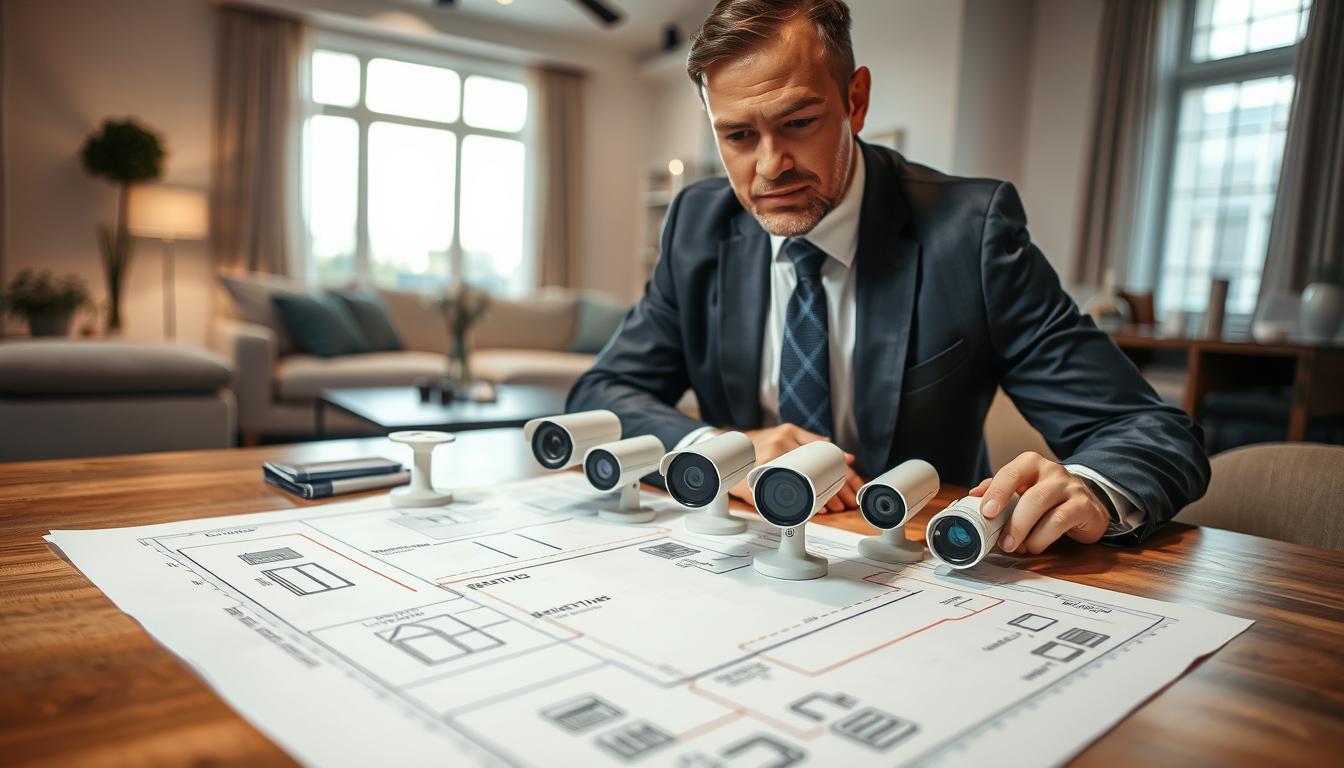
Create a simple map marking each proposed camera location. Note the device type and key features like night vision for each spot. This visual plan clarifies your security system needs.
Next, obtain quotes from reputable providers in Singapore. Consider professional installation for optimal setup and compliance. Balance comprehensive coverage with your budget; a phased approach starting with essential cameras works well.
You are now equipped to decide on a home security solution that deters crime and provides peace of mind. Remember, your surveillance needs may evolve. Review your plan as your family or property changes over time.
FAQ
What is the first step in planning a surveillance system?
The first step is a thorough security assessment. Walk around your property and note all entry points like doors and ground-floor windows. Identify vulnerable zones such as dark alleys or hidden side gates. Consider what you want to protect most, be it family, valuables, or vehicles.
Does the type of property I own affect the number of devices required?
Absolutely. A compact HDB flat has different needs than a sprawling bungalow. The overall square footage and layout are primary factors. More access points and larger living spaces naturally require a more extensive system to eliminate blind spots and ensure complete monitoring.
Which areas are considered essential for video monitoring?
Primary entry points are non-negotiable. This includes your main front door, back door, and garage. For comprehensive coverage, also consider the driveway, side gates, and any first-floor windows. Indoors, focus on living areas, main hallways, and staircases where movement is common.
Are indoor and outdoor surveillance units the same?
No, they are built for different environments. Outdoor cameras from brands like Hikvision or Dahua have robust weatherproof and IP ratings to withstand rain and heat. Indoor models often prioritize design and may lack this rugged housing. Using an indoor unit outside will lead to rapid failure.
What features are most important for effective monitoring?
High resolution (1080p or 4K) and superior night vision are critical for clear identification. Motion detection with instant smartphone alerts keeps you informed in real-time. For Singapore’s tropical climate, ensure all external devices have a high weatherproof rating, such as IP66 or IP67.
How do I cover a large area without using many units?
Consider a wide-angle or panoramic camera model. These devices provide a much broader field of view, reducing the number needed to monitor open spaces like living rooms or large driveways. For active monitoring, a PTZ (Pan-Tilt-Zoom) camera can cover vast areas by moving on command.


