

DVR vs. NVR: Key Differences Explained
Video surveillance is a cornerstone of modern security. For both homes and businesses, these systems provide critical protection. They deter crime and offer peace of mind. In Singapore’s dense urban environment, this security layer is especially valuable.
Two primary technologies dominate the market: the Digital Video Recorder (DVR) and the Network Video Recorder (NVR). Each offers a unique approach to capturing and managing footage. Understanding their core distinctions is the first step to a smart purchase.
This guide provides a clear, side-by-side comparison. We break down the technology, installation processes, and performance features. Our goal is to help you select the ideal security system for your specific needs.
Key Takeaways
- Video surveillance is essential for safety in residential and commercial settings.
- DVR and NVR systems use fundamentally different technologies and cameras.
- The choice impacts video quality, installation complexity, and overall cost.
- DVRs typically use analog cameras and coaxial cables.
- NVRs work with IP cameras and Ethernet cables, often enabling better video analytics.
- Remote viewing capabilities can vary significantly between the two systems.
- Selecting the right recorder ensures a scalable and effective security solution.
Introduction: Understanding Video Recorder Systems
At the heart of every reliable security operation lies a capable video recorder system. These devices form the backbone of modern protection infrastructure. They capture and store footage for critical later review.
The evolution from analog to digital video recording has revolutionized surveillance. Managing and accessing footage is now more efficient. This shift to a digital format is a key advancement.
Two primary technologies dominate this space: the Digital Video Recorder (DVR) and the Network Video Recorder (NVR). Each represents a distinct approach to the task. They come with unique technologies and methodologies.
Understanding begins with a simple fact. Both DVR and NVR systems record video digitally. Their fundamental split is in how they handle video data from the source.
Your choice between these systems has real impact. It affects not only video quality but also installation complexity and long-term upkeep. This decision shapes your entire security experience.
Selecting the right system requires alignment with your objectives. Consider your security goals and operational constraints. A business’s needs differ greatly from a home’s.
For Singapore users, local factors play a role. Network reliability and specific building regulations can influence the best pick. These practical concerns are vital for a smooth setup.
Grasping these basics provides a solid foundation. It allows you to better appreciate the detailed comparisons that follow. Your journey to an informed decision starts here.
Defining DVR and NVR Security Systems
Choosing the right security recorder starts with a clear definition of DVR and NVR technologies. These platforms are the engines of modern surveillance. They dictate how your cameras capture, transmit, and store video.
Grasping their core identities is essential. It moves you from a casual observer to an informed buyer. This knowledge directly impacts your system’s performance and value.
What is a DVR (Digital Video Recorder)?
A Digital Video Recorder is a hybrid system. It records footage in a digital format but connects to traditional analog cameras. This blend defines its character and capabilities.
DVR systems rely on specific hardware. Analog cameras connect to the recorder using thick coaxial cables. These cables carry raw, unprocessed video signals.
The magic happens inside the DVR box. It houses an analog-to-digital encoder. This chip converts incoming signals into viewable digital video. The recorder handles all the processing work.
This architecture makes DVRs a classic choice. They are often praised for cost-effectiveness and straightforward operation.
“DVR technology offers a reliable, no-fuss solution for standard surveillance needs,”
notes a security expert. It’s a proven path for many homes and small businesses.
What is an NVR (Network Video Recorder)?
In contrast, a Network Video Recorder represents a more modern approach. NVR systems are designed for the digital age. They work exclusively with intelligent IP cameras.
These security camera units have built-in processors. Each camera encodes and compresses video data on its own. It then streams this prepared data over a network.
The NVR unit functions primarily as a storage and management hub. Since processing occurs at the camera level, the recorder can focus on other tasks. This enables robust remote viewing and advanced video analytics.
Connection is typically via standard Ethernet cables. These cables often carry both power and data using Power over Ethernet (PoE). Wireless setups are also possible, adding to the system’s flexibility.
This technology supports higher scalability and smarter features. For users in Singapore looking to future-proof their security, NVR systems present a compelling, forward-looking option.
What is the Fundamental Difference Between DVR and NVR?
To grasp the essential contrast, focus on the journey of video data from lens to storage. The pivotal variation lies in where the processing happens.
In a DVR system, the recorder itself does the heavy lifting. Analog cameras capture raw video signals. They send this unprocessed feed through thick coaxial cables.
The DVR box then converts the analog signal into digital video. It encodes and compresses the footage for storage. This centralized processing defines its architecture.
An NVR system flips this model. Intelligence sits at the camera level. Each IP camera has its own processing chip.
It captures, digitizes, and encodes the video internally. The prepared data stream then travels over a standard network. Ethernet cables often handle both power and data.
The NVR primarily acts as a storage and management hub. This decentralized approach is the core difference.
“Think of a DVR as a central brain and its cameras as simple eyes. An NVR system gives each camera its own brain, creating a smarter, more flexible network,” explains a security technician familiar with installations in Singapore.
This fundamental split creates ripple effects. Camera compatibility is the most obvious. DVRs work with legacy analog cameras. NVRs require modern IP security camera units.
Cabling requirements follow suit. DVR installations need separate coaxial cables for video and power lines. NVR setups can use single Ethernet cables for both.
Scalability and remote viewing capabilities are also shaped. Because NVR systems are native to the network, adding cameras is often simpler. Remote viewing from smartphones is typically more seamless.
The on-camera processing in NVR technology unlocks advanced features. These include sophisticated video analytics like motion detection and facial recognition. Each camera can be configured individually.
Your existing infrastructure guides the choice. Have old analog cameras? A DVR might be the cost-effective path. Planning a new, high-definition security project? An NVR system likely offers better future-proofing.
Understanding these differences is key to evaluating your technical needs. It directly impacts video quality, installation complexity, and long-term system growth.
Core Components and How They Work
The performance of your surveillance setup hinges on understanding its fundamental building blocks. Each security platform relies on a specific set of hardware. These parts dictate everything from video clarity to installation ease.
Knowing the components helps you plan better. It also prevents costly mistakes during setup. Let’s examine the key pieces that make DVR systems and NVR systems tick.
At a basic level, the type of camera and cables used creates the main split. This choice determines how video data travels and gets processed. The recorder itself also plays a distinct role in each setup.
DVR System Components: Analog Cameras and Coaxial Cables
DVR systems are built around legacy technology. The heart of the setup is the analog camera. These devices capture a raw video signal, much like older television technology.
They transmit this unprocessed feed through dedicated coaxial cables. These are thick, rigid wires designed solely for video. A major limitation is their maximum reliable length—about 300 feet before signal loss occurs.
Powering these cameras requires separate wiring. Installers often use a siamese cable. This combines the coaxial video line and a power line in one sheath for simpler runs.
All analog feeds converge at the DVR box. Inside, a critical component called an analog-to-digital (AD) encoder does the heavy work. It converts incoming signals into a storable digital format.
“In a DVR setup, every camera is a dumb eye. The recorder is the brain that makes sense of it all,” summarizes a local installer familiar with Singapore’s older building infrastructures.
This architecture means each camera must have a direct, physical cable link to the recorder. Power is typically supplied from a central splitter box. The system is centralized but can be cumbersome to wire in large spaces.
NVR System Components: IP Cameras and Ethernet Cables
NVR systems represent a networked approach. Their core component is the intelligent IP security camera. Each unit is a small computer with its own processing chip.
It captures footage, compresses it, and encrypts the video data right inside the camera housing. This onboard intelligence is the key difference.
Connection to the network is via standard Ethernet cables, like Cat5e or Cat6. These thin, flexible cables are easier to route than coaxial ones. They have a standard run length of 328 feet.
A major advantage is Power over Ethernet (PoE). A single Ethernet cable delivers both data and electrical power to the camera. This eliminates the need for separate power connections.
The NVR unit itself has a simpler job. It acts as a central storage bank and management console. Since processing is done at the edge, the recorder just collects and stores the digital streams.
This decentralized design offers great flexibility. Cameras can be placed anywhere on the local network. Ethernet runs can be extended easily with network switches. This makes NVR systems highly scalable for growing businesses in Singapore.
The onboard processing also unlocks advanced features. These include intelligent video analytics and smoother remote viewing experiences directly on your smartphone.
DVR vs. NVR: Pros and Cons Compared
Every security technology presents a unique set of benefits and trade-offs. A clear side-by-side look at the pros and cons helps you match the platform to your specific needs. This is especially useful for property owners in Singapore balancing budget, performance, and future growth.
Your priorities will determine the best fit. Is upfront cost your main concern, or is future-ready video quality non-negotiable? Weighing these differences is key to a sound decision. For a more detailed comparison of DVR and NVR, explore our dedicated resource.
Advantages and Disadvantages of DVR Systems
DVR systems are celebrated for their cost-effectiveness. The technology is mature, and analog cameras are generally less expensive. This makes DVRs accessible for budget-conscious homes and small shops.
These setups also use minimal local network bandwidth. Video processing happens inside the recorder, not over the internet during capture. This can be a benefit in locations with limited connectivity.
The analog signal transmitted via coaxial cables can be very stable over shorter runs. It’s less susceptible to certain types of interference compared to some wireless data streams.
However, DVR systems have notable limitations. Video resolution is often capped at 1080p or lower. Capturing fine details like license plates at a distance can be challenging.
Native audio support is typically limited. Adding sound usually requires separate audio cables for each camera. The physical coaxial cables are bulky and difficult to run in tight spaces.
“For a basic, reliable setup where cost is king, DVR remains a solid choice. But its scalability is constrained by its own cabling architecture,” notes a security consultant.
Expanding a DVR system often means running more thick cables. This makes it less flexible for growing businesses. The features available are also generally more basic.
Advantages and Disadvantages of NVR Systems
NVR systems excel in delivering superior image quality. They support high-resolution footage up to 4K and beyond. This provides crystal-clear details crucial for identification.
Installation is notably simpler with Power over Ethernet (PoE). A single Ethernet cable delivers both power and data to each security camera. This drastically reduces cable clutter and labor time.
These platforms offer built-in audio capabilities and support advanced video analytics. Features like intelligent motion detection and facial recognition are common. This enables smarter, more efficient security monitoring.
Remote viewing is typically more seamless. Since cameras are native to the network, accessing live feeds from a smartphone is straightforward. The system is highly scalable by simply adding switches.
The primary drawback is higher upfront cost. The NVR unit and IP cameras are more advanced, reflecting in their price. A robust local network infrastructure is also a prerequisite.
Cybersecurity becomes a more active consideration. Each internet-connected camera is a potential entry point if not properly secured. Some brands may have compatibility issues, locking you into a single vendor.
Evaluating these pros and cons side-by-side provides clarity. DVR systems offer a proven, economical path. NVR systems invest in superior quality, flexibility, and intelligent features for the future.
Installation and Cabling: Ease of Setup
Planning the wire runs for your cameras is where theoretical choices meet physical reality. The installation process often dictates the final cost and long-term satisfaction with your security systems.
This practical phase highlights a major split between the two platforms. DVR systems and NVR systems demand completely different materials and techniques.
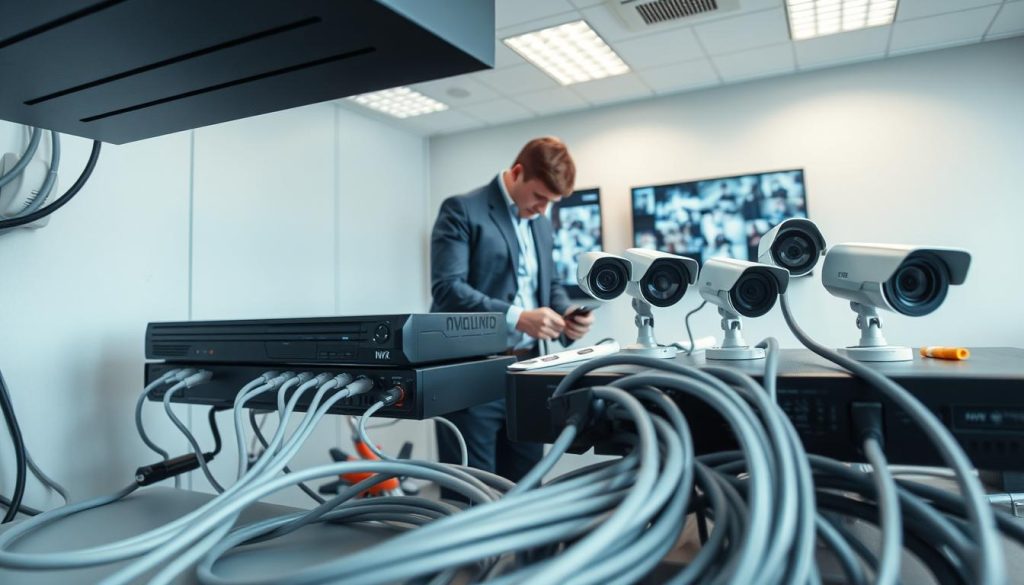
Your building’s layout and your DIY comfort level are key factors. In Singapore’s mix of old and new structures, this decision carries extra weight.
DVR Installation with Coaxial and Power Cables
Setting up a DVR system is a cable-intensive task. It revolves around running thick coaxial cables from each analog camera back to the central recorder.
These cables are stiff and have a wide diameter. Routing them through tight conduits or finished walls can be a genuine challenge.
Each camera also needs a separate power source. Installers often use a siamese cable. This bundles the coaxial video line with a power line in one sheath.
The maximum reliable length for a coaxial run is about 300 feet. Beyond this, video signal quality can degrade significantly.
“Running coaxial for a multi-camera DVR setup in a landed property often requires professional help. The cables don’t bend easily, and managing power for each point adds complexity,” shares a security technician familiar with Singapore homes.
This makes DVR installation less ideal for DIY enthusiasts tackling complex layouts. The need for two separate connections—video and power—for every camera adds to the labor.
NVR Installation with PoE Ethernet Cables
In contrast, deploying an NVR system is typically more streamlined. It utilizes standard Ethernet cables, like Cat5e or Cat6.
These cables are thin, flexible, and far easier to route. Their smaller connectors fit neatly into common wall plates and conduits.
The game-changer is Power over Ethernet (PoE). A single Ethernet cable delivers both data and electrical power to the IP camera.
This eliminates the mess and cost of separate power supplies. The standard maximum cable length is 328 feet, similar to coaxial.
Network switches can extend this range effortlessly. You can add many cameras across a large property without signal loss.
For wireless NVR systems, installation becomes even simpler. Cameras only need a nearby power outlet and a stable Wi-Fi connection.
This flexibility allows for cleaner, faster setups. It often reduces installation time and cost, a significant advantage for Singapore businesses looking to scale.
Understanding these installation realities is crucial for effective planning. It ensures your chosen security platform aligns with your property’s physical constraints and your technical comfort level.
Video Quality, Audio, and Advanced Features
Beyond simple recording, modern surveillance demands high-definition visuals, clear audio, and smart automation. The output from your security system determines its practical value. These elements separate basic monitoring from intelligent protection.
Video quality is the most visible differentiator. DVR systems typically max out at 1080p resolution. This is suitable for general overviews but can struggle with fine details at a distance.
NVR systems support 4K Ultra HD and higher megapixel cameras. This provides crystal-clear footage, crucial for identifying faces or license plates. In Singapore’s dense urban settings, this high quality can be a game-changer.
Audio capabilities also vary greatly. Adding sound to a DVR setup often requires extra RCA cables. This complicates the installation process. Some newer models use audio-over-coax technology, but it’s not universal.
In contrast, NVR systems natively transmit audio over the same Ethernet cable. Cameras with built-in microphones provide synchronized sound and video. This creates a more complete record of events.
The gap widens with advanced features. NVR platforms excel at intelligent video analytics. These features include facial recognition, people counting, and precise intrusion zones.
Motion detection in an NVR system is often smarter. It can distinguish between a person and a stray animal. This reduces false alarms and focuses attention on real threats.
“For proactive security, analytics are invaluable. An NVR can alert you to loitering or an object left behind, turning a passive recorder into an active guard,” explains a security integrator.
Remote viewing is possible on both platforms. NVR systems typically offer a more seamless experience. Their mobile apps and web interfaces are designed for the network from the ground up.
Accessing live feeds or recorded video from a smartphone is straightforward. The digital format of NVR data also allows easier integration with other smart security software.
DVR technology has seen improvements. Yet, it generally lags in feature richness and scalability. Its architecture is less suited for complex analytics.
Evaluating these features helps you match a system to your needs. If crystal-clear video quality and smart alerts are priorities, an NVR is compelling. For basic recording without advanced features, a DVR may suffice.
Choosing Between DVR and NVR for Your Needs in Singapore
In Singapore’s unique environment, the choice between DVR and NVR extends beyond mere technical specifications. Start by assessing your budget and existing wiring. DVR systems offer a cost-effective path if your property already has coaxial cables in place.
For new constructions or major upgrades, NVR systems provide superior video quality and easier scalability. They support advanced features like intelligent video analytics.
Local factors matter greatly. Singapore’s humid climate demands durable cameras. A stable network is crucial for NVR performance. Also, consider data privacy regulations for footage storage.
By weighing these aspects—cost, infrastructure, image clarity, and local conditions—you can select a security system that delivers optimal protection for your home or business.
FAQ
Can I use my existing analog cameras with an NVR system?
No, you cannot directly connect traditional analog cameras to a network video recorder. NVRs are designed to work exclusively with IP cameras, which process video data internally and transmit it digitally over a network. For an NVR setup, you would need to upgrade to compatible IP cameras.
Which system is easier to install, DVR or NVR?
NVR systems often offer easier installation, especially when using Power over Ethernet (PoE). A single Ethernet cable carries both power and data to each camera, simplifying the wiring process. DVR setups require separate coaxial cables for video and power cables for each analog camera, which can be more labor-intensive.
Do DVR systems support audio recording?
Support for audio in a DVR system is limited. It typically requires an additional audio input cable for each camera, and not all analog cameras have built-in microphones. In contrast, most modern IP cameras used with NVRs have integrated audio, transmitting sound over the same Ethernet cable, making audio features more standard and easier to implement.
Which offers better video quality: DVR or NVR?
NVR systems generally provide superior video quality. Since they work with high-resolution IP cameras, they support advanced formats like 4K and offer better clarity, especially for identifying details like faces or license plates. DVR systems are constrained by the limitations of analog camera technology and coaxial cables, often resulting in lower maximum resolution.
Are NVR systems more future-proof than DVRs?
Yes, NVRs are considered more future-proof. They leverage modern network technology, support higher-resolution cameras, and offer advanced features like intelligent video analytics, enhanced remote viewing, and easier integration with other smart security systems. DVR technology, while reliable, is based on older analog infrastructure with more limited upgrade paths.


