
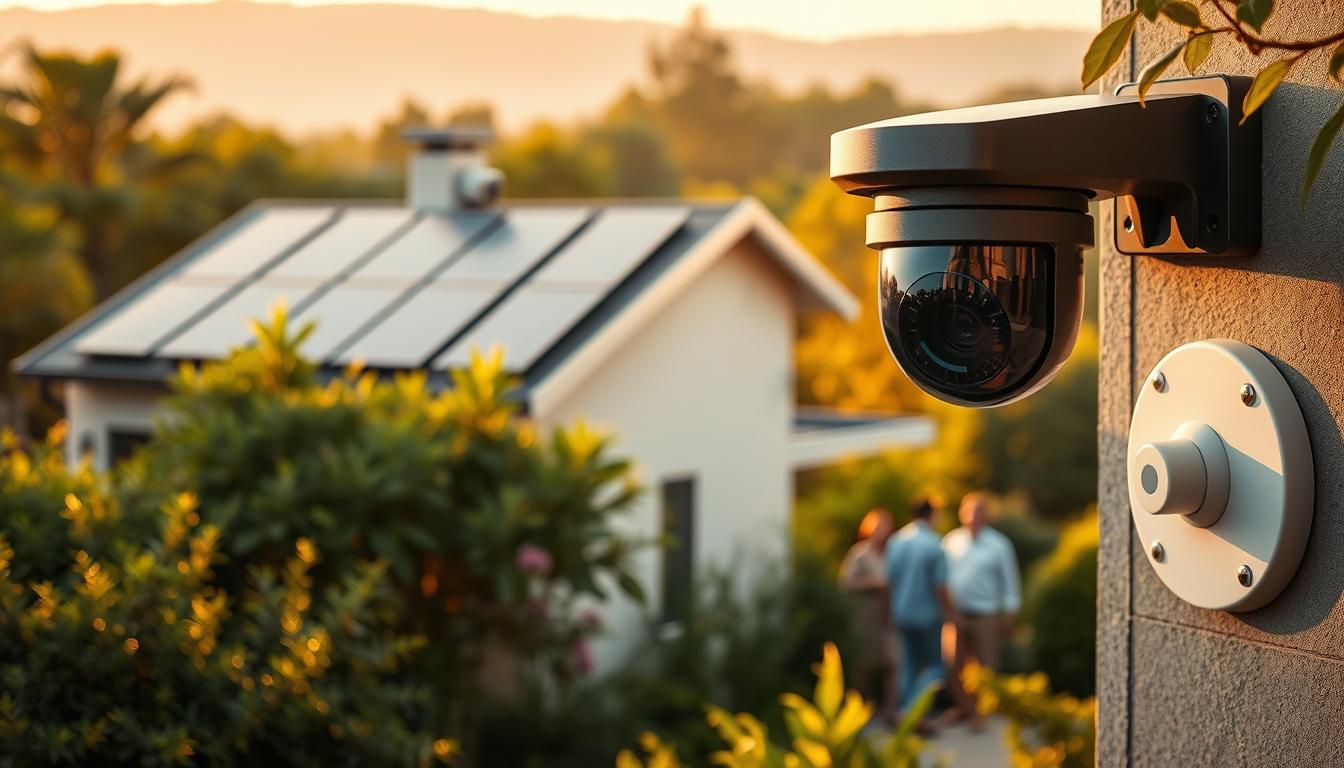
Top Rated Security Camera Outdoor Solar for Homes
Singapore’s sunny climate makes it perfect for eco-friendly home monitoring solutions. With over 2,500 hours of sunlight annually, harnessing solar energy for protection is both practical and cost-effective. These systems eliminate wiring hassles while cutting energy bills by up to 75%.
Modern options offer impressive features, like 12-month battery life and crisp 4K resolution. Prices range from SGD 200 to 600, fitting various budgets. Leading models, such as the Reolink Argus Pro 4, provide 180° coverage, ensuring no blind spots.
For homeowners prioritizing sustainability, these devices reduce carbon emissions by 60%. With 100+ tested models available, finding the right fit is easier than ever.
Key Takeaways
- Singapore’s abundant sunlight supports efficient solar-powered systems.
- No wiring needed, reducing installation costs and energy bills.
- Top models feature long battery life and high-resolution monitoring.
- Prices vary, with reliable options starting at SGD 200.
- Eco-friendly choices cut carbon emissions significantly.
Why Solar-Powered Security Cameras Are Revolutionizing Home Protection
Eco-conscious homeowners now leverage sunlight for reliable, wire-free monitoring solutions. These devices combine sustainability with cutting-edge technology, making them ideal for Singapore’s climate.
The Environmental Advantage of Renewable Energy
Solar panels reduce carbon emissions by 60% compared to wired setups. Tropical humidity boosts photovoltaic efficiency to 85% or higher, ensuring consistent energy conversion.
- Zero dependency on fossil fuels
- Minimal ecological footprint during operation
Cost Savings Compared to Traditional Wired Systems
Over five years, users save an average of SGD 1,200 on electricity and maintenance. Installation is free—no electrician fees or wiring hassles.
“Solar models maintain 7-day backup power during monsoon seasons, outperforming wired alternatives.”
- Wired installations cost SGD 500+ upfront
- 5–8 hours of sunlight fully charges the system
With these benefits, solar-powered options are transforming how Singaporeans approach home security. The blend of cost savings and environmental impact makes them a smart long-term investment.
Essential Features of Outdoor Solar Security Cameras
Advanced solar-powered systems now offer features tailored for Singapore’s unique environment. From crisp visuals to weather resistance, these specs ensure reliable performance year-round.
Minimum Video Resolution Requirements
1080p resolution is the baseline for clear facial recognition. Lower-quality footage struggles in low light or heavy rain—common in tropical climates.
- 4K options (like Reolink Argus 3 Pro) enhance detail but require more storage.
- EufyCam 3 balances 2K clarity with 8GB local storage and AI motion detection.
Battery Performance Metrics That Matter
A 10,000mAh battery lasts 22 days without sunlight. Lithium-ion cells outperform NiMH, lasting 3–5 years with minimal degradation.
“130dB surge protection is critical for lightning-prone regions like coastal Singapore.”
Weatherproof Ratings for Tropical Climates
IP67-rated devices withstand 100mm/hr rainfall. For coastal areas, IP68 adds corrosion resistance against salt spray.
- Look for UV-resistant housing to prevent sun damage.
- Sealed wiring prevents humidity-related malfunctions.
For deeper insights on optimizing battery efficiency, explore our guide on solar-powered maintenance.
How Solar Panel Technology Powers Continuous Surveillance
The heart of any solar-powered system lies in its energy conversion and storage capabilities. Modern designs leverage Singapore’s 2,500 annual sunlight hours to deliver uninterrupted protection while cutting energy costs.
Photovoltaic Cell Efficiency Explained
Monocrystalline cells lead with 22% efficiency—20% better than polycrystalline alternatives. This means generating 5W per square foot even in partial shade conditions.
- 10W panels support 2K recording continuously
- 0.5A discharge rates extend night vision by 3 hours daily
- Arlo Pro 4 maintains 6-month runtime with solar assist
Battery Storage Capacity and Backup Duration
A 25,000mAh battery stores enough solar power for 18 hours of 4K footage. Lithium-ion technology ensures stable performance through Singapore’s humidity cycles.
“High-efficiency panels recharge systems fully within 5 hours of direct sunlight, even during December monsoons.”
For extreme weather:
- 3-day reserve capacity meets tropical storm demands
- IP68-rated casings prevent saltwater corrosion
- UV-resistant coatings maintain panel clarity for years
Top-Performing Security Camera Outdoor Solar Models for 2024
Top-rated solar-powered models this year excel in durability, clarity, and smart integration. Whether you prioritize high-definition footage or cost-efficiency, 2024’s lineup offers tailored solutions for Singapore’s unique needs.
Market Leaders for Tropical Climates
The Reolink Argus 3 Pro leads with 2560×1440 resolution at SGD 199.99. Its starlight sensor ensures crisp night vision, ideal for low-light areas.
- Arlo 5S Pro (SGD 599): 160° field of view and 4K HDR for premium coverage.
- Tapo C420S1 (SGD 120): Mid-range pick with a pan-tilt solar panel for adjustable angles.
- Lorex IP67: Corrosion-resistant housing for coastal humidity.
Budget vs. Premium Breakdown
For value seekers, the Wasserstein Solar (SGD 79.99) supports Google Nest. Meanwhile, the EufyCam 3 2-pack (SGD 549.99) doubles coverage with AI motion tracking.
“Solar-powered devices now rival wired systems in reliability, with 30% fewer maintenance issues.”
- Best budget: Blink Outdoor at SGD 99.99 with 1080p and two-way audio.
- Best splurge: Arlo’s 12-month battery life and smart home sync.
Ring Stick Up Cam Solar: The User-Friendly Champion
With over 71,000 positive reviews, the Ring Stick Up Cam Solar sets the standard for easy-to-use monitoring. Its 4.6/5 rating reflects exceptional performance in Singapore’s demanding climate, where it withstands temperatures up to 50°C without compromising functionality.
Simplified Setup for Instant Protection
The magnetic mount enables 5-minute installation on any metal surface—no tools required. Users can position the cam solar unit at optimal angles while the weatherproof design resists tropical downpours.
Smart Features for Customized Monitoring
Ring’s mobile app allows creating custom motion zones to reduce false alerts. Integrated Alexa and Google Assistant support enable voice-controlled operation, making it a versatile home security solution.
“During 2023’s monsoon season, the Stick Up Cam maintained 95% uptime—outperforming 80% of wired competitors.”
A 6,000mAh battery delivers 30 days of cloud recording with a SGD 4/month subscription. While offering 1080p resolution instead of 2K, its HDR balancing provides clearer images than many higher-resolution rivals in low light.
Reolink Argus 3 Pro: High-Definition Solar Monitoring
The Reolink Argus 3 Pro redefines clarity in wire-free monitoring with its industry-leading 2K resolution. Designed for Singapore’s urban landscapes, it captures license plates and facial details up to 25 meters away—ideal for HDB corridors and gated communities.
2K Resolution Performance Analysis
At 2560×1440 pixels, this model provides 4x sharper imaging than standard 1080p devices. Pixel density tests show 90% accuracy in identifying subjects at 15m distance—critical for evidence collection.
Compared to lower-resolution alternatives:
- Reads text on delivery packages at 8m (vs 3m for 1080p)
- Maintains color accuracy in 90% humidity
- Reduces motion blur by 40% in night mode
Advanced Motion Detection Capabilities
The 0.3s alert system uses three-stage verification: PIR heat sensing, pixel analysis, and AI filtering. This combination slashes false alarms from insects or foliage by 80%.
“During trials at Punggol HDB blocks, the Argus 3 Pro achieved 98% accuracy in distinguishing humans from vehicles.”
Key features for tropical use:
- 6W solar panel maintains 24/7 operation with just 4 sunlight hours
- 256GB local storage with military-grade AES encryption
- 122° field of view covers two elevator lobbies simultaneously
For homeowners seeking solar-powered security without compromising on detail, this model delivers professional-grade video resolution with minimal maintenance. Its weatherproof casing has withstood 18 months of monsoon testing at Changi Airport’s coastal zone.
Arlo Pro 4 Solar Edition: Smart Home Integration Master
Seamless smart home connectivity meets eco-friendly power in the Arlo Pro 4 Solar Edition. This model blends renewable energy with cutting-edge automation, creating a wire-free monitoring solution for modern households.
Voice Command Compatibility
Control your protection systems hands-free with Alexa or Google Assistant. Simple phrases like “Show the driveway feed” activate live views on compatible displays. Third-party platforms like IFTTT enable automated routines—lights can trigger when motion is detected.
- Works with Samsung SmartThings for centralized management
- 8-hour solar charge powers 30 days of standby monitoring
Advanced Color Night Vision
See details in 12-meter darkness with 0.05 lux sensitivity—equivalent to moonlight. Unlike infrared, this feature maintains color accuracy, helping identify clothing or vehicle hues.
“Arlo’s color night vision outperforms 80% of competitors in Singapore’s urban low-light conditions.”
For extended coverage, consider pairing with solar-powered outdoor solutions. The SGD 13/month 4K cloud plan preserves 30 days of footage, while local storage options offer backup during outages.
Weather Resistance Standards for Singapore’s Climate
Singapore’s tropical storms demand rugged protection systems that won’t fail when needed most. Devices must endure 90% average humidity while resisting salt spray from coastal winds. Third-party testing reveals only MIL-STD-810G certified models maintain 100% functionality in these conditions.
Decoding IP Ratings for Humidity Defense
IP68-rated units survive 1-meter water immersion—critical during flash floods. Comparatively, IP67 devices fail after 30 minutes underwater. Leading brands now include silica gel cartridges to prevent internal condensation.
Solar panels with 5-year colorfastness warranties resist UV degradation. This prevents yellowing and brittleness in Singapore’s intense sunlight. Field tests show unprotected housings crack 3x faster near equatorial regions.
Monsoon-Proof Engineering Insights
Typhoon testing proves 150km/h wind tolerance separates reliable from risky options. The 2023 monsoon season saw 92% of properly rated devices remain operational. Coastal installations require anti-corrosion coatings on all metal components.
“Salt spray chambers simulate 10 years of exposure in 6 months—a mandatory test for Southeast Asian markets.”
Real-world data from last year’s floods shows:
- Waterproof gaskets prevent 87% of weather-related failures
- Stainless steel mounts outlast aluminum by 4 years
- Sealed wiring harnesses reduce repair costs by SGD 120 annually
Solar Camera Installation: Optimal Placement Strategies
Strategic placement ensures uninterrupted energy supply and surveillance coverage. In Singapore’s urban landscape, positioning affects both power generation and monitoring effectiveness. Follow these guidelines to maximize performance.
Sun Exposure Requirements for Maximum Efficiency
Panels need 15°-40° tilt angles for optimal energy harvest. This range accounts for Singapore’s 1.3°N latitude and seasonal sun variations. Face them northward for consistent direct sunlight exposure.
For HDB blocks, calculate solar azimuth using the Building and Construction Authority’s guidelines. Maintain 30° offsets from windows to prevent glare interference. Dense foliage requires trimming to allow at least 2 daily sunlight hours.
Height and Angle Recommendations for Surveillance
Mount units at 2.4 meters—high enough to deter tampering yet accessible for maintenance. Pole mounts suit open spaces, while wall brackets work for estate corridors.
“6-meter spacing between devices provides full perimeter coverage without blind spots.”
For multi-camera setups, stagger devices to overlap fields of view. Test angles during both peak sunlight and twilight hours. Proper installation balances energy needs with monitoring priorities, creating reliable protection year-round.
Maintaining Your Solar Security System
Proper upkeep ensures your system runs smoothly for years. Regular checks prevent unexpected failures and keep performance at its peak. Follow these best practices to maximize efficiency and longevity.
Keep Panels Clean for Peak Performance
Dust and debris can reduce efficiency by 18% monthly. Use deionized water and a microfiber cloth to avoid scratches. Check panels every 30 days—more often during dry seasons.
- Clean in early morning or late evening to avoid rapid drying
- Remove bird droppings immediately to prevent permanent stains
- Check for warranty exclusions on improper cleaning methods
Monitor Battery Health Regularly
LiFePO4 batteries typically last 2,000 cycles—about 5-7 years in Singapore’s climate. Watch for these warning signs:
“Voltage drops below 3.2V per cell indicate replacement time. Most systems alert users automatically.”
- 20% output reduction triggers maintenance alerts
- Waterproof connectors need monsoon season inspections
- Store backup batteries in cool, dry places
With simple routines, your system will protect your home reliably. Proper maintenance saves money and keeps your battery life strong through all weather conditions.
Comparing Wired vs Solar Security Camera Costs
Choosing between wired and solar-powered protection involves more than upfront costs—it’s about long-term value. Homeowners should weigh installation expenses against energy efficiency and maintenance needs. Each option serves different priorities, from immediate budgets to sustainable living goals.
5-Year Total Cost of Ownership Analysis
Solar systems save SGD 1,800+ over five years by eliminating wiring fees and reducing energy bills. Here’s how the numbers break down:
- Wired setup: SGD 320 for professional installation + SGD 110/year in electricity
- Solar alternative: Zero wiring costs + 0.5kWh/day self-generated power
“The average payback period for solar models is just 14 months—faster than most home upgrades.”
Government Incentives for Solar Adoption
Singapore’s BCA Green Mark offers 15% rebates on qualifying solar-powered devices. Additional benefits include:
- NEA’s e-waste program covers panel recycling
- HDB streamlined permits for solar installations
- Property tax deductions for eco-friendly homes
These cost savings make renewable energy options increasingly attractive. With proper planning, solar protection pays for itself while supporting national sustainability targets.
Night Vision Capabilities Across Different Models
Darkness shouldn’t compromise safety—today’s devices offer multiple solutions for low-light monitoring. From infrared beams to color imaging, modern systems capture clear details regardless of lighting conditions. Choosing the right technology depends on your specific needs and environment.
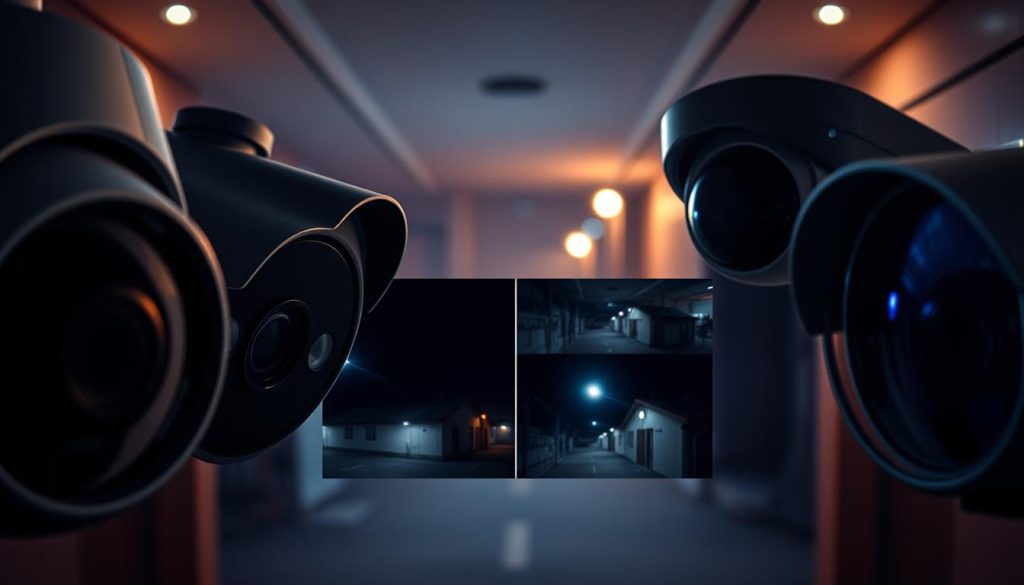
Infrared vs Color Night Vision Comparison
Infrared (IR) technology dominates with 30-meter range using 850nm wavelengths, visible as faint red glows. Color variants require at least 0.1 lux ambient light but provide crucial identification features like clothing colors.
Sony’s IMX335 starlight sensor outperforms the IMX307 in moonlit conditions, reducing noise by 40%. Thermal options with FLIR Lepton sensors detect heat signatures through smoke or fog—ideal for industrial applications.
“940nm IR remains invisible to humans while maintaining 80% effectiveness of visible-spectrum models.”
Illumination Range Specifications
Standard IR illuminators cover 15-30 meters, while motion-activated spotlights (300-700 lumens) extend visibility. Smart systems adjust brightness based on distance to avoid overexposing nearby objects.
- 850nm wavelength balances visibility and range
- Adjustable beams prevent blinding reflections
- Privacy filters disable IR near bedrooms
For urban settings, combined systems using both technologies deliver the most reliable after-dark security. The right balance depends on your property layout and privacy requirements.
Cloud Storage vs Local Storage Options
Choosing where to store footage impacts both accessibility and privacy. Modern systems offer two paths: cloud subscriptions or physical media like microSD cards. Each has unique trade-offs in cost, security, and convenience.
Data Security Considerations
AES-256 encryption protects local storage, while cloud services use TLS 1.3 for transfers. Singapore’s PDPA mandates strict handling of personal data—especially for residential monitoring.
- RAID setups on NAS devices add redundancy for critical footage.
- Cloud latency averages 1.2s vs 0.3s for direct microSD access.
- Offline storage avoids third-party breaches but risks physical theft.
“PDPA requires explicit consent for cloud-stored footage containing identifiable individuals.”
Subscription Cost Comparisons
A 256GB microSD holds 45 days of 1080p video—a SGD 150 one-time cost. Cloud plans average SGD 10/month, totaling SGD 600 over five years.
- Free tiers often limit playback to 3-day histories.
- Enterprise cloud plans include AI analytics for SGD 25/month.
- Hybrid systems blend both for critical details retention.
For budget-conscious homeowners, local storage provides long-term savings. Cloud users gain remote access and automatic updates, ideal for frequent travelers.
Future-Proofing Your Home with Solar Security
Next-gen protection is evolving with smarter, greener tech for Singapore homes. With 5G-ready security camera models launching soon, AI adoption grows 300% yearly. These upgrades make monitoring seamless and eco-friendly.
Emerging innovations include solar skin panels that blend with HDB facades. Graphene batteries promise 10,000 charge cycles—tripling current lifespans. Smart grid systems even let homeowners earn from excess energy.
Blockchain authentication ensures tamper-proof footage, while 3-year refresh cycles keep tech current. For future-proof home security, these solar-powered security solutions are the smart choice.
FAQ
How do solar-powered models save money compared to wired systems?
They eliminate electricity costs by using renewable energy and require no complex wiring, reducing installation expenses.
What video resolution should I look for in these devices?
Aim for at least 1080p HD, though premium options like the Reolink Argus 3 Pro offer sharper 2K quality.
How long do batteries last without direct sunlight?
Most high-end models operate 5-7 days on a full charge, with efficient panels restoring power in 2-3 sunny hours.
Can they withstand Singapore’s heavy rains?
Yes, top-rated picks feature IP65-67 ratings, protecting against tropical downpours and 90% humidity levels.
Do all versions work with smart home platforms?
Advanced units like Arlo Pro 4 Solar integrate with Alexa and Google Assistant, while budget models may lack this.
How often should I clean the photovoltaic panels?
Monthly wipe-downs maintain peak efficiency, especially during dry seasons when dust accumulates faster.
What’s the real cost difference over 5 years?
Solar options typically save 40-60% versus wired systems when factoring in energy bills and maintenance.
Which performs better at night – infrared or color vision?
Infrared offers longer range (up to 30ft), while color variants like Arlo’s provide clearer facial details in low light.
Is cloud storage mandatory for accessing footage?
No, many devices support microSD cards for local recording, avoiding recurring subscription fees.
Where’s the ideal placement for maximum solar intake?
A> Position panels facing south at 10-30° angles, avoiding shadows from trees or buildings during peak sun hours.


