
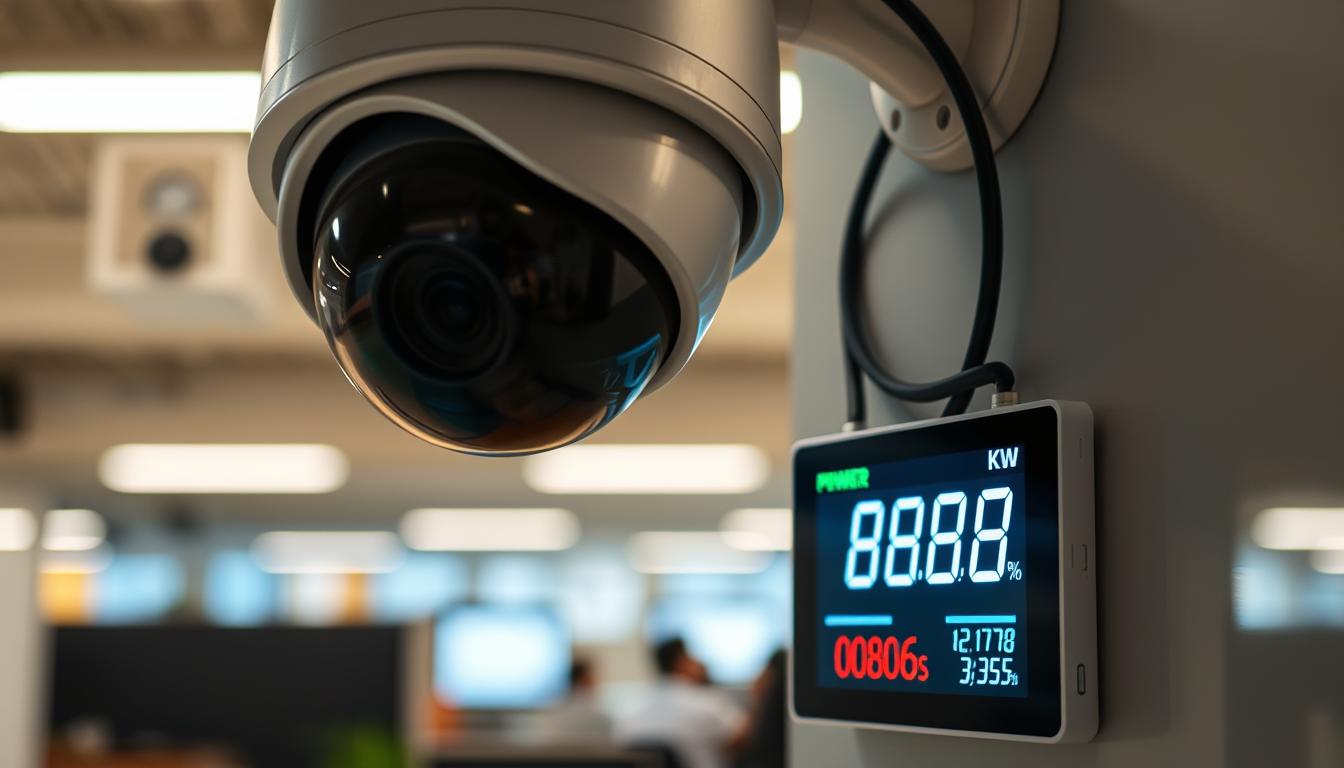
Discover How much electricity does CCTV use per month?
Security cameras have become essential for many Singaporean homes and businesses. People want protection but also worry about rising energy costs.
Understanding camera power consumption helps balance security needs with budget concerns. Different models and setups affect your electricity bills differently.
Most surveillance systems use modest amounts of energy. A typical camera runs on about 4.8 watts, though some models require more power.
This translates to approximately 0.1152 kWh daily per camera. Over a month, this energy use adds up to noticeable consumption figures.
Singapore residents can choose from various power options for their security systems. Individual adapters, multi-camera boxes, and Power over Ethernet offer different installation approaches.
Key Takeaways
- CCTV cameras typically consume around 4.8 watts of power during operation
- Daily energy use averages 0.1152 kWh per standard security camera
- Monthly consumption reaches approximately 3.456 kWh for a single camera
- Different power supply options affect overall system efficiency
- Understanding power usage helps manage electricity costs effectively
- Professional consultation can optimize your surveillance system’s energy consumption
Understanding CCTV System Power Fundamentals
Modern surveillance systems operate on specific electrical principles that determine their performance and operating costs. Knowing these fundamentals helps property owners make informed decisions about their security investments.
Proper power management directly impacts both system reliability and monthly expenses. Understanding these concepts prevents unexpected issues and optimizes your security setup.
Standard Power Supply Voltages: 12V DC and 24V AC
Most security cameras run on 12V DC power, which provides stable operation for continuous monitoring. This low voltage option ensures safety while delivering consistent performance.
Network video recorders and digital video recorders often require 24V AC power for their more complex operations. These higher voltage systems handle multiple camera feeds and data processing tasks.
Choosing the correct voltage prevents equipment damage and maintains optimal surveillance quality. Professional installers verify specifications to ensure perfect matches between cameras and power sources.
Key Electrical Terms: Watts, Voltage, and Amperage
Watts measure actual power consumption, determining how much energy your cameras use during operation. This measurement directly affects your electricity bills over time.
Voltage represents electrical pressure that pushes current through your surveillance system. Proper voltage levels ensure cameras function correctly without performance issues.
Amperage indicates current flow rate, showing how much electrical charge moves through wires. Higher amperage capacity allows support for more cameras on a single power supply.
These three measurements work together to determine total system requirements. Calculating needs involves multiplying rated power by a safety factor of 1.3.
Power distribution boxes become essential for multi-camera installations. They ensure stable delivery across all connected devices while preventing overload situations.
Quality power supplies significantly impact overall system longevity and efficiency. Inferior components can cause voltage fluctuations and premature equipment failure.
Following the 80% Rule prevents overload situations when calculating supply needs. This means total wattage should not exceed 80% of your power supply’s capacity.
Professional installation ensures correct power matching to camera specifications. This optimization prevents compatibility issues while maximizing energy efficiency.
Different Types of CCTV Systems and Their Energy Profiles
Camera technology evolution has created diverse energy consumption patterns across systems. Property owners should understand these differences when planning their surveillance infrastructure.
Each camera type offers unique advantages with corresponding power requirements. Smart selection helps manage operational costs while maintaining security effectiveness.
Analog Cameras vs. IP Cameras: A Power Comparison
Traditional analog models represent the most basic surveillance option available. These devices typically consume between 4-8 watts during operation.
Their relatively low energy use comes with limited functionality compared to digital alternatives. Basic recording capabilities keep power needs modest but restrict feature sets.
IP cameras represent the digital evolution in surveillance technology. These advanced units generally use 5-10 watts per hour during active monitoring.
Enhanced functionality justifies their slightly higher energy consumption. Users gain higher resolution, remote access, and advanced analytics capabilities.
Power over Ethernet (PoE): Simplifying Cabling and Power
This innovative technology revolutionized security system installations. PoE delivers both data and power through single Ethernet cables.
Installation complexity reduces significantly with this streamlined approach. Wiring simplification provides substantial benefits despite marginally higher energy use.
PoE cameras typically consume 10-12 watts during operation. Compatible switches or injectors may add slightly to overall system consumption.
The Reolink RLC-810A exemplifies efficient PoE design. This 4K HD security camera consumes less than 12 watts while delivering high-resolution surveillance.
The Rise of Solar-Powered CCTV Solutions
Solar-powered options represent the cutting edge of energy-efficient surveillance. These systems utilize renewable solar energy to power cameras independently.
Grid electricity dependence reduces significantly with solar assistance. Environmental benefits combine with operational cost savings for comprehensive advantages.
Battery-powered models like the Reolink Altas PT Ultra offer exceptional flexibility. These units provide up to 8 days of battery life for locations without power access.
Solar-assisted models combine high performance with minimal grid consumption. The Reolink Argus 3 Pro Ultra delivers 4K resolution with solar charging capabilities.
Different camera types offer varying energy profiles to match specific needs. Users can balance feature requirements with efficiency goals effectively.
Key Components That Dictate Your CCTV’s Energy Appetite
Multiple technical factors combine to determine your security camera system’s power requirements. Each component contributes differently to the overall energy consumption pattern.
Understanding these elements helps optimize your surveillance setup for efficiency. Smart component selection can significantly reduce operational costs over time.
Camera Features: IR Night Vision, PTZ, and Resolution
Advanced camera features directly impact power consumption levels. Infrared night vision requires additional LED illumination for darkness operation.
This feature typically adds 2-4 watts to baseline power requirements. The extra energy ensures clear nighttime monitoring capabilities.
Pan-Tilt-Zoom cameras represent the highest energy consumers. These units require 8-15 watts to power motorized movement mechanisms.
Enhanced optics and mechanical components drive this increased consumption. Resolution also correlates directly with power needs.
Higher resolution cameras demand more processing power. 4K and above models consume more energy than standard definition alternatives.
The Hidden Consumption of DVR and NVR Units
Recording devices constitute significant hidden energy consumers. DVR and NVR systems typically require 40-60 watts during operation.
This consumption remains relatively constant regardless of camera count. The units process and store video data continuously.
Specific models show varying consumption patterns. Hikvision DVR units use approximately 40 watts.
Dahua DVR systems can consume up to 60 watts. These differences reflect internal component efficiency variations.
Choosing energy-efficient recording equipment helps manage overall system consumption. Professional installation ensures optimal configuration.
Impact of Wiring Quality and Power Distribution Boxes
Infrastructure quality profoundly affects system efficiency. Inferior cables can cause voltage drops over long distances.
This forces cameras to draw more power to maintain performance. Quality wiring prevents these efficiency losses.
Power distribution boxes ensure stable voltage delivery to multiple cameras. They prevent energy waste and maintain consistent performance.
Component compatibility plays a crucial role in energy optimization. Mismatched power supplies and cameras cause inefficiencies.
Regular maintenance helps maintain optimal energy efficiency. Cleaning connections and verifying voltage levels extends system life.
- Infrared night vision adds 2-4 watts to baseline consumption
- PTZ cameras require 8-15 watts for motorized functions
- Higher resolution increases processing power demands
- DVR/NVR units consume 40-60 watts continuously
- Quality wiring prevents voltage drop inefficiencies
- Power distribution ensures stable voltage delivery
- Regular maintenance maintains peak efficiency
The Expanding Role of CCTV in Singapore’s Security Landscape
Advanced monitoring technology now forms an integral part of Singapore’s comprehensive security strategy. The city-state has embraced surveillance systems as essential tools for maintaining public safety and order.
This expansion reflects Singapore’s commitment to leveraging technology for enhanced security outcomes. The growing network addresses both current needs and future challenges in urban safety management.
Government Policies and the PolCam Initiative
Singapore’s surveillance landscape has expanded dramatically with strategic government support. Over 100,000 public safety cameras operate across the city-state, creating a robust monitoring network.
The Police Cameras (PolCam) initiative represents a significant government-led deployment effort. This program has installed more than 62,000 cameras in approximately 10,000 housing blocks.
These installations enhance community security through comprehensive coverage. The Ministry of Home Affairs actively supports integrating artificial intelligence into surveillance systems.
Advanced systems like the Hawk Eye Remote Observatory System demonstrate technological advancement. These systems capture critical information including vehicle license plates and facial recognition data.
Government policies strongly encourage adoption in both public and private spaces. This creates a comprehensive security network across the entire island nation.
Statistics: Current Installations and Future Projections
Current installation statistics reveal concentrated deployment in strategic locations. High-traffic public areas, residential estates, and transportation hubs receive priority coverage.
This creates layered security coverage that addresses diverse safety concerns. The approach ensures optimal resource allocation while maximizing protection.
Future projections indicate substantial growth in surveillance infrastructure. Government targets aim for nearly 180,000 operational cameras throughout Singapore by 2030.
This expansion aligns with Singapore’s smart nation initiative. The integration utilizes technology to enhance public safety while maintaining operational efficiency.
Future trends point toward increased integration with other smart city technologies. This creates interconnected networks that enhance overall security effectiveness.
The evolution of surveillance technology continues to shape Singapore’s security approach. Strategic deployment ensures both current protection and future readiness.
How Much Electricity Does CCTV Use Per Month? The Singapore Calculation
Singapore property owners need precise numbers to budget for security system operation. Understanding monthly energy consumption helps make informed decisions about surveillance investments.
Different camera models and configurations affect your power bills differently. Knowing these figures allows for better financial planning and system optimization.
Breaking Down Daily and Monthly kWh Consumption
Standard surveillance equipment follows predictable energy patterns. A typical unit consumes approximately 0.1152 kWh daily during continuous operation.
This daily usage accumulates to about 3.456 kWh monthly per camera. Annual consumption reaches roughly 41.472 kWh for a single surveillance unit.
The calculation formula provides accurate estimates for any configuration:
Total Energy Consumption (kWh) = (Total camera system wattage × Operation Hours per Day) ÷ 1,000
This equation helps Singapore residents project their security system costs accurately. Proper calculation prevents unexpected expenses on electricity bills.
Real-World Examples from Common Camera Models
Different surveillance technologies show varying energy profiles. The Axis M4215-LV dome camera operates at about 4.8 watts normally.
During peak operation, this model can reach 9.5 watts consumption. This flexibility demonstrates how usage patterns affect total power needs.
Basic IP cameras typically use 3-10 watts during operation. Monthly consumption ranges from approximately 2.1-7.2 kWh depending on operational hours.
Bullet surveillance units generally consume 4-8 watts. This translates to 2.9-5.8 kWh monthly, offering durable monitoring with moderate energy requirements.
PTZ cameras represent the highest consumption category. These advanced units use 8-15 watts due to their mechanical and optical features.
Monthly usage for PTZ models reaches 5.8-10.8 kWh. The Reolink RLC-810A PoE IP 4K HD camera consumes less than 12 watts while delivering high-resolution capabilities.
System configuration significantly impacts total energy consumption. Additional components like DVR/NVR units add 40-60 watts to overall system requirements.
Understanding these patterns helps Singapore residents estimate their surveillance electricity costs accurately. Smart system design balances security needs with energy efficiency.
Factors That Cause Your CCTV Electricity Bill to Fluctuate
Monthly surveillance costs can vary significantly based on several key factors. Understanding these variables helps Singapore property owners predict and manage their security expenses more effectively.
Different operational approaches and environmental conditions create noticeable differences in power consumption. Smart system management can lead to substantial savings on electricity bills over time.
Operational Hours: 24/7 Recording vs. Motion Activation
Continuous recording represents the most energy-intensive surveillance approach. Systems running 24/7 consume significantly more power than those using smart activation features.
Motion detection technology offers substantial energy savings. This intelligent feature reduces consumption by 50-70% compared to constant recording.
Cameras only activate when movement occurs within their detection range. This smart approach cuts power use while maintaining security coverage.
Standby mode still consumes energy even during inactive periods. Most units use 2-4 watts while waiting for activation triggers.
Environmental Factors and System Age
Temperature extremes impact camera performance and energy needs. Both hot and cold conditions force surveillance equipment to work harder.
Infrared night vision consumes extra power during longer winter nights. Seasonal variations create noticeable fluctuations in monthly consumption patterns.
Older surveillance systems tend to be less efficient than modern alternatives. Aging components and outdated technology increase energy costs over time.
Advanced models like the Hikvision Solar-Powered Security Camera demonstrate exceptional efficiency. These units use only 0.01-0.1 watts in standby mode.
Regular maintenance helps maintain optimal performance levels. Cleaned lenses and updated firmware prevent unnecessary energy waste.
Proper camera placement influences overall power needs. Outdoor installations often require more energy for enhanced weather protection features.
“Motion-activated systems can reduce surveillance energy consumption by more than half while maintaining effective security coverage.”
Understanding these fluctuation factors helps Singapore residents manage their surveillance costs. Smart system configuration balances security needs with energy efficiency goals.
Calculating the Exact Impact on Your Singapore Electricity Bill
Singapore residents seeking to understand their surveillance expenses need accurate calculation methods. Precise cost estimation requires combining equipment specifications with local utility rates.
Different security setups create varying financial impacts. Knowing your exact consumption helps manage household budgets effectively.
Step-by-Step Guide to Estimating Monthly Costs
Begin by identifying each component’s wattage rating. Check manufacturer specifications for cameras, recorders, and additional equipment.
Determine daily operational hours for your surveillance setup. Continuous recording requires different calculations than motion-activated systems.
Apply the standard energy calculation formula:
(Total Wattage × Hours Daily × 30 Days) ÷ 1000 × Electricity Rate
This formula provides monthly cost estimates in Singapore dollars. Remember to include all active components in your total wattage calculation.
Sample calculations demonstrate real-world cost variations. A single 6-watt camera operating continuously costs approximately SGD 5.20 monthly.
Recording equipment adds significant expenses. A 40-watt Hikvision DVR running 24/7 adds about SGD 35.76 to monthly bills.
Advanced cameras like the Reolink RLC-810A show different cost patterns. At 12 watts continuous operation, monthly costs reach approximately SGD 10.44.
Multi-camera installations compound these expenses dramatically. Each additional unit increases both security coverage and operational costs.
Understanding Local Electricity Rates in Singapore
Singapore’s energy market features multiple providers with varying rate structures. SP Group, Keppel Electric, and Senoko Energy offer different pricing options.
Residential rates typically range between SGD 0.25-0.30 per kWh. Commercial properties often face different tariff structures.
Time-of-use pricing affects overall surveillance costs. Some providers charge different rates for peak and off-peak hours.
Fixed-rate plans provide cost predictability for security system budgeting. Renewable energy options may offer alternative pricing models.
Seasonal variations and government tariffs influence final costs. Regular rate reviews ensure accurate budget projections.
Professional energy audits provide precise cost projections. Experts consider specific equipment, usage patterns, and local rate structures.
Consult current rate schedules from your electricity provider. Updated information ensures accurate surveillance cost calculations.
Understanding these factors helps Singapore residents manage security expenses effectively. Proper planning balances protection needs with budget considerations.
Practical Strategies to Reduce CCTV Power Consumption
Singapore property owners can implement smart approaches to manage their surveillance energy use effectively. These practical methods help maintain security coverage while minimizing electricity expenses.
Strategic adjustments to camera configurations and operational patterns yield significant savings. Many users achieve substantial reductions without compromising their protection levels.
Optimizing Camera Settings: Resolution, Frame Rate, and Codecs
Resolution adjustments offer immediate energy savings opportunities. Reducing from Full HD to HD quality can cut bandwidth requirements by up to 60%.
This reduction directly impacts processing power needs and overall consumption. Many surveillance situations don’t require maximum resolution for effective monitoring.
Frame rate adjustments provide substantial efficiency improvements. Lowering FPS from 25 to 8 reduces bandwidth and storage needs by approximately 70%.
Modern codec selection dramatically affects power requirements. H265 compression offers about 40% bandwidth savings compared to H264 technology.
These technical settings work together to optimize overall system performance. Smart configuration balances video quality with energy efficiency effectively.
Scheduling Recordings and Leveraging Motion Detection
Recording schedules allow targeted surveillance during critical hours. This approach significantly reduces unnecessary power usage during low-risk periods.
Motion detection technology represents the most effective power-saving strategy. This intelligent feature can reduce energy consumption by 50-70% compared to continuous recording.
Advanced systems only activate when movement occurs within detection ranges. This smart approach maintains security coverage while cutting power use dramatically.
Variable bitrate implementation enables adaptive energy usage. Cameras adjust bandwidth consumption based on scene activity rather than maintaining constant high levels.
These smart features demonstrate how modern technology enhances efficiency. Users gain both security protection and cost savings through intelligent design.
Routine Maintenance for Peak Efficiency
Regular upkeep ensures surveillance equipment operates at optimal efficiency levels. Cleaned lenses and updated firmware prevent unnecessary energy waste over time.
Proper ventilation and environmental management maintain performance standards. These practices extend equipment lifespan while reducing power requirements.
Power supply optimization through multi-camera distribution boxes improves efficiency. This approach reduces energy loss compared to individual adapter setups.
Environmental adjustments like proper camera placement and adequate shading help too. These measures reduce the need for excessive infrared illumination during nighttime operation.
Consistent maintenance routines deliver long-term benefits for Singapore users. Well-maintained systems operate more efficiently and require less energy overall.
- Resolution optimization cuts bandwidth needs by up to 60% when reducing from Full HD to HD quality
- Frame rate adjustment from 25 to 8 FPS reduces bandwidth and storage requirements by approximately 70%
- H265 codec implementation offers about 40% bandwidth savings compared to H264 compression
- Motion detection technology can reduce energy consumption by 50-70% through smart activation
- Recording scheduling targets surveillance during critical hours, reducing unnecessary power usage
- Regular maintenance including lens cleaning and firmware updates prevents energy waste
- Power distribution boxes improve efficiency compared to individual adapter setups
- Environmental adjustments reduce excessive infrared illumination needs during nighttime operation
Choosing an Energy-Efficient CCTV System
Smart surveillance selection involves balancing security needs with operational efficiency. Modern technology offers excellent options that deliver protection while minimizing energy costs.
Advanced engineering now enables high-performance monitoring with reduced power requirements. Singapore property owners can achieve comprehensive security without excessive electricity bills.
What to Look For: Energy Ratings and Efficient Chipsets
Energy-efficient surveillance begins with identifying cameras featuring advanced processing technology. Modern chipsets reduce power consumption while maintaining full performance capabilities.
Look for manufacturers that prioritize efficiency in their design philosophy. These companies invest in research to optimize energy use without compromising security features.
While industry-wide energy certifications are still developing, some manufacturers adopt standards similar to Energy Star for appliances. These ratings help identify units meeting specific efficiency benchmarks.
Efficient chipset technology enables advanced capabilities like deep learning analytics. These processors handle complex tasks while minimizing electricity requirements through optimized operation.
Top Picks for Low-Power Cameras in the Market
The Reolink RLC-810A exemplifies energy-efficient design excellence. This Power over Ethernet camera consumes less than 12 watts while delivering stunning 4K resolution surveillance.
Solar-powered models offer complete energy independence for suitable locations. The Reolink Argus 3 Pro utilizes integrated solar panels to generate electricity and significantly reduce grid dependence.
For remote installations without power access, consider 4G-enabled battery-operated options. The Reolink Go Plus operates on cellular networks with minimal power requirements, perfect for challenging locations.
Wireless camera options typically consume less energy during operation. These units require periodic recharging, making them ideal for applications where continuous recording isn’t essential.
PoE+ (Power over Ethernet Plus) technology represents the latest efficiency advancement. These systems consume approximately 20% less energy than standard PoE while maintaining full functionality.
“Advanced chipset technology enables high-resolution surveillance with minimal energy consumption, proving efficiency and performance can coexist perfectly.”
When evaluating options, carefully review manufacturer specifications for both active and standby power requirements. This attention to detail ensures accurate efficiency assessment and helps manage long-term operational costs.
Singapore residents can now choose from various energy-conscious surveillance solutions. These options provide security protection while respecting both environmental concerns and budget limitations.
Harnessing Technology for Smarter Power Management
Modern surveillance solutions leverage advanced technologies to optimize energy efficiency while maintaining robust security performance. These innovations help Singapore property owners achieve reliable protection without excessive operational costs.
Smart power management approaches combine cutting-edge hardware with intelligent software controls. This integration creates surveillance systems that adapt to actual security needs while minimizing waste.
The Advantages of Power over Ethernet Technology
Power over Ethernet represents a revolutionary approach to surveillance installations. This technology delivers both data connectivity and electrical power through standard Ethernet cables.
The unified infrastructure eliminates separate power wiring requirements. This simplification reduces installation complexity and improves overall system reliability.
Different PoE standards offer varying power delivery capabilities. IEEE 802.3af provides up to 12.95 watts, suitable for most standard surveillance units.
For high-power devices, IEEE 802.3bt Type 4 delivers up to 71.3 watts. This capacity supports advanced cameras with extensive features and capabilities.
Advanced PoE switches enable precise energy allocation management. These systems allow prioritization of critical cameras during power constraints or outages.
“PoE technology transforms surveillance installations by combining power and data transmission, reducing complexity while enhancing reliability and efficiency.”
Implementing UPS Systems for Backup Power
Uninterruptible Power Supply systems ensure continuous operation during electrical interruptions. These backup solutions provide immediate power switching during outages.
UPS protection prevents data loss and maintains surveillance coverage. This reliability is crucial for security-sensitive applications in Singapore.
Battery backup solutions range from small units for individual cameras to large-scale systems for entire networks. Selection depends on specific security requirements and outage risks.
Solar power integration offers sustainable energy solutions for remote installations. Photovoltaic panels generate electricity independently from the grid.
Hybrid systems combine solar, battery, and grid power for maximum reliability. These configurations automatically switch between sources based on availability.
Smart management systems enable remote monitoring and control of power consumption. Users can optimize energy usage based on actual surveillance needs and patterns.
- PoE technology simplifies installations by combining power and data transmission
- IEEE standards define power delivery capabilities from 12.95 to 71.3 watts
- UPS systems provide immediate backup during power outages
- Solar integration offers sustainable energy solutions for remote locations
- Hybrid systems combine multiple power sources for maximum reliability
- Smart management enables remote monitoring and optimization of energy usage
- Advanced PoE switches allow precise control over power allocation
These technological advancements help Singapore residents maintain effective security while managing energy costs. Smart power solutions deliver protection without compromising efficiency.
Weighing the Cost: Security Value Versus Electricity Expense
Singapore property owners face an important decision when considering surveillance investments. The balance between security benefits and operational costs requires careful evaluation.
Modern security systems offer remarkable protection at surprisingly low energy costs. The value proposition extends far beyond simple power consumption numbers.
Analyzing Long-Term Financial Benefits and Potential Insurance Savings
Comprehensive analysis reveals that surveillance electricity expenses remain minimal compared to protection benefits. Many insurance providers recognize this value through premium reductions.
Professional monitoring systems often qualify for 10-20% discount rates. These savings can completely offset operational costs over time.
Solar-powered options like the ZOSI 1NC-291 demonstrate exceptional efficiency. These systems virtually eliminate grid dependence while maintaining continuous coverage.
Crime prevention benefits extend beyond direct property protection. Reduced insurance claims and business interruption risks add significant financial value.
“The security benefits of modern surveillance systems far outweigh their minimal operational costs, making them one of the most cost-effective protection investments available today.”
Why the Peace of Mind Offered Outweighs the Minimal Cost
The psychological value of security represents an intangible benefit that frequently justifies the expense. Knowing your property remains protected provides immeasurable comfort.
Modern systems offer remote monitoring capabilities that enhance convenience and flexibility. These features add value beyond basic security functions.
Professional installation ensures optimal efficiency and proper component matching. This expertise maximizes security value while minimizing ongoing operational expenses.
Long-term financial analysis should consider both hardware costs and energy consumption against potential loss prevention. The minimal power needs make these systems highly cost-effective investments.
- Insurance premium reductions often cover operational costs completely
- Solar integration eliminates grid dependence for suitable locations
- Crime prevention protects property values and reduces claim risks
- Remote monitoring adds convenience beyond basic security
- Professional installation optimizes both performance and efficiency
- Peace of mind provides intangible value that justifies minimal expenses
The overall value proposition clearly favors surveillance implementation. Security benefits significantly outweigh the modest power consumption concerns for most Singapore applications.
Future Trends: The Path Towards Greener Surveillance in Singapore
Singapore’s surveillance landscape is rapidly evolving toward sustainable solutions that balance security needs with environmental responsibility. Emerging technologies focus on reducing energy consumption while enhancing monitoring capabilities.
These innovations address both operational efficiency and environmental concerns. Singapore’s smart nation initiative supports this transition to greener security systems.
AI and Analytics for Smarter, Less Wasteful Monitoring
Artificial intelligence transforms how cctv cameras operate and consume power. Smart algorithms analyze scenes in real-time, activating full recording only when needed.
This approach significantly reduces unnecessary energy use. Systems focus resources on relevant events rather than continuous operation.
Machine learning enables predictive monitoring capabilities. Cameras can anticipate security events before they occur, further optimizing power usage.
These technologies help save energy while maintaining comprehensive protection. The result is lower electricity bills without compromising security.
The Integration of 5G and IoT in Future CCTV Systems
5G network technology enhances surveillance performance with ultra-low latency. This enables more efficient data transmission compared to traditional networks.
Internet of Things integration creates interconnected security ecosystems. Cameras communicate with other devices, optimizing overall system efficiency.
Edge computing processes video data locally within cameras. This reduces bandwidth requirements and cloud processing needs, lowering energy consumption.
Cloud-native solutions offer improved scalability and cost efficiency. Resources allocate dynamically based on actual needs rather than maintaining constant high capacity.
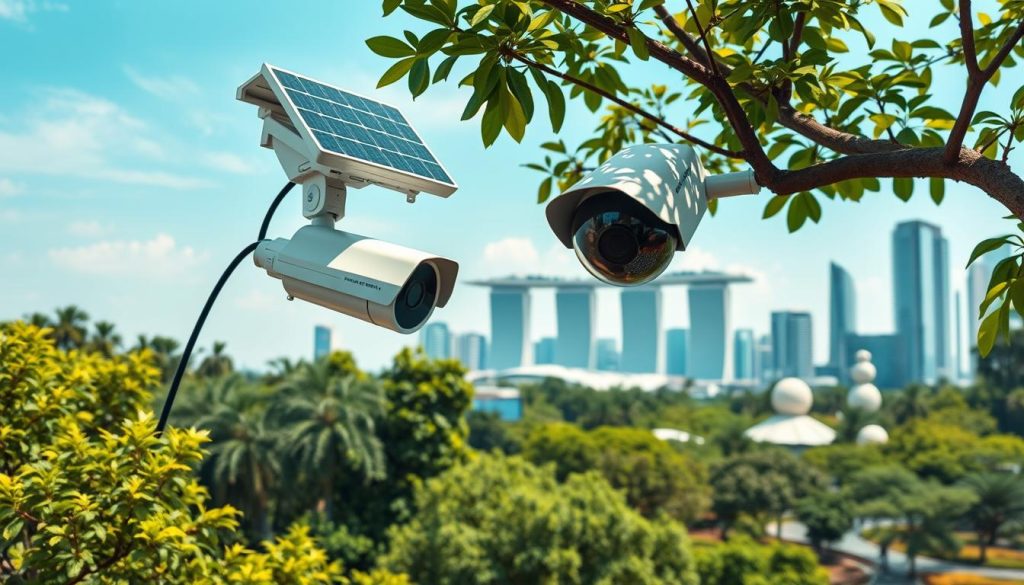
Future developments include self-powering cameras utilizing ambient energy harvesting. These systems might eventually eliminate grid electricity dependence entirely.
Singapore’s commitment to technological advancement drives these innovations. The integration with smart city infrastructure enables centralized energy management across surveillance networks.
For remote locations, solar-powered CCTV with 4G connectivity offers complete energy independence. These systems represent the cutting edge of sustainable security solutions.
“Advanced AI and IoT technologies enable surveillance systems to operate with unprecedented efficiency, reducing energy waste while enhancing security coverage.”
These trends point toward a future where security systems use less power while delivering better protection. Singapore remains at the forefront of adopting these green surveillance technologies.
Making an Informed Decision on Your CCTV Power Needs
Choosing the right surveillance setup requires careful consideration of your specific security requirements and power consumption goals. Every property has unique monitoring needs that influence optimal system selection.
Professional consultation ensures you get personalized recommendations for your situation. Experts like CCTV Maintenance (+65 60135960) provide current solutions that balance protection with energy efficiency.
Understanding your power needs helps select appropriate cameras and configurations. Modern energy-efficient models deliver comprehensive security with lower operating costs.
The minimal electricity used by today’s systems means excellent value. You achieve robust protection without significant impact on your monthly bills.
FAQ
What is the typical power consumption of a CCTV camera?
Most modern cameras use between 4 to 15 watts. Analog models often use less power, while advanced IP cameras with features like PTZ or high-resolution sensors might use more. Always check the manufacturer’s specifications for exact power needs.
How does Power over Ethernet (PoE) affect energy use?
PoE simplifies installation by delivering both data and power through a single cable. It can improve efficiency by reducing power loss compared to some traditional setups, and it typically supports cameras that use watts within standard ranges, making energy management easier.
Do DVR and NVR units add significantly to electricity bills?
Yes, these recording devices contribute to overall consumption. A typical DVR or NVR might use 10 to 40 watts, depending on the number of channels and hard drives. This hidden consumption should be factored into your total system power usage.
Can I reduce my CCTV system’s energy costs?
Absolutely. Adjust settings like resolution and frame rate, enable motion activation instead of continuous recording, and perform routine maintenance. Choosing energy-efficient models and leveraging technologies like PoE can also cut power use and lower your bills.
How do I calculate the monthly cost for my CCTV in Singapore?
Multiply the total wattage of your cameras and recorder by the number of operational hours, then convert to kWh. Multiply that by Singapore’s electricity rate (around SGD 0.25 to 0.30 per kWh) to estimate your monthly expense. For example, a 10-watt camera running 24/7 might cost about SGD 1.80 per month.
Are solar-powered CCTV systems a viable option?
Yes, especially in sunny climates. Solar solutions can eliminate grid power dependence for cameras, reducing electricity bills to zero for the surveillance component. They are becoming more reliable and are an excellent choice for remote or eco-conscious installations.
Does night vision increase a camera’s power consumption?
Yes, activating IR LEDs for night vision will increase energy use. The extra power needed varies but is generally a small addition. Modern cameras are designed to manage this efficiently, but it’s a factor in total consumption.
Will a CCTV system noticeably increase my home’s electricity bill?
For most standard setups, the increase is minimal. A typical system with a few cameras and a recorder might add only a few dollars to your monthly bill. The security benefits far outweigh this small cost for nearly all users.


