
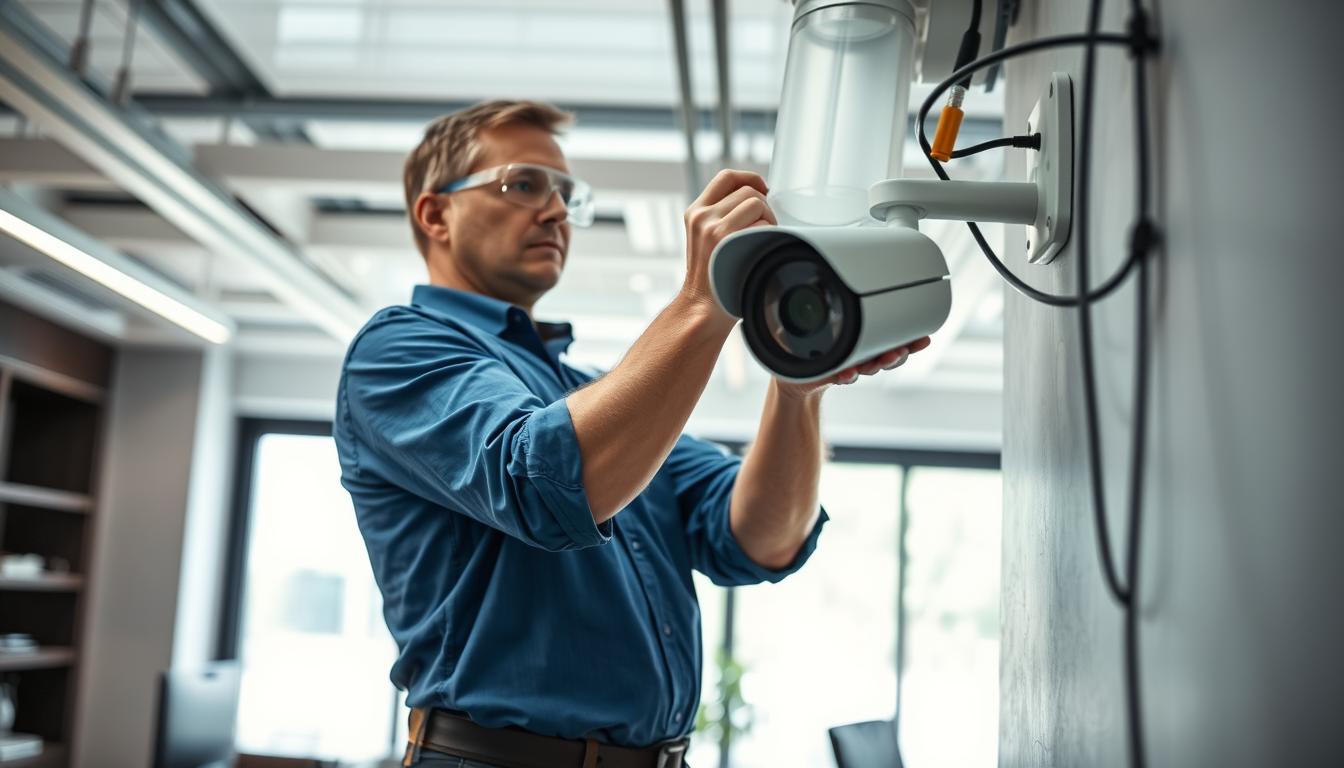
Definition: What is CCTV installer called?
People who set up surveillance equipment go by several professional titles. You might hear them called Surveillance Systems Technicians or Security Systems Installers. Some specialists focus on IP camera technology.
These experts play a crucial role in Singapore’s security landscape. Their work helps protect homes, businesses, and public spaces. The demand for skilled professionals continues to grow alongside the nation’s Smart Nation goals.
This career path blends hands-on technical work with IT knowledge. Professionals need problem-solving skills for complex installations. They often integrate camera systems with access control and monitoring solutions.
Our guide explores this vital field in detail. We will cover common job titles and daily responsibilities. You’ll learn about required training, certifications, and promising career prospects in Singapore.
Key Takeaways
- Security camera professionals have multiple job titles based on their specific expertise.
- These technicians are essential for safety in Singapore’s private and public sectors.
- The role requires a mix of practical, technical, and analytical skills.
- Industry certifications and proper training are important for career advancement.
- Professionals often work with integrated security solutions beyond just cameras.
- Singapore’s security industry offers growing opportunities for qualified individuals.
- Technical knowledge must include both hardware installation and software configuration.
What is a CCTV Installer Called? Defining the Security Professional
Singapore’s expanding security field features multiple career titles for those handling camera systems. These roles reflect different levels of technical skills and areas of expertise. The choice of title often indicates the complexity of projects a professional manages.
With over 5.2 million operational cameras nationwide, Singapore’s security industry needs varied specialists. This growth creates steady demand for qualified individuals. Professionals ensure proper monitoring and recording for homes and businesses.
Common Professional Titles in the Industry
Several specific designations exist within the surveillance sector. A Security Systems Technician typically handles physical hardware mounting and component replacement. This role demands solid practical experience with various equipment types.
A Surveillance Engineer usually manages complex network configurations and system integration. This position requires deeper knowledge of IP-based solutions. These engineers often design entire monitoring networks from scratch.
An IP Camera Specialist focuses specifically on network-connected devices. They understand video compression, bandwidth management, and remote access. Their expertise ensures optimal performance for digital surveillance systems.
The title CCTV Technician remains common for general installation and maintenance work. These professionals troubleshoot basic issues with analog and digital systems. They follow established standards for safe and effective installations.
Beyond Installation: The Scope of Modern Roles
Today’s surveillance professionals do much more than mount cameras. Their work includes comprehensive system design and planning. They assess site requirements and recommend appropriate solutions.
Integration forms a crucial part of modern security systems. Specialists connect cameras with access control and alarm systems. This creates unified protection networks for enhanced safety.
Regular maintenance and proactive servicing prevent system failures. Technicians perform software updates and hardware checks. They ensure continuous operation of critical surveillance infrastructure.
Client consultation and training have become essential soft skills. Professionals explain system operation to end-users. They provide guidance on best practices for security monitoring.
Advanced troubleshooting addresses complex technical problems. Specialists diagnose network issues and connectivity problems. Their analytical skills minimize downtime for security operations.
These expanded responsibilities make surveillance careers more dynamic. Professionals now need both technical and interpersonal abilities. The field offers diverse opportunities for those with the right certifications and training.
The Core Responsibilities of a Surveillance Systems Technician
Professionals in this field manage a comprehensive cycle of planning, implementing, and sustaining security infrastructure. Their work ensures reliable protection for Singaporean homes and businesses. Daily duties extend well beyond basic equipment setup.
Technicians handle three primary areas: system deployment, ongoing care, and technical problem-solving. Each area requires specific skills and knowledge. Together, they form the foundation of effective surveillance operations.
Installation and System Configuration
Every project begins with a detailed site assessment. Technicians evaluate lighting conditions, potential blind spots, and optimal camera positions. They consider both security coverage and aesthetic factors.
Cable management is crucial for clean, tamper-resistant installations. Professionals conceal wiring within walls or conduits whenever possible. This approach maintains property appearance while protecting critical connections.
Recording device configuration follows physical setup. Technicians program DVRs or NVRs with appropriate video retention periods. These settings balance storage capacity with client needs for evidence preservation.
Digital interface setup enables real-time monitoring. Specialists configure mobile apps and desktop software for remote access. They ensure authorized users can view live feeds and playback recorded footage easily.
Routine Maintenance and Proactive Servicing
Regular upkeep prevents system failures and extends equipment lifespan. Nearly 43% of technician roles require this ongoing care. Proactive servicing is essential for reliable security solutions.
Quarterly diagnostics check all system components. Technicians verify camera alignment, focus, and infrared functionality. They examine recording devices for proper operation and adequate storage space.
Lens cleaning removes dust, spider webs, and environmental debris. Clear optics ensure sharp image quality for identification purposes. Storage optimization involves managing archive files and adjusting compression settings.
“Preventive maintenance is far more cost-effective than emergency repairs. Regular checks identify small issues before they become major problems.”
Firmware updates keep systems current with the latest features and security patches. Technicians also perform hardware upgrades, such as retrofitting older cameras with modern 4K models. These improvements enhance overall surveillance capabilities.
Troubleshooting and Fault Resolution
When problems arise, technicians must diagnose and resolve them quickly. Common issues include connectivity loss, poor image quality, or false motion detection alarms. Night vision failures require particular expertise to fix.
Specialists use tools like multimeters and network diagnostic software. These instruments help pinpoint faults from power surges to IP address conflicts. Methodical troubleshooting minimizes system downtime.
Emergency call-outs address urgent security breaches or complete system failures. Technicians provide rapid response to restore protection. They coordinate with law enforcement when footage is needed for evidence collection.
End-user training completes the service cycle. Professionals teach clients how to operate their surveillance systems effectively. They explain basic controls, playback procedures, and alarm response protocols.
In Singapore, technicians must comply with local standards and regulations. This is especially important when integrating cameras with access control systems. Proper integration creates unified security networks for enhanced safety.
Essential Technical Skills for CCTV Installation
Effective implementation of surveillance solutions demands proficiency across several specialized technical areas. These competencies ensure reliable system performance and compliance with Singapore’s strict regulations. Professionals must master hardware configuration, network management, and electrical safety principles.
Technical expertise separates qualified technicians from amateurs in the security industry. Each installation presents unique challenges requiring specific knowledge. Proper training in these areas forms the foundation of a successful career.
Expertise in Cameras, DVRs, and NVRs
Camera selection requires understanding different form factors and their applications. Dome cameras offer discreet monitoring for indoor spaces. Bullet models provide longer range coverage for perimeter security.
Pan-tilt-zoom units deliver flexible viewing angles for large areas. Technicians must calculate infrared illumination ranges for low-light environments. This ensures clear recording during nighttime hours.
Lens specifications determine field of view and detail capture. Varifocal lenses allow adjustment during installation. Fixed lenses suit locations with consistent viewing requirements.
Digital video recorder configuration involves setting appropriate compression codecs. H.264 and H.265 formats balance video quality with storage efficiency. Network video recorders manage IP camera streams across local networks.
Storage calculation considers retention periods and camera resolutions. Motion-activated recording conserves disk space during quiet periods. Backup procedures protect critical footage from system failures.
Networking and IT Knowledge for IP Systems
Modern surveillance relies heavily on internet protocol technology. IP addressing schemes must accommodate all cameras and recording devices. Network segmentation enhances security by isolating video traffic.
Bandwidth management prevents network congestion from multiple video streams. Technicians calculate required throughput based on resolution and frame rates. Quality of service settings prioritize surveillance data over other network traffic.
Power over Ethernet switches simplify installation by delivering both data and power. Proper PoE budgeting ensures adequate power for all connected devices. Cable termination requires precision for reliable gigabit connections.
Virtual local area networks create secure compartments within larger networks. VLAN implementation protects video feeds from unauthorized access. This approach follows cybersecurity best practices for sensitive data.
Network diagnostic tools identify connectivity issues and performance bottlenecks. Packet sniffers analyze data flow between cameras and recorders. Cable testers verify proper termination of CAT6 and coaxial cables.
Electrical Wiring and Power Management
Power distribution forms the physical backbone of any surveillance system. Technicians must calculate voltage drop over extended cable runs. Proper gauge selection prevents power loss to distant cameras.
Transformer installation converts mains voltage to suitable levels for equipment. Isolation transformers protect sensitive electronics from power surges. Uninterruptible power supplies maintain operation during outages.
Grounding practices prevent electrical hazards and equipment damage. Singapore’s PSB standards mandate specific safety measures for all installations. Compliance ensures protection for both property and personnel.
Cable routing avoids interference from other electrical systems. Conduit installation protects wiring from environmental damage and tampering. Proper labeling simplifies future maintenance and troubleshooting.
Multimeters verify voltage levels and circuit continuity. Tone generators trace cable paths through walls and ceilings. These tools are essential for diagnosing power-related issues.
These technical skills form the core curriculum of vocational programs like the CCISS. Mastery enables professionals to deliver compliant and reliable security solutions. The field rewards those who continuously update their technical knowledge.
Crucial Soft Skills for Client Success
While technical prowess is vital, a truly successful surveillance technician relies heavily on a distinct set of interpersonal and cognitive abilities. These soft skills directly impact client satisfaction and pave the way for a thriving career. They transform a competent technician into an exceptional professional who builds lasting trust and repeat business.
In Singapore’s diverse security industry, interactions range from homeowners to corporate facility managers. Each client has unique concerns and varying levels of technical knowledge. The ability to navigate these differences is as critical as configuring a network.
Effective Communication and Client Management
Clear communication forms the bedrock of every successful project. It begins with the initial site survey, where listening is key. Technicians must understand the client’s core security objectives, not just their requested equipment list.
Translating technical jargon into plain language is a necessary skill. Clients need to understand system capabilities, limitations, and proper operation. A report from Singapore’s Security Association highlights a critical finding.
“72% of installation disputes stem from communication gaps, not technical failures.”
This data underscores why managing expectations is paramount. Providing detailed documentation and thorough post-installation training prevents confusion. It ensures clients feel empowered to use their new surveillance solutions effectively.
Professional follow-up on inquiries cements a positive reputation. It demonstrates commitment beyond the initial sale. These practices are essential for anyone aiming to advance in this field.
Problem-Solving Under Pressure
The reality of the job often involves troubleshooting under stressful conditions. Emergency callouts for system failures at high-security sites demand calm, logical diagnostics. Technicians cannot afford to panic when monitoring is down.
Some issues are notoriously difficult to replicate, like intermittent camera dropouts. Solving these requires methodical testing and sharp analytical expertise. It’s a mental puzzle as much as a technical one.
Project management skills are constantly tested. Juggling multiple installations requires excellent time management. Technicians must work efficiently, whether independently or as part of a coordinated team.
Cultural awareness and adaptability are invaluable in Singapore’s multicultural environment. They help professionals build rapport and work effectively with a wide range of people. This adaptability is crucial when integrating camera systems with other security components like access control.
These cognitive and interpersonal abilities are learned and refined through experience. They complement technical certifications and form the complete profile of a top-tier security specialist. Mastering them leads to fewer issues, happier clients, and a more rewarding career path.
Becoming a Certified CCTV Installer in Singapore
Formal certification provides a structured pathway for entering Singapore’s growing surveillance industry. Quality training validates your technical competency to potential employers. It also ensures compliance with local regulations and industry standards.
Singapore offers several routes to gain the necessary credentials. These range from short specialized courses to comprehensive diploma programs. Each option prepares you for different roles within the security field.
Proper education bridges the gap between theory and real-world application. It gives you confidence to handle complex installations and troubleshooting. Certification is often the first step toward a stable career.
Training Programs and Course Content
Eversafe Academy’s Certificate in CCTV Installation (CCISS) serves as a premier example. This intensive 16-hour program delivers practical, hands-on training. It covers essential modules for modern surveillance work.
The curriculum includes camera selection, system design principles, and wiring standards. Students learn about pan-tilt-zoom calibration and network configurations. Cybersecurity fundamentals are also addressed to protect sensitive footage.
Training centers in Little India and Pioneer Junction host these sessions. The environment simulates real worksites to build practical experience. Instructors with industry expertise guide participants through each module.
Other educational pathways exist alongside specialized programs like the CCISS. The Institute of Technical Education offers a Nitec in Security Technology. Polytechnic diplomas in engineering or infocomm technology provide broader foundations.
These programs differ in scope and duration. A specialized certificate focuses intensely on surveillance systems. Broader diplomas cover multiple security domains including access control and alarm systems.
Choosing the right program depends on your career goals. Specialized training suits those targeting immediate technician roles. Comprehensive diplomas offer flexibility for future advancement into design or management positions.
Hands-On Learning and Assessment Requirements
Effective training extends far beyond classroom theory. Practical sessions form the core of competency development. Students physically mount various camera types on different surfaces.
They configure digital video recorders and network video recorders from scratch. Simulated fault scenarios test troubleshooting skills under pressure. These exercises build muscle memory for common installation tasks.
Assessment validates the skills acquired during training. The CCISS program requires passing two key evaluations. A 50-question written exam tests theoretical knowledge across all modules.
Participants must score at least 50 out of 100 to proceed. The practical assessment evaluates physical installation ability and system configuration. Eversafe Academy reports an impressive 89% pass rate for determined candidates.
“Certification provides tangible proof of competency that employers trust. It separates qualified applicants from those with only informal experience.”
This credential serves as a valuable differentiator in job applications. Many companies require certification for technician roles. It may also be a prerequisite for certain licensing under Singapore’s regulatory framework.
Quality training establishes both technical proficiency and professional soft skills. Graduates learn to communicate effectively with clients about system capabilities. They understand project timelines and documentation standards.
Such comprehensive preparation meets the industry’s growing demand for skilled professionals. With foundational knowledge secured, many candidates explore financial support options. Government initiatives can make certification more accessible for Singaporean residents.
Funding and Support for Training in Singapore
Aspiring surveillance technicians can access substantial financial support to offset training costs in Singapore. Government and union initiatives actively lower barriers to entering the security field. These programs represent strategic investments in building a skilled workforce.
Multiple subsidy avenues make professional certification highly accessible. Cost should not deter qualified individuals from pursuing this growing career path. Singapore’s commitment to security industry development is evident in these support structures.
Utilizing SkillsFuture Credits and Subsidies
SkillsFuture credits provide Singaporeans with direct funding for approved courses. Every citizen receives an initial credit allocation for lifelong learning. These credits significantly reduce out-of-pocket expenses for security training.
The Certificate in CCTV Installation (CCISS) demonstrates this benefit clearly. With SkillsFuture funding applied, the course fee drops dramatically to just S$97.50. This makes professional certification accessible to a wide range of candidates.
Self-sponsored applicants can claim their credits online in under ten minutes. The streamlined process involves logging into the SkillsFuture portal. Users select their chosen course and apply credits during registration.
Mid-career switchers may access enhanced career conversion programs. These initiatives often include mentorship and job placement support. They help professionals transition smoothly into new security roles.
NTUC UTAP and Other Funding Avenues
NTUC members benefit from the Union Training Assistance Programme (UTAP). This initiative provides additional funding atop SkillsFuture credits. Members can receive up to 75% coverage of remaining course fees.
Combining UTAP with SkillsFuture creates powerful cost reduction. It virtually eliminates financial obstacles for union members seeking certification. This dual support system encourages continuous skill development.
Other valuable mechanisms include WSQ funding frameworks. Companies sponsoring employees can claim absentee payroll subsidies. These help businesses invest in their teams’ technical capabilities.
Various grants assist with specific equipment or advanced training needs. The security industry’s growth drives increased funding availability. Professionals can often stack multiple subsidies for maximum benefit.
These financial support structures make surveillance careers more attainable. They reflect Singapore’s focus on developing homegrown security expertise. Interested individuals should explore all available options before enrolling.
Proper certification opens doors to stable, rewarding positions. The initial investment in training pays dividends through career advancement. With subsidies reducing costs, now is an excellent time to begin this journey.
Mandatory Licensing and Legal Requirements in Singapore
Beyond technical skills, surveillance professionals must navigate a complex regulatory landscape. Singapore enforces strict rules to maintain high standards in the security industry. Compliance is not optional for anyone working with monitoring systems.
These regulations protect both clients and the public. They ensure proper handling of sensitive visual data. Understanding this framework is essential for a legitimate career.
PLRD Licensing for Security Professionals
The Police Licensing & Regulatory Department oversees all security work. This agency mandates specific certifications for technicians. Operating without proper authorization violates Singapore law.
Most installers need a Security Consultant License from the PLRD. The application involves thorough background checks. Applicants must submit proof of technical training and relevant experience.
Approval depends on clean criminal records and verified qualifications. The process ensures only trustworthy individuals handle sensitive installations. Licenses may be revoked for serious misconduct.
Working without this license carries significant penalties. Fines and legal action can result from non-compliance. Proper licensing is the first step in any professional security project.
Complying with the PDPA for Data Protection
Singapore’s Personal Data Protection Act governs all surveillance footage. Video recordings qualify as personal data under this law. Installers have direct responsibility for PDPA adherence.
Systems must be designed with privacy from the start. Cameras should never point at private residential areas inadvertently. Proper placement avoids legal issues for clients.
Reasonable security measures protect stored footage from unauthorized access. This includes encryption, password protection, and physical control of recording devices. Access logs must track everyone who views the recordings.
Data retention periods should be clearly defined and implemented. Footage with identifiable faces requires careful handling. Some public installations may need anonymization features.
Blocking unauthorized data transfers is another key requirement. Monitoring solutions must prevent external breaches. These measures maintain public trust in surveillance technology.
“PDPA non-compliance can result in penalties reaching S$1 million. The law treats data protection with utmost seriousness in Singapore’s digital landscape.”
This financial risk highlights why legal knowledge is crucial. It complements technical expertise in modern security work. Professionals who master both aspects provide greater value.
The regulatory field demands constant attention. Laws and standards evolve alongside new technology. Continuous learning keeps professionals compliant and competitive.
Career Pathways and Advancement Opportunities
Technical specialists can chart a rewarding journey through multiple tiers of responsibility. The security industry provides clear progression routes for those committed to developing their skills. This structured growth transforms technical work into a sustainable long-term career.
Starting positions offer practical experience with essential systems. Senior roles then leverage accumulated knowledge for greater impact. Each stage builds upon the previous one, creating a logical advancement ladder.
Entry-Level Positions and Apprenticeships
Newcomers typically begin as Assistant Installation Technicians. This foundational role involves supporting senior team members with physical installations. Starting salaries average around S$2,400 per month in Singapore’s market.
Apprenticeship programs serve as excellent entry points. Major firms like Certis and ST Engineering offer structured learning opportunities. These programs combine classroom instruction with supervised field work.
Apprentices gain hands-on experience with various camera types and mounting techniques. They learn proper cable management and basic troubleshooting methods. This supervised environment builds confidence for independent work.
Entry-level professionals master fundamental security concepts during this phase. They understand basic monitoring principles and recording configurations. This foundation prepares them for more complex projects.
Senior Roles and Specialization Areas
With experience, technicians advance to positions like Lead Systems Integrator. These senior roles command salaries exceeding S$4,800 monthly. The financial advancement reflects increased responsibility and expertise.
Project Managers oversee complete security implementations from planning to completion. Systems Designers create customized solutions for complex environments. Security Consultants provide strategic advice to clients on protection strategies.
Specialization areas offer focused career paths within the broader field. Marine surveillance requires knowledge of harsh environmental conditions. Government projects for agencies like LTA and HDB involve strict compliance standards.
Retail security focuses on loss prevention and customer behavior analysis. Smart building integration combines camera systems with automated environmental controls. AI video analytics represents a cutting-edge specialization with growing demand.
Career conversion programs facilitate transitions into these advanced positions. These initiatives often include mentorship from experienced professionals. They help technicians develop the necessary certifications and specialized knowledge.
“Specialized certification from manufacturers can increase earning potential by 25-30%. These credentials demonstrate mastery of specific technology platforms to employers.”
Continuous learning remains essential for advancement. Technicians must stay current with evolving security technologies and methods. Regular training updates prevent knowledge gaps from limiting career growth.
Entrepreneurship represents the ultimate advancement for some professionals. Starting a sole proprietorship allows experienced technicians to build their own businesses. This path offers complete control over projects and client relationships.
The progression from entry-level to expert status demonstrates the industry’s growth potential. Each advancement step connects personal development with Singapore’s expanding security needs. This alignment creates sustainable opportunities for dedicated professionals.
Industry Demand for CCTV Technicians in Singapore
Singapore’s commitment to safety translates into robust career prospects for security system experts. Market analysis reveals consistent growth across both private and public sectors. This creates exceptional opportunities for surveillance specialists seeking stable employment.
The security sector projects 6.8% annual expansion through 2026. This growth rate outpaces many traditional industries in Singapore. It reflects increasing national focus on comprehensive protection solutions.
Growth in Private and Public Sectors
Private sector demand spans multiple property types across the island. Residential complexes including condominiums and HDB estates require modern monitoring networks. Commercial spaces like offices and retail malls need sophisticated security systems.
Industrial facilities represent another major demand source. Warehouses and factories implement surveillance for asset protection and safety compliance. Each environment presents unique installation challenges for technicians.
Research firm Mordor Intelligence identifies specific workforce needs. Singapore requires over 1,200 qualified technicians annually to meet current demand. This figure continues rising alongside technological advancements.
Public sector initiatives drive additional opportunities. The Smart Nation vision prioritizes integrated urban security solutions. Safe City projects enhance protection across transportation networks and public spaces.
Government facilities require specialized security installations. Public housing estates implement community monitoring programs. These public projects follow strict technical standards and compliance requirements.
The combination creates a balanced employment landscape. Professionals can choose between corporate clients and government contracts. Both sectors offer competitive compensation and career advancement paths.
Entrepreneurship and Starting Your Own Business
Experienced technicians often transition to business ownership. This path offers greater control over projects and client relationships. Singapore’s regulatory framework supports small security enterprises.
The startup process begins with ACRA registration for your company. Next comes obtaining necessary PLRD licenses for security work. Liability insurance protects your business from potential claims.
Successful entrepreneurs frequently service 300+ cameras monthly. Maintenance contracts provide predictable recurring revenue streams. System upgrades and technology retrofits represent additional income sources.
Niche specializations can differentiate your business from competitors. Some firms focus exclusively on marine surveillance applications. Others specialize in retail loss prevention solutions.
“Independent installers who partner with property management firms secure steady workflow. These partnerships create mutually beneficial relationships with consistent project pipelines.”
Property management companies represent ideal partnership opportunities. They manage multiple buildings requiring regular security maintenance. These relationships can generate year-round service contracts.
Business ownership demands both technical and managerial skills. Entrepreneurs must handle client acquisition and project scheduling. Financial management becomes as important as technical troubleshooting.
The surveillance field supports multiple business models. Some entrepreneurs focus exclusively on residential installations. Others build commercial portfolios with corporate clients.
This career path offers remarkable flexibility for ambitious professionals. Technical expertise forms the foundation for successful entrepreneurship. Market demand ensures sufficient opportunities for new market entrants.
Integrating CCTV with Comprehensive Security Solutions
1>I need an article
ав2;
TWO0-8. The entire
1
{-optimizer scripts. You areа10
6 2″ (2 0 ” is not in I`Keyword Analysis:
-10. In order. “8 11 2: I will contain 68:10;11 and the “What do notepad2[1t
The Impact of Advancing Surveillance Technology
A new generation of intelligent devices is changing how surveillance professionals approach their work. The field is shifting from passive recording to active, predictive analysis. This transformation demands updated skills and continuous learning for professionals.
Modern security solutions now incorporate sophisticated algorithms. These systems analyze footage in real time to identify potential threats. Technicians must understand both hardware and the software that powers these smart systems.
AI, Video Analytics, and Smart Systems
Artificial intelligence brings powerful capabilities to video monitoring. Automated object detection can flag unattended bags or unusual loitering. Facial recognition technology requires careful handling under Singapore’s PDPA regulations.
Crowd counting and heat mapping provide valuable operational insights. These analytics help businesses optimize space usage and improve safety. Configuring these features becomes a key part of the technician’s role.
Edge computing represents another major advancement. Cameras with onboard processors analyze footage locally. This approach reduces bandwidth needs and enables faster response times.
Professionals now focus more on software parameters and analytics interpretation. Their work involves tuning sensitivity settings and defining alert rules. This shift requires deeper knowledge of data processing and algorithm behavior.

Cloud Storage and Wireless Solutions
Cloud-based Video Surveillance as a Service is gaining popularity. VSaaS replaces on-premise network video recorders with remote storage. This offers flexible access from any internet-connected device.
Scalability becomes much easier with cloud solutions. Adding more cameras doesn’t require expensive hardware upgrades. Off-site data backup provides protection against physical damage or theft.
Wireless technology simplifies installation in challenging locations. Mesh networks extend coverage without complex cabling runs. Understanding wireless network stability and security is now essential.
Fifth-generation cellular networks enable ultra-low latency streaming. 5G supports high-resolution video transmission from mobile units. This technology benefits temporary installations and rapid deployment scenarios.
“The technician’s role is evolving from cable puller to data analyst. Understanding these technologies is no longer optional for career advancement in Singapore’s security industry.”
Continuous learning keeps professionals current with rapid advancements. Regular training updates prevent knowledge gaps in this fast-moving field. Many manufacturers offer specialized certifications for their latest platforms.
These trends align perfectly with Singapore’s Smart Nation vision. Efficient, data-driven security supports urban management goals. The career path remains dynamic and tech-forward for those willing to adapt.
Future projects will increasingly involve integrated smart systems. Surveillance networks will connect with other building management functions. This integration creates new opportunities for troubleshooting and system design expertise.
Daily Life and Work Environment of an Installer
A surveillance technician’s workday unfolds across diverse locations, from quiet residential neighborhoods to bustling commercial hubs. No two days follow exactly the same pattern in this dynamic field. The role demands constant adaptation to new environments and unexpected challenges.
Morning often begins with travel to the first job site. Technicians review the day’s projects and gather necessary equipment. They must be prepared for both routine maintenance and complex new installations.
Typical On-Site Tasks and Challenges
Physical work forms the core of each day. Professionals climb ladders to mount camera housings at optimal heights. They drill into various building materials to secure mounting brackets firmly.
Cable management presents constant logistical puzzles. Technicians pull wires through cramped false ceilings and narrow conduits. Outdoor runs require weatherproofing against Singapore’s tropical climate.
Site surveys assess lighting conditions and potential blind spots. This planning phase determines optimal camera placement for comprehensive coverage. Technicians must balance security needs with aesthetic considerations.
Unexpected structural issues frequently arise behind walls and above ceilings. Existing pipes or beams can block planned cable pathways. Creative problem-solving finds alternative routes while maintaining standards.
Hardware upgrades involve replacing older analog units with modern IP systems. Technicians ensure minimal disruption during these transitions. They often work within tight client operating hours to avoid business interruptions.
Environmental factors add another layer of complexity. Attic spaces become extremely hot during afternoon hours. Rain showers can delay exterior work unexpectedly.
Troubleshooting connectivity issues consumes significant time. Technicians use network diagnostic tools to identify faults. They restore monitoring capabilities as quickly as possible.
Client Interaction and Project Management
Communication with clients happens throughout each installation. Professionals explain technical processes in understandable language. They manage expectations about timelines and system capabilities.
Travel between multiple job sites requires efficient routing. Technicians might service a condominium in the morning and a retail store in the afternoon. This variety keeps the work engaging but demands excellent time management.
Project coordination involves regular check-ins with supervisors. Technicians report progress and any encountered issues. They request additional materials when site conditions differ from initial plans.
Documentation completes each job. Technicians record camera locations, cable routes, and network configurations. This information supports future maintenance and troubleshooting efforts.
Handover demonstrations teach clients how to operate their new security systems. Technicians show basic controls and playback procedures. They emphasize proper monitoring practices for optimal protection.
Balancing multiple concurrent projects tests organizational skills. Emergency call-outs can disrupt carefully planned schedules. Flexibility becomes essential for managing these competing demands.
The work environment rarely involves office desks. Most time is spent at client locations solving practical problems. This hands-on approach suits those who prefer active, varied workdays.
Physical fitness supports the demanding nature of the career. Patience helps when dealing with complex structural challenges. Adaptability ensures success across Singapore’s diverse security landscape.
Those considering this path should review the required qualifications to ensure proper preparation. The role offers tangible satisfaction from creating functional protection solutions.
Building a Professional Network in Singapore’s Security Industry
Networking forms a critical component of long-term success in Singapore’s dynamic security sector. Your technical skills and certifications provide the foundation, but connections within the industry unlock advancement opportunities. Active participation in professional circles transforms you from a passive employee to an engaged career builder.
Strategic relationships offer multiple benefits for surveillance professionals. They provide access to insider knowledge about emerging technologies. Networking also reveals unadvertised job openings and lucrative subcontracting work.
Building a reputation within the community establishes credibility. Colleagues become valuable resources for solving complex technical issues. This collaborative approach enhances your problem-solving capabilities for future projects.
Industry Associations and Trade Events
Joining established organizations connects you with Singapore’s security leadership. The Security Association Singapore represents companies across the protection field. Membership includes advocacy efforts that shape local regulations and standards.
The Association of Certified Security Agencies focuses on professional development. Both groups offer exclusive training sessions and job boards for members. Regular meetings facilitate direct interaction with potential employers and partners.
Trade exhibitions provide concentrated networking opportunities. Intersec Singapore attracts international manufacturers and local distributors annually. Safety & Security Asia showcases the latest surveillance technology and solutions.
These events feature product demonstrations and technical workshops. You can evaluate new camera models and recording equipment firsthand. Meeting supplier representatives builds relationships for future equipment purchases.
Conference sessions address current industry challenges and regulatory updates. Panel discussions often include government representatives from agencies like PLRD. This exposure keeps you informed about compliance requirements for installations.
“The connections made at trade shows often lead to collaborative projects. Many technicians find their next career move through conversations in exhibition halls.”
Active participation demonstrates commitment to your professional development. Volunteering for association committees increases visibility. These roles position you as a knowledgeable contributor to Singapore’s security community.
Continuous Learning and Skill Updates
Initial certification represents just the beginning of your educational journey. Technology evolves rapidly within the surveillance field. Regular skill updates ensure you remain competitive and compliant.
Continuing Education Units maintain the validity of many professional credentials. CEU requirements vary between certification bodies. Tracking these obligations prevents accidental credential expiration.
Manufacturer-specific training programs deliver deep product knowledge. Axis Communications Academy offers comprehensive courses on their technology platforms. Similar programs exist for Hikvision, Dahua, and other major brands.
These workshops cover advanced configuration techniques and troubleshooting methods. Participants gain hands-on experience with latest firmware features. Completion often results in specialized certifications recognized industry-wide.
Legal updates require constant attention as regulations change. Amendments to Singapore’s PDPA affect monitoring practices and data handling. Understanding these changes protects both you and your clients from compliance issues.
Online communities provide peer support for technical challenges. Forums dedicated to surveillance technology host active discussions. Members share solutions for uncommon installation scenarios and equipment failures.
Technical publications like Security Singapore Magazine offer industry insights. These resources analyze market trends and emerging security threats. Regular reading builds broader context around your daily work.
Professionals who prioritize learning adapt more easily to new systems. They confidently handle integrations with access control and other protection components. This adaptability meets growing demand for comprehensive security solutions.
Building your network and updating skills creates a virtuous cycle. New connections expose you to different approaches and expertise. Enhanced capabilities make you a more valuable contact for others in the industry.
This proactive stance toward career development yields tangible results. It opens doors to specialized roles and leadership positions. Your professional journey becomes self-directed rather than dependent on single employers.
Comparing CCTV Installation to Related Security Fields
Understanding where surveillance specialists fit within the broader protection ecosystem clarifies career pathways and specialization options. The electronic security landscape features interconnected roles that collaborate on comprehensive safety networks. This comparison helps aspiring technicians identify their ideal niche in Singapore’s growing security industry.
Security Systems Technician vs. Surveillance Engineer
A Security Systems Technician typically maintains a broader focus across multiple electronic protection systems. Their work often includes intruder alarms, access control, and basic camera setups. These professionals handle routine maintenance and standard installations for various commercial and residential clients.
In contrast, a Surveillance Engineer specializes deeply in network-centric video solutions. They design complex IP-based systems from initial concept through integration. Their expertise covers advanced configuration, bandwidth management, and sophisticated analytics platforms.
Salary ranges reflect these different skills and responsibilities. Technicians might earn between S$2,400 to S$3,600 monthly in Singapore. Engineers often command S$4,000 to S$6,000 due to their specialized knowledge and design capabilities.
The required training also differs significantly. Technicians benefit from vocational programs covering multiple security domains. Engineers usually possess formal engineering qualifications or advanced IT certifications.
“Choosing between these paths depends on your interest in breadth versus depth. Generalists enjoy variety across different systems, while specialists master complex surveillance technology.”
Overlap with Fire Safety and Access Control Professions
Significant collaboration occurs between protection trades during major projects. Surveillance experts frequently work alongside fire alarm engineers on construction sites. Integrated solutions require coordinated planning and installation timing.
Fire safety integration involves connecting camera feeds with alarm verification systems. This overlap demands understanding of both video monitoring and fire detection standards. Professionals who master this integration become highly valuable.
Access control specialists represent another key collaborative partner. Modern security networks combine badge readers with video verification. Commissioning these integrated systems requires joint troubleshooting and configuration.
Cross-training has become increasingly common in response to market demand. Many professionals pursue additional qualifications in related fields. This versatility makes them more adaptable to different project requirements.
The interconnected nature of these trades creates natural career progression opportunities. Technicians might start with basic CCTV installation before expanding their expertise. This gradual specialization helps build comprehensive protection knowledge.
Singapore’s construction and facility management sectors particularly value these overlapping skills. Large commercial developments require coordinated security planning. Professionals who understand multiple systems can manage these complex projects more effectively.
This comparative analysis helps clarify where CCTV specialists fit within the protection industry. It reveals both distinct roles and valuable intersection points. Understanding these relationships supports informed career decisions in Singapore’s dynamic security landscape.
Why CCTV Installation is a Future-Proof Career Choice
In an era of rapid technological change, few professions offer the combination of stability and growth found in surveillance technology. This career path stands resilient against automation and economic shifts. It provides meaningful work that directly enhances community safety across Singapore.
The security industry projects 8.7% annual expansion locally. This growth creates consistent opportunities for skilled professionals. Your technical expertise becomes increasingly valuable as protection needs evolve.
Job Stability and Growing Market Needs
Enduring security requirements ensure steady work for qualified technicians. Physical installations and hands-on maintenance cannot be easily outsourced. This creates a reliable foundation for long-term career development.
Regular maintenance contracts and system upgrades generate recurring revenue. These services remain essential even during economic downturns. Businesses and homeowners prioritize protecting their assets regardless of market conditions.
The constant evolution of surveillance technology actually strengthens job security. New systems with AI and cloud capabilities require skilled human implementation. Technicians who update their knowledge stay ahead of technological curves.
Regional partnerships within ASEAN open additional project opportunities. Singaporean security solutions are increasingly sought after across Southeast Asia. This expands the potential market for experienced professionals.
Specialized certifications further enhance your market position. They demonstrate mastery of current standards and best practices. Employers value this verified expertise when selecting team members.
Contributing to Singapore’s Smart Nation Vision
This profession directly supports national goals of safety, innovation, and efficiency. Surveillance specialists help implement tech-integrated protection across public infrastructure. Their work makes tangible contributions to Singapore’s development.
Public transportation networks rely on advanced monitoring solutions for passenger safety. Housing developments integrate camera systems with smart building management. These projects create safer living environments for residents.
“Security professionals are essential partners in building Singapore’s future. Their technical skills transform abstract safety concepts into functional protection systems that serve entire communities.”
Critical infrastructure protection represents another vital contribution. Power facilities, water treatment plants, and communication hubs all require robust surveillance. Technicians ensure these essential services remain secure and operational.
The integration of access control with video monitoring creates comprehensive protection networks. These unified systems represent the future of urban security management. Professionals who master this integration become invaluable assets.
Your daily work produces measurable community benefits. Safer neighborhoods, secure public spaces, and protected commercial areas result from quality installations. This meaningful impact provides deep professional satisfaction.
The field offers both immediate opportunities and long-term growth potential. Continuous learning ensures your skills remain relevant as technology advances. This forward-looking career path combines stability with purposeful contribution.
Taking the Next Step in Your Security Career Journey
Your journey into Singapore’s protection field begins with practical training and proper credentials. You now understand the various professional titles, required skills, and strong market demand.
Eversafe Academy graduates report a 97% employment rate within three months. Their CCISS program offers mobile-friendly training and corporate packages. SkillsFuture-funded batches are available at Jalan Besar or Pioneer centers.
Research specific providers and check your eligibility for subsidies. Visit academy websites or attend information sessions. Download course brochures to compare programs.
With the right certification and dedication, a rewarding career in security is within reach. Take action today to join this growing industry of essential professionals.
FAQ
What is the official job title for someone who installs CCTV?
The professional is commonly called a Security Systems Technician or Surveillance Systems Installer. Other titles include Electronic Security Technician, CCTV Engineer, and Integrated Security Specialist.
What does a typical day look like for a surveillance technician?
A day involves on-site project work, like running cables and mounting cameras. Technicians configure recording systems, test equipment, and troubleshoot issues. They also interact with clients to explain system operation and complete maintenance reports.
What technical skills are most important for this career?
A> Key skills include networking knowledge for IP cameras, electrical wiring for power, and configuring DVRs/NVRs. Understanding access control and fire alarm integration is also valuable for providing complete security solutions.
Are there specific certifications required to work in Singapore?
Yes. Professionals need a PLRD license from the Police Licensing & Regulatory Department. Many employers seek technicians with certifications like the Certified CCTV Installation Specialist (CCISS) and training in PDPA compliance for data protection.
How can I get trained and are there funding options?
A> Many institutes offer hands-on training programs. In Singapore, you can use SkillsFuture Credits or the NTUC UTAP scheme to subsidize course fees for recognized security certifications.
Is there strong demand for these professionals?
A> Demand is high and growing. The need for skilled technicians spans commercial, residential, and public sectors. Expertise in modern solutions like AI analytics and cloud monitoring creates excellent career stability and advancement opportunities.
What are the prospects for career advancement?
A> You can progress from an installer to a senior technician, project supervisor, or systems designer. Specializing in integration with other security systems or starting your own business are common pathways for growth in this industry.
How does this role integrate with other security fields?
A> Modern security is interconnected. A technician often works with access control systems, intrusion alarms, and fire safety equipment. This overlap makes the role dynamic and opens doors to broader security industry roles.


