
Can CCTV work in dark? Understanding Night Vision CCTV
Modern security systems have evolved to capture clear footage even in low-light conditions. Thanks to infrared and thermal imaging technologies, surveillance cameras now provide reliable monitoring around the clock. This is especially useful in places like Singapore, where 24/7 security is a priority.
High-quality sensors and IR illumination allow these cameras to see up to 200 feet in complete darkness. Some models, like the eufyCam series, offer both greyscale and color night vision for better detail. Whether for homes or businesses, these advancements ensure continuous protection.
Performance depends on factors like sensor size and infrared range. For those facing issues, troubleshooting nighttime CCTV problems can help optimize results. Next, we’ll explore how different systems compare in real-world conditions.
Key Takeaways
- Infrared and thermal imaging enhance visibility in darkness.
- Top-tier cameras can cover distances up to 200 feet at night.
- Singapore’s urban areas benefit from 24/7 surveillance solutions.
- Sensor quality and IR lighting impact performance significantly.
- Advanced models offer color night vision for clearer details.
Introduction to CCTV Technology
Singapore’s smart city initiatives rely heavily on cutting-edge surveillance systems. These networks combine high-resolution cameras, cloud storage, and AI analytics to create safer urban environments. From bustling streets to residential areas, real-time monitoring ensures rapid response to incidents.
How Surveillance Systems Enhance Security
Modern cameras offer 4K/UHD video quality, capturing fine details like license plates or facial features. Advanced motion detection filters out false alarms, focusing only on relevant activity. For businesses, remote mobile access allows owners to check footage anytime, anywhere.
Integration with Singapore’s smart infrastructure enables automated alerts to authorities. This reduces crime rates and improves public safety. Troubleshooting nighttime footage issues ensures uninterrupted coverage.
Key Components of Modern CCTV
Today’s systems depend on several critical parts:
- Lenses: Wide-angle or zoom options adapt to different environments.
- IR LEDs: Enable clear imaging in low-light conditions.
- Processing chips: Enhance video quality and enable AI features like object recognition.
Vandal-proof housings protect cameras from Singapore’s tropical weather. Wireless models simplify installation, while wired systems offer stable connections. PTZ (pan-tilt-zoom) units provide flexible coverage for large areas.
The Importance of Surveillance in Low-Light Conditions
Crime rates spike after sunset, making low-light surveillance indispensable. In Singapore, police data reveals 60% of burglaries occur at night, underscoring the need for reliable after-dark monitoring. Urban areas face heightened risks, but rural zones aren’t immune—light pollution and sparse infrastructure complicate visibility.
Why Nighttime Security Matters
Human night vision pales compared to technology. Without aid, guards miss 80% of movement in darkness. Glass-fronted high-rises add complexity—thermal bridging creates blind spots where intruders hide.
Monsoon rains and haze further degrade visibility. Consumer-grade cameras often fail here, while professional systems with IR illumination deliver clearer images. Reflective surfaces in Singapore’s skyline can distort footage, demanding strategic placement.
Challenges of Monitoring in Darkness
Tropical humidity corrodes camera components, requiring frequent maintenance. The National Environment Agency (NEA) mandates lighting levels for public spaces, but private properties often fall short. Security lighting zones—areas with targeted illumination—help bridge gaps.
Key hurdles include:
- Weather: Heavy rain scatters IR light, reducing range.
- Equipment gaps: Budget cameras lack sensors for true low-light conditions.
- Regulations: Compliance with NEA standards ensures consistent image quality.
Can CCTV Work in Dark? Exploring Night Vision Capabilities
Infrared innovations enable cameras to pierce through total darkness effortlessly. These systems leverage the electromagnetic spectrum’s invisible wavelengths to illuminate scenes without visible light. From retail stores to HDB corridors, this technology ensures 24/7 vigilance.
How Night Vision Overcomes Darkness
Infrared LEDs emit wavelengths between 850nm and 940nm—invisible to humans but detectable by sensors. The 850nm range offers brighter illumination, while 940nm operates stealthily. EXIR technology outperforms standard IR with 40% wider coverage and edge-to-edge clarity.
Key advancements include:
- Smart IR: Auto-adjusts exposure to prevent overexposure on nearby objects.
- Hybrid systems: Combine visible and IR light for color footage in near-darkness.
- Heat management: Aluminum housings dissipate heat during prolonged use.
Infrared Technology Explained
Singapore’s Technical Reference 76 mandates IR standards for public surveillance. Cameras with EXIR illuminators distribute light evenly, unlike spot-focused LEDs. For example, commercial systems deliver 100–200 lumens, ideal for parking lots or industrial sites.
Cybersecurity is critical for networked IR systems. Encrypted firmware updates prevent hackers from disabling night vision functions. Pairing IR with AI analytics further enhances threat detection in complete darkness.
Types of Night Vision Cameras
Different surveillance technologies excel in varying lighting conditions, offering unique advantages for nighttime security. From infrared to thermal imaging, each system caters to specific needs, whether for residential safety or high-stakes environments like Singapore’s ports.
Infrared (IR) Night Vision Cameras
IR cameras use invisible light wavelengths (850nm–940nm) to illuminate scenes. They typically cover 30 meters, making them ideal for homes and small businesses. Features like Smart IR adjust brightness to prevent overexposure.
Singapore’s PSB-certified models often include vandal-proof housing for urban use. Compared to thermal systems, IR delivers sharper images of facial details but struggles in fog or heavy rain.
Thermal Imaging Cameras
These cameras detect heat signatures with a precision of 0.01°C, spotting intruders through smoke or foliage. Their range exceeds 100 meters, perfect for large areas like Changi Airport’s perimeter.
Military-grade thermal sensors in Singapore’s ports use AI to flag anomalies. Though costlier (S$5,000+), their ability to work in total darkness justifies the investment for critical infrastructure.
Low-Light Night Vision Cameras
Starlight sensors capture color footage at 0.0001 lux—brighter than moonlight. Multispectral models combine IR and visible light for clearer images in near-darkness.
Prices range from S$500 for basic models to S$2,000 for advanced features like AI motion tracking. These are popular in Singapore’s HDB corridors, where ambient light varies.
How Night Vision Cameras Operate
The science behind nighttime surveillance involves a delicate balance of light emission and detection. Modern systems combine infrared illumination with advanced sensors to capture details invisible to the human eye. This synergy ensures reliable performance in Singapore’s urban and industrial landscapes.
The Role of Infrared LEDs
Infrared LEDs act as invisible flashlights, emitting wavelengths between 850nm and 940nm. Ring-style arrays provide even coverage, while matrix configurations target specific zones. High-end models use EXIR technology to distribute light 40% wider than standard LEDs.
Key considerations for LED setups include:
- Power requirements: PoE+ supports energy-hungry IR arrays without separate wiring.
- Heat dissipation: Aluminum housings prevent overheating during prolonged use.
- Stealth modes: 940nm LEDs operate undetectably, ideal for covert surveillance.
Sensor Technology in Low Light
Sony’s STARVIS sensors set the benchmark with 2000mV sensitivity per µm². Backside-illuminated (BSI) designs outperform traditional CMOS and CCD chips in near-darkness. For Singapore’s humid climate, IMDA-approved models feature corrosion-resistant coatings.
Critical sensor metrics:
- Lux ratings: 0.001 lux captures usable footage under moonlight.
- Pixel binning: Combines adjacent pixels to boost low-light clarity.
- WDR: Balances extreme light contrasts in mixed environments.
Together, these components transform night vision from a concept into a round-the-clock security solution.
Challenges of Using CCTV in Complete Darkness
Total darkness presents unique obstacles for security cameras despite technological advancements. Tropical weather and technical limitations often degrade performance when illumination drops below 0.1 lux. Singapore’s heavy rainfall can reduce infrared effectiveness by 60-70%, creating blind spots in critical areas.
Factors Affecting Nighttime Performance
Signal-to-noise ratio (SNR) degradation becomes pronounced in low light conditions. Slow shutter speeds combat darkness but introduce motion blur – a critical issue for SCDF emergency response standards. The Singapore Civil Defence Force mandates at least 15 fps for actionable footage.
Compression artifacts differ significantly between H.264 and H.265 formats. While H.265 saves bandwidth, its complex algorithms sometimes distort crucial details in images. Vandalism risks also increase after dark, with exposed IR LEDs being prime targets in urban installations.
Quality of Footage in Low Light
Dynamic range limitations become apparent when capturing both bright and dark areas. Reflective surfaces like tropical foliage bounce IR illumination unpredictably. This creates hotspots that obscure facial features or license plates.
Maintenance cycles shorten in humid environments. Lens cleaning every 3 months prevents condensation buildup that degrades quality. Insect attraction to IR illuminators remains an underrated factor – moths and beetles frequently trigger false motion alerts.
Bitrate requirements nearly double for usable low light footage compared to daytime recording. Professional systems in Singapore typically allocate 8-12 Mbps to maintain image clarity when ambient light disappears.
Accessories to Enhance Night Vision
The right add-ons transform standard night vision systems into powerful security solutions. In Singapore’s varied urban environments, supplemental lighting and specialized attachments overcome limitations of standalone cameras. These upgrades ensure consistent performance from HDB corridors to industrial complexes.
Utilizing Additional Light Sources
Auxiliary IR illuminators extend coverage by 300%, with laser models reaching 500 meters. Solar-powered options like the Hikvision DS-2CE56H0T-IRP suit Singapore’s tropical climate, charging efficiently despite frequent rain.
Smart light scheduling integrates with building automation systems. This synchronizes illumination with patrol routes or motion triggers. LTA-compliant pole-mounted units provide uniform coverage for public areas without glare.
Essential Add-ons for Clearer Images
UV-filtered housings prevent lens fogging during humidity spikes. Anti-glare visors combat reflection issues in glass-heavy business districts. PoE injectors deliver stable power to remote installations.
Key features to consider:
- Hybrid lighting: Combines visible and IR spectrum for color night vision
- Green Mark certified options reduce energy use by 40%
- Modular designs allow upgrades without replacing entire systems
These accessories address Singapore’s unique challenges—from monsoon weather to high-rise shadows. Properly configured, they turn night into day for security teams.
Setting Up CCTV Systems for Optimal Night Vision
Singapore’s urban landscape demands precision placement for 24/7 monitoring effectiveness. Proper configuration turns standard cameras into powerful tools that overcome architectural challenges and environmental factors. The right placement strategy can double your system’s nighttime coverage without additional hardware.
Camera Placement Tips
HDB corridor installations require 2.4m minimum height under Singapore’s fire safety codes. Angling cameras at 45° reduces IR backscatter from walls while maintaining 90% coverage. Consider these urban-specific factors:
- Elevation trade-offs: Higher mounts widen views but decrease facial recognition accuracy below 3m
- Heritage district rules: URA guidelines restrict visible wiring in conservation areas
- Wildlife monitoring: NParks specifies 30° tilt for canopy coverage in nature reserves
Vandal-resistant brackets should withstand 50kg of force in public areas. IP68-rated housings prevent moisture damage during monsoon seasons. For parking lots, thermal cameras need 20° horizontal FOV calculations to track moving vehicles.
Using Reflective Surfaces Effectively
Modern building materials impact IR lighting differently. Aluminum composite panels reflect 85% of infrared, while textured concrete absorbs 40%. Strategic positioning leverages these properties:
- Place IR illuminators opposite glass facades to avoid hotspotting
- Use matte-finish mounting plates to diffuse reflected light
- Angle cameras parallel to polished surfaces for uniform illumination
Multi-system setups should overlap coverage by 15% to eliminate blind spots. The Urban Redevelopment Authority mandates discrete installations in historic areas, requiring careful placement of supplemental lighting. Proper calibration maintains performance across Singapore’s varying architectural styles.
Choosing the Right Night Vision Camera
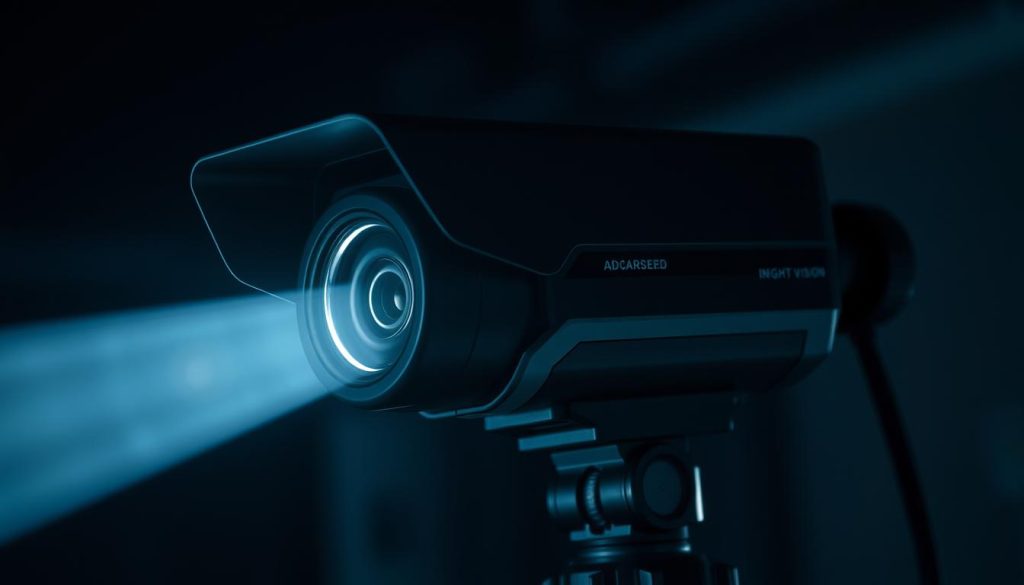
Selecting the ideal night vision camera requires balancing technical specs with real-world needs. Singapore’s urban environment demands features that handle humidity, variable lighting, and dense infrastructure. The eufyCam S330 exemplifies this with 4K resolution and 15m color imaging after sunset.
Key Features to Look For
Lens choice impacts coverage significantly. Varifocal options adapt to changing needs, while fixed lenses offer reliability. ONVIF compliance ensures compatibility with existing security systems across Singapore’s smart buildings.
Analytics packages vary by manufacturer. Advanced systems provide:
- Perimeter scanning with PTZ presets
- Vehicle recognition for parking enforcement
- Cloud/edge processing options for different bandwidth needs
Storage calculations matter for 24/7 recording. A 4MP camera typically uses 1TB monthly at 15fps. CSA cybersecurity certification prevents unauthorized access to footage.
Matching Cameras to Your Needs
PSB-approved vendor lists help navigate Singapore’s regulations. Residential properties benefit from 1080p resolution, while commercial sites need 4K detail. Consider these factors:
- IR range matching property size
- Warranty terms covering tropical weather damage
- Integration with existing smart home systems
Strategic placement maximizes each camera’s features. HDB corridors need wide-angle views, while retail stores prioritize facial recognition. Proper selection ensures reliable security when light levels drop.
Best Practices for Nighttime Surveillance
Effective nighttime surveillance requires more than just high-tech equipment—it demands strategic planning and regular upkeep. In Singapore’s urban environment, tropical conditions and constant use can degrade performance without proper care. Implementing structured maintenance routines ensures your security investment delivers consistent results.
Maintenance and Upkeep
Quarterly cleaning maintains 98% light transmission through lenses, critical for clear night footage. Singapore’s humidity accelerates corrosion, requiring:
- Bi-monthly inspections of housings and seals
- Specialized lens coatings that resist mold growth
- NEA-compliant silent cooling fans for IR arrays
Power system redundancy prevents outages during storms. SCDF protocols mandate backup power for emergency access points. Firmware updates should follow cybersecurity audits to patch vulnerabilities.
Strategic Lighting Techniques
Complementary lighting boosts camera effectiveness without creating glare. Smart city integration allows synchronization with street lamps and building lights. Consider these approaches:
- Positioning IR illuminators to avoid reflective surfaces
- Using motion-activated lighting to conserve energy
- Balancing ambient and artificial light sources
Proper configuration maintains performance across Singapore’s varied urban conditions. Regular testing ensures all components work together seamlessly for uninterrupted security.
Ensuring Security Around the Clock
Round-the-clock protection demands smart solutions that blend advanced technology with human oversight. Integrated systems slash response times by 73%, as seen in Jurong Island’s AI-powered surveillance hubs. These centers analyze threats in real-time, reducing false alarms by 40%.
Automated security cuts costs but lacks situational judgment. Hybrid models excel—using cameras for detection and guards for intervention. Singapore’s CSA Cyber Essentials Mark ensures compliance across networks, vital for cross-jurisdiction monitoring.
Redundancy is non-negotiable. Backup power and LiDAR integrations future-proof systems against outages. Emerging 5G networks will enable faster data transfers, making night vision feeds sharper than ever.
As technology evolves, so does surveillance. Tomorrow’s solutions will likely merge thermal imaging with predictive analytics, keeping Singapore safe 24/7.
FAQ
How do night vision cameras capture images in darkness?
Night vision cameras use infrared (IR) LEDs or thermal imaging to detect heat signatures and ambient light, allowing them to produce clear images even in low-light conditions.
What’s the difference between infrared and thermal imaging cameras?
Infrared cameras rely on IR LEDs to illuminate dark areas, while thermal imaging detects heat signatures from objects and people, making them effective in complete darkness.
Can security cameras record in pitch-black environments?
Yes, cameras with infrared or thermal technology can record in total darkness by using non-visible light or heat detection to generate surveillance footage.
What factors affect nighttime CCTV performance?
Key factors include sensor sensitivity, IR range, resolution, and external lighting conditions, all of which impact image clarity in low-light scenarios.
Do all security cameras have built-in night vision?
No, only models specifically designed with IR LEDs, thermal sensors, or low-light imaging capabilities can function effectively in darkness.
How far can night vision cameras see in the dark?
The range depends on the camera’s IR strength—typically between 30 to 200 feet—with higher-end models offering extended visibility.
Can glare or fog interfere with night vision footage?
Yes, reflective surfaces, heavy rain, or fog can distort images. Choosing cameras with wide dynamic range (WDR) helps minimize these issues.
Are there accessories to improve nighttime surveillance?
Adding IR illuminators, motion-activated lights, or anti-glare housings can enhance visibility and reduce blind spots in dark areas.


