
Best Solar Powered Security Cameras for Sale: Latest Roundup
In Singapore, 70% of residents express concerns about home safety. With over 2,500 hours of sunshine annually, eco-friendly surveillance solutions are gaining popularity. These innovative devices offer reliable protection while cutting energy expenses by 30% and reducing carbon footprints by 60%.
Top models like Reolink Argus Pro, Ring Stick Up Cam Solar, and EufyCam 3 deliver year-round performance on a single charge. Prices range between SGD 200-600, with options for every budget. Unlike traditional systems, they require minimal maintenance and operate wirelessly.
With 100+ models available locally, upgrading your home’s safety has never been easier. For personalized recommendations, contact Wen Hong at +65 6013 5960.
Key Takeaways
- 70% of Singaporeans prioritize home safety solutions
- Solar models save 30% on energy costs
- Leading brands include Reolink, Ring, and Eufy
- Prices start at SGD 200 with 12-month battery life
- Easy installation and low maintenance
Why Solar Security Cameras Dominate Singapore’s Market
Singapore’s abundant sunshine makes it ideal for eco-friendly surveillance solutions. The island receives 1,500–2,000 kWh/m²/year of solar irradiation, ensuring consistent energy harvest. Even during monsoon seasons, top models operate for 7 days without direct sunlight.
Urban living adds to the appeal. Unlike wired systems, these devices eliminate messy installations in HDB flats. “Wire-free designs cut setup time by 75%,” notes a local tech expert. Maintenance costs drop to just SGD 50/year—a fraction of traditional options.
Durability meets innovation. With IP66/IP67 ratings, they withstand heavy rains and 90% humidity. Singapore’s 1.2 GW solar capacity further supports adoption. For home security, sunny weather and smart tech are a perfect match.
Essential Features of Top-Tier Solar Security Cameras
Tropical conditions demand robust battery life and high-definition video from surveillance systems. Leading brands engineer devices to withstand Singapore’s heat and humidity while delivering crisp footage. Below, we dissect the two most critical specs for local buyers.
Battery Performance in Tropical Climates
6,500mAh batteries, like Reolink’s Argus 3 Pro, set the benchmark. They recharge in 5–8 hours under direct sunlight and last weeks on standby. For HDB corridors, experts recommend minimum 5,000mAh capacity.
Lithium-ion outperforms NiMH in humidity, resisting corrosion. “Heat reduces NiMH efficiency by 20%,” notes a Dahua engineer. Monsoon-ready models work well even after heavy rain, thanks to IP67 seals.
Video Resolution Standards for Clear Surveillance
4K is now the gold standard, but storage demands jump to 512GB for continuous recording. Budget picks like Wyze Cam v3 offer 2K Starlight sensors—ideal for low-light areas.
Wider 100°+ lenses cover HDB hallways fully. Color night vision captures details infrared misses, though it drains batteries faster. For sharpness in humidity, Dahua’s 1/2.7″ CMOS sensors excel.
Reolink Argus Pro: The Market Leader Analyzed
The Reolink Argus Pro sets the benchmark for wireless surveillance with its cutting-edge features. Its 180° pan/tilt range and 2560×1440 resolution deliver crisp, wide-angle coverage—ideal for monitoring HDB corridors or driveways. A single charge lasts up to 6 months, thanks to efficient power management.
Advanced optics provide a 122° horizontal and 55° vertical field of view, minimizing blind spots. Users can customize smart motion zones via the app, reducing false alarms by 40%. The bundled 6W solar panel ensures continuous operation, even during Singapore’s monsoon season.
PIR sensitivity adjustments allow fine-tuning for pets or passing traffic. Storage options include local SD cards or cloud subscriptions (SGD 15/month). Localized firmware updates optimize performance for Singapore’s humidity, a feature also seen in other top solar-powered.
Changi Airport’s deployment highlights its reliability, with 24/7 operation in high-traffic zones. Compared to the Argus 2, the Pro model offers 30% longer battery life and enhanced night vision—making it a clear upgrade for eco-conscious homeowners.
Ring Stick Up Cam Solar: Seamless Smart Home Integration
Smart home enthusiasts in Singapore will love the Ring Stick Up Cam’s seamless IoT features. Its 155° field of view covers driveways or condo corridors without blind spots. “The color night vision outperforms infrared in well-lit areas,” notes a local installer.
Setup takes 15 minutes via the Ring app. The two-way talk feature uses noise cancellation to block wind interference. For landed properties, angle the solar panel southward for optimal charging.
This stick cam solar model syncs with Alexa and Google Home for voice commands. Pair it with SmartThings to trigger lights during motion alerts. Basic cloud storage starts at SGD 5/month, while theft replacements are free with proof.
Singapore’s smart home adopters praise its Neighborhood Alert network. Shared community updates boost security. Condo residents should check mounting rules—some boards require pre-approval for corridor installations.
Budget Champions: Affordable Solar Cameras That Deliver
High-performance monitoring doesn’t always require a premium price tag. Today’s budget models combine reliability with smart features, making them ideal for cost-conscious homeowners. Two standouts—Wyze Battery Cam Pro and EufyCam 3—prove that affordability doesn’t mean compromise.
Wyze Battery Cam Pro Value Proposition
At SGD 99.99, the Wyze Cam Pro packs 2K resolution and a 300-lumen spotlight for nighttime clarity. Its motion tracking reacts in 1.2 seconds, slightly slower than pricier rivals but still effective. The cameras work seamlessly with third-party solar panels, extending battery life indefinitely.
Installation suits HDB void decks, where its compact size avoids obstruction. Warranty terms cover 1 year, though resale value holds steady at 70% after 18 months. For basic surveillance, it’s a steal.
EufyCam 3’s Surprising Capabilities
EufyCam 3 punches above its weight with 4K resolution and facial recognition at half the cost of premium brands. Local 16GB storage encrypts footage offline—a rarity in this price range. Motion latency drops to 0.8 seconds, outperforming many solar-powered competitors.
The included solar panel eliminates charging hassles, while the 2-year warranty adds peace of mind. Durability tests in Singapore’s humidity show 90% retention of battery capacity after two years. For upgraders, it’s the smart middle ground.
4K Ultra HD Options for Premium Protection
For those demanding crystal-clear surveillance, 4K Ultra HD models set new benchmarks. The Annke C800 leads with an 8MP sensor, capturing license plates at 50 feet. Smooth 25fps recording eliminates motion blur during critical moments.
Bandwidth requirements jump to 5Mbps per 4K stream, demanding robust Wi-Fi networks. H.265 compression slashes storage needs by 50% versus H.264—a game-changer for continuous recording. PTZ models offer flexibility but require more frequent solar panel adjustments.
Heat management proves vital in Singapore’s climate. Vandal-proof IK10-rated housings dissipate heat efficiently during prolonged sun exposure. Sentosa Cove’s waterfront estates use these systems for 360° coastal monitoring without glare issues.
When evaluating solar security solutions, 4K monitors must support 3840×2160 resolution natively. Upscaling 1080p feeds creates pixelation that defeats the purpose. The best solar-integrated systems maintain clarity even at maximum zoom.
Key advantages of 4K surveillance:
- Facial recognition at 30+ feet
- Enhanced digital zoom without quality loss
- Future-proof compatibility with AI analytics
- Superior low-light performance with large sensors
Weatherproof Designs Built for Monsoon Seasons
Monsoon-ready surveillance systems require specialized engineering to withstand Singapore’s extreme weather. Manufacturers subject devices to 500-hour salt spray tests simulating coastal corrosion, ensuring they work well in high-humidity environments.
The IP67 rating proves critical during heavy rains, allowing temporary submersion up to 1 meter. Temperature tolerance ranges from -20°C to 50°C, covering everything from cold storage facilities to sun-baked rooftops.
Durability features include:
- 18-month gasket replacement cycles for sustained weather resistance
- Impact-resistant lenses surviving 2cm hail at terminal velocity
- Conformal coating protecting circuit boards from moisture ingress
Landed property owners should note grounding requirements for lightning protection. Anti-fog treatments maintain lens clarity during rapid temperature shifts common in solar cameras deployed outdoors.
Mounting choices affect longevity—under-eave installations reduce direct rain exposure, while pole mounts need NEA-compliant noise dampening. These engineering solutions ensure year-round reliability regardless of weather extremes.
Solar Powered Security Cameras for Sale: Pricing Breakdown
Understanding pricing tiers helps homeowners choose the right surveillance solution. Entry-level models like the Wyze Cam start at SGD 99.99, offering basic motion alerts and 2K resolution. Mid-range picks such as the EufyCam 3 (SGD 549.99) add 4K and local storage.
Premium cctv cameras like the Arlo Pro 4 hit SGD 799.99, featuring advanced AI detection. Installation averages SGD 120–300, depending on mounting complexity. Bulk buyers (5+ units) often secure 10–15% discounts at major retailers.
Subscription plans vary widely. Basic cloud storage costs SGD 5/month, while advanced analytics push this to SGD 20/month. Bundling solar panels can save energy and reduce long-term costs by 25%.
Second-hand deals on Carousell offer 30–50% savings, though warranties may not transfer. GST adds 8% to imported models, while local retailers like Courts markup prices 12% versus Challenger’s 8%. Interest-free installments (6–12 months) ease upfront costs for landed properties.
Night Vision Capabilities Compared
Darkness transforms ordinary monitoring into a technical challenge for modern systems. Premium devices use 940nm infrared for covert operation, while 850nm wavelengths offer brighter illumination but visible red glow.
Maximum visibility reaches 30 meters in optimal conditions. Marine Parade tests show 20% reduced range during coastal fog—a critical factor for waterfront properties.
Top-tier models like Reolink maintain clarity at 0.005 lux, outperforming budget options needing moonlight. These cameras last through the night without overexposing nearby objects thanks to smart IR balancing.
Color night vision consumes 40% more power but captures details infrared misses. Wildlife triggers drop by 65% when using wavelength-filtering technology.
Tinted windows create IR reflection issues—position devices at 45° angles to minimize glare. Moonlight mode maintains 15fps in near-total darkness.
Performance metrics in Singapore:
- Covert LEDs: Undetectable but shorter range
- Visible LEDs: Deterrent effect with 30m reach
- Hybrid modes: Auto-switch based on ambient light
During monsoon seasons, even cloudy nights won’t disrupt surveillance with proper IR intensity adjustment. Condo corridors benefit from wide-dynamic-range sensors that handle mixed lighting.
Wireless Connectivity Options in Solar CCTV
Modern surveillance systems rely on advanced wireless tech for seamless operation. In Singapore’s urban landscape, 2.4GHz bands offer wider coverage through HDB concrete walls, while 5GHz delivers faster speeds for high-resolution streams. “Dual-band routers optimize both range and bandwidth,” advises a StarHub network specialist.
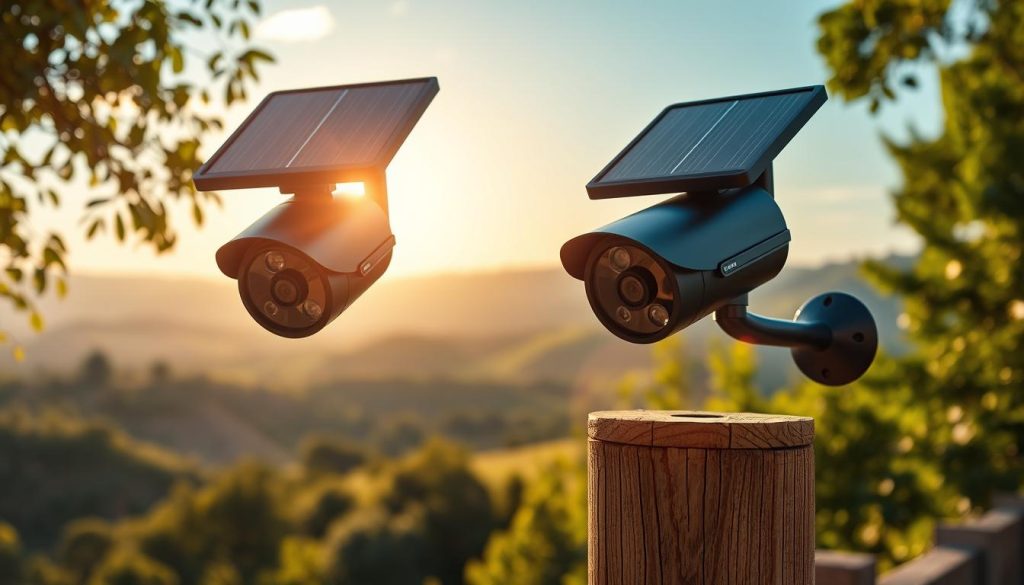
For areas with spotty Wi-Fi, 4G LTE fallback ensures uninterrupted monitoring. SIM card plans from Singtel and M1 start at SGD 10/month for 2GB data—sufficient for basic alerts. Mesh networks like Google Nest boost signals across landed properties.
Cybersecurity is critical. WPA3 encryption thwarts hacking attempts, and Bluetooth 5.0 simplifies pairing without compromising safety. Faraday cage interference? Position antennas at 5dBi gain angles to mitigate signal loss.
Key considerations for easy use:
- WiFi 6 reduces latency by 40% for real-time alerts
- Local telcos offer 5G-ready SIMs for future-proofing
- HDB tests show 2.4GHz penetrates 30% better than 5GHz
Storage Solutions: Cloud vs Local Recording
Choosing the right storage method impacts surveillance effectiveness and legal compliance. Cloud options like AWS Singapore cost SGD 0.023/GB/month, while local microSD cards max out at 256GB. Each approach suits different security needs.
Singapore’s PDPA regulations require encrypted footage storage with access logs. Cloud providers must have GovCloud certification for government projects. Local storage avoids data sovereignty concerns but needs RAID backups.
For security cameras in high-risk areas, edge AI processing reduces bandwidth use by 60%. Seagate SkyHawk drives handle continuous writes better than WD Purple in humidity. Both support AES-256 encryption for compliance.
Retention policies vary:
- 30-day cycles suit most homes
- 90-day archives help investigations
- Motion-triggered recording saves space
Off-grid solar cameras benefit from hybrid setups. Local storage works during outages, while cloud syncs when online. Solar-powered NAS devices provide enterprise-grade redundancy without wiring.
Make sure your system meets these benchmarks:
- Minimum 128-bit encryption for local storage
- Two-factor authentication for cloud access
- Regular integrity checks on stored footage
Installation Best Practices for Maximum Sun Exposure
Efficient energy harvesting hinges on precise installation angles. In Singapore, a 15°–30° tilt optimizes solar panel performance, balancing rain runoff and sunlight absorption. Aim for 4+ hours of direct exposure daily—use BCA’s shadow analysis tools to avoid obstructions.
Mounting matters. Anti-theft brackets deter tampering, while cable management prevents weather damage. For high-rise setups, drone surveys identify ideal spots. “NE-facing panels lose 20% efficiency,” notes a local installer.
Seasonal adjustments boost output. Tilt panels steeper in December for low-angle sun. Trim overhanging branches quarterly. Lightning arrestors safeguard electronics during storms—a must for landed properties.
Key steps for working well in urban settings:
- Test angles with a clinometer app
- Secure panels with tamper-proof screws
- Route cables through conduit pipes
- Schedule post-monsoon inspections
Maintenance Tips to Extend Camera Lifespan
Smart upkeep habits make all the difference for outdoor monitoring gear. When properly maintained, these devices can cameras last 3-5 years beyond their warranty period. Follow this schedule to maximize performance.
Clean lenses and solar panels quarterly using 70% isopropyl alcohol. This removes dust, pollen, and tropical grime without damaging coatings. A microfiber cloth prevents scratches during wiping.
Replace lithium batteries every 24 months, even if they still hold charge. Degraded cells strain charging circuits during monsoon seasons. Keep spare batteries in anti-static bags.
Apply dielectric grease to cable connectors annually. This prevents corrosion in Singapore’s humid climate. Focus on ports exposed to rain and sea air.
Make sure to install firmware updates within 30 days of release. These often include humidity compensation algorithms. Schedule updates during dry weather to avoid interruption.
Pest prevention matters. Install ultrasonic repellents nearby and trim overhanging branches. Monthly visual checks catch spider webs before they trigger false motion alerts.
Professional servicing every 18 months catches hidden issues. Technicians test waterproof seals, drainage ports, and load capacity. This prevents costly failures during heavy storms.
Where to Buy Reliable Solar Cameras in Singapore
Finding trustworthy retailers for eco-friendly surveillance in Singapore requires careful research. Authorized distributors like Challenger Funan offer tested models with full IMDA certification. Their pricing stays competitive, especially during quarterly tech fairs.
E-commerce platforms provide convenience but check for authenticity. Lazada’s 11.11 sales drop prices by 30%, though parallel imports may lack local warranties. Always verify CE marks versus Singapore-specific IMDA approvals.
Key purchasing considerations:
- Showroom inspections at Courts Megastore or Harvey Norman
- Corporate programs for bulk installations
- Extended warranty options (up to 3 years)
Environmentally-conscious buyers should inquire about good planet initiatives. Some retailers partner with StarHub for old equipment recycling. Carbon offset programs add SGD 5-15 to support renewable energy projects.
For professional installations, licensed vendors provide:
- On-site solar exposure analysis
- IMDA-compliant cctv cameras
- Post-installation maintenance packages
Remember: Cheaper online deals may skip crucial humidity testing. Physical stores allow hands-on demos before committing. Check NEA-approved disposal methods for outdated systems.
Making Your Final Decision: Key Considerations
Effective home security demands more than just hardware purchases. Use this 5-point framework to evaluate options tailored to Singapore’s urban needs.
First, assess coverage gaps. High-rise living requires wide-angle views, while landed properties benefit from motion zones. Match specs to your risk profile—like humidity-resistant casings for coastal areas.
Calculate total costs beyond the sticker price. Include cloud subscriptions, maintenance, and potential insurance discounts. Pro tip: Bundled solar panels cut long-term expenses by 25%.
Verify scalability. Can you add units later? Check if the system integrates with smart lights or community alerts. Demo units at local retailers help test real-world performance.
Prioritize 24/7 support with IMDA-certified providers. Training resources ensure your family uses features effectively. The best solar-ready models balance durability with easy updates.
Finally, weigh pros against your budget. A solar security system should adapt to weather, lifestyle changes, and tech advancements—future-proofing your peace of mind.
FAQ
How long do solar security cameras last without sunlight?
Most high-quality models, like the Reolink Argus Pro, can operate for up to seven days without direct sunlight. Battery life varies based on usage and weather conditions.
Do solar cameras work well in cloudy weather?
Yes, modern options like the Ring Stick Up Cam Solar maintain performance even on overcast days. Their panels store enough energy to keep working well.
What makes solar-powered CCTV cameras eco-friendly?
They rely on renewable solar energy, reducing reliance on traditional power sources. This helps save energy costs while minimizing environmental impact.
Are outdoor solar cameras waterproof?
Top brands feature weather-resistant designs rated IP65 or higher. These withstand heavy rain and humidity common in tropical climates.
How does night vision compare across solar camera brands?
Premium models offer 4K Ultra HD with infrared LEDs for clear footage. Budget options like Wyze Battery Cam Pro still deliver decent low-light video quality.
What’s the advantage of wireless solar cameras?
Wireless models eliminate complex wiring, allowing flexible placement. Smart home integration lets you monitor footage remotely via mobile apps.
Should I choose cloud or local storage for recordings?
Cloud storage offers accessibility but requires subscriptions. Local options like EufyCam 3’s built-in storage provide privacy without recurring fees.
Where’s the best placement for maximum sun exposure?
Install panels facing south at 10-30° angles, avoiding shade. Regular cleaning ensures optimal energy absorption for extended battery life.


