
How CCTV Cameras Work in Dark: Night Vision Guide
Property owners in Singapore often wonder about nighttime monitoring. Complete darkness presents a challenge for traditional surveillance equipment. Modern technology provides effective solutions for 24/7 protection.
Urban environments like Singapore require constant vigilance. Security risks don’t fade when the sun goes down. Reliable after-dark monitoring is essential for both homes and businesses.
Today’s surveillance systems overcome low-light conditions with specialized technology. Two main approaches deliver clear footage at night. Infrared illumination and thermal imaging form the backbone of modern dark surveillance.
Understanding these options helps you make smart security investments. Proper installation and strategic placement maximize effectiveness. This guide explores everything you need for round-the-clock protection.
Key Takeaways
- Modern surveillance technology effectively operates in low-light and no-light conditions.
- Infrared night vision and thermal imaging are the two primary methods for dark surveillance.
- Proper system installation and camera placement are crucial for nighttime effectiveness.
- Singapore’s urban environment makes 24/7 security monitoring particularly important.
- Understanding different night vision technologies helps in selecting the right security system.
- Regular maintenance ensures continuous performance of nighttime surveillance equipment.
- Strategic planning enhances overall security coverage during dark hours.
Understanding the Core Question: Does CCTV Camera Work in Dark?
Effectiveness when natural light diminishes remains a primary consideration for security planning. Modern surveillance solutions have evolved to address this fundamental challenge.
Today’s advanced equipment can capture usable footage under extremely low-light conditions. Specialized technology makes this possible, transforming how we monitor properties after sunset.
The Short Answer: Yes, with the Right Technology
The capability exists on a spectrum. Standard recording devices struggle when illumination drops below certain levels. Specialized units designed for low-light environments perform remarkably better.
Infrared illumination represents the most common approach. This technology uses bulbs emitting light invisible to human eyes. These illuminators activate automatically when darkness falls.
High-quality systems produce clear, detailed monochrome footage at night. The difference between basic and advanced models is substantial. Investment in proper equipment yields significant returns in monitoring reliability.
Singapore’s urban landscape provides excellent examples. Many commercial buildings utilize these advanced systems for 24/7 oversight. Residential complexes also benefit from enhanced after-hours protection.
From Passive Observation to Active Illumination
Traditional monitoring relied entirely on ambient light. This passive approach limited effectiveness to well-lit areas. The technological leap to active systems changed everything.
Modern solutions don’t just capture existing light. They create their own illumination using the infrared spectrum. This allows operation in complete darkness where visible light is absent.
Two main methodologies dominate today’s market:
- Active infrared systems that project invisible light
- Thermal imaging technology that detects heat signatures
The evolution represents a fundamental shift in capability. Surveillance is no longer constrained by environmental lighting conditions. Properties can maintain consistent monitoring regardless of time or weather.
Implementation across Singapore demonstrates practical success. From HDB corridors to industrial estates, these systems provide continuous coverage. They address the unique challenges of dense urban environments where shadows and limited natural light are common.
The transition from passive to active night vision marks one of the most significant advancements in modern security technology.
Understanding this evolution helps property owners make informed decisions. The right technology selection depends on specific needs and environmental factors. Professional installation maximizes the potential of any chosen system.
The Science Behind Seeing in the Dark: Night Vision Fundamentals
Behind every clear nighttime security feed lies a combination of physics and engineering designed to pierce through darkness. This technology transforms invisible radiation into viewable footage. Understanding these principles helps you evaluate different surveillance options.
Two core components make nighttime monitoring possible. Specialized light spectrum utilization and advanced sensor technology work together. They overcome the limitations of human vision when illumination fades.
Invisible Light: The Role of the Infrared Spectrum
Visible light represents only a small portion of the electromagnetic spectrum. Infrared radiation exists just beyond the red light humans can see. Security equipment harnesses this invisible energy for illumination.
Infrared wavelengths range from 700 nanometers to 1 millimeter. Near-infrared (NIR) is most commonly used in surveillance systems. These wavelengths are perfect for covert monitoring applications.
Special LEDs emit infrared radiation that’s invisible to the naked eye. The sensors in security equipment detect this reflected energy. They then process it into monochrome images viewers can understand.
This approach doesn’t rely on ambient visible light. Systems create their own illumination source. That’s why they function effectively even in complete darkness.
Infrared technology allows security systems to ‘see’ using light wavelengths invisible to humans, providing discreet nighttime surveillance.
Singapore’s tropical climate presents unique considerations. High humidity can slightly affect infrared transmission over long distances. Modern systems account for this through adjustable illumination strength.
Image Sensors: CMOS and CCD in Low-Light Conditions
Sensor technology determines how well equipment performs when light diminishes. Two primary types dominate the market today. Each has distinct characteristics affecting nighttime image quality.
CCD (Charge-Coupled Device) sensors were traditionally preferred for low-light applications. They generally produce less digital noise in challenging conditions. This results in cleaner, more detailed grayscale images at night.
CMOS (Complementary Metal-Oxide-Semiconductor) sensors have advanced significantly. They now offer competitive performance with lower power consumption. Many modern systems utilize CMOS for its efficiency and cost-effectiveness.
Both sensor types convert photons into electronic signals. This process transforms invisible infrared reflections into viewable footage. Sensor sensitivity, measured in lux, indicates minimum light requirements.
A lower lux rating means better performance in dim conditions. High-quality sensors can function with just 0.001 lux of available light. This enables clear imaging even under moonlit or overcast skies.
Sensor size and pixel quality also impact nighttime performance. Larger sensors capture more available light particles. This enhances detail preservation in shadowy areas common in urban environments.
When selecting surveillance equipment, consider both sensor type and specifications. The right combination ensures reliable monitoring regardless of lighting conditions. This is particularly important for 24/7 security in Singapore’s dense urban landscape.
Infrared Illumination: How IR LEDs Light Up the Night
The secret to clear nighttime surveillance lies in specialized LEDs that emit light beyond human visual perception. These components act as invisible flashlights for security equipment. They illuminate scenes without alerting anyone to the monitoring activity.
This technology enables continuous property protection after sunset. Urban environments like Singapore benefit greatly from such discreet systems. They provide reliable oversight in alleyways, car parks, and building perimeters.
The Function of Infrared LED Arrays
Infrared LED clusters function as engineered light sources for low-light conditions. They typically operate at specific wavelengths measured in nanometers. The most common are 850nm and 940nm variants.
Wavelength selection involves important trade-offs. 850nm diodes produce a faint red glow that’s slightly visible. 940nm options remain completely invisible to the naked eye.
The number and arrangement of LEDs determine illumination quality. Denser patterns create more even coverage across a scene. Strategic placement minimizes dark spots and shadows.
Power output directly affects how far the system can see at night. Higher wattage extends the effective range of surveillance. This is crucial for monitoring large outdoor areas.
Singapore’s tropical climate presents unique considerations. High humidity can slightly reduce infrared transmission distance. Modern systems account for this with adjustable intensity settings.
Infrared LED arrays transform complete darkness into a illuminated landscape visible only to security sensors, providing covert monitoring capabilities essential for modern protection.
Temperature also impacts LED performance and longevity. Quality components withstand Singapore’s consistent heat. They maintain consistent output throughout extended operation.
Identifying Cameras with IR Capabilities
Recognizing equipment with true infrared functionality is straightforward. Look for small red dots around the lens housing. These indicate active IR illuminators during low-light conditions.
Some models feature completely invisible 940nm illumination. These lack the characteristic red glow. Their specifications will clearly state infrared capability.
Evaluate illumination range when selecting equipment. This specification indicates maximum distance for clear image capture. Match this to your property’s specific monitoring needs.
Consider the beam angle alongside the range. Wider angles cover more area but reduce intensity over distance. Narrower beams reach further with concentrated illumination.
Check for automatic IR cut filters in color models. These switches remove infrared during daytime for accurate colors. They engage infrared illumination only when needed at night.
Review technical specifications for lux ratings. Lower numbers indicate better performance in dim conditions. This complements the infrared system’s effectiveness.
Professional installation maximizes any system’s potential. Proper alignment ensures infrared illumination covers critical zones. This creates reliable 24/7 surveillance coverage for Singaporean properties.
Thermal Imaging: A Different Approach to Night Surveillance
Beyond conventional illumination methods lies a surveillance approach that visualizes the world through temperature differences. This technology operates on a completely different principle than standard night vision equipment.
Thermal detection doesn’t require any visible or infrared light to function. Instead, it senses the natural heat radiation emitted by all objects and living beings. This makes it uniquely effective for challenging monitoring scenarios.
Detecting Heat Signatures Instead of Light
Every object with a temperature above absolute zero emits infrared energy. Thermal security cameras capture this radiation using specialized microbolometer sensors. These sensors detect minute temperature variations across a scene.
The technology translates temperature differences into visual representations. Warmer areas appear brighter on the display, while cooler zones show as darker. This creates a heat map that reveals what’s present, regardless of lighting conditions.
Advanced thermal systems can detect temperature differences as small as 0.01°C. This sensitivity allows them to identify human presence even through light obstacles. The technology performs consistently in total darkness, heavy fog, or light smoke.
Thermal imaging sees the world not by reflected light, but by emitted heat energy, making it immune to lighting conditions that defeat conventional surveillance.
Key Applications for Thermal Security Cameras
Singapore’s unique environment presents ideal use cases for this technology. Perimeter protection for industrial estates benefits greatly from thermal detection. Coastal monitoring stations use these systems to spot vessels at night.
Wildlife management represents another practical application. Parks and nature reserves can monitor animal movements without disturbing them. The technology detects warm bodies against cooler backgrounds with remarkable clarity.
Critical infrastructure protection represents a primary application. Power plants, water treatment facilities, and communication hubs employ thermal systems. They provide reliable monitoring when conventional cameras struggle.
Urban security teams integrate thermal technology with existing surveillance networks. This creates comprehensive coverage that addresses multiple threat scenarios. The combination delivers both detailed identification and reliable detection.
Practical examples demonstrate the technology’s effectiveness. Intruders attempting camouflage cannot hide their body heat signatures. Warm machinery left running in restricted zones becomes immediately visible. Regular system checks ensure thermal components maintain optimal performance.
The growing integration trend combines thermal and conventional imaging. Modern security platforms fuse data from both sensor types. This provides operators with multiple perspectives on any situation.
Singapore’s maritime and industrial sectors increasingly adopt these hybrid solutions. They offer reliable 24/7 monitoring regardless of environmental conditions. The technology continues evolving toward smarter, more integrated security ecosystems.
Comparing Your Options: IR Night Vision vs. Thermal Imaging
Two distinct technological paths lead to reliable monitoring when daylight fades, each with its own strengths. Choosing between them depends on what you need to see and the challenges your property faces.
Infrared systems are common for detailed identification. Thermal options excel at detection through visual obstacles. Understanding this core difference guides a smart security investment.
Image Output: Grayscale Detail vs. Heat Maps
The visual results from these technologies are fundamentally different. Infrared night vision cameras produce monochrome footage.
They show sharp details like facial features or license plates. This is because they work with reflected light, similar to daytime vision but in the infrared spectrum.
Thermal imaging creates a color-coded map based on temperature. Warmer objects like people or vehicles appear bright against cooler backgrounds.
These images reveal presence and movement clearly. They do not show fine facial details, making them ideal for perimeter alerting rather than identification.
The choice often boils down to a simple question: Do you need to see who is there, or simply know that something is there?
Performance in Fog, Smoke, and Total Darkness
Environmental conditions heavily influence performance. Standard infrared systems can struggle with Singapore’s occasional haze or heavy rain.
These particles scatter infrared light, reducing image quality and range. In clear, total darkness, however, they perform very well.
Thermal imaging technology operates independently of visible light. It sees the heat emitted directly from objects.
This makes it highly effective in fog, light smoke, and complete darkness. It provides consistent detection capability where other cameras might fail.
Cost and Implementation Considerations
The financial and practical factors between these systems are significant. Infrared night vision is widely available and cost-effective.
Most modern CCTV cameras include this technology. Installation is straightforward and integrates easily with existing security setups.
Thermal imaging units represent a higher initial investment. Their specialized sensors and processing features command a premium price.
Implementation may require more planning for power and data handling. The payoff is unparalleled reliability in challenging low light and obscured conditions.
For many properties in Singapore, a hybrid approach is optimal. Use infrared cameras for entry points where identification is key.
Deploy thermal imaging for large perimeters or areas prone to fog. This combination leverages the strengths of both technologies for complete surveillance.
Factors That Impact Nighttime CCTV Performance
Achieving reliable after-dark surveillance requires careful consideration of both equipment specifications and installation environment. Several technical variables work together to determine how well your system captures usable footage when natural illumination fades.
Understanding these elements helps property owners make informed decisions. It also guides professional installers in optimizing system placement. The right combination delivers consistent night vision quality regardless of external conditions.
IR Range and Illuminator Strength
Infrared range specifications indicate maximum distance for effective illumination. This number represents how far the invisible light can travel while maintaining useful reflection. Real-world performance often falls slightly below manufacturer claims.
Illuminator strength, measured in watts or lumens, determines brightness intensity. Higher power creates clearer images at greater distances. It also reduces shadows in complex urban areas.
Consider both beam angle and illumination pattern when selecting equipment. Wide beams cover larger spaces but reduce intensity over distance. Narrow beams provide concentrated light for longer-range observation.
Singapore’s dense urban landscape presents unique challenges. Reflections from glass buildings can create hotspots. Dark alleyways between structures may require supplemental lighting.
Camera Sensor Sensitivity and Lens Aperture
Sensor sensitivity, measured in lux ratings, indicates minimum light requirements. Lower numbers mean better low light capability. High-quality sensors can function with just 0.001 lux of available illumination.
Lens aperture, expressed as f-stop, controls how much light reaches the sensor. Wider apertures (lower f-numbers) gather more photons. This significantly improves image quality in dim conditions.
“A camera’s low-light capability depends more on its sensor and lens combination than on megapixel count alone. The right pairing can transform marginal nighttime footage into usable evidence.”
Sensor size and pixel density also influence night vision results. Larger sensors capture more available light particles. This preserves finer details in shadowy zones common around Singaporean properties.
Modern image processing algorithms enhance footage through noise reduction. They distinguish between important motion and visual artifacts. This technology helps maintain clear images even when illumination is minimal.
Environmental Obstacles in Urban Singapore
Singapore’s unique environment introduces specific challenges for nighttime surveillance. Urban light pollution creates uneven illumination across scenes. Bright signs and streetlights can overwhelm sensors while leaving adjacent areas in deep shadow.
Building density affects both light distribution and infrared transmission. Narrow spaces between structures create perpetual darkness. Concrete and glass surfaces reflect infrared energy unpredictably.
Tropical weather patterns present consistent obstacles. High humidity absorbs infrared radiation, reducing effective range. Frequent rainfall scatters available light and creates lens-obscuring water droplets.
Seasonal haze from regional fires further degrades image quality. These fine particles scatter both visible and infrared light. They create a milky effect that reduces contrast and details.
Practical testing methods help evaluate real-world performance. Conduct assessments during actual night hours rather than relying on specifications. Test under different weather conditions to establish reliable baselines.
Strategic system design addresses these environmental factors. Position cameras to minimize backlight from bright sources. Use weatherproof housings to protect against Singapore’s high humidity. Regular maintenance ensures lenses remain clean for optimal light transmission.
Understanding these interconnected factors enables better security planning. It helps property owners select appropriate night vision technology for their specific needs. Professional installers can then optimize placement to overcome local environmental challenges.
Boosting Visibility: The Strategic Use of External Lighting
Supplemental lighting acts as a powerful force multiplier for after-dark surveillance systems. When strategically deployed, external illumination can dramatically improve the quality of nighttime footage. This approach works alongside built-in infrared technology to create optimal viewing conditions.
Singaporean properties benefit greatly from this combined methodology. Urban environments present unique challenges with uneven natural light distribution. Intelligent external lighting solutions address these gaps in coverage.
Different approaches serve distinct purposes in security planning. Visible lights can deter potential intruders through psychological means. Infrared illuminators provide covert monitoring capability without announcing their presence.
The right combination depends on your specific property needs. Residential homes might prioritize deterrence with visible fixtures. Commercial installations often require discreet observation for evidence collection.
Complementing IR with Ambient Light Sources
External illumination comes in several forms suitable for Singapore. Street light provides consistent baseline visibility in public areas. Architectural lighting enhances building facades while improving security coverage.
Motion-activated security lights offer energy-efficient solutions. They illuminate specific zones only when movement triggers them. This sudden illumination can startle intruders and alert monitoring personnel.
Specialized infrared illuminators extend the range of night vision cameras. These standalone units project invisible light across larger distances. They help cameras capture clearer images in expansive outdoor spaces.
Positioning techniques prevent common problems like shadows and glare. Lights should be placed to cross-illuminate critical zones. This approach minimizes dark spots where intruders could hide.
Angle calculations ensure lights complement rather than conflict with cctv placement. Fixtures mounted above cameras prevent lens flare from direct exposure. Side-mounted units create depth and texture in the surveillance scene.
“The most effective nighttime security integrates multiple lighting layers—ambient, activated, and infrared—each serving a specific purpose in the overall surveillance strategy.”
Balancing visible and infrared illumination requires careful planning. Entry points often benefit from visible deterrent lighting. Perimeter zones might use covert infrared for undetected observation.
Modern systems allow automated switching between modes. Visible lights can activate during alarm events. Infrared remains active for continuous covert surveillance.
Overcoming Challenges: Glare, Shadows, and Light Pollution
Singapore’s urban landscape presents specific illumination challenges. Existing light pollution creates bright hotspots and deep shadows. This uneven environment tests the dynamic range of security equipment.
Glare from powerful nearby sources can wash out important details. Positioning cameras with light sources behind them reduces this problem. Adjustable mounting brackets help achieve optimal angles.
Shadows created by architectural features or vegetation require special attention. Supplemental lighting placed opposite primary sources fills these dark areas. Multiple light angles eliminate single-source shadow problems.
Lens flare occurs when strong light hits the camera directly. Anti-glare housings and proper positioning minimize this issue. Some advanced cctv models include flare-reduction algorithms in their processing.
Maintaining camera sensitivity in mixed-light environments requires calibration. Automatic iris adjustment helps balance bright and dark zones. Manual settings might be necessary for particularly challenging installations.
Smart lighting integration represents the next evolution in this field. Motion detectors can trigger both recording and illumination. Scheduled lighting patterns match your property’s usage rhythms.
Cost-benefit analysis helps determine the optimal approach. Basic motion lights offer high value for residential applications. Commercial properties might justify integrated smart systems with multiple sensor types.
The effectiveness investment varies by property size and risk profile. Small enhancements often yield significant improvements in nighttime vision capability. Professional assessment ensures your lighting strategy matches your security requirements perfectly.
Strategic Installation for Optimal Night Vision Coverage
Proper positioning transforms basic equipment into powerful nighttime security assets. The physical location of your surveillance units determines their effectiveness after sunset. Strategic placement decisions make the difference between spotty coverage and comprehensive monitoring.
Singapore’s urban landscape requires thoughtful installation approaches. Different property types present unique challenges for after-dark surveillance. Tailored strategies ensure your system performs optimally when natural light fades.
Camera Placement Tips for Homes and Businesses
Different environments demand specific positioning strategies. Landed homes benefit from elevated corner placements. This provides overlapping coverage of entry points and perimeter zones.
Condominiums and apartments require focused entryway monitoring. Position units to cover lift lobbies and stairwell access points. Corridor placements should minimize blind spots between doors.
Shop houses need both street-facing and rear alley coverage. Commercial entries require clear identification capability. Storage areas behind businesses often need supplemental infrared illumination.
Industrial facilities present the most complex challenges. Large open spaces demand strategic tower placements. Perimeter fencing requires consistent coverage along entire lengths.
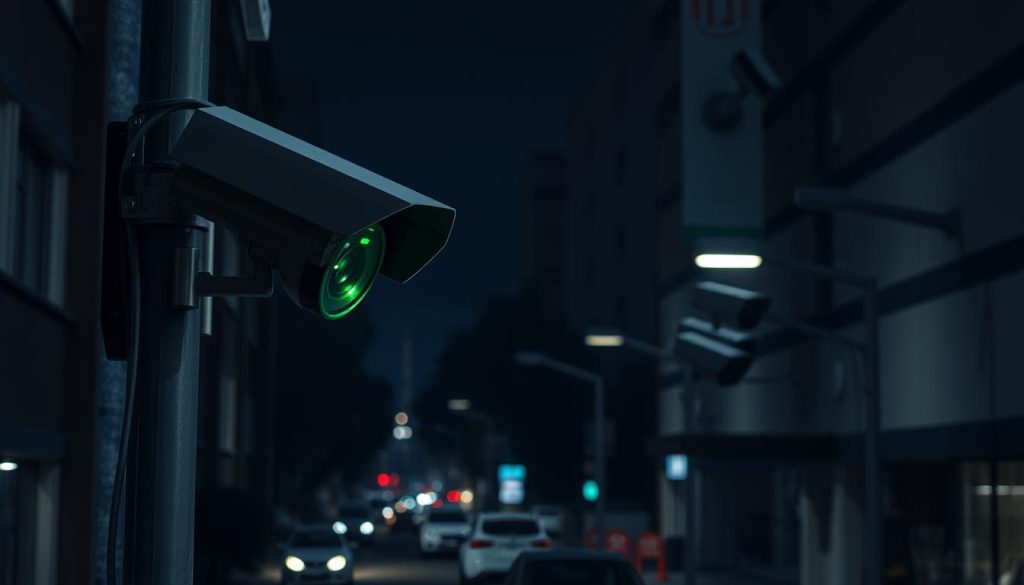
Height considerations significantly impact nighttime performance. Mounting between 2.5 to 3 meters optimizes facial recognition. Higher placements expand coverage but reduce identification details.
Angle optimization prevents common problems. A 15-30 degree downward tilt minimizes sky glare. This positioning also reduces infrared reflection from nearby surfaces.
Avoiding Common Night Vision Obstructions
Singapore’s tropical vegetation requires regular maintenance. Overgrown branches can block infrared illumination. Trim foliage at least one meter from all surveillance units.
Architectural features often create unexpected shadows. Balconies, awnings, and decorative elements can obstruct views. Test sightlines during both day and night before permanent installation.
Seasonal decorations present temporary challenges. Festive lights can overwhelm sensors during holiday periods. Temporary camera adjustments may be necessary during these times.
Weather conditions affect different installation locations. Units facing prevailing winds collect more dust and rain spots. Protective housings help but cannot eliminate all environmental effects.
“The most common installation mistake is failing to test camera positions during actual nighttime conditions. What looks optimal in daylight often performs poorly after sunset.”
Light source placement requires careful planning. Avoid pointing surveillance equipment directly at bright fixtures. Position units with light sources behind them rather than in front.
Reflections from common Singapore building materials can cause issues. Glass facades and polished surfaces create glare hotspots. Angled mounting often solves these reflection problems.
Utilizing Reflective Surfaces to Your Advantage
Strategic use of existing surfaces enhances infrared performance. Light-colored walls act as natural reflectors. They bounce infrared illumination into shadowed areas.
Concrete and plaster finishes provide excellent diffusion. These materials scatter infrared light evenly across surveillance zones. This creates more uniform illumination without hot spots.
Positioning near reflective surfaces extends effective range. A white wall behind a camera amplifies its infrared projection. This technique works particularly well in narrow spaces.
Metallic surfaces require different approaches. They create mirror-like reflections that can distort images. Angled placement minimizes these distortion effects.
Pre-installation testing identifies optimal reflective positions. Use temporary mounts to evaluate different locations. Test during actual nighttime conditions for accurate assessment.
Singapore’s common building materials offer various reflective properties. HDB corridor walls typically provide good diffusion. Commercial glass facades require more careful positioning strategies.
Combining natural and artificial reflection maximizes coverage. Use architectural features to redirect infrared illumination. This approach extends the effective range of limited equipment.
Regular maintenance ensures reflective surfaces remain effective. Clean walls and surfaces near surveillance units periodically. Dust accumulation reduces infrared reflection efficiency over time.
Choosing the Right Night Vision Camera for Your Needs
Selecting the optimal surveillance equipment for after-hours protection involves balancing technical specifications with practical application needs. The market offers numerous options, each promising reliable nighttime performance. A systematic evaluation framework helps identify units that deliver on their promises.
Understanding your property’s specific requirements forms the foundation of smart selection. Different environments demand different capabilities. Singapore’s urban landscape presents unique challenges that influence equipment choices.
Technical specifications provide valuable guidance but require careful interpretation. Real-world performance often differs from laboratory measurements. Practical testing under actual conditions reveals true capability.
Essential Features: Resolution, IR Range, and Weatherproofing
Image resolution determines how much detail your system captures. Higher megapixel counts produce sharper footage for identification purposes. 4K units offer exceptional clarity but require more storage capacity.
1080p models provide excellent balance for most applications. They deliver sufficient detail while managing bandwidth efficiently. Consider your primary monitoring objectives when selecting resolution levels.
Infrared illumination range indicates how far the system sees in complete darkness. Manufacturer specifications represent ideal laboratory conditions. Real-world performance typically reaches 70-80% of claimed distances.
Weather resistance ratings ensure equipment withstands Singapore’s tropical climate. IP66 certification guarantees protection against heavy rain and dust. IP67 units can withstand temporary immersion in water.
Low-light sensitivity, measured in lux ratings, reveals minimum illumination requirements. Lower numbers indicate better performance in dim conditions. Quality sensors function effectively with just 0.001 lux available.
Sensor size and type significantly impact nighttime image quality. Larger sensors capture more available light particles. This preserves finer details in shadowy urban environments.
Matching Camera Type to Your Surveillance Environment
Indoor installations prioritize discreet design and wide viewing angles. These units monitor entry points and common areas effectively. They benefit from existing ambient lighting in residential or commercial spaces.
Outdoor models require robust construction and extended infrared range. They face environmental challenges like rain, humidity, and temperature fluctuations. Proper housing protects sensitive components from Singapore’s tropical weather.
Short-range applications focus on identification at entry points. These positions demand high-resolution capture of facial features. Clear images help authorities recognize individuals if incidents occur.
Long-range monitoring covers expansive perimeters or open areas. These installations prioritize detection over identification. They alert security personnel to unauthorized presence in restricted zones.
“The most effective security systems combine different camera types strategically—using high-resolution units for identification at critical points while deploying detection-focused models for perimeter coverage.”
Thermal imaging excels in challenging environmental conditions. It performs consistently through fog, smoke, or complete darkness. This technology detects presence effectively but doesn’t provide identification details.
Infrared systems deliver detailed monochrome footage for recognition purposes. They require some ambient light or their own illumination source. These units identify individuals clearly within their effective range.
Hybrid approaches leverage both technologies for comprehensive coverage. Thermal sensors detect movement across large areas. Infrared cameras then zoom in for identification when alerts trigger.
Top Camera Brands for Nighttime Performance
Several manufacturers dominate Singapore’s security market with reliable offerings. Each brand brings distinct strengths to nighttime surveillance applications. Understanding these differences helps match products to specific needs.
Hikvision delivers robust professional-grade systems with excellent low-light capability. Their DarkFighter technology captures color images in near-darkness conditions. These units integrate seamlessly with existing security infrastructure.
Dahua offers competitive performance at various price points. Their Starlight series provides impressive sensitivity in dim environments. The brand maintains strong local support networks across Singapore.
Arlo specializes in wireless solutions for residential applications. Their battery-powered units offer flexible placement options. These systems feature easy installation and mobile app management.
Reolink combines affordability with solid nighttime performance. Their products include both wired and wireless configurations. The brand receives positive reviews for value and reliability.
When evaluating brands, consider warranty terms and local service availability. Singapore-based support ensures prompt assistance when issues arise. Professional maintenance services extend equipment lifespan and performance.
Regulatory compliance represents another important consideration. Ensure selected equipment meets Singapore’s security standards. Proper certification guarantees legal operation and insurance validity.
Integration capabilities determine how well new units work with existing systems. Compatibility prevents costly infrastructure replacements. Modern security platforms support multiple brands through standardized protocols.
Budget considerations should balance initial cost with long-term value. Premium brands often justify higher prices through extended durability. They typically require less frequent replacement or repair.
For basic home security, mid-range infrared models provide excellent coverage. Commercial installations might justify thermal imaging for perimeter protection. Industrial facilities often benefit from hybrid systems combining multiple technologies.
Test equipment under actual nighttime conditions before finalizing purchases. Evaluate performance during Singapore’s rainy season for accurate assessment. This practical approach ensures your investment delivers reliable 24/7 protection.
Maintaining Clear Night Vision: Care and Upkeep
Singapore’s tropical climate accelerates the need for surveillance system maintenance to preserve nighttime effectiveness. Consistent care routines protect your investment and ensure reliable after-hours monitoring. Without proper upkeep, even the best equipment loses its ability to capture clear footage.
Dust, humidity, and urban pollution gradually degrade components. These environmental factors affect lenses, sensors, and infrared illuminators. A structured maintenance program prevents this slow performance decline.
Regular Cleaning Protocols for Lenses and Housings
Singapore’s high humidity and urban dust create unique challenges. Moisture combines with particulate matter to form a filmy residue. This buildup scatters light and reduces image clarity during low-light conditions.
Establish a quarterly cleaning schedule for most installations. Units in particularly dusty or coastal areas may need monthly attention. Always power down equipment before beginning any cleaning procedure.
Use appropriate materials to avoid damaging sensitive components. Microfiber cloths work best for lens surfaces. Isopropyl alcohol (70% solution) effectively removes stubborn grime without leaving residue.
Follow this systematic approach for optimal results:
- Gently remove loose debris with a soft brush or compressed air
- Apply cleaning solution to a microfiber cloth, not directly to the lens
- Wipe in a circular motion from center to edges
- Clean protective housing with mild soap and water
- Ensure all surfaces are completely dry before restoring power
Infrared LED arrays require special attention. Dust accumulation on these small lights significantly reduces their output. Carefully clean between individual LEDs using cotton swabs dipped in alcohol.
Weatherproof seals demand regular inspection in Singapore’s climate. Check rubber gaskets around housing edges for cracks or deterioration. Replace compromised seals immediately to prevent moisture ingress.
Lens condensation indicates seal failure or rapid temperature changes. This common issue in tropical environments creates hazy nighttime images. Desiccant packets inside housings help control internal humidity.
“Preventive maintenance costs far less than emergency repairs or system replacement. A few minutes of regular cleaning preserves years of reliable nighttime surveillance capability.”
Document each maintenance session with before-and-after images. This creates a performance history for your security system. It also helps identify patterns in degradation rates.
The Importance of Firmware Updates and System Checks
Modern surveillance technology relies on software as much as hardware. Manufacturers regularly release firmware updates that enhance performance. These updates often include improved night vision algorithms and security patches.
Check for updates at least twice annually. Most systems allow remote update capabilities. Always back up current settings before proceeding with any firmware changes.
Systematic performance checks detect gradual degradation. Compare current nighttime footage with archived samples from installation. Look for these common indicators of declining capability:
- Reduced effective infrared range
- Increased image noise or graininess
- Inconsistent switching between day and night modes
- Uneven illumination across the scene
- Longer adjustment periods when lighting changes
Create a testing protocol using consistent reference points. Measure how far you can identify objects at night. Note any changes in clarity or detail recognition over time.
Environmental sensors within advanced units provide diagnostic data. Monitor internal temperature and humidity readings. Abnormal values often precede component failure.
Schedule comprehensive system reviews every six months. Professional technicians can identify issues invisible to casual observation. They perform calibration procedures that restore optimal performance.
Maintenance frequency depends on installation location and exposure. Units facing streets need more frequent cleaning than those in protected areas. Create a customized schedule based on your property’s specific conditions.
Proactive care extends equipment lifespan significantly. It ensures consistent surveillance quality throughout Singapore’s challenging climate. This protection of your security investment delivers peace of mind year after year.
The Evolving Landscape of Low-Light Surveillance Technology
Innovation in low-light monitoring is moving beyond simple illumination to intelligent interpretation. The latest breakthroughs are transforming how properties are protected after sunset. These advancements deliver clearer information and smarter responses.
Singapore’s security sector is rapidly adopting these new tools. They address the unique challenges of an urban, tropical environment. The result is more effective 24/7 protection for homes and businesses.
Advances in Color Night Vision and AI-Powered Analytics
Traditional nighttime footage often meant grainy, black-and-white video. New color night vision technology changes that completely. It uses advanced, sensitive sensors and powerful image processors.
These systems can pull color information from minimal ambient light. Street lamps or building reflections become usable light sources. The result is full-color images that make identification much easier.
Artificial intelligence takes this capability even further. Machine learning algorithms analyze the video stream in real time. They can distinguish a person from a swaying tree branch in near-total darkness.
This reduces false alarms dramatically. Security teams spend less time checking irrelevant alerts. They focus only on genuine threats, improving overall response performance.
Facial recognition now functions in very low-light conditions. AI enhances the available visual data. It sharpens details and can even predict movement patterns.
“The integration of AI doesn’t just show us what happened; it helps us understand what is likely to happen next. This predictive capability is revolutionizing nighttime security management.”
The Growing Integration of Thermal and IR Technologies
The old choice between infrared detail and thermal detection is fading. Modern systems combine both into a single, powerful solution. This hybrid approach offers the best of both worlds.
A single unit might use a thermal imaging sensor for initial detection. It scans a wide area for heat signatures. Once a warm object is spotted, a pan-tilt-zoom infrared camera activates.
This PTZ unit zooms in to capture high-resolution images. It provides the clear details needed for identification. This seamless handoff happens automatically, without human intervention.
These integrated systems are perfect for large, complex sites. Industrial parks and port facilities in Singapore are ideal candidates. They provide blanket coverage without blind spots.
The technology also addresses traditional limitations. Fog or heavy rain that scatters infrared light is no longer a deal-breaker. The thermal component ensures detection continues uninterrupted.
For current system owners, upgrades are becoming more accessible. Many modern network video recorders support these hybrid cameras. Adding a single dual-sensor unit can enhance an entire section of a property.
Looking ahead, Singapore’s Smart Nation initiative will likely embrace these tools. They offer the data-rich, automated monitoring that smart cities require. The future points toward security cameras that are not just recording devices, but intelligent sentinels.
Securing Your Property Around the Clock
With today’s technology, the question is no longer about capability but about optimization and integration. True 24/7 protection emerges from combining the right equipment with smart planning.
Your journey starts with selecting appropriate night vision cameras for your specific environment. Consider both infrared range and sensor sensitivity. Strategic placement then maximizes their effectiveness after sunset.
Regular maintenance ensures consistent image quality over time. Clean lenses preserve clear footage in low light conditions. This proactive approach prevents performance degradation.
Reliable nighttime monitoring provides more than just evidence. It delivers genuine peace of mind for property owners. You gain confidence knowing your security system performs regardless of lighting.
Begin by assessing your current setup or planning a new installation. Focus on critical areas that need after-hours coverage. With proper implementation, comprehensive protection becomes your reality.
FAQ
What is the main difference between infrared and thermal night vision?
Infrared night vision uses invisible IR light to illuminate a scene, creating a detailed black-and-white image. Thermal imaging detects heat signatures from objects, producing a color heat map that shows temperature differences. The first is great for identification; the second excels in total darkness and challenging weather.
Can security cameras see in complete darkness?
Yes, modern surveillance systems are designed for this. Models with powerful infrared LEDs or thermal sensors capture clear footage with zero ambient light. Their performance depends on the technology’s range and the absence of physical obstructions.
Why does my camera’s night footage look black and white?
Most systems switch to a monochrome mode when IR illuminators activate. The camera’s image sensor is more sensitive to light without processing color, which significantly improves low-light performance and detail capture in the dark.
How far can a typical IR security camera see at night?
The effective range varies by model. Consumer cameras often see 30 to 100 feet, while professional-grade systems from brands like Hikvision or Dahua can illuminate beyond 200 feet. Check the product’s specified “IR range” for this key performance metric.
What is "color night vision" in surveillance technology?
This advanced feature uses a combination of large, sensitive image sensors, wide-aperture lenses, and ambient lighting to maintain color footage in low-light conditions. It doesn’t rely on IR LEDs, so there’s no monochrome switch, providing more natural nighttime images.
Do I need special lighting for my cameras to work at night?
A> Not necessarily. Infrared illuminators are built into most modern units. However, adding strategic ambient lighting, like pathway or porch lights, can enhance image quality, reduce shadows, and may enable features like color night vision.
How does weather affect nighttime camera performance?
Weather has a big impact. Heavy rain or fog can scatter IR light, reducing clarity. Thermal imaging technology often performs better in these conditions because it sees through obscurants. Always choose cameras with a suitable IP rating for weatherproofing.
What maintenance do night vision cameras require?
Regular cleaning of the lens and the IR LED cover is crucial. Dust, spider webs, or water spots can blur images or cause “IR glare.” Also, keep firmware updated for optimal performance and check that illuminators are functioning during system checks.


