
What does a flashing red light mean? Learn the Rules
Singapore’s roads use special flashing red signals to keep everyone safe. These traffic signals tell drivers to make a full stop, just like at a regular stop sign.
You’ll often see these lights near schools, busy intersections, and places with lots of pedestrians. They help prevent accidents and protect people walking nearby.
Ignoring these signals can lead to serious legal consequences under Singapore’s traffic laws. All drivers must follow these rules for road safety.
This guide covers everything you need to know about handling these situations correctly. Understanding these signals helps maintain smooth traffic flow and keeps our roads safe for everyone.
Key Takeaways
- Flashing red signals require a complete stop, similar to a stop sign
- These signals are commonly placed in high-risk areas like school zones
- Ignoring flashing red lights can result in legal penalties
- Proper response to these signals helps prevent accidents
- Singapore follows international standards while enforcing local traffic rules
- These rules apply consistently across all Singapore roads
- Understanding these signals contributes to overall road safety
Understanding the Flashing Red Signal: A Basic Definition
Singapore’s traffic management system employs various signal types to maintain order and safety. The flashing red signal serves as a critical safety measure at specific locations.
This pulsating signal appears at intersections requiring extra caution. It operates differently from standard traffic lights and demands specific driver responses.
How a Flashing Red Light Differs from a Solid Red Light
A solid red light commands drivers to stop and remain stationary. Vehicles must wait behind the stop line until the signal turns green.
Flashing red lights require a different approach. Drivers must make a complete stop but may proceed when the intersection clears.
The key difference lies in waiting requirements. Solid red means wait for green, while flashing red means stop then go when safe.
The Legal Equivalence to a Stop Sign in Singapore
Singapore’s Land Transport Authority treats flashing red signals exactly like stop signs. Both require identical driver actions under traffic laws.
Drivers must bring their vehicle to a full stop behind the designated line. Wheels must cease all motion before proceeding.
Right-of-way rules apply identically for both signals. Vehicles must yield to pedestrians and cross traffic before moving forward.
This legal equivalence ensures consistent driver behavior across different intersection types. It simplifies compliance and enhances overall road safety.
What Does a Flashing Red Light Mean? The Driver’s Mandatory Actions
Motorists approaching intersections with pulsating red signals must execute specific safety protocols. These procedures ensure smooth traffic flow and prevent accidents at critical junctions.
Singaporean drivers face strict requirements when encountering these signals. The Land Transport Authority enforces precise stopping and observation rules.
Coming to a Complete and Full Stop
Vehicles must halt completely behind the white stop line. All wheel movement must cease for at least three seconds.
This duration allows proper assessment of intersection conditions. Partial stops or rolling pauses constitute traffic violations.
Common errors include stopping over the line or insufficient duration. Both mistakes carry penalties under Singapore’s traffic laws.
Scanning 360 Degrees for Pedestrians and Cross Traffic
Drivers must perform comprehensive visual checks before proceeding. This safety sweep covers all potential hazard directions.
- Check left for oncoming vehicles and motorcycles
- Scan right for bicycles and approaching traffic
- Examine frontal areas for crossing patterns
- Review rearview mirrors for emergency vehicles
This systematic approach ensures no blind spots remain unchecked. Particular attention needed at busy intersections like Jurong East.
Yielding the Right-of-Way Correctly
Singapore follows a established priority sequence at these intersections. Understanding this hierarchy prevents accidents and conflicts.
Emergency vehicles with active sirens receive top priority. Pedestrians in marked crosswalks follow next in the sequence.
When multiple cars arrive simultaneously, right-of-way goes to the vehicle on the right. This rule maintains order and prevents confusion.
Special consideration required for vulnerable users including seniors and children. Their slower movement demands extra patience from drivers.
Failure to follow these procedures incurs S$150 fines and 4 demerit points. Consistent compliance contributes to overall road safety across Singapore.
Navigating Different Intersection Types with a Flashing Red
Singapore’s diverse road network features various intersection configurations requiring specific protocols. Each junction type demands distinct approaches when encountering pulsating traffic signals.
Understanding these variations ensures proper compliance with local traffic laws. Different intersection designs present unique challenges for motorists.
Protocols for a Standard Four-Way Stop
The first-come-first-served principle governs standard multi-directional stops. Vehicles must stop completely behind designated lines before proceeding.
Drivers should observe approaching vehicles from all directions. Proper sequencing prevents conflicts and maintains smooth traffic flow.
LTA Rule 78B specifically addresses simultaneous arrival scenarios. When cars arrive at the same time, right-hand priority applies.
Effective communication through indicators and eye contact helps coordinate movement. This prevents confusion during busy periods at locations like Orchard Road.
Handling Simultaneous Arrivals and Right-of-Way Hierarchy
Simultaneous approaches require strict adherence to established priority rules. The vehicle on the right typically receives right-of-way precedence.
All drivers must yield to pedestrians and emergency vehicles first. Commercial vehicles and buses follow standard way rules without special privileges.
Clear intention signaling through turn indicators helps prevent accidents. Patience and proper observation ensure safe passage through complex junctions.
During peak hours, these protocols prevent gridlock and maintain road safety. Proper understanding of these rules contributes to overall safe driving practices across Singapore.
Flashing Red vs. Other Traffic Signals: Knowing the Difference
Singapore’s urban landscape features various signal types that serve distinct purposes. Understanding these differences helps drivers respond appropriately to each situation.
Different signals convey unique instructions through color and flashing patterns. This system ensures smooth movement while maintaining high safety standards.
https://www.youtube.com/watch?v=30uzZRSVxXQ
Flashing Yellow Light: Caution vs. Stop
Flashing yellow signals indicate caution rather than requiring a full halt. Drivers should reduce speed and proceed carefully through intersections.
These amber lights often appear during off-peak hours at locations like Clementi Ave 6. They help maintain traffic flow when full stops aren’t necessary.
Unlike flashing red signals that mandate a complete stop, yellow lights allow continuous movement. Drivers must still yield to pedestrians and cross traffic.
The key distinction lies in the required action. Yellow means proceed with caution while red means stop completely.
Steady Red Arrow: Prohibition vs. Conditional Movement
Steady red arrows represent absolute prohibitions for specific movements. They completely forbid turns in the indicated direction until the signal changes.
These signals carry stricter rules than flashing red lights. While flashing signals allow movement after stopping, red arrows prohibit any movement.
Singapore’s traffic laws treat red arrows as complete bans. Drivers must wait for a green arrow or circular green signal.
This system prevents conflicts at complex intersections. It enhances road safety by eliminating guesswork about permitted movements.
Modern LED technology enables automatic signal mode switching. The East Coast Parkway uses this system extensively during nighttime hours.
Smart traffic systems adjust signals based on real-time conditions. This optimization helps prevent accidents and improve overall efficiency.
Signal standardization ensures consistent understanding across different intersection types. International standards blend with Singapore’s specific implementations for optimal safe driving conditions.
Retroreflective materials enhance visibility for all signal types. This technology ensures drivers can recognize signals from appropriate distances.
Responding to Malfunctioning or Blacked-Out Traffic Signals
Singapore’s advanced traffic management system occasionally experiences technical failures requiring immediate driver awareness. When traffic signals malfunction, specific protocols activate to maintain order and road safety.
The Land Transport Authority treats all non-operational signals as equivalent to flashing red indicators. This standardized approach ensures consistent driver behavior during unexpected outages.
Treating a Non-Functioning Intersection as a Four-Way Stop
Motorists must approach darkened intersections with extreme caution. The first rule requires a complete stop behind the white line.
All vehicles must stop completely before proceeding. This mandatory halt allows proper assessment of intersection conditions.
During the 2023 Woodlands outage, this protocol successfully prevented accidents despite multiple signal failures. Drivers applied four-way stop rules effectively.
Right-of-way follows established patterns. The first vehicle to arrive receives priority to move.
For simultaneous arrivals, the car on the right proceeds first. This system maintains smooth traffic flow during disruptions.
Proper stopping position prevents blocking pedestrian crossings. This consideration protects vulnerable road users.
How to Report Signal Failures to the LTA
Singapore provides multiple reporting channels for malfunctioning traffic signals. Quick reporting ensures rapid response from authorities.
The LTA Hotline: 1800-CALL-LTA offers direct assistance. Average response time stands at 38 minutes based on recent data.
MyTransport.SG app features real-time reporting capabilities. This mobile solution provides convenient outage documentation.
Drivers should collect timestamped evidence for insurance purposes. Photographs and videos support potential claims.
Nighttime outages require additional safety measures. Activating hazard lights warns approaching motorists.
Contractor accountability standards ensure prompt repair operations. The LTA monitors all response times closely.
Understanding these procedures helps drivers must navigate unexpected situations safely. Proper response minimizes legal consequences and supports overall safe driving practices.
Prioritizing Pedestrian Safety at Flashing Red Intersections
Singapore’s transportation network places special emphasis on protecting vulnerable road users through advanced safety measures. These protocols become particularly crucial at intersections featuring pulsating red signals.
Motorists must maintain a minimum 1.5-meter clearance from crosswalk markings when stopping. This buffer zone provides essential protection for people crossing the street.
Driver Responsibilities and Safe Stopping Distances
Operators must bring their vehicles to a complete stop behind designated lines. Proper positioning ensures clear visibility for both drivers and pedestrians.
Singapore’s Active Mobility Act grants absolute right-of-way to pedestrians in marked crossings. Once someone steps into the crosswalk, all vehicles must yield immediately.
Drivers should wait until pedestrians completely clear the intersection before proceeding. This precaution prevents accidents and demonstrates respect for vulnerable road users.
Enhanced Safety Measures in Singapore School Zones
Educational institutions receive special attention through increased enforcement and higher penalties. Violations near schools start at S$300, reflecting the serious nature of these infractions.
The “Stop for Students” initiative combines flashing beacon systems with trained crossing guards. These measures help protect children during peak arrival and dismissal times.
New LED countdown timers at Clementi crossings display remaining crossing time. This technology helps both pedestrians and drivers make informed decisions about intersection navigation.
Motorists must anticipate unpredictable movements near schools. Children might suddenly dart across streets without checking for traffic.
Special consideration applies to seniors and persons with disabilities. Their slower movement requires additional patience and caution from all drivers.
Coordination between traffic signals and pedestrian systems ensures optimal safety. This integrated approach represents Singapore’s commitment to protecting all road users.
Common and Costly Mistakes Drivers Make
Many motorists develop dangerous habits when approaching intersections with pulsating signals. These errors often lead to serious violations and compromise road safety across Singapore’s transportation network.
Recent studies reveal consistent patterns in improper intersection behavior. Understanding these common errors helps drivers avoid penalties and maintain safe driving practices.
The Dangers of the “Rolling Stop”
Partial stops represent the most frequent violation at these intersections. This dangerous practice accounts for 38% of all flashing signal infractions.
Drivers often slow to 5-10 km/h instead of making a complete stop. This rolling approach fails to meet legal requirements under Singapore’s traffic laws.
Common errors include stopping over pedestrian crossing lines. Many motorists also fail to pause for the required three seconds.
NTU’s 2023 research discovered critical stopping distance miscalculations. Most drivers underestimate distances by 1.2 meters during wet conditions.
These mistakes create serious hazards for pedestrians and cross traffic. Proper stopping procedures remain essential for intersection safety.
Misjudging Gaps in Traffic and Right-of-Way
Right-of-way errors cause significant collisions at Singapore intersections. Tampines data shows 22% of accidents occur from incorrect assumptions.
Surveillance footage reveals alarming patterns during evening rush hours. Approximately 47% of violations involve improper right-of-way assessments.
Drivers frequently proceed when cross traffic hasn’t fully cleared. Many misjudge safe gaps in approaching vehicle patterns.
Insurance claim analysis shows recurring error patterns in these situations. Distracted scanning causes 23% of accidents at these intersections.
Preventive strategies include enhanced awareness campaigns and education. These initiatives help reduce common driver errors and improve overall traffic flow.
Proper understanding of right-of-way rules prevents accidents and legal consequences. All motorists must remain vigilant when navigating these critical intersections.
Legal Consequences and Penalties in Singapore
Singapore maintains strict enforcement protocols for traffic violations. These measures ensure compliance with national road safety standards.
The Land Transport Authority imposes clear penalties for signal infractions. Understanding these consequences helps drivers maintain clean records.
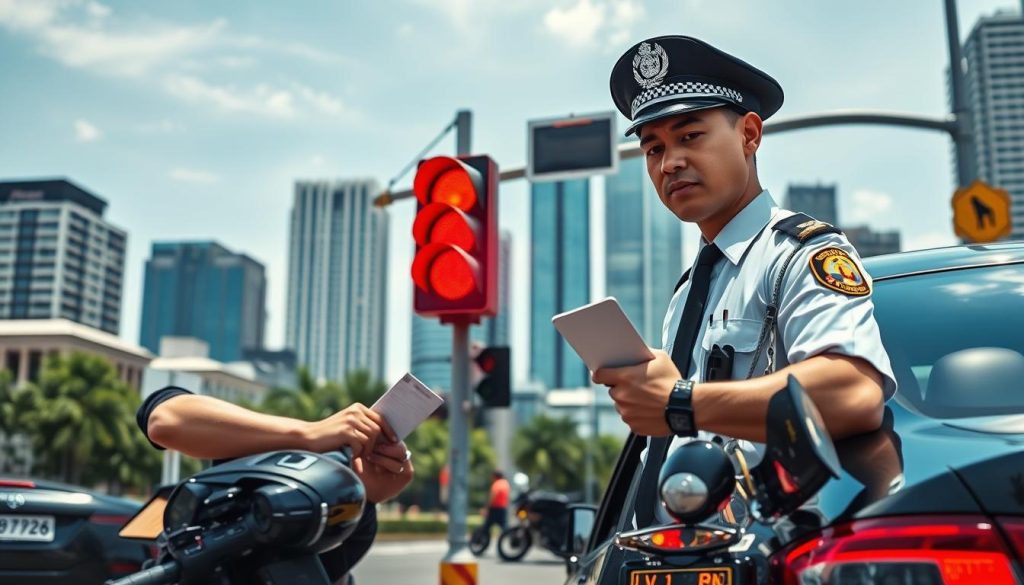
Fines, Demerit Points, and the Driver Improvement Points System
First-time offenders face a S$150 fine with 4 demerit points. This base penalty applies to all flashing signal violations.
Repeat violations within 12 months trigger escalated consequences. Second offenses incur S$300 fines with 8 demerit points.
Subsequent violations may result in court summons. Judges can impose license suspensions for persistent infractions.
Demerit points remain active for exactly 12 months. The system tracks accumulation over rolling 24-month periods.
Reaching 24 points triggers mandatory license suspension. Commercial drivers face vocational suspension at 13 points.
Singapore’s Traffic Police maintain an online dispute portal. Drivers can contest violations within 14-day windows.
Impact on Insurance Premiums and Liability in Accidents
At-fault violations significantly affect insurance costs. Premiums can increase by up to 50% following infractions.
Insurers consider multiple underwriting factors. These include violation frequency and demerit accumulation rates.
Prior accident history influences premium calculations. Companies assess risk profiles before determining rates.
Foreign license holders face additional consequences. Outstanding violations may prevent license conversion.
Mandatory corrective driving education often applies. These programs help improve road safety awareness.
State Court rulings affirm strict violation interpretations. Legal precedents support consistent penalty applications.
Proper compliance helps maintain affordable insurance rates. It also prevents potential liability issues in accidents.
Special Scenarios: Railroad Crossings and Emergency Vehicles
Singapore’s transportation infrastructure includes unique situations requiring specialized driver responses. These scenarios demand heightened awareness and strict adherence to established protocols.
Railroad crossings and emergency vehicle encounters present distinct challenges. Understanding proper procedures ensures both compliance and safety.
Mandatory Stop Procedures and Safety Systems at Rail Crossings
Vehicles must stop completely at least five meters before active railroad crossings. This buffer zone provides essential safety margins.
Advanced sensor technology detects approaching trains up to one kilometer away. These systems trigger warning sequences with precise timing.
The activation sequence begins with bell ringing thirty seconds before arrival. Flashing red lights start fifteen seconds prior to crossing.
Safety gates lower completely five seconds before the train arrives. This fail-safe system automatically activates all warnings during malfunctions.
Singapore has achieved a 72% reduction in crossing accidents since 2000. Enhanced barriers and LED lighting contribute to this improvement.
CCTV surveillance and trespassing prevention measures provide additional protection. These systems work together to maintain road safety.
Yielding to Ambulances and Police with Activated Sirens
Emergency vehicles with activated sirens receive absolute right-of-way priority. The Singapore Civil Defence Force requires thirty-meter clearance buffers.
Motorists must identify approaching emergency vehicles by their distinct siren patterns. Different patterns indicate various emergency services.
Smart traffic signals provide preemptive right-of-way at 92% of signaled intersections. These systems detect approaching emergency vehicles automatically.
When emergency vehicles approach, drivers must move to the right and stop completely. This action creates safe passage corridors.
Proper intersection clearance procedures prevent blocking emergency routes. Vehicles should never stop in crosswalks or intersections.
Failure to yield carries serious legal consequences under Singapore’s traffic laws. These rules help prevent accidents during critical responses.
Historical data shows these protocols significantly reduce emergency response times. They contribute to overall safe driving practices throughout Singapore.
How Adverse Weather Affects Visibility and Response
Singapore’s tropical climate presents unique challenges for motorists, particularly during intense monsoon conditions. Heavy rainfall can reduce signal visibility by up to 40%, creating hazardous driving situations that demand special precautions.
The National Environment Agency integrates real-time weather alerts with traffic management systems. This coordination helps drivers anticipate changing conditions and adjust their behavior accordingly.
Adjusting Driving for Singapore’s Monsoon Season
During heavy downpours, motorists should activate headlights and increase following distances. These simple adjustments significantly improve safety when approaching intersections.
Proper wiper maintenance becomes crucial for maintaining clear visibility. Worn blades should be replaced immediately to ensure optimal performance during heavy precipitation.
Modern traffic systems incorporate advanced features for monsoon conditions. LED upgrades provide brighter illumination, while anti-fogging treatments on lens covers maintain signal clarity.
Retroreflective materials meeting AS/NZS 1906 standards ensure signals remain effective when wet. These technical specifications help maintain recognition despite reduced visibility.
Nighttime Driving and Signal Recognition Tips
Evening hours require extra vigilance when approaching intersections. Smart windshield projection systems are currently in trial phases to improve signal recognition.
Drivers should regularly clean windshields to maintain optimal visibility. Dirty glass can further reduce already compromised signal recognition during nighttime driving.
Headlight angle adjustments based on vehicle load ensure proper illumination. This technical consideration helps drivers spot signals from appropriate distances.
School crossing guards wear reflective vests during evening hours for enhanced safety. These measures protect pedestrians when visibility conditions are poorest.
Singapore’s integrated approach to weather-responsive driving helps maintain road safety during challenging conditions. Proper preparation and awareness prevent accidents despite reduced visibility.
Singapore’s Traffic Technology and Enforcement
Singapore’s advanced traffic management combines cutting-edge technology with strict enforcement measures. This integrated approach ensures optimal compliance with intersection protocols across the island.
LTA’s GLIDE System and Smart Traffic Signals
The GLIDE system processes real-time data from over 2,000 intersections throughout Singapore. Sophisticated sensors monitor vehicle volume and adjust signal phases automatically.
This adaptive technology optimizes traffic flow while maintaining strict safety standards. The system responds instantly to changing conditions at major junctions.
Standardized timing specifications follow precise LTA regulations. These protocols ensure maximum road safety for all road users.
Future upgrades include glare-resistant signals for 2025 monsoon readiness. These improvements will enhance visibility during adverse weather conditions.
AI Enforcement Cameras and High-Risk Intersections
AI-powered cameras deploy at high-risk locations like Rochor and Newton Circus. These systems detect violations with 99.3% accuracy.
The technology processes approximately 12,000 incidents daily. It instantly identifies rolling stops and other infractions.
Heat map analysis reveals Tampines Ave 7 as the primary violation hotspot. Forty-three percent of incidents involve right-turning vehicles ignoring flashing red signals.
Mobile enforcement squads use license plate recognition during peak hours. They supplement the 24/7 CCTV surveillance covering 87% of Singapore roads.
Tourist education programs incorporate rental car GPS alerts. These warnings notify visitors about high-risk intersections and proper procedures.
This comprehensive enforcement strategy helps prevent accidents and promotes safe driving practices. The system ensures consistent application of traffic laws across all intersections.
Elevating Road Safety Through Awareness and Technology
Singapore’s impressive 22% drop in intersection accidents from 2020-2023 demonstrates how compliance saves lives. This progress stems from advanced technology and comprehensive education programs working together.
The Land Transport Authority integrates adaptive signals and glare-resistant lighting into traffic management systems. These innovations enhance visibility and response times at critical junctions.
Public awareness campaigns reach schools and workplaces across Singapore. Defensive driving courses master complete stops, thorough scanning, and proper yielding techniques.
Community engagement initiatives promote shared responsibility for road safety improvements. Multi-stakeholder collaboration between authorities, educators, and employers drives continuous progress.
Every driver’s commitment to these practices ensures Singapore’s roads remain among the world’s safest. Your participation in safety programs makes a real difference for everyone.
FAQ
Is a flashing red light the same as a stop sign?
Yes. Legally, a flashing red signal requires the exact same action as a stop sign. You must come to a complete stop, yield to all other traffic and pedestrians, and only proceed when it is safe to do so.
Do I have to stop completely, or can I just slow down?
You must come to a full and complete stop. A “rolling stop” is illegal and dangerous. Your wheels must cease moving behind the stop line or crosswalk before you check for a safe gap in traffic.
Who has the right-of-way at a four-way stop with flashing red lights?
The standard right-of-way rules apply. The first vehicle to arrive and stop has the right to go first. If two cars arrive simultaneously, the driver on the right proceeds first. Always yield to pedestrians.
What should I do if the traffic signal is completely blacked out?
Treat a malfunctioning or blacked-out intersection as an all-way stop. Every direction must act as if there is a flashing red signal. Come to a complete stop and proceed cautiously, yielding to other vehicles based on right-of-way rules.
What is the difference between a flashing red and a flashing yellow light?
A flashing red light means stop. A flashing yellow light means proceed with caution. You should slow down and be alert for potential hazards, but you are not required to make a complete stop for a flashing yellow signal.
Are there higher penalties for ignoring a flashing red light in certain areas?
Yes. Fines and demerit points are often increased in high-risk zones, such as school areas. Enforcement is also typically stricter near schools to protect children and pedestrians.
How do I handle a flashing red light at a railroad crossing?
A flashing red signal at a railroad crossing demands an immediate and mandatory stop. You must stop and may not proceed until the lights stop flashing and it is clear that no train is approaching.
Do I still have to stop for a flashing red light if no other cars are around?
Absolutely. The law requires a complete stop regardless of visible traffic. This ensures safety for pedestrians who may be crossing and prepares you for vehicles that could appear suddenly.


