
Can CCTV work in dark? – Night Vision Explained
Modern security systems provide reliable protection around the clock. Many people wonder about surveillance performance when natural light disappears. Advanced technology ensures clear monitoring even during nighttime hours.
Singapore’s urban environment presents unique challenges for nighttime security. Dense city areas and tropical climate conditions require specialized solutions. Infrared and thermal imaging technologies overcome these lighting limitations effectively.
These advanced features capture detailed images in complete darkness. Security devices maintain excellent performance regardless of lighting conditions. Continuous monitoring remains possible through innovative vision technology.
This guide explores how modern surveillance systems handle low-light situations. We’ll examine the technical aspects and real-world applications. Understanding these capabilities is essential for both residential and commercial security needs.
Key Takeaways
- Modern security cameras utilize advanced night vision technology for 24/7 monitoring
- Infrared and thermal imaging enable clear surveillance in complete darkness
- Singapore’s urban environment requires specialized nighttime security solutions
- Camera performance depends on multiple technical factors and features
- Night vision capabilities have evolved significantly from basic daylight recording
- Understanding these technologies is crucial for effective security planning
- Tropical conditions present unique challenges for nighttime surveillance systems
Understanding Night Vision Technology in CCTV Systems
State-of-the-art observation devices utilize revolutionary light-capture techniques for consistent performance during nighttime hours. These systems transform invisible radiation into visible images through advanced optical engineering.
How Infrared Illumination Works
Infrared technology operates within the 850-940nm wavelength spectrum, completely invisible to human vision. Security equipment employs specialized LEDs that emit this non-visible radiation.
When ambient light decreases below specific thresholds, these illumination systems activate automatically. The emitted infrared light reflects off objects and returns to the sensor for processing.
“Infrared illumination represents the fundamental breakthrough that enabled practical nighttime surveillance applications.”
CMOS vs CCD Sensors for Low Light
Modern surveillance technology predominantly uses CMOS sensors for superior low-light performance. These components consume approximately 30% less energy than traditional CCD alternatives.
CMOS technology demonstrates enhanced sensitivity in challenging lighting conditions. The reduced power consumption makes these sensors ideal for continuous monitoring applications.
Energy efficiency becomes particularly important in tropical environments like Singapore. Lower heat generation helps maintain optimal sensor performance during extended operation.
The Science Behind Night Vision Imaging
Photon detection initiates the imaging process through sophisticated conversion mechanisms. Incoming infrared photons strike the sensor surface, triggering electron release.
This photon-to-electron conversion forms the foundation of night vision capability. The system amplifies these signals to create recognizable images from minimal light input.
Lux ratings quantify equipment sensitivity, with lower values indicating better performance in near-total darkness. Thermal imaging complements this technology by detecting temperature variations as minute as 0.01°C.
Spectral response curves determine how effectively devices capture specific infrared wavelengths. These technical factors directly influence overall surveillance effectiveness in various environmental conditions.
Does CCTV Camera Work in Dark? The Core Answer
Modern surveillance systems deliver reliable performance regardless of lighting situations. Advanced technology enables continuous monitoring through various environmental challenges.
Infrared Capabilities for Complete Darkness
Infrared illuminators operate at 850-940nm wavelengths. This invisible spectrum provides consistent illumination without disturbing human subjects.
Standard models offer 25-meter visibility ranges. Enhanced EXIR technology extends this distance beyond 50 meters. These systems automatically activate when ambient light decreases.
“Infrared technology represents the cornerstone of modern nighttime security surveillance.”
Limitations of Standard Cameras at Night
Basic devices without infrared support struggle in low-light conditions. They typically produce grainy or unusable footage after sunset.
Color imaging requires at least 50 lux of ambient light. Many residential areas fall below this threshold during nighttime hours. This limitation affects identification capabilities.
Factors Affecting Nighttime Performance
Singapore’s humidity presents unique challenges for electrical systems. Moisture can cause voltage drops that reduce infrared effectiveness.
Multi-illuminator systems combat this issue through distributed lighting. Smart IR technology automatically adjusts intensity based on environmental conditions.
Proper installation considers these technical factors for optimal performance. Strategic placement ensures clear images for identification purposes.
Facial recognition and license plate reading require specific illumination levels. Advanced systems maintain consistent monitoring across large areas.
Comparing Different Night Vision Technologies
Security professionals face multiple options when selecting nighttime monitoring solutions. Each technology offers distinct advantages for various applications. Understanding these differences ensures optimal system performance.
Infrared vs Thermal Imaging Cameras
Infrared systems detect reflected light in the invisible spectrum. They provide detailed images within 50-meter ranges. These solutions offer excellent value for most security applications.
Thermal imaging technology detects heat signatures instead of light. It identifies temperature differences as small as 0.01°C. This capability makes it ideal for perimeter protection.
Thermal units excel in challenging weather conditions. Fog, smoke, or complete darkness don’t affect their performance. They can detect objects up to 300 meters away.
“Thermal imaging provides unmatched detection range while infrared offers superior image detail for identification purposes.”
EXIR Night Vision for Enhanced Clarity
Extended Infrared technology represents a significant advancement. It reduces center hotspotting by 40% compared to traditional arrays. This improvement creates more evenly illuminated images.
EXIR systems distribute light more efficiently across monitored areas. They maintain consistent clarity throughout the entire field of view. The technology significantly improves facial recognition capabilities.
Color Night Vision Capabilities
Starlight sensor technology enables full-color imaging in near-total darkness. These advanced sensors require only 0.005 lux of ambient light. They capture recognizable color images when most cameras would switch to monochrome.
Color night vision provides critical identification details. Clothing colors, vehicle paint, and other visual cues become available. This technology enhances investigative capabilities significantly.
Singapore’s urban environments benefit from these advanced features. The technology helps distinguish details in complex lighting conditions. It’s particularly valuable for high-security areas.
Cost and Compliance Considerations
Basic infrared systems start around $150 per unit. Thermal imaging cameras begin at approximately $2,000. Military-grade thermal units can exceed $15,000.
Singapore regulations mandate specific compliance standards. Public installations require PSB certification and IP66 ratings. EN 50130-4 standards ensure electromagnetic compatibility.
Hybrid systems combine multiple technologies for comprehensive coverage. They leverage the strengths of each vision system. This approach provides optimal monitoring across different scenarios.
Changi Airport utilizes advanced thermal imaging for perimeter security. The system detects intrusions across large open areas. It demonstrates effective technology deployment in real-world conditions.
Infrared LEDs: The Backbone of Night Surveillance
Infrared LEDs serve as the primary illumination source for nighttime security systems. These specialized components emit invisible light that enables clear monitoring when natural lighting disappears. Advanced LED technology forms the foundation of reliable 24/7 surveillance operations.
https://www.youtube.com/watch?v=B_lwxOunSmk
How IR LEDs Illuminate Darkness
Infrared LEDs operate at specific wavelengths between 850-940 nanometers. The 850nm variants produce a faint red glow visible to careful observers. Higher-end 940nm LEDs remain completely covert during operation.
These illumination sources activate automatically when ambient light decreases. They project invisible infrared radiation across monitored areas. Reflected radiation returns to camera sensors for image processing.
“Infrared LED technology revolutionized nighttime security by providing consistent illumination without visible light pollution.”
Identifying Quality IR Illumination
Premium infrared LEDs deliver exceptional performance through advanced engineering. High-quality units last approximately 50,000 hours under normal operating conditions. Effective heat dissipation significantly impacts longevity and reliability.
Leading manufacturers like Luminus integrate copper heat sinks into their designs. This innovation reduces failure rates by 35% compared to standard aluminum components. Proper thermal management ensures consistent performance in Singapore’s tropical climate.
Environmental protection standards guarantee durability during challenging conditions. IEC 60529-rated enclosures provide monsoon-resistant protection for outdoor installations. These features maintain optimal performance during heavy rainfall and high humidity.
Effective Range Considerations
Infrared illumination range depends on multiple technical factors. A 50-meter monitoring distance requires approximately 10 lumens per square meter. Higher lumen output extends effective surveillance range significantly.
Modern video management software enhances infrared performance through automation. These systems dynamically adjust LED intensity based on ambient lighting conditions. Smart adjustments optimize illumination while conserving energy.
Regular maintenance ensures consistent infrared performance over time. Quarterly testing using lux meters verifies LED output levels. Lens cleaning prevents infrared reflection issues that can degrade image quality.
Professional security providers recommend regular performance checks for infrared systems. These inspections identify potential issues before they affect surveillance capabilities. Proper maintenance guarantees reliable nighttime monitoring.
Thermal Imaging: Advanced Night Vision Alternative
Heat detection technology offers a revolutionary approach to nighttime security monitoring. Unlike traditional methods, these systems create images based on temperature variations rather than visible light. This capability provides unique advantages in challenging environmental conditions.
Heat Signature Detection Principles
Thermal imaging operates through Planck’s Law principles. All objects emit electromagnetic radiation when above absolute zero temperature. Advanced sensors capture this radiation to create detailed thermal images.
Modern microbolometer technology detects temperature differences as slight as 0.05°C. These sensors visualize human presence at impressive 300-meter ranges. The technology performs consistently regardless of lighting conditions.
“Thermal detection represents the pinnacle of surveillance technology, operating independently of visible light sources.”
Applications for Security Surveillance
Perimeter protection benefits significantly from thermal imaging capabilities. Large outdoor areas require reliable detection across extended distances. These systems excel in complete darkness and adverse weather.
The Singapore Coast Guard deployment demonstrates practical effectiveness. Their implementation reduced false alarms by 62% through accurate heat signature analysis. This improvement enhanced operational efficiency dramatically.
Critical infrastructure protection utilizes thermal technology extensively. Port facilities, airports, and military installations rely on its consistent performance. The technology provides early warning capabilities for potential security breaches.
Comparing Thermal and IR Solutions
Infrared systems require some light reflection for image creation. Thermal imaging operates independently of visible light conditions. This fundamental difference determines their optimal application scenarios.
Fusion technology combines both approaches for comprehensive coverage. These systems overlay thermal detection with visible-light details. The combination provides both detection and identification capabilities.
Financial considerations influence technology selection for many organizations. Thermal systems typically reach break-even points around three years for commercial installations. Reduced maintenance needs contribute significantly to this calculation.
Regular maintenance ensures optimal thermal imaging performance. Quarterly sensor calibration maintains accuracy in humid environments. Professional servicing guarantees consistent detection capabilities over time.
Optimizing CCTV Placement for Night Coverage
Strategic positioning transforms ordinary security systems into exceptional monitoring solutions. Proper installation maximizes camera effectiveness during critical nighttime hours. Every placement decision directly impacts identification capabilities and overall system performance.
Height and Angle Fundamentals
Mounting height significantly affects surveillance quality. The ideal 2.4-meter position balances security needs with identification requirements. This elevation provides clear facial recognition while maintaining vandal resistance.
A 15-30° downward tilt prevents sky glare during nighttime operation. This angle optimization ensures consistent image quality across changing lighting conditions. Proper angling maximizes the camera’s effective monitoring range.
Overcoming Environmental Obstructions
Singapore’s urban landscape presents unique installation challenges. Ultrasonic repellents prevent spider webs on dome housings. These devices maintain clear visibility without chemical solutions.
Glass facades require specialized installation techniques. Anti-reflective coatings applied at 45° angles minimize glare and reflection issues. This approach ensures clear images through transparent surfaces.
“Strategic camera placement accounts for both environmental factors and human behavior patterns for optimal nighttime coverage.”
Strategic Zone Coverage
Effective surveillance requires careful area planning. Position cameras every 15 meters with 70% overlap for comprehensive coverage. This arrangement eliminates blind spots and provides multiple viewing angles.
HDB corridors benefit from specific installation approaches. Place units opposite stairwells for full corridor views. Use 2.8mm lenses for 90° coverage in confined spaces.
Public areas must comply with URA regulations. These requirements mandate coverage of all entry points and emergency exits. Proper planning ensures both security and regulatory compliance.
Orchard Road deployments demonstrate effective zone coverage strategies. Their implementation uses overlapping camera positions for complete area monitoring. This approach provides reliable security across diverse lighting conditions.
External Lighting Solutions to Enhance Night Vision
Supplemental illumination systems dramatically improve surveillance effectiveness during nighttime hours. Strategic lighting integration creates optimal conditions for security monitoring. These solutions work alongside existing camera technology for superior results.
Harnessing Existing Light Sources
Urban environments offer numerous ambient light sources that enhance surveillance capabilities. Street lamps, building illumination, and commercial signage provide valuable lighting infrastructure.
Positioning security units near 3000K-4000K temperature lights minimizes glare issues. This color temperature range produces clean white light ideal for surveillance applications. The approach maximizes existing resources while reducing energy consumption.
Surveillance equipment performs best with at least 0.5 lux ambient light for color imaging. Proper positioning relative to existing lights ensures this minimum requirement gets met consistently.
Integrated Lighting Systems
Modern security systems incorporate dedicated illumination directly into monitoring solutions. PoE-powered LED arrays synchronize with camera systems through ONVIF protocols. This integration creates seamless lighting control alongside video monitoring.
These systems provide up to 40% visibility enhancement compared to standalone arrangements. The synchronized operation ensures lighting activates precisely when surveillance requires additional illumination.
Clarke Quay’s implementation demonstrates effective lighting integration. Their system uses coordinated lighting to maintain consistent monitoring across changing conditions.
Optimizing Light Distribution
Effective illumination requires careful planning to eliminate dark spots while preventing overexposure. Floodlights should illuminate key zones without creating washed-out images. This balance ensures clear identification capabilities.
Smart IR-cut filters automatically switch between modes based on lighting levels. These advanced features maintain optimal image quality across day night transitions. The technology adapts to changing conditions without manual intervention.
For HDB corridors, staggered LED placement prevents dark spots while complying with light pollution regulations. This approach provides consistent coverage throughout residential areas.
“Integrated lighting solutions transform nighttime surveillance from detection to positive identification.”
Public space installations must consider both security needs and community impact. Properly designed systems enhance safety without creating light pollution issues. This balance ensures regulatory compliance and public acceptance.
Common Night Vision CCTV Problems and Solutions
Even advanced surveillance systems encounter challenges in tropical environments. Understanding these issues helps maintain optimal nighttime monitoring performance. Proper troubleshooting ensures reliable security around the clock.
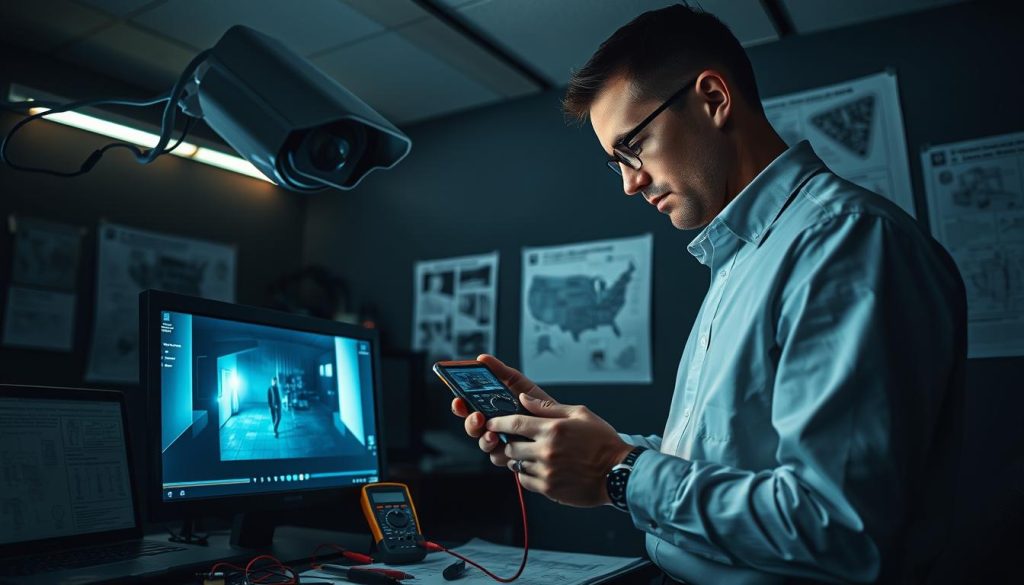
Dealing with Voltage Drop Issues
Singapore’s humidity accelerates corrosion in 12V DC power lines. This causes up to 10% voltage loss over extended distances. The reduced power affects infrared illumination effectiveness.
For cable runs exceeding 50 meters, calculate drop using Ohm’s Law. Install IP68-rated waterproof connectors every 30 meters. This prevents moisture ingress and maintains stable power delivery.
Regular voltage checks ensure consistent system performance. Use a multimeter to verify minimum 11.5V DC at camera endpoints. This simple test prevents many common nighttime failures.
Fixing Hazy or White Screen Problems
Condensation and IR reflection create foggy video during humid nights. These issues particularly affect dome housing configurations. The problem reduces image clarity and identification capabilities.
Apply anti-fog silica gel packs inside dome housings. This simple solution absorbs moisture and prevents internal condensation. Calibrate Smart IR intensity to 70% maximum output.
“Proper IR calibration prevents overexposure while maintaining sufficient illumination for clear images.”
Sentosa Cove residences resolved persistent fogging through these methods. Their implementation reduced maintenance calls by 45% annually. The solution proved effective in Singapore’s challenging climate.
Troubleshooting No-Signal at Night
When systems fail after dark, begin with power supply verification. Test with a multimeter to ensure adequate voltage levels. Check BNC/Ethernet connections for oxidation signs.
Verify IR activation using an 850nm light meter. This confirms whether infrared illuminators function properly. Many apparent failures simply involve disabled night vision settings.
Connection oxidation frequently causes intermittent signal loss. Regular cleaning with contact spray maintains reliable data transmission. This preventive measure ensures consistent nighttime operation.
Professional maintenance includes quarterly performance validation. Technicians use specialized equipment to verify all night vision features. This proactive approach prevents most after-dark failures.
Maintaining Your Night Vision CCTV System
Proper maintenance ensures your surveillance equipment delivers consistent results. Regular care prevents common issues that affect nighttime monitoring capabilities. A well-maintained system provides reliable security around the clock.
Regular Cleaning and Inspection Routines
Singapore’s humid environment demands frequent cleaning schedules. Dust and moisture accumulation degrade image quality rapidly. Bi-monthly cleaning with 70% isopropyl alcohol maintains optical clarity.
Jurong Industrial Estate achieved impressive results through systematic maintenance. Their program reduced false alarms by 38% through consistent lens cleaning. This approach demonstrates the value of regular care.
Inspect housing gaskets quarterly for weatherproofing integrity. Replace any damaged seals immediately to prevent moisture ingress. These simple steps protect sensitive internal components.
“Preventative maintenance extends equipment lifespan while ensuring optimal nighttime performance.”
Firmware Updates for Optimal Performance
Outdated software causes 27% of nighttime system failures. Regular updates address security vulnerabilities and improve functionality. Always validate updates through manufacturer bulletins before installation.
Test all updates during daylight hours before full deployment. This precaution prevents unexpected issues during critical nighttime operation. Proper validation ensures smooth transitions between software versions.
Compliance with Singapore’s Cyber Security Agency standards is essential. Their guidelines help maintain system security and performance. Following these protocols protects against emerging threats.
Preventative Maintenance Checklist
A comprehensive checklist ensures no component gets overlooked. Monthly testing of IR illuminators with lux meters verifies proper output. This simple check maintains consistent illumination levels.
Replace SD cards every 18 months or 3,000 write cycles. Memory degradation affects recording quality and reliability. Scheduled replacement prevents unexpected data loss.
Annual sensor calibration using NIST-traceable light meters maintains accuracy. This professional service ensures precise light measurement capabilities. Proper calibration guarantees consistent image quality.
Document all warranty validation dates for system components. This practice enables cost-effective replacement of failing parts. Organized records simplify maintenance management.
These maintenance practices ensure your vision cameras perform optimally in all lighting conditions. Consistent care extends equipment lifespan while maintaining security effectiveness.
Choosing the Right Night Vision CCTV for Your Needs
Selecting optimal surveillance equipment requires careful evaluation of both technical specifications and environmental factors. Different applications demand distinct features and capabilities for effective monitoring. Understanding these differences ensures your investment delivers maximum security value.
Residential vs Commercial Requirements
Home security systems typically focus on perimeter protection and entry point monitoring. These installations often prioritize discreet designs and user-friendly interfaces. Residential units commonly feature simplified operation with automated functions.
Commercial applications demand more robust capabilities for extensive area coverage. Business environments require higher resolution imaging and advanced analytics features. These systems often integrate with access control and alarm systems for comprehensive security.
Key differences include:
- Residential systems typically monitor smaller areas with fewer cameras
- Commercial installations require higher storage capacity and longer retention periods
- Business applications often need integration with existing security infrastructure
- Home systems prioritize ease of use and minimal maintenance requirements
Key Specifications to Evaluate
Technical performance depends on multiple critical factors that determine surveillance effectiveness. Understanding these specifications helps identify equipment suited to specific monitoring needs.
Infrared range represents a crucial consideration for nighttime operation. Standard models offer 25-meter visibility, while advanced units extend beyond 50 meters. This measurement indicates how far the system can detect movement after dark.
Lux rating determines minimum light requirements for quality imaging. Superior units operate below 0.01 lux, capturing clear images in near-total darkness. This specification becomes particularly important in urban environments with variable lighting conditions.
“The right combination of technical specifications ensures reliable performance across diverse monitoring scenarios.”
Resolution quality directly impacts identification capabilities. Higher megapixel counts provide clearer details for facial recognition and license plate reading. Modern systems typically offer 4K resolution or higher for investigative purposes.
Weatherproof ratings guarantee durability in challenging environments. IP67 protection ensures resistance to dust and water immersion. This feature becomes essential in tropical climates with heavy rainfall and high humidity.
Singapore-Specific Considerations
Local regulations significantly influence equipment selection and installation practices. HDB guidelines limit ceiling-mounted devices to 2.4 meters height for safety and accessibility. This restriction affects camera positioning and field of view calculations.
Landed properties often require weatherproof bullet models with extended 50-meter infrared range. These installations typically need more robust housing and enhanced weather resistance. The additional coverage range accommodates larger property perimeters.
Tropical climate operation demands specific performance standards. High humidity and temperature variations affect equipment reliability. Systems must maintain consistent operation despite environmental challenges.
Tengah Eco Town’s pilot project demonstrated hybrid thermal/IR system effectiveness. This implementation reduced false alarms by 42% through advanced detection capabilities. The success highlights technology adaptation to local conditions.
Smart Nation initiatives influence modern security deployments through technology standards. Approved vendors under GovTech’s framework offer 5G-ready edge computing capabilities. These systems integrate with municipal emergency networks for coordinated response.
Financial analysis shows commercial-grade systems achieve ROI within 32 months through reduced security incidents. This calculation includes equipment costs, installation expenses, and ongoing maintenance requirements. Proper selection ensures cost-effective security solutions.
Storage capacity requirements vary based on resolution and recording duration needs. High-resolution systems typically require 2TB monthly storage per camera for continuous recording. This consideration affects both equipment selection and ongoing operational costs.
Future-proofing considerations include 5G readiness and renewable energy integration. Solar-powered options reduce operational expenses while supporting sustainability goals. These features align with Singapore’s green initiatives and technological advancement plans.
Professional Installation and Support Options
Expert installation transforms quality equipment into reliable security solutions. Professional setup ensures optimal performance across all lighting conditions. Certified technicians understand how to maximize your system’s capabilities.
Typical Installation Processes
Residential installations typically complete within 4-8 hours. Technicians follow CSA-certified protocols for every deployment. The process includes comprehensive testing before final handover.
Commercial projects often require 2-3 days for completion. Larger systems need careful planning for camera placement. UEN-verified contractors document all compliance requirements.
Installation teams consider Singapore’s tropical climate during setup. They select locations that minimize weather impact on performance. Proper mounting prevents moisture-related issues in humid conditions.
Service Contract Benefits
Professional support packages offer significant advantages for system owners. These contracts typically include emergency response within two hours. Regular maintenance ensures consistent performance over time.
Service agreements often feature:
- Bi-annual performance audits and system optimization
- Automatic firmware updates for security enhancements
- Priority response for critical system issues
- Comprehensive documentation for regulatory compliance
“Professional installation increases system reliability by 40% compared to DIY setups.”
Case Study: Marina Bay Financial Institution
A major financial center achieved exceptional results through professional installation. Their security system maintains 99.8% uptime across all monitoring periods. This reliability demonstrates the value of expert implementation.
The institution’s annual health checks maintain optimal performance. Regular maintenance addresses Singapore’s unique climate challenges. The program includes sensor calibration and lens cleaning.
Emergency response capabilities proved crucial during system alerts. Service technicians resolved issues within guaranteed timeframes. This responsiveness ensured continuous security coverage.
Total cost analysis showed better value than DIY approaches. Professional installation reduced long-term maintenance expenses. The investment delivered superior security performance.
Future Trends in Night Vision Surveillance
Surveillance technology continues evolving with remarkable speed. Advanced thermal imaging systems now detect heat signatures in total darkness. These innovations transform how we approach nighttime security monitoring.
Artificial intelligence integration enhances recognition capabilities dramatically. Smart algorithms analyze footage in challenging lighting environments. This technology identifies patterns that human observers might miss.
Sensor improvements deliver higher resolution and better low-light performance. Modern devices capture clearer images than ever before. Enhanced processing creates sharp footage even in difficult conditions.
Singapore’s urban landscape benefits from these advancements. Businesses and homeowners gain superior protection through cutting-edge features. The future promises even greater integration with smart city infrastructure.
These developments make comprehensive security more accessible and effective. Ongoing innovation ensures surveillance systems will continue improving. Our communities become safer through technological progress.
FAQ
How do security cameras see in the dark?
Many modern surveillance cameras use infrared night vision technology. Built-in IR LEDs emit light invisible to the human eye but detectable by the camera’s sensors, allowing it to capture clear images even in total darkness.
What is the difference between infrared and thermal imaging?
Infrared night vision relies on reflected IR light to create images, while thermal imaging cameras detect heat signatures from objects and people. Thermal technology works in complete darkness and through obstructions like smoke or light fog.
How far can night vision cameras see?
The effective range varies by model and technology. Standard IR cameras typically cover 30-150 feet, while advanced systems with EXIR technology or powerful illuminators can reach 300 feet or more. Thermal imaging cameras often have longer detection ranges.
Do all security cameras work in low-light conditions?
A> No. Standard cameras without night vision features struggle in low lighting. Only cameras specifically designed with IR illuminators, light-sensitive sensors, or thermal technology perform well in darkness or poor lighting conditions.
Can weather affect nighttime camera performance?
Yes. Heavy rain, fog, or snow can reduce IR camera effectiveness by scattering light. Thermal imaging cameras generally perform better in adverse weather conditions since they detect heat rather than rely on light reflection.
What is color night vision technology?
Color night vision uses advanced sensors and ambient light processing to maintain color images in low-light conditions. These cameras require some ambient light but provide more detailed and recognizable images compared to traditional black-and-white IR footage.
How important are infrared LEDs in security cameras?
IR LEDs are crucial for most night vision systems. They provide the invisible illumination that allows cameras to see in complete darkness. Quality and arrangement of these LEDs directly impact clarity, range, and overall nighttime performance.
What maintenance do night vision cameras require?
Regular cleaning of lenses and IR windows prevents haze or blurry images. Check for spider webs or debris that can cause false IR reflection. Firmware updates ensure optimal performance, and occasional IR LED inspection maintains proper illumination.


